
 Society14 November 2026
What future for technical jobs with AI?
Developers, engineers and technicians: tasks, trials and job postings




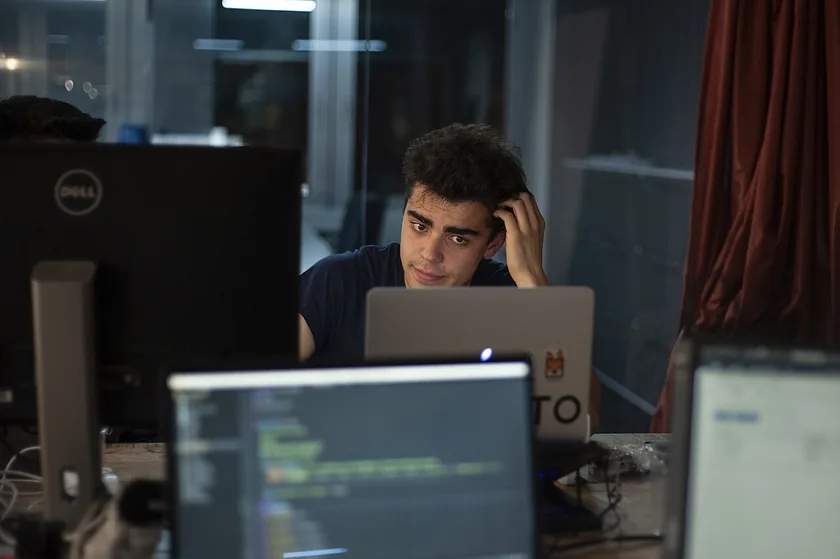
A participant at a hackathon at ETH Zurich. Photo Arthur Gamsa, CC BY 4.0, via Wikimedia Commons.
Software development is the technical occupation best measured against AI, through surveys, trials and series of job postings. AI already writes part of the code for most developers, who mainly keep it away from deployment, planning and review. Productivity trials range from a task completed 56% faster to 19% more time, depending on the developer and the code, and the only trial that measured a loss, in 2025, could not be reliably repeated in 2026. In the United States, developer job postings remain 27.5% below their February 2020 level, while all postings have regained it; Indeed observes that the occupations most exposed to AI have fallen the most since 2022, without establishing the cause. For engineers and technicians outside software, almost nothing is measured.
Contents
Among technical occupations, software development is the one where AI is used the most, at least at Anthropic: in August 2025, 36% of conversations with Claude concerned computing and mathematical tasks, the 1st category, far ahead of education (about 12%). It is also the best-measured occupation: surveys of tens of thousands of developers, randomised trials in companies, series of job postings.
This analysis is limited to technical occupations. The exposure of all occupations is covered in Will AI replace occupations?, and the entry of young people into employment in What happens to entry-level workers when AI does their work?.
Developer tasks entrusted to AI
In 2025, 84% of the 33,662 respondents to the annual Stack Overflow survey used AI to develop or planned to do so, and 51% of professional developers used it every day. The survey asks, task by task, whether AI is already used for it, and for which tasks the respondent does not plan to use it.
| Task | Partly done with AI | Kept away from AI |
|---|---|---|
| Writing code | 59 % | 29 % |
| Searching for answers | 56 % | 20 % |
| Learning a technology | 47 % | 32 % |
| Debugging and fixing | 47 % | 36 % |
| Documenting code | 30 % | 39 % |
| Testing code | 28 % | 44 % |
| Validating and reviewing code (commit and review) | 23 % | 59 % |
| Planning a project | 17 % | 69 % |
| Deploying and monitoring | 11 % | 76 % |
Stack Overflow, 2025 survey. 2nd column: among the 20,991 respondents who do at least one task partly with AI, the share who put this task there. 3rd column: among the 25,349 respondents who do not plan to use AI for at least one task, the share who put this one there. The 2 columns do not have the same base and cannot be compared line by line; the survey also counts tasks done mainly by AI (11,202 respondents).
We read in this a split that follows responsibility: AI is used where an error shows quickly and costs little, such as a piece of code that does not compile or an answer to check, and kept away from where an error goes into production, such as the review that validates the code, deployment and monitoring.
Trust remains low. 46% of respondents distrust the accuracy of AI tools, against 33% who trust them. The 1st frustration, cited by 66% of them, is an answer that is "almost right, but not quite" (our translation); 45% find it takes longer to debug code written by an AI.
Developers entrust writing and searching to AI, and keep review, planning and deployment.
Productivity trials with developers
Randomised trials give opposite results, and the difference comes down to the developer and the code.
| Trial | Developers and code | Result with AI |
|---|---|---|
| GitHub and Microsoft Research, 2023 | A short, isolated task: writing a web server in JavaScript | Task completed 55.8% faster |
| Microsoft, Accenture and a large American company, 2025 | 4,867 developers, in their usual work, over several months | 26% more tasks completed, with high uncertainty; larger gain among the less experienced |
| METR, 2025 | 16 experienced developers, on 246 tasks from their own open source projects, averaging over a million lines | 19% more time |
| METR, 2026 | 57 developers, more than 800 tasks | Estimated time saving, not significant; METR judges a gain probable but the result unreliable, and is redoing its protocol |
Sources: Peng et al., arXiv; Cui et al., working paper; METR, July 2025 and February 2026.
The largest gain concerns a short task, written from scratch, with no existing code to know. The only trial that measures a loss concerns developers who know a very large codebase thoroughly and have contributed to it for several years. Before the trial, they expected AI to give a gain of 24%; afterwards, they estimated they had gained 20%, whereas they had taken 19% more time.
In 2026, METR could not repeat the measurement reliably: developers refused to work without AI, and the tasks where they expected the most gain dropped out of the trial. The confidence intervals contain zero. Other studies find the same gap between perceived and measured time; they are read in Does AI really make us more productive at work?.
Job postings and projections
In the United States, job postings published on Indeed relative to their level on 1 February 2020, according to Indeed (July 2026); all postings at about 100:
Developer postings swelled during the pandemic, peaked in spring 2022, then fell: according to Indeed, the fall in postings in occupations exposed to AI began before the release of ChatGPT, at the end of 2022. Developer postings fell below their 2020 level in spring 2023, and were close to 33% below it in October 2024. They have been rising since 2025: 71% of the increase from May 2025 to May 2026 comes from experienced-level positions, and 37% from postings that mention AI in their title. Indeed notes that, since May 2022, the occupations most exposed to AI have fallen the most, a correlation whose cause it does not establish. None of the studies we have found separates the share due to AI from the other causes of this cycle.
The US Bureau of Labor Statistics separates 2 occupations in its projections from 2025 to 2035: employment of developers would grow by 10%, driven notably by the development of AI, and that of programmers, who translate into code the plans designed by developers, would fall by 7%, notably because companies would have to automate repetitive programming tasks with AI.
The International Labour Organization places software developers in its gradient 3, the 2nd exposure class out of 6, with a mean score of 0.53. Web and multimedia developers are in gradient 4, the most exposed (0.60), which mainly groups office jobs. For France, we have not found a public series of developer job postings that would allow the same comparison.
Engineers and technicians outside software
For mechanical, civil or process engineers, and for maintenance, laboratory or design office technicians, we have found neither a randomised trial nor a hiring series that isolates the effect of generative AI. Exposure studies rate the tasks of these occupations on what a language model can do with text and code.
The International Labour Organization itself points out the limit. In the survey used to rate the tasks, respondents answered "I don't know" 2 times more often for technical and manual tasks, which, according to the authors, suggests that they felt less able to judge them. Part of these occupations takes place on a building site, in a factory or in front of a machine, where a language model does not act.
What comes closest is the documentation side of these occupations: writing a calculation note, searching a standard, writing a test report, programming a controller. These tasks resemble the developer's, and the measurements above can be partly transposed to them, with caution: none measures them directly.
Our reading
In our view, the measurements describe a shift in work more than a disappearance. AI takes a share of the writing, and the developer keeps what commits: defining what to build, reviewing what is produced, deploying and answering for what runs. The skills that gain value are those that make it possible to judge code one did not write.
This shift has a cost for entry into the occupation. The tasks that AI takes first, simple code and searching for answers, were those of beginners, and the trial by Cui and co-authors shows that they are the ones who gain the most from using it. They then have to learn to review code before having written much of it; their situation is detailed in What happens to entry-level workers when AI does their work?.
The Stack Overflow survey covers its own users, who are volunteers. The productivity trials measure tasks or code merge requests, not the quality of the software delivered; the METR trial of 2026 gives no usable result, as its authors acknowledge. The Indeed job postings and the Bureau of Labor Statistics projections cover the United States. For engineers and technicians outside software, this text describes the absence of measurement, not a result.
Sources
11 documents
- Anthropic, Anthropic Economic Index report: Uneven geographic and enterprise AI adoption2025entry 507
- Stack Overflow, 2025 Developer Survey, AI2025entry 406
- Peng, Kalliamvakou, Cihon and Demirer, The Impact of AI on Developer Productivity: Evidence from GitHub Copilot, arXiv preprint2023entry 508
- Cui, Demirer, Jaffe, Musolff, Peng and Salz, The Effects of Generative AI on High-Skilled Work: Evidence from Three Field Experiments with Software Developers, working paper2025entry 509
- METR, Measuring the Impact of Early-2025 AI on Experienced Open-Source Developer Productivity2025entry 85
- METR, update to the study on experienced developers2026entry 86
- Indeed Hiring Lab, AI and Job Postings: From Destruction to Creation?2026entry 510
- Indeed Hiring Lab, US Q3 2024 Business-to-Business Labor Market Update2024entry 511
- US Bureau of Labor Statistics, Occupational Outlook Handbook, Software Developers, Quality Assurance Analysts, and Testers2026entry 512
- US Bureau of Labor Statistics, Occupational Outlook Handbook, Computer Programmers2026entry 513
- ILO, Generative AI and Jobs: A Refined Global Index of Occupational Exposure, Working Paper 1402025entry 55
Every figure was read in its source; the hub's methodology is described in Methodology and sources.
AI Impact, Projet Celsius, "What future for technical jobs with AI?", 14 November 2026. https://projetcelsius.com/en/ai/analyses/future-of-technical-jobs-with-ai/