
 Society20 October 2026
Surface AI and deep AI
What is the environmental impact of artificial intelligence, from everyday use to the industrial machine?
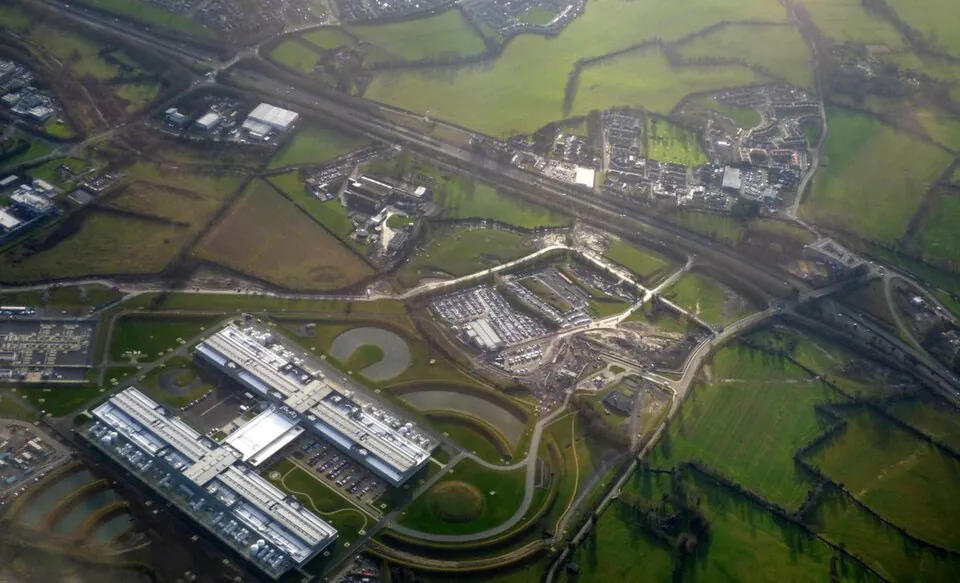
Public debate looks at the AI people can see, the AI of chat windows. Its footprint is decided almost entirely below the surface, in an AI with no interface that can only be detected through the electricity grid.
Contents
Ever since ChatGPT entered offices and classrooms, one question comes up whenever climate and digital technology are discussed: should we feel guilty about using AI? It comes with a string of figures: a bottle of water for an email drafted by a chatbot, a smartphone charge for a generated image, a question to ChatGPT said to use 10 times as much as a Google search.
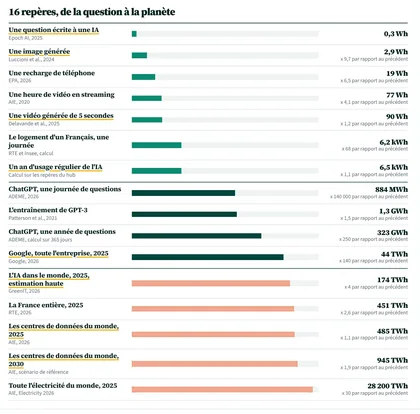
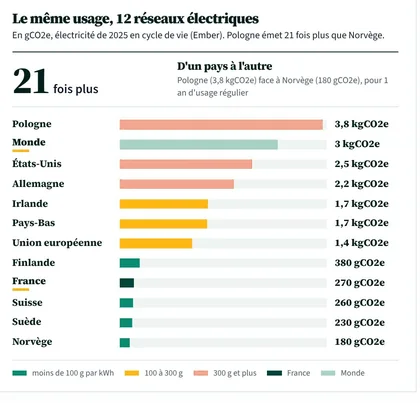
These figures have one thing in common: they rest on estimates from 2023 and 2024, made on models and machines of another generation. The best public measurement to date, published by Google in August 2025, gives 0.24 Wh for a median question to Gemini. OpenAI gives 0.34 Wh for ChatGPT, roughly what an oven uses in a little over a second, and independent estimates fall between 0.2 and 0.6 Wh. Depending on the country where the server runs, that is between 0.01 and 0.2 gram of CO2 equivalent per question. Even at 50 questions a day for a year, the total stays below 0.1% of the carbon footprint of a French person, which was 8.3 tonnes in 2025.
We could stop there and reassure everyone. But in 2025, the electricity used by data centres dedicated to AI rose by 50% according to the International Energy Agency (IEA), Google's by 37%, and orders for gas turbines soared in the United States. These findings are all true at once, and one image reconciles them: AI has a surface and depths. Public debate looks at the surface, whereas the footprint lies almost entirely beneath it.
Surface AI accounts for a few per cent of the electricity used by AI
By surface AI I mean the AI that has an interface and someone in front of it: the window of ChatGPT, Gemini, Vibe (formerly Le Chat) or Claude, the image we ask for, the video we generate for a story. It is the only AI the general public sees, and therefore the only one it debates. Its audience is massive: ChatGPT had 900 million weekly users at the end of 2025, and received 2.6 billion messages a day as early as June 2025, of which 73% were unrelated to work according to the study published by OpenAI with the NBER.
In energy terms, this audience weighs little. At 0.34 Wh per question, consumer ChatGPT uses in the order of 0.3 TWh a year, about 0.2% of the roughly 155 TWh used in 2025 by data centres dedicated to AI. Even multiplying this figure by 5 to allow for long documents and reasoning, then by 3 to add the other assistants, consumer chat remains below 5% of the electricity used by AI.

 Electricity
What share of data centre electricity does ChatGPT account for?
Electricity used in one year, in TWh; the area of each square reflects consumption · 2025
Source: IEA; RTE; GreenIT; Shift Project; ADEME · projetcelsius.com/en/ai · CC BY 4.0
The surface has nonetheless spread beyond what we ask for. The AI-generated summaries at the top of Google results reach 2.5 billion people a month, and Meta AI passed a billion users by being built into the search bar of WhatsApp and Instagram, without anyone asking for either. Even there, the energy remains modest: if every web search went through a simple AI, the IEA estimates that the total would stay below 4 TWh a year, less than 1% of data centre electricity.
The surface also has heavy uses. An image costs 1 to 3 Wh, or 3 to 10 questions. A question with intensive reasoning can rise to between 17 and 34 Wh according to estimates made on GPT-5, and a 5-second video clip ranges from a few Wh to nearly 1 kWh depending on the model. These differences are a reason to choose one's uses, but they do not change the order of magnitude: it is not this consumption that is getting power stations built.
Deep AI runs without an interface, and we see it only through the electricity grid
Deep AI has no one in front of it. It is the models that choose every post and every advert in a news feed, the agents that carry out tasks while their owner sleeps, companies' automated processing chains, and the training of models, which no one triggers by asking a question.
Total volumes, however, have changed scale. Google processed 9,700 billion tokens a month in spring 2024, and more than 3 quadrillion in May 2026, 330 times more in 2 years; a quarter of this flow goes through its API, that is, through its customers' software, and most of the rest through its own products, from search summaries to the Gemini app. OpenAI's API processed 15 billion tokens a minute in April 2026, probably more than ChatGPT itself. Google's internal development tools went from 500 to 3,000 billion tokens a day between March and May 2026, and Microsoft is redesigning Copilot to hand tasks to agents that keep working after the user has logged off.
The leap can also be seen at the scale of one person. The climate scientist Zeke Hausfather tallied the consumption of his own programming agents: about 3 kWh a day on average over 8 weeks, or in the order of 1.1 MWh a year at that rate, as much as nearly 200 heavy ChatGPT users. Content recommendation, for its part, already accounted for up to 79% of inference computation in Facebook's data centres in 2019, well before ChatGPT. Meta now runs it on hundreds of thousands of chips designed for it, and is building large language models into it. Meta has not published any breakdown of its computation since 2021.
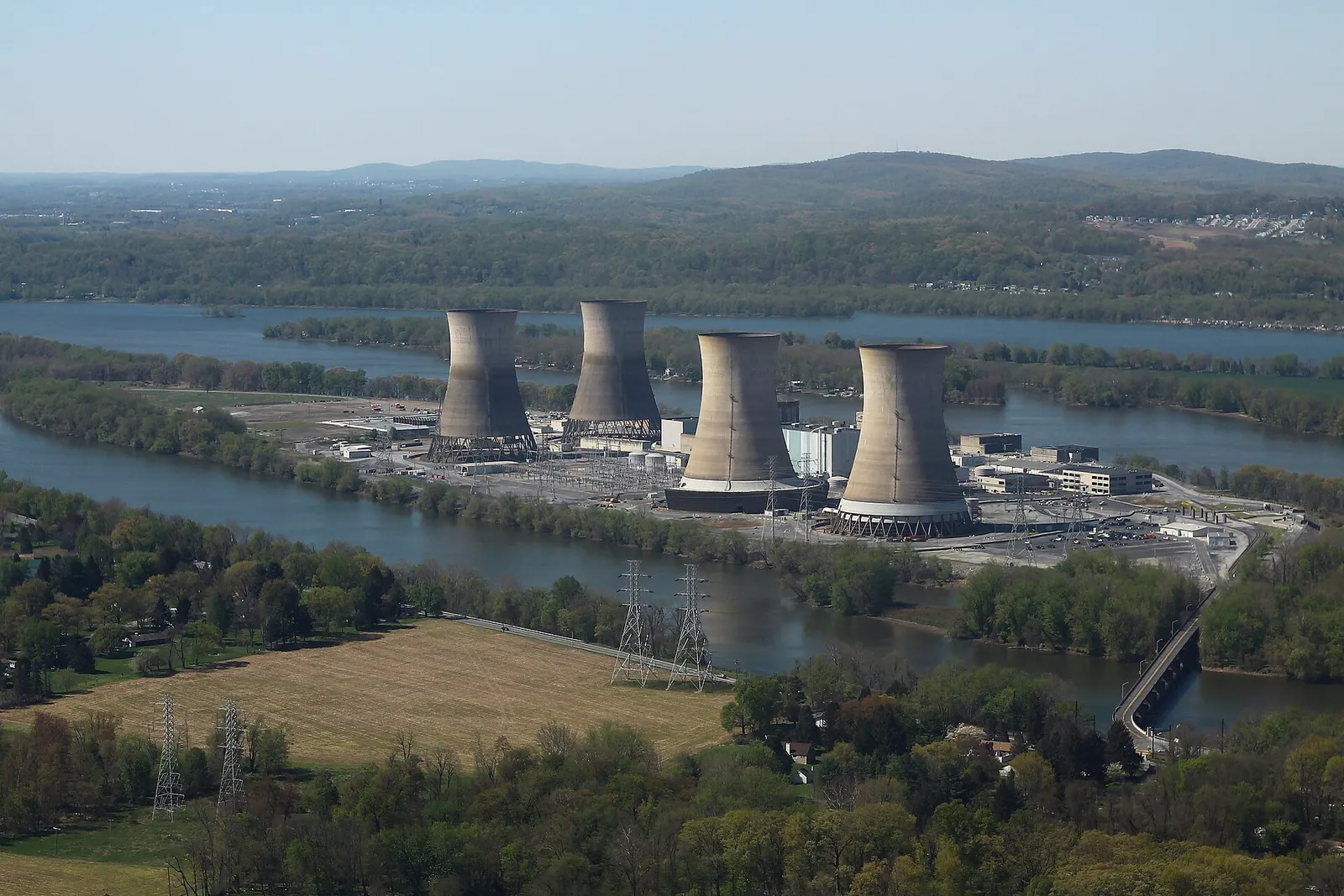
That is the difficulty: deep AI is also the least documented. My training as a physicist suggests an analogy. Like dark matter, it probably accounts for most of the mass, and we detect it only through its effects. For galaxies, the evidence is the rotation speed of stars. Here, it is the electricity grid. GE Vernova reports 116 GW of orders and reservations for gas turbines, sold years in advance. In July 2026, PJM, which runs the grid of 13 states in the eastern United States, fell 6.8 GW short of its reliability requirement for the first time in its history; it attributes 30 of the 32 GW of expected peak growth by 2030 to data centres. Meta plans up to 5 GW for its Hyperion site in Louisiana, supplied by 7 new gas power stations. xAI, Elon Musk's company, installed dozens of turbines without permits near Memphis, for which it has faced a complaint from the NAACP since April 2026.
The computer scientist Mark Weiser wrote in 1991 that the most profound technologies are those that disappear, weaving themselves into everyday life. AI is taking that path, and that is what makes its footprint so hard to debate: what disappears from view also disappears from the accounts.
The means of intellectual production are now bought by the tonne
The 5 largest digital companies invested more than 400 billion dollars in their infrastructure in 2025, and plan more than 700 billion in 2026. According to the IEA, that is now more than global investment in oil and gas exploration and production. This capital produces a commodity whose price is collapsing: for equal performance, the cost of a token has fallen by a factor of 9 to 900 each year depending on the task, according to Epoch AI.
When the capacity to reason becomes a cheap raw material, the question is who can buy it in quantity. An individual consumes it by the spoonful: 50 questions a day, in the order of 18 million tokens a year counting a thousand tokens per exchange. Nearly 500 Google cloud customers each use more than 1,000 billion a year, as much as 55,000 heavy users. This ratio of 1 to 55,000 is not a market detail: the means of intellectual production, long spread across the heads of millions of workers, are becoming an industrial service bought by volume, and whoever already has processes to automate and capital to pay buys the most.
The expression "deep AI" can also be read literally. Equinor credits AI, which reprocessed its seismic data, with 27 new discoveries on the Norwegian continental shelf, and Chevron claims an efficiency gain of more than 30% in its drilling in the Permian Basin. A study published in August 2026 in npj Climate Action estimates that the productivity gains AI brings to fossil fuel extraction could add 0.47 to 1.8 billion tonnes of CO2 a year, or 3 to 12 times the emissions of all the world's data centres. The AI that helps drill deeper could count for more in the climate account than the electricity it uses.
The same logic, less spectacular, applies to advertising: a model that targets better sells more. The researchers Sasha Luccioni, Emma Strubell and Kate Crawford class these among induced effects, which appear in no data centre meter and which no one measures.
Jevons, cognitive slaves and a finite world
In 1865, the economist William Stanley Jevons observed that more efficient steam engines had not reduced British coal consumption: they had pushed it up, by making steam profitable for new uses. AI is replaying the scene 160 years later: Google cut the energy of a Gemini question by a factor of 33 between May 2024 and May 2025, and its total electricity consumption rose by 37% in 2025, its emissions by 18% according to its own accounting. The mechanism is not mysterious: a data centre is sized by the power the grid grants it, and a more efficient chip is used to produce more tokens per megawatt, not to use fewer megawatts.
ElectricityElectricity use of Google and Microsoft
Electricity used by the company, in TWh a year · 2020 to 2025, published years
Source: Google, 2026 report; Microsoft, 2026 data sheet · projetcelsius.com/en/ai · CC BY 4.0
Jean-Marc Jancovici popularised the idea of "energy slaves": every kWh used makes machines work in our place, with a force that no human body could supply. What we call growth is above all this multiplication of physical force by fossil energy. AI extends the principle to intellectual work: after energy slaves come cognitive slaves, which sort, draft, code, monitor and recommend without tiring, with available electrical power as their only limit on pace.
The difference from the age of steam lies in speed: data centre electricity rose by 17% in 2025, and that of AI-dedicated centres by 50%, while global demand grew by 3%. According to IEA satellite data, the capacity of "AI factories" more than tripled in 18 months. The Shift Project estimates that the sector's emissions are rising by about 9% a year, when they would need to fall by 5% a year to meet climate targets. The gap is widening between the pace of a human society, which takes decades to transform its buildings and mobility, and that of an industrial machine that triples its capacity in a year and a half.
This world has physical limits. By 2030, data centres could require more than 0.5 million tonnes of copper a year and more than 10% of global demand for gallium, a metal whose refining China largely controls and whose export it has restricted since 2023. According to a study in Nature Computational Science, generative AI could produce 1.2 to 5 million tonnes of cumulative electronic waste between 2020 and 2030; the GreenIT association assumes a lifespan of 1 to 3 years for an AI server, compared with 7 for a conventional server. And low-carbon electricity is not unlimited, even in France: data centre projects had reserved about 18 GW of grid connection in May 2026, the equivalent of a fifth of the winter peak, while the same kWh will be needed to electrify transport, heating and industry.
What this text does not say
AI is not currently one of the planet's major emitters. The IEA attributes about 150 million tonnes of CO2 a year to data centres, about 0.4% of global energy-related CO2, roughly a sixth of aviation's share. By 2030, they should account for less than 10% of the global rise in electricity demand, less than air conditioning, industrial motors or electric cars. The thesis of this text concerns acceleration, not the stock.
The split between surface and depths is an order of magnitude reasoned out from heterogeneous data, not a measurement: no company publishes the share of its computation that serves its users, its business customers or its own systems. Content recommendation could be the largest block, or a shrinking one.
Deep AI is not useless by nature either. It detects fraud, runs electricity grids, reads medical images. The IEA estimates that existing applications could avoid about 1.4 billion tonnes of CO2 in 2035 if they were widely adopted, while noting that nothing is currently driving that adoption. Of 154 industry climate claims examined in February 2026 by the association Beyond Fossil Fuels, none showed a verified, substantial reduction due to generative AI.
Finally, the surface is not without effect. It is what establishes the habit, builds the audiences, and justifies to the markets the investments that fund the depths. Not feeling guilty about one's question to ChatGPT does not rule out asking what one is taking part in.
The question to ask concerns deep AI: who decides on it, and who counts it
The question "how much does my prompt cost?" is legitimate, and its answer is reassuring. Its drawback is that it leaves the essentials out of the picture. In May 2025, 84% of the tokens processed by the OpenRouter platform went through models that publish no environmental data, according to a study by Sasha Luccioni and her co-authors cited by Arcep. The European AI Act requires providers of large models to document the energy used in training, but only for the European AI Office, not for the public. The energy rating of European data centres is due in 2027. Nothing targets agents, AI switched on by default or industrial uses that run without an interface.
Some requirements nevertheless follow directly from this finding:
- Publish, model by model, the energy consumed in use and not only in training, calculated with the actual electricity grid rather than with green electricity contracts.
- Count AI in companies' Bilans Carbone®, in their purchases of digital services and hardware, instead of burying it in a general "IT" line.
- Make AI functions opt-in rather than active by default. ADEME already asks that users at least be able to switch them off.
- Make new data centres conditional on heat recovery, their water consumption and their ability to reduce demand at peak times, and decide collectively what low-carbon kWh should be used for.
On the surface, everyone can keep asking their questions without embarrassment. Whether this technology helps an economy live within its limits or helps it exceed them faster is decided in the depths, and those decisions are not made in a chat window.

He holds a doctorate from École polytechnique and an engineering degree from ESPCI Paris, and co-founded Projet Celsius, which he chairs. He is a lead trainer in Bilan Carbone® and life cycle assessment at the Institut de Formation Carbone.
His page and articles →Contact him →LinkedIn ↗Sources
24 documents
- IEA, Key Questions on Energy and AI2026entry 2
- IEA, Powering Artificial Intelligence2026
- Google, Measuring the environmental impact of delivering AI at Google scale2025
- Google, 2026 Environmental Report2026entry 13
- Sam Altman, The Gentle Singularity2025
- Chatterji et al., How People Use ChatGPT, NBER2025
- MIT Technology Review, Google's estimate of Gemini's energy use2025
- Our World in Data, How much energy do data centers and AI use?2026
- Google, Google I/O 20262026
- Google, 2nd quarter 2026 results2026
- Zeke Hausfather, The real energy use of agentic AI2026
- Gupta et al., The Architectural Implications of Facebook's DNN-based Personalized Recommendation2019
- PJM, 2028/2029 capacity auction results2026
- SELC, xAI built an illegal power plant2026
- Epoch AI, LLM inference price trends2025
- Axios, AI could boost oil and gas emissions2026
- DeSmog, AI and fossil fuel exploration2026
- Luccioni, Strubell and Crawford, From efficiency gains to rebound effects2025
- The Shift Project, summary on AI and data centres2025
- IMF, Inside the AI-led resource race2025
- Wang et al., E-waste challenges of generative artificial intelligence, Nature Computational Science2024entry 43
- Euronews, AI greenwashing: most of Big Tech's AI climate promises fall flat2026
- Arcep, Intelligence artificielle et environnement (mesures du PEReN)2026entry 27
- SDES and Insee, L'empreinte carbone de la France de 1990 à 20252026entry 52
Every figure was read in its source; the hub's methodology is described in Methodology and sources.
AI Impact, Projet Celsius, "Surface AI and deep AI", 20 October 2026. https://projetcelsius.com/en/ai/analyses/surface-ai-and-deep-ai/

 Climate