
 Society12 November 2026
Does AI really make us more productive at work?
Tasks, working weeks and national accounts
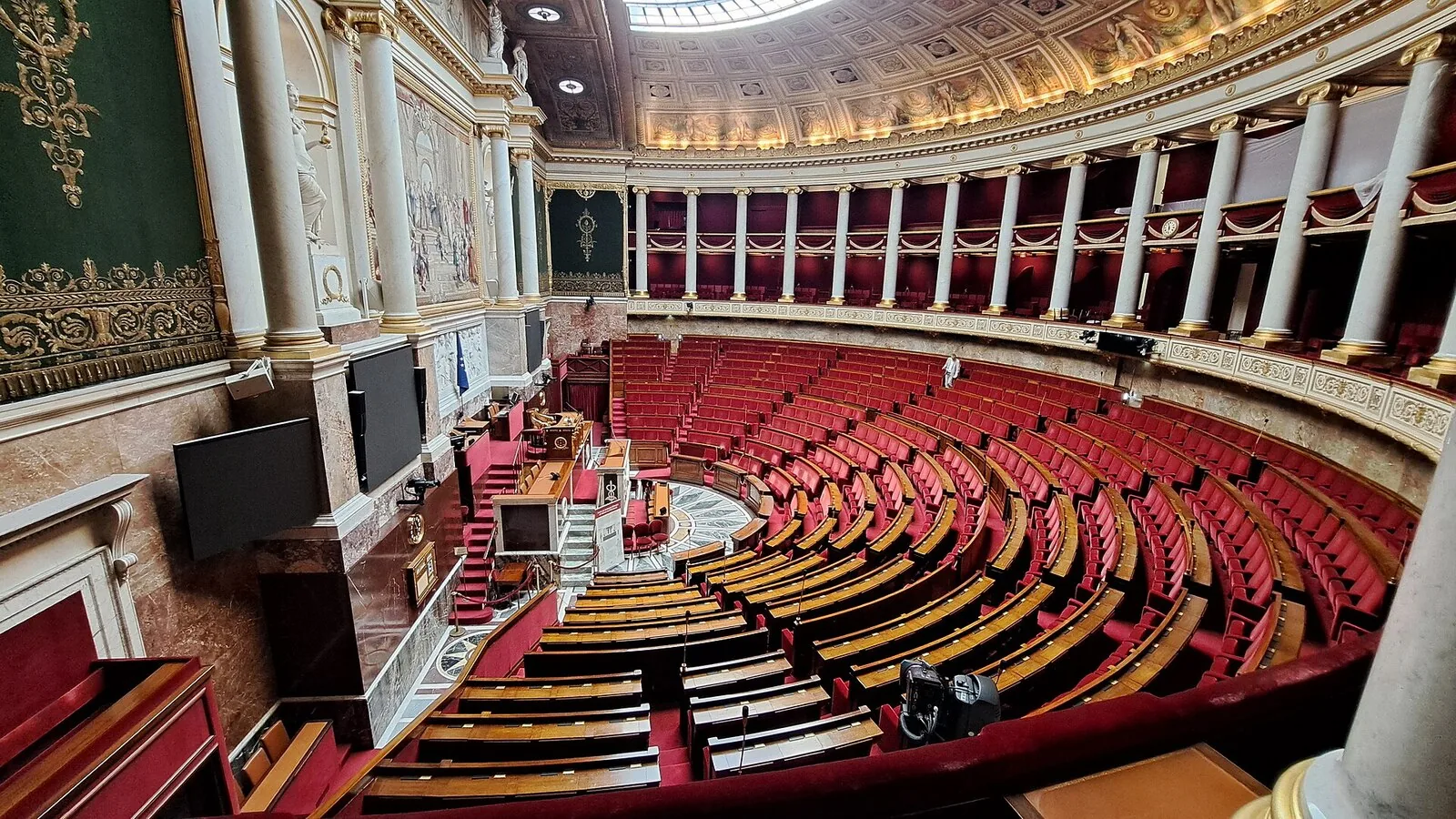
The chamber of the Assemblée nationale, in September 2024. The hearing cited took place in a committee room. Photo PanierAvide, CC BY-SA 4.0, via Wikimedia Commons.
AI saves time for the people who use it, yet that time is almost impossible to find in the accounts of companies and countries. Speaking to French MPs, the head of Mistral AI unintentionally offered one way of explaining the gap.
Contents
On 12 May 2026, Arthur Mensch appeared before French MPs. The head of Mistral AI, the best-known French artificial intelligence company, was answering under oath to a parliamentary committee of inquiry, and he described how AI is changing his developers' work.
"When you are alone, you can go ten or twenty times faster; when there are five of you, the gains are a little smaller because there is the matter of communication."
At 20 times faster, 35 hours of work take less than 2. Yet the rest of the sentence is more interesting than its opening. With 5 people, the gains are already shrinking. And in a very large company, he goes on, you first have to "remove organisational bottlenecks".
Arthur Mensch was talking about his developer teams. Yet his remark sheds light on a puzzle that has occupied economists for 4 years: AI saves time for those who use it, and that time is almost nowhere to be found in company and national accounts.

On a task, the gain is real
Let us start with what is solid. When 2 groups are given the same work and only one of them is equipped with AI, AI saves time. 3 frequently cited experiments show this, each with its own measure.
| Experiment | Participants | Result with AI |
|---|---|---|
| Customer support centre of a software company | 5,172 agents | 14% more requests resolved per hour |
| Professional writing tasks | 453 graduates | 40% less time, higher-rated texts |
| Consulting assignments, tasks within the model's reach | 758 consultants | 25% less time |
Sources: Brynjolfsson, Li and Raymond (Stanford and MIT); Noy and Zhang, Science; Dell'Acqua et al., Harvard Business School.
These experiments share a feature that is cited less often: the gain goes first to the least experienced. At the help desk, junior agents improve by 34% according to the working-paper version of the study, while the most experienced barely improve. AI brings novices closer to professionals more than it speeds professionals up.
They also have a limit. When the consultants were given a problem deliberately chosen to be beyond the model's reach, those using it found the right answer less often: 60% and 70% depending on the group, compared with 84.5% for those working alone.
In the consultants' experiment, AI saved time on what it can do, and led to mistakes on the rest.
Over a user's week, 1 to 2 hours remain
The tool has spread unusually fast. In the United States, 21% of employees said they used it at work in 2023, and 52% in spring 2026, according to Gallup. In the euro area, the European Central Bank tracks the same trend : 26% of employees in 2024, 52% in 2026. Companies are further behind. In France, 18% of companies with 10 or more employees used some form of AI in 2025, according to Eurostat, and 8% used an AI that produces text or code.

Users are convinced they benefit. In late 2024, American users said they saved 5.4% of their working time, according to a survey published by the Federal Reserve Bank of St. Louis. In Denmark, users report 3%.
Over a 35-hour week, the time users say they save comes to between 1 and 2 hours.
That is worthwhile, and a long way from the full day sometimes claimed. The Boston Consulting Group does give 8 hours per week, but for 42% of frontline employees who use AI regularly, and the firm sells AI consulting.
There is no contradiction between 40% of time saved on a task and 5% over a week. A working week is not made up solely of tasks that an AI can do.
In the accounts, almost nothing
Denmark keeps registers that track the pay and hours of every employee. 2 economists, from the universities of Chicago and Copenhagen, have linked to these registers a survey of 25,000 employees in 11 occupations exposed to AI. 2 years after ChatGPT arrived, they find no effect on wages or hours, and rule out any effect larger than 2%, even among those who use an assistant every day.
In France, the Banque de France surveyed about 7,000 companies in early 2026. Among those that use generative AI:
Executives in 7 countries surveyed by central bank researchers put this gain at 0.2% per year over the past 3 years.
The national accounts tell the same story. In France, an hour of work produced slightly less in 2025 than in 2019: 0.9% less, according to OECD data. Insee, the French national statistics institute, notes one exception, market services, whose productivity has moved back above its pre-pandemic trend. It attributes this partly to "notable gains in computer programming with the rise of generative artificial intelligence".
In the United States, the picture is more favourable. Productivity has grown by 2.3% a year since 2019, an average lifted by 2020 (5.3%), compared with 1.5% over the previous 12 years, and the Federal Reserve Bank of Dallas notes that the 3 sectors most exposed to AI are outperforming the others. It points out that this is a correlation. The economist Torsten Slok put it this way in February : AI is everywhere except in the latest macroeconomic data (our translation).
On employment, the only measured signal concerns young people
A brief digression is needed here. If AI does not show up in productivity, does it show up in employment? Before the MPs, Arthur Mensch said there would be "growth but also job losses - at least a change in existing jobs".
For now, aggregate statistics show nothing. The Budget Lab at Yale, which tracks the American labour market month by month, finds no clear sign of AI-related disruption. A Stanford team reaches the same conclusion for employees as a whole, with one exception: workers aged 22-25. In the most exposed occupations, the gap comes mainly from fewer young people being hired rather than from departures. In France, researchers from HEC and the Banque de France observe the same gap in hiring on permanent contracts.
| Since November 2022 | Occupations most exposed to AI | Least exposed occupations |
|---|---|---|
| United States, employment of workers aged 22-25, to June 2026 | about −11% | about +10% |
| France, permanent-contract hires of workers aged 21-29, to March 2026 | about −28% | about −8% |
Sources: Brynjolfsson, Chandar and Chen, Stanford, August 2026 (payroll data); Bergeaud et al., HEC Paris and Banque de France, 2026 (private-sector recruitment).
In each of the 2 countries, the authors warn that they describe a gap without establishing its cause. The French team cites other possible explanations, including the reorganisation of IT activities after the pandemic.
Computers posed the same puzzle, and electricity before them
Torsten Slok's line echoes an older one. In July 1987, the economist Robert Solow wrote in the New York Times that you could see the computer age everywhere but in the productivity statistics. Companies were buying computers, and productivity was slowing.
Productivity did eventually respond. In the United States, it grew by 1.4% a year between 1973 and 1990. Growth then rose to 3.1% a year between 1995 and 2004, according to Bureau of Labor Statistics data. This came 8 years after Solow's remark, and much longer after the first office computers.

Optimists take this as a sign that it is too early. Arthur Mensch made the same point in his own way before the MPs: there is not enough hindsight yet, because handing an agent a task for a whole day has only been possible for 6 months. Erik Brynjolfsson, of Stanford, with Daniel Rock and Chad Syverson, turned this into a theory, the J-curve: companies that adopt a technology of this kind start by spending time on training and reorganisation. The statistics count this time but not what it builds, so measured productivity is underestimated at first and overestimated later, when the benefits arrive. The cautious answer with a calculation. Daron Acemoglu, of MIT, estimates that AI will add at most 0.66% to overall productivity in 10 years.
The economic historian Paul David had answered Solow as early as 1990 by pointing to another machine, the dynamo. In 1899, electric motors accounted for less than 5% of the installed motive power in American factories. It took 2 decades to pass the halfway mark, and the productivity gains came only in the 1920s.
The reason bears directly on our subject. The first electrified factories replaced their steam engine with one large electric motor and kept everything else: the line shaft on the ceiling, the belts, the machines lined up underneath. The gain came when each machine was given its own motor, which made it possible to redesign the workshop. Electricity did little for productivity as long as the factory remained organised around steam.

Paul David himself warned that computers are not dynamos. It is an analogy, and it does not say how long it will take this time.
You can badly misjudge your own time
Part of the gap has a simple explanation: people misjudge their own time. In 2025, the research organisation METR followed 16 experienced developers on 246 tasks, some with AI and some without. Before starting, they expected to be 24% faster.
The developers estimate they saved 20 % of their time thanks to AI.
They took 19% more time than on the tasks done without AI.
The tools have improved since, and the same researchers consider it likely that AI now speeds these developers up, but cannot put a reliable figure on it. What remains from this experiment is that people can misjudge their own speed by 39 points. Every survey that asks employees how much time they save relies on this perception.
The time each person saves is lost in work done together
That leaves the explanation Arthur Mensch hints at, which is the one we favour. Look again at what he said. Alone, a developer goes 10 or 20 times faster. With 5 people, a little less. Earlier in the same hearing, answering another question, he had given a figure for his whole company: in 6 months, he said, Mistral AI multiplied its productivity by 2. This is his own statement, and no study verifies it. He warns that this doubling does not apply to everyone. At Mistral AI, the use of agents "causes little friction" because of the "small physical footprint" of the business, whereas in heavy industry physical systems have to be tested.
Arthur Mensch speaks of physical friction. The organisational friction he alluded to with his bottlenecks exists everywhere, offices included. One experiment measured it. In 66 companies, researchers randomly selected 7,137 employees and gave some of them an assistant built into their email, meetings and word processor.
Work done alone, which each person organises as they wish. The gain is that of the 80% of equipped employees who used the tool.
Work done with others : shortening a meeting or deciding who writes a document requires agreeing with colleagues.
This is the authors' explanation. At this stage of adoption, AI has sped up what each person does alone and stopped where work with others begins. 2 caveats: the study measures time spent in applications, not what is produced, and some of the authors worked for Microsoft, which sells this assistant.
Computer scientists have known this phenomenon since 1967. That year, Gene Amdahl, an engineer at IBM, asked what is gained by adding processors to a computer. His conclusion : the effort is wasted if the part of the computation that cannot be split up does not speed up at the same rate. A formula named after him was later derived from it. The overall gain is bounded by the share of the work that is not sped up. A team whose AI makes half the work 20 times faster goes only 1.9 times faster, because the other half takes as long as before. Even with an infinitely fast machine, it would not go more than 2 times faster.
From the gain on a task to the gain for a team
Gene Amdahl's reasoning applied to 35 hours of work. The 2 settings are assumptions you can adjust.
Saving 2.0 h out of 35 amounts to an overall gain of × 1.06. At the speed set above, AI would have to speed up 6% of your work. The rest is done at the same speed as before.
Gain = 1 / ((1 − p) + p / v), where p is the share sped up and v the speed-up on that share. Preset speeds: Brynjolfsson, Li and Raymond; Dell'Acqua et al.; Noy and Zhang; Arthur Mensch's hearing on 12 May 2026 ("ten or twenty times", upper bound used). The calculation assumes that the rest of the work does not change.
This calculation does not explain the doubling at Mistral AI, which nobody outside the company can break down. It shows that a factor of 20 on a task and a factor of 2 overall are not contradictory. Economists follow a similar line of reasoning at the scale of a country. Philippe Aghion, with Benjamin and Charles Jones, wrote as early as 2017 that growth could be limited "not by what we do well, but by what is essential and yet hard to improve" (our translation).
This is one reading, and there are others: the cost of learning the tools, adoption that is still limited within companies, statistics that lag behind. We prefer this one because it points to what to do.
Before counting hours, count meetings
An executive who has just bought licences has 2 ways of measuring their return. The first is to ask their teams whether they save time. They will probably say yes, in good faith, and the METR study shows how badly people can misjudge this.
The second is to look at the output: cases completed, turnaround times, what the client receives, and to look for where the work is held up. If the AI writes the first draft in 10 minutes and it still takes 3 weeks to sign it off, the first draft was never the problem. The factories of 1900 had bought the motor and kept the line shaft.
Finally, there is a question the studies do not ask, and which matters most to us. In Denmark, 85% of assistant users say they spend the time saved on other tasks in their job. If those tasks also go through an assistant, AI adds hours of use instead of removing them, with the queries and electricity that come with them. This is a hypothesis, and none of the studies cited here measures it. It deserves to be measured before anyone talks about sufficiency.
A lone developer may be 20 times faster. Mistral AI, according to its chief executive, is 2 times faster. Between those 2 figures lies a company.
The 3 levels are not measured in the same way: time clocked on a task, time self-reported over a week, company registers and surveys for the accounts. The figures given by Arthur Mensch are those of a chief executive about his own company. The organisational explanation is our interpretation.

He holds a doctorate from École polytechnique and an engineering degree from ESPCI Paris, and co-founded Projet Celsius, which he chairs. He is a lead trainer in Bilan Carbone® and life cycle assessment at the Institut de Formation Carbone.
His page and articles →Contact him →LinkedIn ↗Sources
29 documents
- Assemblée nationale, commission d'enquête sur les dépendances structurelles et les vulnérabilités systémiques dans le secteur du numérique et les risques pour l'indépendance de la France, audition d'Arthur Mensch (Mistral AI), compte rendu n° 422026entry 60
- Brynjolfsson, Li and Raymond, Generative AI at Work, NBER2023entry 61
- Noy and Zhang, Experimental evidence on the productivity effects of generative artificial intelligence, Science2023entry 62
- Dell'Acqua et al., Navigating the Jagged Technological Frontier, Harvard Business School2023entry 63
- Gallup, surveys on the use of AI at work, 2023 to 20262026entry 67
- European Central Bank, AI adoption and the productivity promise: what workers report2026entry 68
- Eurostat, Intelligence artificielle dans les entreprises (isoc_eb_ai)2026entry 69
- Bick, Blandin and Deming, The Impact of Generative AI on Work Productivity, Federal Reserve Bank of St. Louis2025entry 64
- Humlum and Vestergaard, Still Waters, Rapid Currents, NBER2026entry 65
- Boston Consulting Group, AI at Work 20262026entry 66
- Banque de France, L'IA s'installe dans les entreprises françaises, Bulletin n° 266/12026entry 70
- Yotzov, Barrero, Bloom et al., Firm Data on AI, NBER2026entry 71
- OECD, Productivity Database, GDP per hour worked2026entry 72
- Insee, Les gains de productivité français en partie retrouvés, sans effacer le retard accumulé2026entry 73
- Bureau of Labor Statistics, labour productivity of the non-farm business sector (series OPHNFB, read on FRED)2026entry 74
- Federal Reserve Bank of Dallas, International comparisons show AI effect on productivity2026entry 75
- Torsten Slok (Apollo), Waiting for the AI J-Curve2026entry 76
- The Budget Lab (Yale), Tracking the Impact of AI on the Labor Market2026entry 77
- Brynjolfsson, Chandar and Chen, Canaries in the Coal Mine?, Stanford Digital Economy Lab2026entry 78
- Bergeaud, Bertheau, Bunel, Degos and Palladino, Exposition des métiers à l'IA générative, adoption par les entreprises et dynamiques du marché du travail en France, HEC Paris and Banque de France2026entry 79
- Robert Solow, We'd Better Watch Out, The New York Times Book Review1987entry 80
- Brynjolfsson, Rock and Syverson, The Productivity J-Curve, American Economic Journal: Macroeconomics2021entry 81
- Daron Acemoglu, The Simple Macroeconomics of AI, NBER2024entry 82
- Paul David, The Dynamo and the Computer, American Economic Review1990entry 83
- METR, Measuring the Impact of Early-2025 AI on Experienced Open-Source Developer Productivity2025entry 84
- METR, update to the study on experienced developers2026entry 85
- Dillon, Jaffe, Immorlica and Stanton, Shifting Work Patterns with Generative AI, NBER2025entry 86
- Gene Amdahl, Validity of the Single Processor Approach to Achieving Large Scale Computing Capabilities, AFIPS1967entry 87
- Aghion, Jones and Jones, Artificial Intelligence and Economic Growth, NBER2017entry 88
Every figure was read in its source; the hub's methodology is described in Methodology and sources.
AI Impact, Projet Celsius, "Does AI really make us more productive at work?", 12 November 2026. https://projetcelsius.com/en/ai/analyses/does-ai-boost-productivity-at-work/