
 Society13 November 2026
Is AI making us stupid?
Polls, surveys and controlled trials




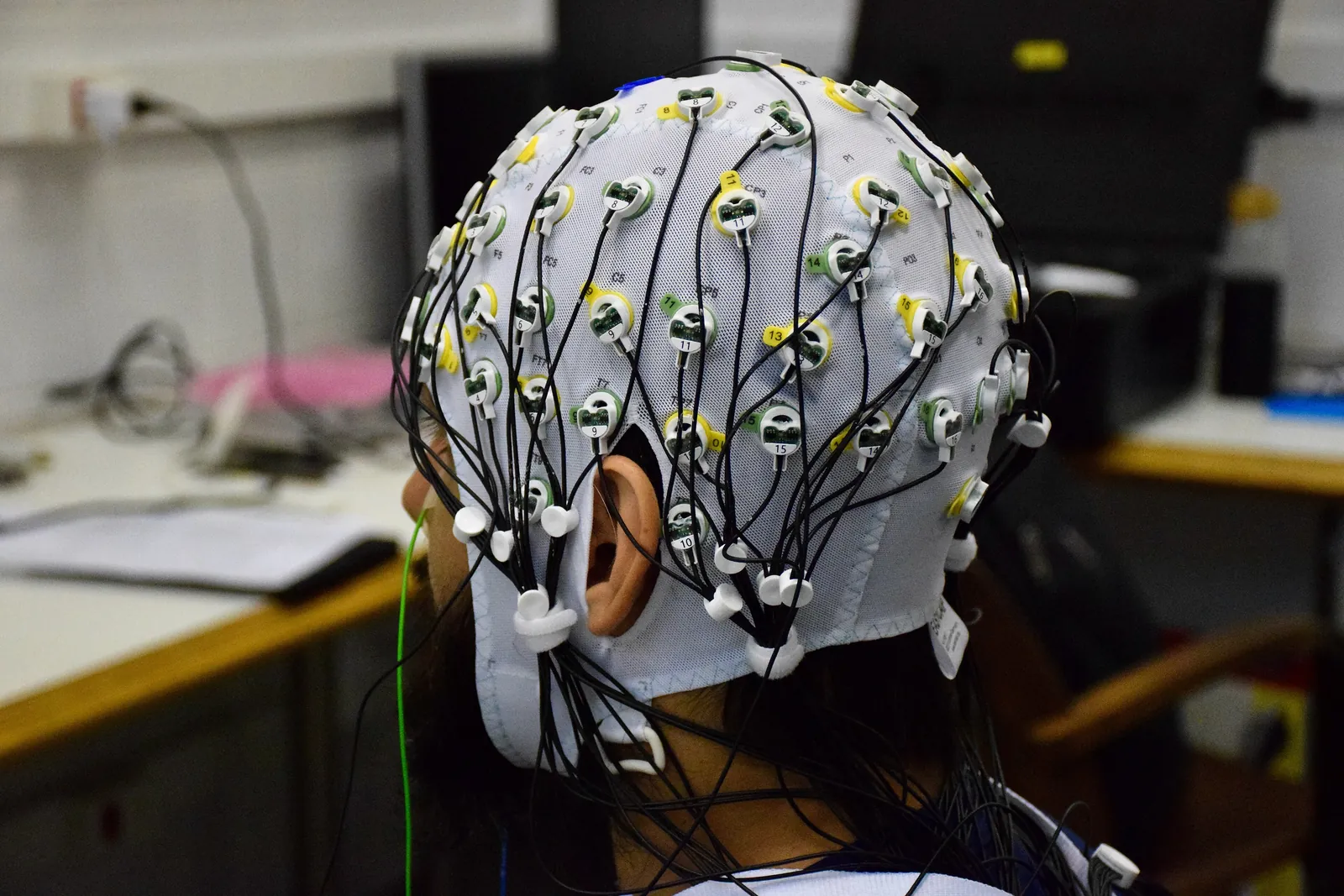
An electroencephalography cap during a training session at the NeuroMat research centre, in January 2024. Photo Thaismay, CC BY-SA 4.0, via Wikimedia Commons.
None of the studies we have found measures a decline in intelligence among people who use AI. Randomised trials measure a narrower effect: pupils and students who work with an AI that gives the answers get worse results, which did not happen with an AI set up to guide. The studies that made the headlines are among the weakest.
Contents
On 10 June 2025, 8 researchers from MIT and 2 neighbouring institutions posted online a study on writing essays with ChatGPT. 2 weeks later, a Belgian daily ran the headline "ChatGPT makes you less intelligent". Yet on the study's website, the authors answer "No!" to the question "can we say that language models make us dumber?", and ask that the words "stupid", "dumb" and "damage" not be used. The study covers 54 people and had not been published in a journal as of 13 November 2026, 17 months after it was posted.
The fear is widespread. In January 2025, 44% of French people aged 18 to 75 cited a decline in the ability to think among the main risks of generative AI.
The most cited studies and what they measure
We identified the studies that measure the abilities or effort of people using generative AI, excluding literature reviews. Among the most cited, 5 exceed 950 citations in OpenAlex, a public database of scientific publications. None measures intelligence.
| Study | Participants | Measure | Result | Status |
|---|---|---|---|---|
| Survey by a Swiss business school, 2025 | 666 people, questionnaires and interviews | Use of AI tools, critical thinking scores | More use, less critical thinking; the youngest depend most on the tools and have the lowest scores | Peer-reviewed journal, with a correction |
| MIT, 2025 | 54 people, 3 texts of 20 minutes | Electrical activity of the brain during writing; ability to quote one's own text | In the 1st session, none of the 18 participants using ChatGPT quoted their own text correctly, compared with 2 and 3 failures out of 18 in the groups without it; in later sessions, 4 then 6 failures, compared with 2 | Preprint |
| Writing experiment, 2024 | 117 students assigned at random | Essay grade, knowledge gained | Essay graded higher with ChatGPT, with no more knowledge gained than with the other aids | Peer-reviewed journal |
| Microsoft Research and Carnegie Mellon, 2025 | 319 people who use AI at work, 936 examples | Self-reported critical thinking | The more people trust AI, the less they report exercising their critical thinking | Peer-reviewed conference proceedings |
| High school in Turkey, 2025 | Nearly 1,000 pupils from the same school, assigned at random between classes | Mathematics exam without AI | 17% lower after revising with a ChatGPT-like AI without safeguards | Peer-reviewed journal |
In table order, 2,120, 1,436, 1,344, 996 and 976 citations in OpenAlex on 13 November 2026. Sources: Gerlich, Societies; Kosmyna et al., arXiv; Fan et al., British Journal of Educational Technology; Lee et al., CHI 2025; Bastani et al., PNAS.
2 of these studies measure critical thinking at a single point in time, through scores or self-reports. The other 3 randomly assign participants to groups and measure an effect on the same day. We set aside another much-cited study, on stories written with the help of AI, because it grades the texts without measuring the abilities of their authors.
The most cited study is at the lowest level of evidence
The Haute Autorité de santé (France's National Authority for Health) classifies studies into 4 levels of evidence. Level 1 covers large randomised trials and meta-analyses of those trials; level 4, retrospective studies and surveys that describe a population at a given point in time. Our scale follows the same order, with the opinion poll, which measures a fear, at the bottom, and meta-analyses at the top, their level depending on the studies they pool.

The Swiss survey, the most cited with 2,120 citations, and the Microsoft survey are at level 4. The MIT study and the writing experiment randomly assign small numbers of participants, at level 2. The trial conducted in Turkey, in a single high school, is the only one of the 5 at level 1, and the least cited.
Meta-analyses do not yet settle the matter. In March 2026, one of them, covering 35 studies and 4,193 participants, found a "moderate" positive effect of ChatGPT on the results of pupils and students, while including non-randomised experiments with widely scattered results. Another, which concluded in May 2025 that the effect was "large", was retracted on 22 April 2026 because of inconsistencies in the analysis. 4 researchers audited some of the experiments pooled by a third: in their view, the gains observed cannot yet be attributed to ChatGPT with confidence.
Trials measure poorer learning with an AI that gives the answers
In autumn 2023, about fifty classes in a Turkish high school revised mathematics in 4 sessions of 90 minutes, each ending with an exam taken without help. Each class was assigned to one of 3 groups: no AI, a ChatGPT-like AI, or an AI set up with the teachers to give hints rather than answers.
compared with the classes that never had AI, with an uncertainty of about 3% to 30%. During the practice exercises, those classes scored 48% higher.
The authors read the chat logs. With the AI without safeguards, pupils often asked for the solution and copied it. They did not think they had done worse in the exam.
A larger trial, posted online in September 2026 without peer review, points in the same direction. At an American public university, randomly selected courses were given an AI tutor set by default to give the answer directly. The trial covers 2,379 students; between sections of the same course, the final grade fell by 0.37 standard deviations, a measure of how spread out grades are. The authors are cautious about inferring an effect on learning, since the grade is set by the instructor.
In the trial conducted in Turkey, the loss concerned the exercises the AI had done for the pupils, and the pupils did not notice it.
For a skill already acquired, the evidence is weaker
Smaller studies, on other tools and without random assignment, point the same way. At McGill University in Montreal, 50 drivers had poorer spatial memory the more they had driven with GPS; 13 of them, reassessed 3 years later, had declined more the more they had used it. In a Boeing 747 simulator, 16 airline pilots retained their manual flying skills but struggled to keep track of the aircraft's position and to decide on the next step, all the more so when their minds had wandered while the automation was flying. In 4 endoscopy centres in Poland, the detection rate of adenomas, polyps some of which become cancerous, fell from 28.4% to 22.4% in colonoscopies performed without AI in the 3 months after a detection AI was introduced; the authors write that AI "might" be the cause.
On the Haute Autorité de santé scale, these studies provide a scientific presumption or a low level of evidence. The Microsoft researchers point to the supposed mechanism, the "ironies of automation" described by Lisanne Bainbridge in 1983: handing routine work to the machine deprives the user of opportunities to exercise judgement.
None of the studies we found measures intelligence
The studies that come closest, the Swiss survey and the Microsoft survey, link AI use to critical thinking scores or to self-reports. A correlation of this kind can be read in 2 directions: AI may weaken critical thinking, and people who exercise it less may also use AI more.
The MIT study measures brain signals that are less connected to one another during writing with ChatGPT, and does not say what remains of this months later. 4 other researchers call for a more cautious reading of its results, pointing to the small sample and to results reported inconsistently.
2 older studies serve as precedents. In 2011, a study published in Science concluded that people remember information less well when they expect to be able to find it again on a computer; only one of its 4 experiments, which did not concern memory, has failed to replicate. In 1986, a meta-analysis of 79 studies concluded that calculators, used alongside conventional teaching, improved the pencil-and-paper arithmetic of average-ability pupils, except in the fourth year of primary school (CM1). The blog article on what the studies measure in the brain finds that none of the studies it cites measures a lasting effect on the brain.
The design of the tool determines what is learned
In the Turkish high school, the AI set up to give hints eliminated almost all of the exam loss, without producing a gain. In 18 Tennessee middle schools, a 2-year trial, posted online in August 2026 without peer review, gave randomly selected pupils a tutor set up to guide rather than answer: the result was a small gain in mathematics, close to that of the same platform's exercises without AI, and pupils rarely used the tutor. At Harvard, 194 physics students gained more than 2 times as much with a tutor that guided them step by step, following the teachers' instructions, as in an active-learning class, on a test taken immediately afterwards.
| Use associated with a loss | Use with no measured loss |
|---|---|
| The tool gives the answer while people are learning (high school and university, AI without safeguards) | The tool guides or gives hints (high school, AI set up to give hints; Tennessee middle schools; Harvard) |
| The skill is no longer practised, then the tool is unavailable (GPS, colonoscopy; observations) | Practice continues alongside the tool (calculators, except in the fourth year of primary school, CM1) |
Sources: Bastani et al.; Liu et al.; Oreopoulos and Low; Kestin et al.; Dahmani and Bohbot; Budzyń et al.; Hembree and Dessart. GPS and colonoscopy: observations, on tools that are not generative AI.
Among the studies we identified, none of those published in a journal follows the same people using generative AI for more than a few months.
Our reading
In our view, nothing we have read shows that AI makes people stupid. The studies address a narrower question: which tasks does the tool do for us, and will we need those skills on the day it is unavailable? A pupil learning to solve an equation, a doctor spotting polyps and a pilot who must know where the aircraft is all need them, and it is not always possible to know in advance which task will have to be done again unaided.
In a Bilan Carbone®, each data point is assigned an uncertainty: a meter reading is better than an estimate, and an estimate better than an average ratio. Applied to this debate, the same rule places randomised trials above the studies that made the headlines. Before deploying an assistant in a classroom or a team, we would ask the question these trials tested: does the tool give the answer, or does it help you look for it?
The MIT study is a preprint that has not yet been peer reviewed; the trials at the American university and the Tennessee middle schools are working papers. The trial conducted in Turkey covers a single high school and only the short term. The studies on GPS, pilots and colonoscopies concern tools that are not generative AI, with a low level of evidence. Citation counts come from OpenAlex as of 13 November 2026 and cover only the studies we found. The ranking of the studies by level of evidence is ours, based on the grading system of the Haute Autorité de santé.
Sources
24 documents
- Kosmyna, Hauptmann, Yuan et al., Your Brain on ChatGPT: Accumulation of Cognitive Debt when Using an AI Assistant for Essay Writing Task, arXiv preprint, June 2025 (version 2 of December 2025)2025entry 95
- Kosmyna et al., Your Brain on ChatGPT, frequently asked questions on the study's website, read on 13 November 20262025entry 96
- Stankovic, Hirche, Kollatzsch and Doetsch, Comment on: Your Brain on ChatGPT, arXiv preprint2025entry 97
- Michael Gerlich, AI Tools in Society: Impacts on Cognitive Offloading and the Future of Critical Thinking, Societies, January 2025 (correction of September 2025)2025entry 98
- Lee, Sarkar, Tankelevitch, Drosos, Rintel, Banks and Wilson, The Impact of Generative AI on Critical Thinking: Self-Reported Reductions in Cognitive Effort and Confidence Effects From a Survey of Knowledge Workers, CHI 2025 proceedings2025entry 99
- Fan, Tang, Le et al., Beware of metacognitive laziness: Effects of generative artificial intelligence on learning motivation, processes, and performance, British Journal of Educational Technology2024entry 100
- Bastani, Bastani, Sungu, Ge, Kabakcı and Mariman, Generative AI without guardrails can harm learning: Evidence from high school mathematics, PNAS2025entry 101
- Liu, Sweet, Chen et al., The Effects of Course-Integrated AI Tutoring on Student Performance and Engagement: A Randomized University Trial, EdWorkingPaper 26-1598, Annenberg Institute (Brown University)2026entry 116
- Oreopoulos and Low, One Click Away: AI Tutoring with Khanmigo in a Two-Year School Experiment, NBER2026entry 117
- Kestin, Miller, Klales, Milbourne and Ponti, AI tutoring outperforms in-class active learning: an RCT introducing a novel research-based design in an authentic educational setting, Scientific Reports2025entry 102
- Budzyń, Romańczyk et al., Endoscopist deskilling risk after exposure to artificial intelligence in colonoscopy: a multicentre, observational study, The Lancet Gastroenterology & Hepatology2025entry 103
- Dahmani and Bohbot, Habitual use of GPS negatively impacts spatial memory during self-guided navigation, Scientific Reports2020entry 104
- Casner, Geven, Recker and Schooler, The Retention of Manual Flying Skills in the Automated Cockpit, Human Factors2014entry 105
- Sparrow, Liu and Wegner, Google effects on memory: cognitive consequences of having information at our fingertips, Science2011entry 106
- Guido Hesselmann, No conclusive evidence that difficult general knowledge questions cause a "Google Stroop effect". A replication study, PeerJ2020entry 107
- Hembree and Dessart, Effects of Hand-Held Calculators in Precollege Mathematics Education: A Meta-Analysis, Journal for Research in Mathematics Education1986entry 108
- Wu, Zhu, Zhang, Yin and Wang, ChatGPT's impact on student learning outcomes: a meta-analysis of 35 experimental studies, Humanities and Social Sciences Communications2026entry 110
- Wang and Fan, The effect of ChatGPT on students' learning performance, learning perception, and higher-order thinking: insights from a meta-analysis, Humanities and Social Sciences Communications, May 2025, retracted on 22 April 2026 (retraction notice)2026entry 109
- Weidlich, Gašević, Drachsler and Kirschner, ChatGPT in Education: An Effect in Search of a Cause, Journal of Computer Assisted Learning2025entry 111
- Doshi and Hauser, Generative AI enhances individual creativity but reduces the collective diversity of novel content, Science Advances2024entry 118
- Haute Autorité de santé, Niveau de preuve et gradation des recommandations de bonne pratique, état des lieux2013entry 113
- Ipsos-CESI study, an engineering school, L'usage de l'intelligence artificielle par les Français2025entry 112
- OpenAlex, number of citations of each study, counted on 13 November 20262026entry 114
- La DH, ChatGPT rend moins intelligent : une nouvelle étude montre les effets inquiétant de l'IA sur le cerveau2025entry 115
Every figure was read in its source; the hub's methodology is described in Methodology and sources.
AI Impact, Projet Celsius, "Is AI making us stupid?", 13 November 2026. https://projetcelsius.com/en/ai/analyses/is-ai-making-us-stupid/