
 Electricity
 Water
 Climate
 Hardware
 Uses
 Society
Measuring the environmental impact of delivering AI at Google scale
Strengths
- "The only published measurement over a full inference scope."
- A measurement in production: active accelerators, processor and memory, idle machines, data centre overhead.
- It also gives the narrow approach (0.10 Wh): the wider scope more than doubles the value.
Its limitations
- Measurement published by the provider itself, not audited by a third party.
- Valid for Gemini; it cannot be transposed as it stands to other assistants.
- For water, the narrowest scope of the published figures: 170 times less than the life cycle assessment by Mistral AI.
The 8 values recorded in this document
| Value | What it measures | Where in the document | Checked on |
|---|---|---|---|
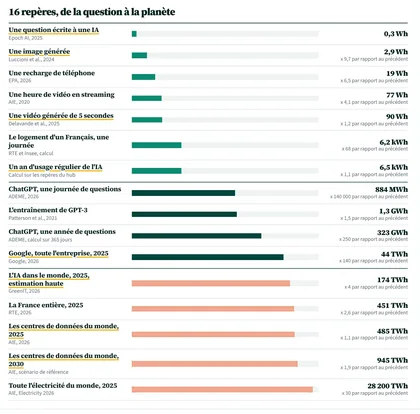
| 0.24 Wh | Electricity used by a text query, median question to Gemini, May 2025 · reference value | Results section, table 1 | 21 Oct. 2026 |
| 0.24 Wh | Energy of the median question to Gemini Apps (text), May 2025 · reference value | Results section, figure 3 | 21 Oct. 2026 |
| 0.10 Wh | The same query, narrow approach (accelerators only) | Section 4.1, table 1 | 24 Oct. 2026 |
| 0.26 mL | Water consumed per question, Google Gemini (median) · reference value | Section 4.2, table 2 | 21 Oct. 2026 |
| 1.15 L/kWh | Water consumed per kWh, Google data centres serving language models | Section 3.3 | 21 Oct. 2026 |
| 0.03 gCO2e | Emissions per median written question to Gemini | Section 4.2, table 2 | 21 Oct. 2026 |
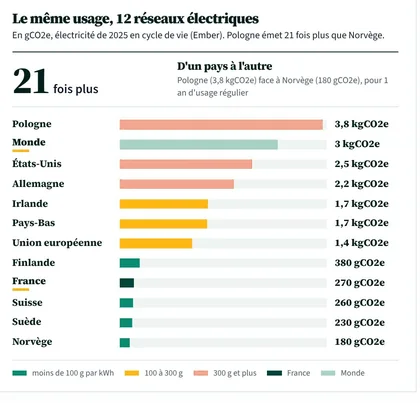
| 94 g/kWh | Google electricity in 2024, according to its contracts | Section 3.3, p. 6 | 24 Oct. 2026 |
| 345 g/kWh | Google electricity in 2024, according to the grid | Section 3.3, p. 6 | 24 Oct. 2026 |
Where it is cited in the hub · 10 items
 AnalysisWhy do estimates of AI's impact differ?
 Where does this figure come from?"An email written by an AI is a bottle of water"
 AnalysisWhat is the footprint of my AI use over a year?
 AnalysisHow do you account for AI in a Bilan Carbone®?
 AnalysisCan AI be decarbonised?ChartWater for one question, from 0.26 to 50 mL depending on scopeChartOne question, 4 ways of counting CO2e
Cite this source
[14] Elsworth et al. (Google), Measuring the environmental impact of delivering AI at Google scale, August 2025. https://arxiv.org/abs/2508.15734
For software and AI
@misc{elsworth2025,
  author = {Elsworth and others},
  title  = {Measuring the environmental impact of delivering AI at Google scale},
  year   = {2025}, month = {aug},
  url    = {https://arxiv.org/abs/2508.15734}
}