
 Uses13 November 2026
What is the footprint of my AI use over a year?
Personal use, office work and coding agents




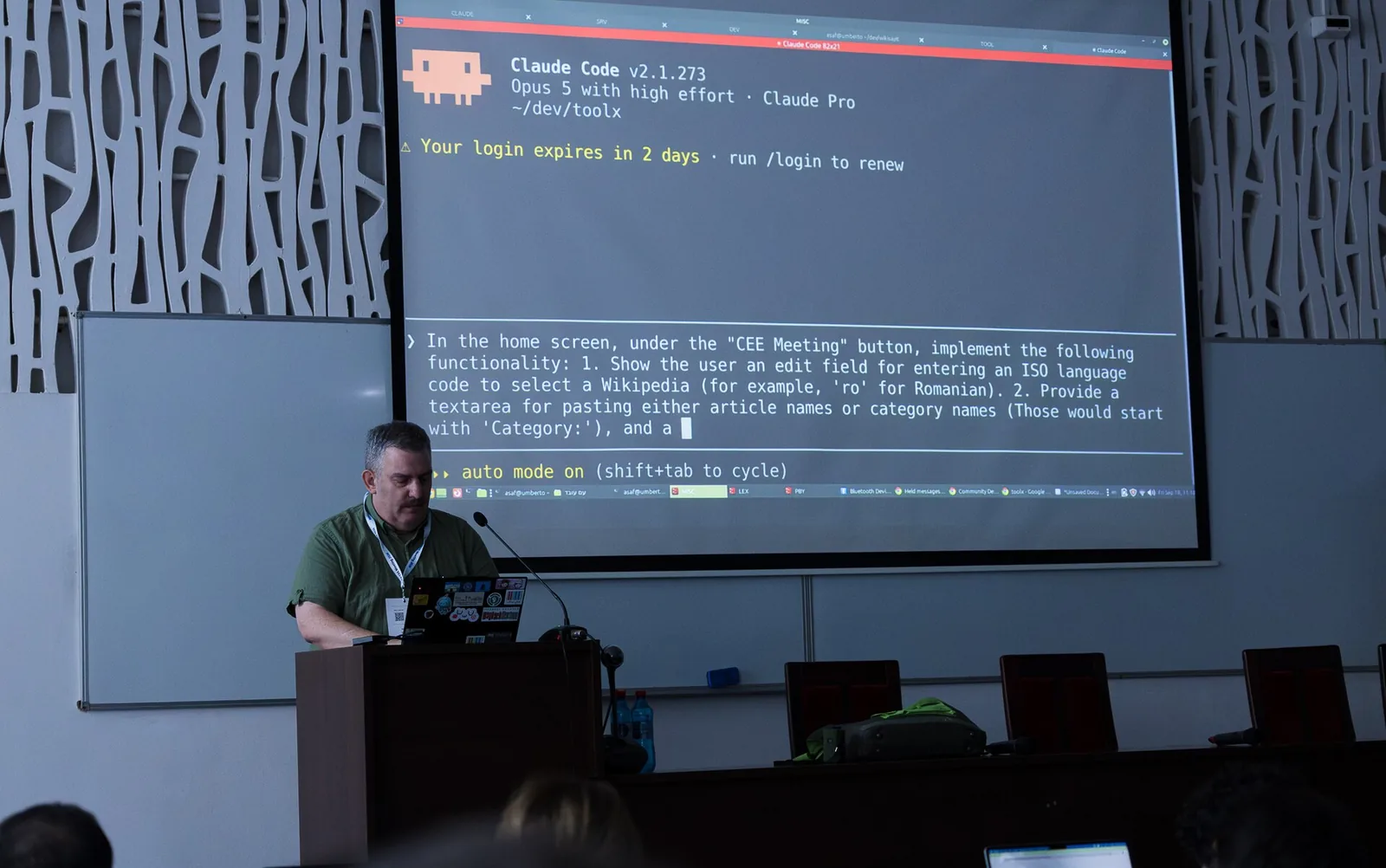
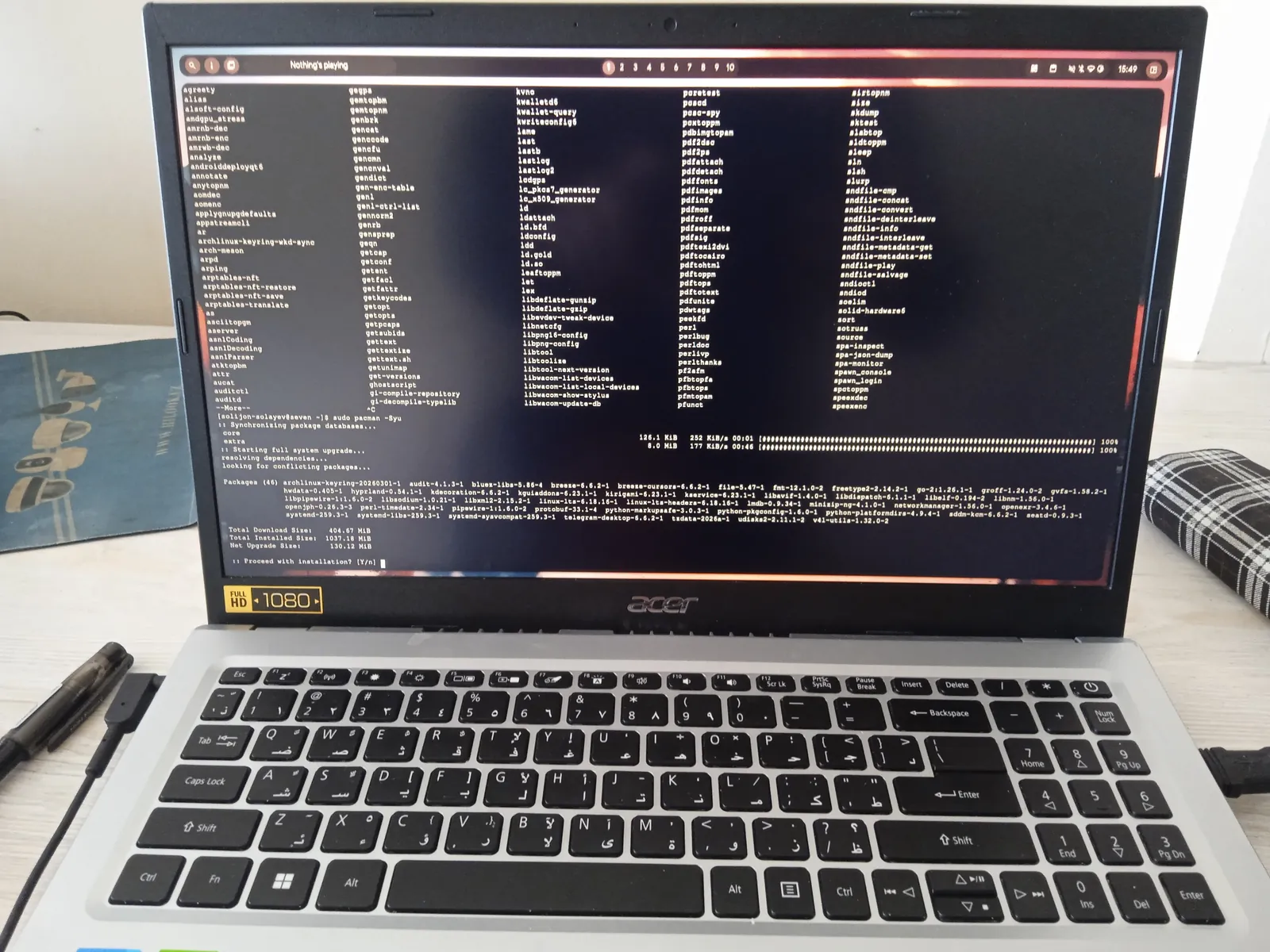
Claude Code, set to a high reasoning effort, shown on screen at the Wikimedia CEE Meeting, 18 September 2026. Photo Knovisuals, cropped, CC BY-SA 4.0, via Wikimedia Commons.
Counting the electricity of the servers that answer it, a year of regular personal AI use amounts to about 340 gCO2e, or 0.004% of the carbon footprint of a person in France. Depending on the profile, the year ranges from 58 g for occasional use to 180 kg for a developer who hands tasks to agents every day, and the published logs of one intensive agent user reach 4.5 to 6% of a French person's footprint. The difference depends far more on the tasks given to AI than on the number of questions.
Contents
In France, 48% of people aged 12 and over used generative AI in 2025, compared with 20% 2 years earlier, according to the Baromètre du numérique. 46% of French people consider that it has a greater environmental impact than a conventional search. The figures in circulation almost all concern a single question. A year of use adds up hundreds of questions, a few images, sometimes a video or hours of agent work, and it is this total that shows whether the use is significant.
The AI Impact Database builds up this total task by task, for typical profiles: someone who uses the free plans at home, an office employee, a subscriber, a developer. The calculations below come from its engine, and anyone can redo them on each profile's entry.
The electricity of the servers that process each request, including cooling and data centre equipment, converted into CO2e with the world average electricity mix for 2025, 458 gCO2e per kWh. The major assistants do not say where a given request is processed.
The manufacture of servers and chips, model training, the network, the person's phone or computer. The values on this page are therefore a lower bound.
A year of regular personal use comes to about 340 gCO2e
The Database's year of personal use describes the median user of free plans, outside work. They ask 365 quick questions, hold 47 conversations of about ten exchanges each, create or edit around fifteen images, generate 2 video clips of 5 seconds and run one deep research task. Their web searches show them about 330 AI-written overviews. These frequencies draw on the Baromètre du numérique; they are Projet Celsius assumptions, adjustable on the profile's entry.
All of this consumes 750 Wh at the servers and emits 340 gCO2e over the year. That is as much as 2.4 km by petrol or diesel car, including the manufacture of the car, whereas the AI year does not count the manufacture of the servers.
| Task | Times per year | Electricity per year | Share of the year |
|---|---|---|---|
| 5-second video clips | 2.1 | 210 Wh | 27 % |
| Conversations of 10 exchanges | 47 | 160 Wh | 22 % |
| Deep research tasks | 1.2 | 120 Wh | 16 % |
| Quick questions | 365 | 110 Wh | 15 % |
| Images created or edited | 16 | 51 Wh | 7 % |
| AI overviews generated at the top of search results | 329 | 44 Wh | 6 % |
| Other tasks (emails, texts, translations, voice, documents, code) | 55 Wh | 7 % |
Source: AI Impact Database, free personal use over a year, regular use, engine 0.3.1. The frequencies are assumptions based on the Baromètre du numérique.
2 video clips and 1 deep research task account for 43% of the year, more than the 365 questions and 47 conversations combined (37%). In the Database, a 5-second clip is calculated with WAN 2.1, in its 1.3-billion-parameter version, the most downloaded open generator: 99 Wh, as much as 330 quick questions. It computes 81 high-definition images, and its electricity use rises quickly with the length and resolution of the video; Sora, Veo and the other closed generators publish nothing (see the note "A generated video uses 1 kWh"). A deep research task, which in the Database reads about a hundred web pages before writing a 5-page report, uses as much electricity as a clip. A quick question uses 0.3 Wh, the value on which a Google measurement in production, 2 estimates and an OpenAI statement have agreed since 2025.
The weight of the same task basket changes with the intensity of use. For an occasional user, in the least active third, the year comes to 58 gCO2e, more than a third of it from the overviews that search engines generate unprompted. For an intensive user, in the most active tenth, it reaches 1.9 kg, 32 times the occasional year, half of it from about twenty video clips.
At work, an office employee's year comes to about 590 gCO2e
The year of an office employee or manager consists of different tasks: emails, proofread pages, meeting minutes, spreadsheets, presentations, over 220 working days. It uses 1.3 kWh and emits 590 gCO2e. Nearly half (47%) comes from 220 web searches delegated to an AI. For each one, the assistant runs 2 searches, reads 5 pages and writes an answer with sources, which uses 2.7 Wh, 9 times the 0.3 Wh that Google gave in 2009 for a conventional search.
Mainstream subscriptions stay within the same order of magnitude. For the use the Database assumes, a year of Claude Pro comes to 1.3 kgCO2e, ChatGPT Plus to 1.4 kg and Google AI Pro to 2.1 kg. Anthropic and Google do not quantify the usage limits of their plans, and the Database's typical uses are Projet Celsius assumptions.
With agents, the year runs to tens or hundreds of kilograms of CO2e
A coding agent works on its own. It reads the project, writes, tests and corrects, and at each step it sends everything that came before back to the model. In the Database, one coding-agent hour involves 120 steps and each time rereads about 100,000 tokens of context. It uses 670 Wh, as much as about 2,200 quick questions.
The year of a developer who uses AI without agents, mainly for code suggestions, comes to 2 kgCO2e for 4.3 kWh. With agents, the Database counts 594 agent hours in the year, about 2 h 40 per working day. The year then rises to 400 kWh and 180 kgCO2e, 93 times the year without agents, and the agent hours account for 99% of it.
In the Database, the typical uses of the top-tier plans also include agent hours: 390 hours for Claude Max, whose year comes to 120 kg, and 260 hours for ChatGPT Pro, 91 kg. The typical use of a GitHub Copilot licence includes 88 agent hours, 94% of its 29 kg year.
The Database's agent hour is based on the median Claude Code session that the climate scientist Zeke Hausfather estimated for his own use. Over 8 weeks in 2026, he recorded the tokens he consumed, then converted them into electricity using published factors, including Watershed's, which the Database also uses: about 0.6 kWh for the median session, 3 kWh per day on average. These are one user's personal records, not a study, and the one-hour session length is an assumption of the Database. If he kept up this pace all year, he estimates he would use about 1.1 MWh, between 0.4 and 2.2 MWh, or 2.7 times the Database's typical developer. The Database's range for this profile runs from 190 to 770 kWh, depending on the cost of context reread from cache, which nobody publishes: from 1 to 25% of a token read.
One coding-agent hour uses as much electricity as about 2,200 quick questions. The year of a developer who hands about 2 h 40 a day to agents comes to 180 kgCO2e, more than 3,000 times an occasional user's year.
The difference comes down to 4 factors that multiply together
From 58 g to 180 kg, the Database's profiles span a ratio of 1 to more than 3,000. 4 factors explain this difference.
| Factor | Mechanism | Effect over a year, in the Database |
|---|---|---|
| The intensity of use | The share of tasks entrusted to AI | From 58 g to 1.9 kg for personal use, a factor of 32 |
| Heavy tasks | One clip or one deep research task equals 330 questions | 2 clips and 1 deep research task make up 43% of a regular year |
| Agent hours | One hour equals about 2,200 questions | From 2 kg to 180 kg for a developer, a factor of 93 |
| Model size and reasoning mode | The electricity of each request | From 0.5 to 15 times the regular personal year |
Source: AI Impact Database, engine 0.3.1, servers worldwide; for the last row, search engine overviews left at their default setting.
The first 3 depend on the tasks given to AI. The fourth depends on the model that answers, and applies to all requests at once. In the Database, a large frontier model uses about 4 times more per token than the average model of consumer assistants, and a small model about 6 times less. Reasoning mode, in which the model writes a draft before answering, multiplies the compute energy of an answer by 1.92 on average, an effect estimated by the Pôle d'expertise de la régulation numérique (PEReN), the French government's centre of expertise for digital regulation, on 23 open models, and by about 10 in the Database at high reasoning effort.
The regular personal year, when the same setting applies to all requests made to the assistant; search engine overviews keep the small model that the engine chooses.
These settings often depend more on the assistant and its default setting than on the user's choice. The actions that follow from this are covered in the article on the actions that reduce the impact of AI.
The factors multiply together. An office employee whose every request went through a large model with extended reasoning would go from 1.3 to 23 kWh over the year, and from 590 g to 10 kgCO2e, 18 times more. Intensive personal use with a large model comes to about 4 kgCO2e.
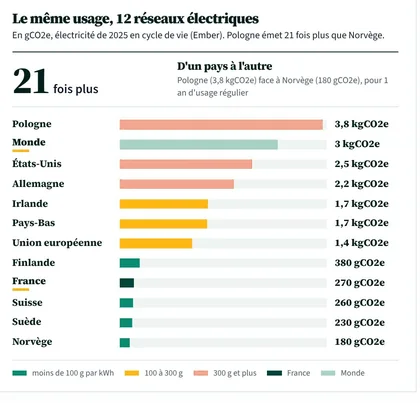
One last setting changes the CO2e without changing the electricity. The same personal year emits 340 g with the world average electricity mix, 160 g with the European Union's and 31 g with France's, 11 times less. The major assistants do not say where a given request is processed, and the Database uses the world average. The hub publishes the carbon intensity of electricity country by country.
Against the 8.3 tCO2e of a French person, from less than 0.01% to a few per cent
The carbon footprint of a person in France was 8.3 tCO2e in 2025, according to the provisional estimate by the statistical service of the Ministry for the Ecological Transition and Insee, the French national statistics institute. It counts the greenhouse gases generated by what people in France consume, imports included. The year of regular personal AI use accounts for 0.004% of it, the office employee's year for 0.007% and the ChatGPT Plus subscriber's for 0.017%. The Claude Max subscriber reaches 1.5%, the developer with agents 2.2%.
The year that Zeke Hausfather extrapolates from his records, 1.1 MWh, would come to 370 kgCO2e by his calculation, using average US electricity, and about 500 kgCO2e with the world average used here, or 4.5 to 6% of a French person's footprint. It is the highest value on this page, and it comes from a single intensive user.

Digital technology as a whole gives a closer benchmark. ADEME (the French Agency for Ecological Transition) estimates its footprint at 434 kgCO2e per person per year in France: devices, networks, and data centres in France and abroad, manufacture included, based on 2022 data. The year of regular personal AI use would account for 0.08% of it, the developer with agents 43%. The comparison has 2 limitations. ADEME counts manufacture, which accounts for 60% of the total, whereas the Database counts only electricity. And its study covers a year when generative AI was not yet widespread; ADEME states that it does not take its growth into account.
France · 2022 data · 29.5 MtCO2e · ADEME, January 2025
The digital sector's share of France's carbon footprint→Over the life cycle, the year would weigh a little more. The first life cycle assessment published by a provider, that of Mistral AI carried out with Carbone 4 and ADEME, gives 1.14 gCO2e for an answer of 400 tokens from its large model, server manufacture included. In this assessment, server manufacture accounts for 11% of emissions; at Google, the manufacture of chips and memory accounts for about 30% of the 0.03 gCO2e of a question. Counting manufacture would therefore raise the annual figures on this page by about 10 to 40%, without changing their order of magnitude. Model training remains separate. The hub's analysis "Why do estimates of AI's impact differ?" details these scopes.
These benchmarks point to 2 situations. With the Database's default settings, personal or office use, even intensive, accounts for less than 0.03% of a person's footprint, less than 15 km in a petrol or diesel car; a large model with extended reasoning on every request takes the office employee to 0.13%. For anyone who hands hours of work to agents, AI becomes a line item in their footprint, from a few tenths of a per cent to a few per cent.
Working out your own year
The site currently gives 3 values for a year of use, which do not cover the same use. 340 g is the Database's year of free personal use. 740 g is the year of the typical user of the "My AI footprint" tool, which combines personal and professional use and counts 6 deep research tasks, 37% of their year. 3 kg is the year of the default profile of the tool "Estimate the footprint of your AI use", in which 52 videos account for 72%.
In our view at Projet Celsius, it is delegating work to agents that changes the order of magnitude of a year of AI. For most users, with default settings, the year amounts to hundreds of grams of CO2e. With agents, especially when a large model reasons at length, it amounts to tens or hundreds of kilograms, from a few tenths of a per cent to a few per cent of a person's footprint.
To place your own year among these profiles, the "My AI footprint" tool builds it from your assistants, your week, your tasks and your settings, with the Database's factors.
The annual figures on this page count the electricity of the servers and the data centre, excluding hardware manufacture and model training, and are therefore lower bounds. The usage frequencies and the typical uses of subscriptions are Projet Celsius assumptions, based on surveys, with the Database's default settings (average model, no reasoning). The agent hour is based on the records of a single user and on the assumption that a session lasts one hour. CO2e is based on the world average electricity mix, since we do not know where requests are processed.
Sources
12 documents
- SDES and Insee, L'empreinte carbone de la France de 1990 à 20252026entry 52
- ADEME, Évaluation de l'impact environnemental du numérique en France2025entry 38
- Arcep, Arcom, CGE and ANCT, Baromètre du numérique2026entry 56
- Our World in Data, based on Ember, Lifecycle carbon intensity of electricity2026entry 34
- Epoch AI, How much energy does ChatGPT use?2025entry 20
- Elsworth et al. (Google), Measuring the environmental impact of delivering AI at Google scale2025entry 14
- Sam Altman (OpenAI), The Gentle Singularity2025entry 21
- Delavande, Pierrard and Luccioni, Video Killed the Energy Budget2025entry 23
- Zeke Hausfather, The real energy use of agentic AI, The Climate Brink2026entry 119
- PEReN for Arcep, Étude IA et environnement, technical report2025entry 120
- Mistral AI, with Carbone 4 and ADEME, Our contribution to a global environmental standard for AI2025entry 17
- ADEME, Impact CO2, transport2026entry 121
Every figure was read in its source; the hub's methodology is described in Methodology and sources.
AI Impact, Projet Celsius, "What is the footprint of my AI use over a year?", 13 November 2026. https://projetcelsius.com/en/ai/analyses/footprint-of-my-ai-use-over-a-year/


 Electricity