
 Uses20 October 2026
"A generated video uses 1 kWh"




The figure has circulated since 2025, often attached to Sora. It comes from a real measurement, but one taken on a different, open model, in a particularly heavy version. Measurements of 7 generators range from 0.14 to 415 Wh.
Contents
Where the figure comes from
In May 2025, MIT Technology Review measured an open video generator, CogVideoX: about 30 Wh for 5 seconds with the older version of the model, 944 Wh with the new one; the graphics card was measured and the result doubled to allow for the rest of the server. Blogs turned this into "1 kWh per Sora video". Neither OpenAI for Sora, nor Google for Veo, nor Kuaishou for Kling has published a measurement.
Researchers' measurements
In September 2025, Julien Delavande, Régis Pierrard and Sasha Luccioni measured 7 open generators with their default settings. The most economical uses 0.14 Wh, the most power-hungry more than 415 Wh, a factor of 3,000. The most downloaded open generator, WAN 2.1 in its 1.3-billion-parameter version, uses 90 Wh for a 5.4-second video in 720p. The International Energy Agency (IEA), for its part, takes 115 Wh for 6 seconds, GPU only.
For the same model, CogVideoX in its 5-billion-parameter version, the 2 studies give about 25 Wh and 944 Wh. The gap is not explained: settings, number of steps and hardware differ, and none of the 2 publishes everything that would be needed to settle it.
 Uses
Electricity used by a generated video, 7 models measured
Electricity per video, default settings, in Wh, logarithmic scale · Measurements published in September 2025
Source: Delavande, Pierrard and Luccioni, September 2025 · projetcelsius.com/en/ai · CC BY 4.0
Why the gaps are so large
The energy of a video grows as the square of its duration and as the square of its number of pixels: doubling the duration multiplies it by about 4, moving from 720p to 1080p by 5. By extrapolation, 10 seconds in 1080p with the reference model would exceed 1.5 kWh, but the relationship has been verified only up to 6.6 seconds. A kilowatt-hour is therefore not absurd for a long high-definition video; it is absurd for "a video" in general.
Key points
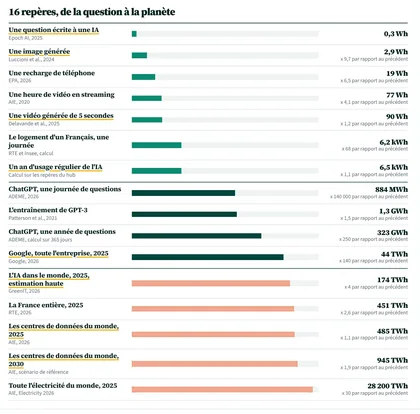
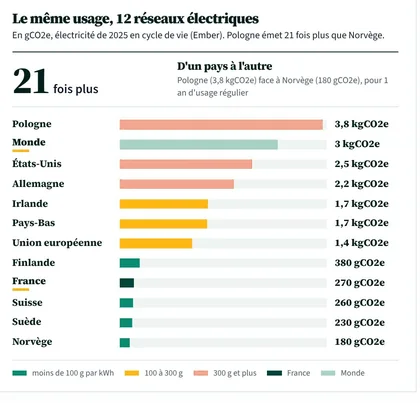
The hub takes 90 Wh for a 5-second video, naming the model. That is 300 written questions, 31 images, and 41 grams of CO2e with the world average electricity mix, the equivalent of about 290 metres in a petrol or diesel car. Over a year of use, one video a week weighs more than 10 questions a day.
Most downloaded open generator · 5.4 seconds in 720p · measured in September 2025
Electricity used by a generated 5-second video→A figure for a video means nothing without the model name, the duration and the resolution: depending on these 3 parameters, it varies from 1 to more than 3,000.
Sources
3 documents
- MIT Technology Review, We did the math on AI's energy footprint2025entry 24
- Delavande, Pierrard and Luccioni, Video Killed the Energy Budget2025entry 23
- Arcep, Intelligence artificielle et environnement (mesures du PEReN)2026entry 27
Every figure was read in its source; the hub's methodology is described in Methodology and sources.
AI Impact, Projet Celsius, "A generated video uses 1 kWh", 20 October 2026. https://projetcelsius.com/en/ai/analyses/video-equals-one-kilowatt-hour/