
 Uses20 October 2026
"A generated image is a phone charge"




The comparison did the rounds of the media in late 2023. It came from a serious study, but from its preliminary version, from the most power-hungry generator, and from a phone charge counted as 12 Wh.
Contents
Where the figure comes from
In November 2023, Sasha Luccioni, Yacine Jernite and Emma Strubell posted "Power Hungry Processing" online, the first systematic measurement of the electricity used by AI tasks: 88 open models, 10 tasks, 1,000 trials per task. In this first version, the most power-hungry image generator uses roughly as much as a smartphone charge, which the study then counts at 12 Wh. The press picks up the phrase and generalises it to all images.
What the published version says
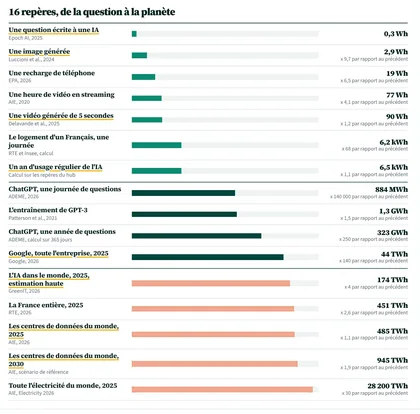
The version published in 2024 counts the charge at 22 Wh, the value used by the US Environmental Protection Agency at the time. The most power-hungry generator then amounts to half a charge, and the average across generators to 13%. The measurements themselves have not changed: 2.9 Wh on average per image, 1.35 Wh for the median generator, 11.5 Wh for the most power-hungry.
 Uses
Electricity by type of AI task
For 1,000 inferences, in kilowatt-hours, logarithmic scale · Measurements published in 2024
Source: Luccioni et al., Power Hungry Processing, 2024 · projetcelsius.com/en/ai · CC BY 4.0
Image generation is the most expensive task in the study, 60 times as much as text generation.
The comparison in 2026
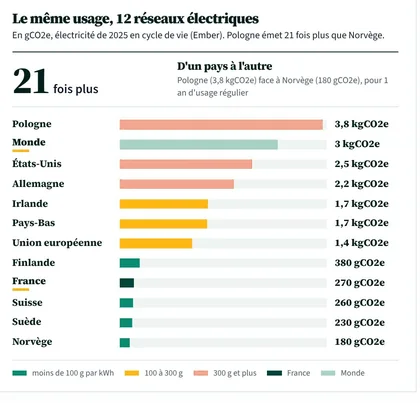
The US agency now counts a charge at 19 Wh. An average image represents 15% of that, and an image from the most power-hungry generator 60%. Compared with a written question (0.3 Wh), an image costs about 10 times more. With the world average electricity mix, that comes to 1.3 gram of CO2e, the equivalent of 9 metres in a petrol or diesel car.
Other measurements confirm the order of magnitude: MIT Technology Review measured 0.63 Wh for an image of 1,024 pixels a side with Stable Diffusion 3 Medium, and 1.22 Wh with twice the number of computation steps.
- the most power-hungry generator
- the preliminary version of the study
- a charge counted at 12 Wh
- 15% of a 19 Wh charge
- 10 times a written question
- 1.3 gram of CO2e with the world average electricity mix
What the figure does not say
No commercial generator, whether OpenAI's, Google's or Midjourney, publishes its consumption per image. All the available values come from open models measured by researchers. Image resolution and the number of computation steps make the energy vary by a factor of 1.3 to 4.7: the value for a given image can differ greatly from the average.
A phone charge is not a fixed standard: its official value went from 12 to 22 and then to 19 Wh in 2 years. For comparisons, it is better to give watt-hours.
Sources
3 documents
- Luccioni, Jernite and Strubell, Power Hungry Processing: Watts Driving the Cost of AI Deployment?2024entry 22
- EPA, Greenhouse Gas Equivalencies Calculator, calculations and references2026entry 59
- MIT Technology Review, We did the math on AI's energy footprint2025entry 24
Every figure was read in its source; the hub's methodology is described in Methodology and sources.
AI Impact, Projet Celsius, "A generated image is a phone charge", 20 October 2026. https://projetcelsius.com/en/ai/analyses/image-equals-phone-charge/

 Electricity