
 Climate13 November 2026
Can AI be decarbonised?
Levers ranked by what they remove




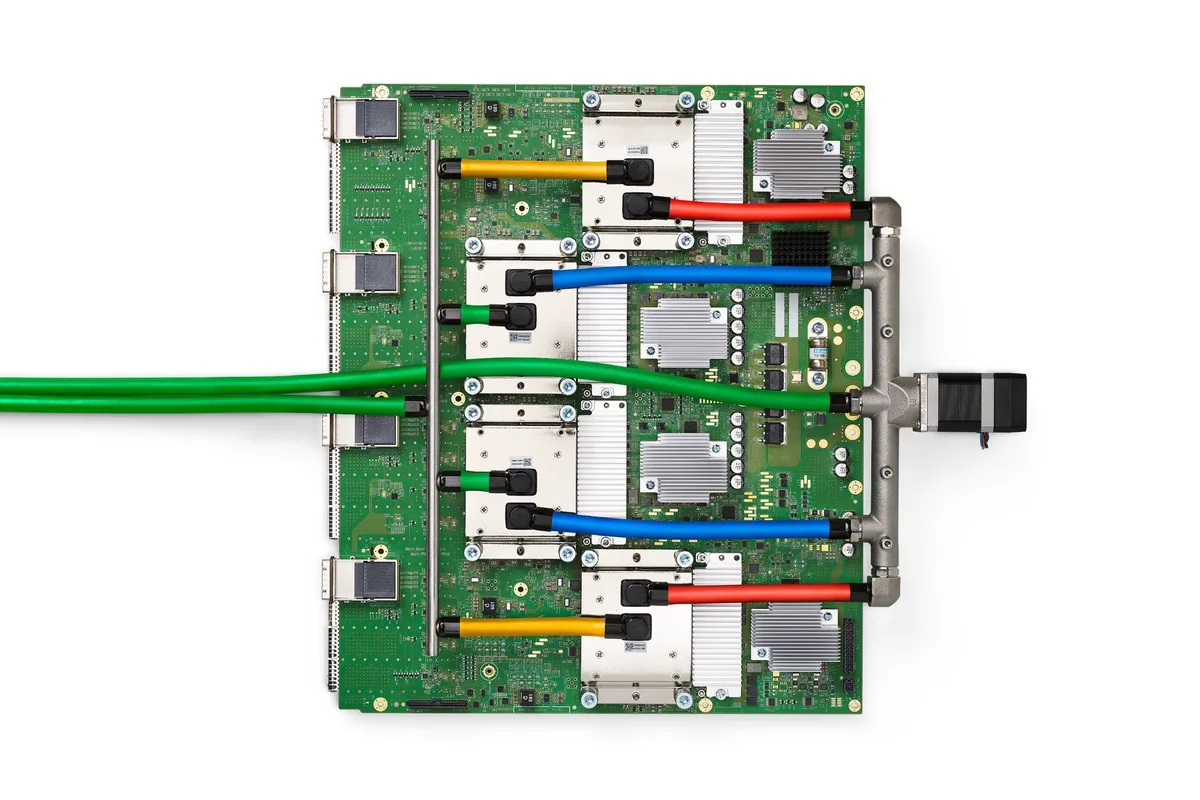
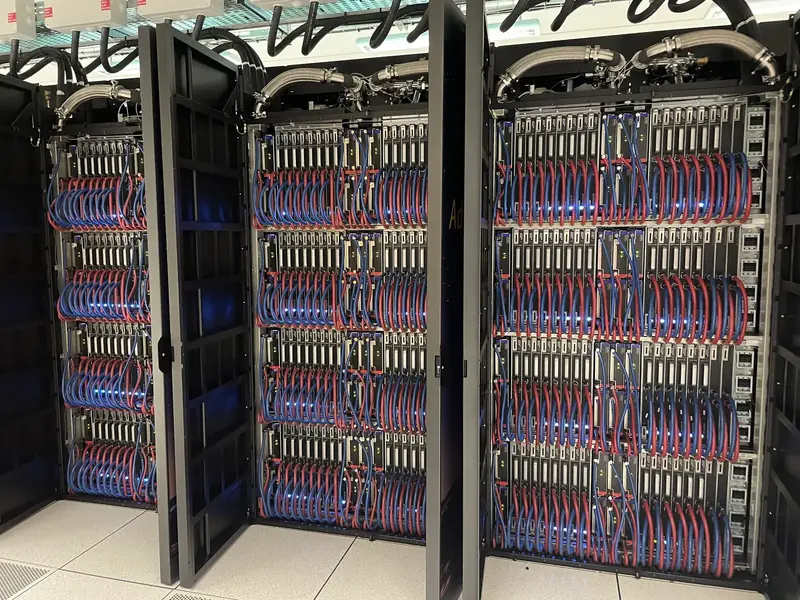
A Google TPU v4 board, an AI chip put into service in 2020, with its 4 liquid-cooled chips. Photo Jouppi et al. (Google), arXiv, CC BY 4.0, cropped, via Wikimedia Commons.
For an 2024 AI chip running on the average emission factor of Google's grid, 366 gCO2e per kWh, electricity like France's would cut the emissions of the same computation, manufacturing included, by a factor of nearly 5, and of nearly 7 with the smallest model sufficient for each task; switching to the European Union's average grid would remove only 38%. Model efficiency could remove more: Microsoft researchers consider a factor of 8 to 20 possible, without saying from what starting point, and Google cut the energy of the median Gemini query by a factor of 33 in one year. No lever brings AI down to zero, and these gains have not stopped the electricity consumption of data centres from rising.
Contents
Decarbonising AI can mean 2 things: removing emissions from each service it provides (an answer, an image, a trained model), or lowering its total emissions. The 2 can move in opposite directions. At Google, the energy of the median text query to the Gemini app fell by a factor of 33 between May 2024 and May 2025; the company's electricity demand rose by 37% in 2025.
We ranked the levers by what they remove from the emissions of the same service, starting from a single reference: a Google AI chip put into service in 2024, kept for 6 years, powered by the grid at the company's average factor, 366 gCO2e per kWh. Emissions include manufacturing and electricity, always location-based, excluding purchases of low-carbon electricity, which belong to a separate, market-based account. The levers do not add up.

On Google's grid, electricity accounts for 9 tenths of an AI chip's emissions
In February 2025, Google engineers published the life cycle assessment of 5 models of its AI chips, the TPUs, from raw material extraction to end of life, including the share from building data centres. It is a preprint based on the company's internal data, not peer-reviewed by other researchers, and, according to its authors, the first to publish the manufacturing emissions of an AI accelerator. For the same chip, it counts both manufacturing and electricity.
For the chip put into service in 2024, Trillium, the authors count, over 6 years, 692 kgCO2e for manufacturing, of which 109 for the buildings' share, and 5,759 kgCO2e for electricity, using Google's average location-based factor in 2023. Manufacturing makes up 10.7% of the total, electricity nearly 9 tenths.
The proportion depends on the grid. The open model BLOOM was trained in 2022 on a French supercomputer powered at 57 gCO2e per kWh. Hardware manufacturing accounts for 22% of the emissions there, with a manufacturing value for graphics cards that its authors gave as a lower bound.
The levers that reduce the amount of computation are measured in other studies. To convert them to the reference, we assume that the server fleet follows demand: less computation means less electricity and fewer machines to manufacture. Google makes the same choice for Gemini: it allocates manufacturing by machine hour, and its non-electricity emissions per query (scopes 1 and 3) fell by a factor of 36 in one year, in step with the number of machine hours per query.
The biggest gains come from models and serving software
Of the 33-fold reduction in the energy of a Gemini query, Google attributes a factor of 23 to its models and a factor of 1.4 to better use of its machines. The company links these gains to architectures that activate only part of the model, to quantisation and to distillation into smaller models such as Gemini Flash. This is a measurement, published by the company, of a service that changes from one year to the next.
Researchers at Microsoft estimate that recent progress in models, serving software and hardware could together reduce energy use by a factor of 8 to 20; the published summary does not say from what starting point. Applied to the reference, this factor would remove 88 to 95% of the emissions of the same service, if the fleet follows demand. Part of this gain may already be in place on a 2024 chip and at Google, which applies these techniques to Gemini. This lever overlaps with the choice of model and with chip efficiency, and their gains do not multiply.
These gains depend on model providers: Hugging Face found that 8 recent models out of 14 consume as much as or more than models of similar size evaluated in February 2025.
Chips have progressed more slowly. From 2020 to 2024, over 2 generations, Google's chips reduced the emissions of the same computation by a factor of 3, manufacturing included: from 1,043 to 354 gCO2e per billion billion operations, or from 788 to 354 g starting from the other 2020 chip. This gain is already banked: the reference chip benefits from it. For graphics cards designed for AI, Epoch AI noted in 2023 that computation per watt doubles every 3 years, based on the peak performance and rated power announced by manufacturers.
These gains did not prevent the rise. Google's electricity demand rose by 37% in 2025, with no published share for AI. The International Energy Agency projects that the world's data centres will go from 485 TWh in 2025 to 945 TWh in 2030. In its "high efficiency" case, which assumes more efficient models matched to their tasks, and more computation on devices, they would still consume 868 TWh, 8% less than in its base case.

 Electricity
Data centre electricity consumption in 2030, according to 3 studies
Electricity consumption of data centres in 2030, in TWh per year, projection published by each study · 2023 to 2030
Source: IEA, 2026; The Shift Project, 2025; GreenIT, 2026 · projetcelsius.com/en/ai · CC BY 4.0
Low-carbon electricity removes 8 tenths of the emissions
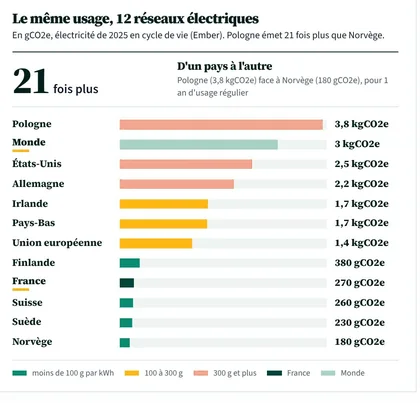
The second lever is the electricity of the grid that powers the servers. With electricity purchases unchanged, the reference chip connected to a grid like France's, 41 gCO2e per kWh according to the Ember data used by the hub's database, would emit about 650 kgCO2e over 6 years for its electricity instead of 5,759. Its total would go from 6,451 to 1,344 kgCO2e, which is 79% less. On the average European Union grid, 210 g, the gain would be 38%. On the world average, 458 g, emissions would increase by 23%. The hub's map shows every country.
This lever works through 2 channels. The first is the choice of site, by hosting companies, model providers and organisations that write a hosting region into their contracts. The second is the decarbonisation of the grid, which depends on governments and grid operators. In the United States, more than 2,000 GW of low-carbon electricity projects are waiting to be connected, according to Google's environmental report.
This lever has a limit at the scale of a country. Low-carbon electricity consumed by a data centre is no longer available for other uses, and the effect on the climate then depends on the generation added to meet this demand. This is one of the mechanisms described in our analysis of AI and the climate crisis.
Electricity contracts belong to a separate account
"100% renewable" electricity is counted differently, by deducting purchase contracts and certificates. For Google in 2023, the same electricity comes to 366 gCO2e per kWh location-based, 212 g when purchases count only if generated in the same hour on the same grid, and 135 g market-based, on the year's contracts. In 2025, Google purchased renewable electricity equivalent to 100% of its consumption over the year; about 65% of the consumption of its data centres and offices was covered hour by hour by low-carbon electricity, from the grid or from its contracts.
The model card for Llama 3.1 gives 11,390 tCO2e for its training location-based, and 0 market-based, on the company's contracts.
ClimateElectricity emissions, by contract or by grid
Emissions from purchased electricity (scope 2), 2 methods, in tCO2e, logarithmic scale · 2024 and 2025
Source: Meta, 2025; Google, 2026; Microsoft, 2026 · projetcelsius.com/en/ai · CC BY 4.0
Meta's scope 2 in 2024: 1,358 tCO2e market-based, nearly 6 million location-based.
In its hour-by-hour accounting, Google calculates that 90% low-carbon electricity on each grid, grid generation and matched contracts combined, would divide the emissions of its 2024 chip by 3.3. This is not the accounting used in the ranking, which is location-based.
A contract signed with a new power plant can add low-carbon generation to the grid; in the United States, delivery often comes 4 to 5 years after signing, according to Google. Current practice also allows certificates bought anywhere on a continent and at any time of the year to be deducted, a practice the Google authors describe as increasingly criticised. Neither contracts nor certificates make the electricity that servers draw from the grid each hour low-carbon; only generation added to that grid lowers its factor, for all its consumers. Our note on Meta's 1,358 tonnes and our analysis of diverging estimates set out the 2 accounts.
The smallest sufficient model removes more than a quarter of the emissions
The third lever is the choice of model among those that exist. The impact of an answer grows roughly in proportion to the size of the model that produces it, according to Mistral AI. A 2025 study estimates that choosing, for each task, the smallest model that does it well would reduce the electricity used by AI inference worldwide by 27.8%, or 31.9 TWh in 2025. The calculation is weighted by open model downloads, and answer quality does not drop on average.
If the fleet follows demand, this lever removes 28% of the reference's emissions; on a fleet already purchased, it acts only on electricity, removing 25%. It is in the hands of model providers, who choose the model served by default, of organisations, which can specify it in an AI use charter, and of users. Mistral AI also proposes that public buyers include model size and efficiency in their criteria.
Reasoning cannot be valued on the same basis. A model that reasons writes a draft before its answer, and reasoning models consume on average 30 times more energy than the others, according to Hugging Face measurements on open models. Microsoft researchers give an example: a modest share of long-reasoning requests, 10% for instance, can more than double total electricity use. No source measures the share of requests that go through reasoning without needing it, and this lever remains outside the ranking.
 Uses
Reasoning mode multiplies energy use
Energy with reasoning, relative to the same request without, as a multiple · Measurements from 2025 and 2026
Source: Arcep and PEReN, 2026; Hugging Face, 2025 · projetcelsius.com/en/ai · CC BY 4.0
A person's actions are quantified in our article on reducing the impact of AI, the choice of a service in the one on green AI.
On a low-carbon grid, manufacturing makes up half of what remains
On a grid like France's, the reference chip would emit only 1,344 kgCO2e over 6 years, of which 692 for its manufacturing, or 51%. The Google authors point out that reducing manufacturing emissions becomes more important as electricity decarbonises, and that it is harder, because action is needed across the whole supply chain.
The lever that acts on this share is hardware lifetime. Google spreads the manufacturing of its chips over 6 years. GreenIT uses 3 years for AI servers, because the practice is to scrap the whole unit rather than replace failed components, with graphics cards making up most of its cost. Keeping the chip 6 years rather than 3 removes 8% of the emissions of the same computation on the reference grid, and 30% on a grid like France's. Building construction stays outside this calculation, since a data centre serves several generations of machines.
On a low-carbon grid, lifetime therefore removes as much as the choice of the smallest model, 30% compared with 28%. On a fleet already purchased, it comes first, as the choice of model then removes only 13%. Keeping a chip 6 years rather than 5 removes only 2% on the reference grid, and 8% on a grid like France's.
Accounting lifetimes are moving in 2 directions. Alphabet extended the accounting lifetime of its servers from 4 to 6 years in 2023. Amazon shortened that of part of its servers and network equipment from 6 to 5 years in 2025, attributing the change to the faster pace of technology development, particularly in artificial intelligence and machine learning. These are accounting depreciation periods, not measurements of the actual life of the hardware.
These 2 levers work against each other. Keeping a chip longer means waiting for the next one, which is more efficient but more emissions-intensive to manufacture. On the reference grid, where electricity dominates, early replacement can come out ahead; on a low-carbon grid, each early replacement weighs more heavily.
On a low-carbon grid, manufacturing makes up half of an AI chip's emissions, and keeping hardware 6 years rather than 3 removes as much as the choice of the smallest model.
The strongest levers are decided by model providers and hosting companies, and in the grids
| Lever | Reference grid, 366 g | Grid like France's, 41 g | Who controls it |
|---|---|---|---|
| Efficiency of models and serving, potential of 8 to 20 times | 88 to 95% | 88 to 95% | Model providers (architecture, distillation, serving software) |
| Grid electricity, purchases unchanged | 79 % | already pulled | Hosting companies and model providers (choice of sites); governments and grid operators; buyers (hosting region in the contract) |
| Smallest sufficient model for each task | 28 % | 28 % | Model providers (default model); organisations and public buyers; users |
| Lifetime, 6 years rather than 3 | 8 % | 30 % | Hosting companies (renewal, component repair) |
| Reasoning reserved for requests that need it | not quantified | not quantified | Model providers (default settings); organisations; users |
Share removed from the emissions of the same service relative to the reference: a Google AI chip from 2024, kept for 6 years, manufacturing included, location-based electricity, excluding purchases of low-carbon electricity. Model efficiency and the choice of model both assume that the server fleet follows demand, and they overlap. Lifetime is measured from the same chip kept for 3 years. The levers do not add up. Hub calculation based on Schneider et al. (Google, 2025), Oviedo et al. (Microsoft, 2026), Barros et al. (2025) and GreenIT (2026).
The user controls 2 levers: the choice of model and the use of reasoning. Governments control low-carbon electricity generation, grid connections and the reporting rules they do or do not impose on data centres and model providers.
From a 2024 chip, low-carbon electricity and the smallest sufficient model would divide emissions by nearly 7
Combined, the effects of independent levers multiply. From the reference chip, electricity like France's would divide the emissions of the same service by 4.8, and the smallest sufficient model by 1.4: together, they would divide them by nearly 7, in our calculation. Model efficiency could remove much more if Microsoft's estimates come true, but it overlaps with the choice of model and does not multiply with it.
No lever brings emissions down to zero. On a grid like France's, the reference chip still emits 1,344 kgCO2e over its life, of which 692 for its manufacturing. None of these levers touches what AI makes possible either, which could weigh more according to our analysis of AI and the climate crisis.
At Projet Celsius, we believe an AI cannot call itself carbon neutral. Neutrality is a global balance between emissions and removals, as explained in our article on carbon neutrality ; chip manufacturing and the fossil share of grids remain, and an electricity contract lowers location-based emissions only if it adds low-carbon generation to that grid. Decarbonising AI remains possible service by service. The useful questions to ask a supplier concern the model and the reasoning mode served by default, the electricity of the grid that powers its servers and the lifetime of its hardware.
The ranking's reference is the life cycle assessment of Google's chips, a preprint by company authors based on internal data. Model efficiency and the choice of model come from estimates, converted to this reference using one assumption: the server fleet follows demand. The reference grid is counted with the factor published by Google, the French grid with Ember data; using only the ratio between the US and French grids in Ember data, the electricity lever is worth 80% instead of 79%. The ranking's percentages and the 7 factor are our calculation.
Sources
15 documents
- Schneider, Xu, Benecke, Patterson et al. (Google), Life-Cycle Emissions of AI Hardware: A Cradle-To-Grave Approach and Generational Trends, arXiv preprint2025entry 195
- Elsworth et al. (Google), Measuring the environmental impact of delivering AI at Google scale2025entry 14
- Luccioni, Viguier and Ligozat, Estimating the Carbon Footprint of BLOOM, a 176B Parameter Language Model, arXiv preprint of November 2022, published in the Journal of Machine Learning Research in 20232022entry 196
- Google, 2026 Environmental Report2026entry 13
- Oviedo, Kazhamiaka, Choukse et al. (Microsoft), Energy use of AI inference, efficiency pathways, and test-time scaling, Joule2026entry 197
- Hugging Face, AI Energy Score v22025entry 26
- Hobbhahn, Heim and Aydos, Trends in Machine Learning Hardware, Epoch AI2023entry 198
- IEA, Key Questions on Energy and AI2026entry 2
- Our World in Data, based on Ember, Lifecycle carbon intensity of electricity2026entry 34
- Meta, model card for Llama 3.12024entry 46
- Barros et al., Small is Sufficient: Reducing the World AI Energy Consumption Through Model Selection2025entry 29
- Mistral AI, with Carbone 4 and ADEME, Our contribution to a global environmental standard for AI2025entry 17
- GreenIT, Impacts environnementaux et sanitaires de l'intelligence artificielle dans le monde en 2025 et 20302026entry 6
- Alphabet, fourth quarter 2023 results, appendix 99.1, change in the useful life of servers2024entry 199
- Amazon, 10-K annual report for fiscal year 2025, note 1 (Use of Estimates)2026entry 200
Every figure was read in its source; the hub's methodology is described in Methodology and sources.
AI Impact, Projet Celsius, "Can AI be decarbonised?", 13 November 2026. https://projetcelsius.com/en/ai/analyses/can-ai-be-decarbonised/