

Google and Microsoft emissions
Declared greenhouse gas emissions, index 100 the base year
Google and Microsoft emissions
Sources
Source: Google and Microsoft, 2026 reports, published years. projetcelsius.com/en/ai · CC BY 4.0
The analysis
- Both 2 companies aim for carbon neutrality or negative emissions by 2030; their emissions have increased by 58 to 81%.
- Microsoft attributes its 25% increase in one year to the expansion of its data centres and to the end of some renewable electricity certificates.
The figures
- Each curve starts at 100 in the base year chosen by the company: 2019 for Google, fiscal year 2020 for Microsoft.
- Google: +81 % from 2019 to 2025.
- Microsoft: +58 % from 2020 to 2025.
Assumptions
- Emissions declared by the companies, scopes 1, 2 and 3, according to their own rules.
- The series were recalculated in the 2026 editions: Google's 2025 edition gave +51% since 2019 on a different basis.
- These totals rely on the so-called "market-based" method; based on the actual electricity grid, they would be much higher.
- The increase does not come from AI alone: data centre construction, hardware, cloud growth.
More on climate
The whole Climate topic →Charts and maps
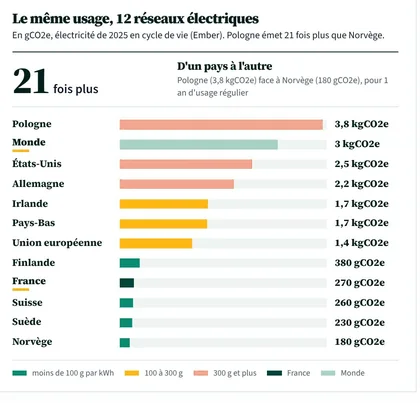
Chart ClimateElectricity emissions, by contract or by grid1 to 4,400the same scope 2 at Meta, depending on the methodChartClimateOne question, 4 ways of counting CO2eover90timesgap between the lowest and the highestChartClimateServer electricity, country by country14times as muchin Poland than in France, for the same calculationChartClimateAI emissions, compared99MtCO2eAI in 2025, as much as Belgium
Analyses
 AnalysisClimate12 November 2026Why do estimates of AI's impact differ?Calculated with French electricity, one question to an AI emits 0.012 gram of CO2e; Mistral AI publishes 1.14 gram, more than 90 times as much. Its water use ranges from 0.26 to 45 millilitres depending on the published measurements. These figures are accurate; they do not cover the same scope.
 Where does this figure come from?Climate20 October 2026"Meta's electricity emits only 1,358 tonnes of CO2e"In 2024, Meta reports 1,358 tonnes of CO2e for the electricity it buys, the annual footprint of 170 people in France. The same report also gives 5.97 million tonnes. Both of the 2 figures are accurate.
Tools
On the Projet Celsius blog ↗


 Water
Across the hub
 AI Impact DatabaseAll the figures, their methodology and their sources.
 AI Ranking10 assistants rated out of 100: performance, ethics and environment.


 AnalysesThe signed pieces: analyses, viewpoints, "Where does this figure come from?".
 Charts and mapsYou are hereThe reference visuals, with their data and sources.
 ToolsOpen calculations, your assumptions on the left, the result on the right.




A question about a figure?
An error, a source to add, a methodology question, a press request: write to us. Guillaume Pakula, Clément Reynaud, Sébastien Pierfederici and Alexandre Veilly will reply.
Write to us →
Projet Celsius, which runs this hub, also helps companies measure and reduce the footprint of their AI use.
Accounting for AI in your Bilan Carbone® ↗