
 Climate20 October 2026
"Meta's electricity emits only 1,358 tonnes of CO2e"





In 2024, Meta reports 1,358 tonnes of CO2e for the electricity it buys, the annual footprint of 170 people in France. The same report also gives 5.97 million tonnes. Both of the 2 figures are accurate.
Contents
2 methods, 2 figures
Since 2015, the GHG Protocol has asked companies to publish the emissions of their purchased electricity, the Scope 2, in 2 ways. With the location-basedmethod, emissions are calculated with the average carbon intensity of the grid where the electricity is consumed. With the market-basedmethod, they are calculated with the intensity of the contracts purchased: power purchase agreements with wind or solar farms, renewable origin certificates. A company that covers all its consumption with contracts can report Scope 2 emissions close to zero.
The same gap at Google and Microsoft
For 2025, Google reports Scope 2 emissions of 2.8 million tonnes with its contracts and 15.1 million with the grid. Microsoft reports 2.7 and 12 million for its 2025 financial year. At Microsoft, the market-based figure was multiplied by 10 in a year: the company stopped buying so-called "non-additional" renewable certificates, which finance no new installation.
 Climate
Electricity emissions, by contract or by grid
Emissions from purchased electricity (scope 2), 2 methods, in tCO2e, logarithmic scale · 2024 and 2025
Source: Meta, 2025; Google, 2026; Microsoft, 2026 · projetcelsius.com/en/ai · CC BY 4.0
Which one to use
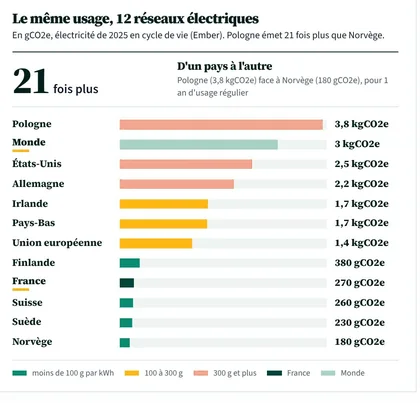
Contracts that finance new installations genuinely reduce the emissions of an electricity system; certificates bought from existing installations make no difference to the power stations already running. To understand what data centres are doing to the climate today, the grid figure is the closest to the physics. That is the hub's choice: its calculations use grid intensity, 458 gCO2e/kWh as a world average (Ember, life cycle).
World · 2025 · life cycle · Ember
Carbon intensity of world electricity→Consequences for a company
A company that buys AI services counts them in its Scope 3, using its provider's figures. If the provider reports only its market-based figure, the emissions of these uses are underestimated by a factor of 4 to several thousand. In a Bilan Carbone®, both 2 figures must be requested, and the one used must be stated.
The GHG Protocol is revising its Scope 2 method; the rules on certificates could tighten in the coming years.
Sources
6 documents
- Meta, 2025 Environmental Data Index2025entry 16
- Google, 2026 Environmental Report2026entry 13
- Microsoft, 2026 Environmental Sustainability Report, Data Fact Sheet2026entry 15
- GHG Protocol, Scope 2 Guidance2015entry 58
- IEA, Electricity 20262026entry 3
- SDES and Insee, L'empreinte carbone de la France de 1990 à 20252026entry 52
Every figure was read in its source; the hub's methodology is described in Methodology and sources.
AI Impact, Projet Celsius, "Meta's electricity emits only 1,358 tonnes of CO2e", 20 October 2026. https://projetcelsius.com/en/ai/analyses/meta-1358-tonnes/