 Society14 November 2026
How can you tell whether a text was written by an AI?
Overrepresented words, phrasing specific to each assistant, and error rates of automatic detectors

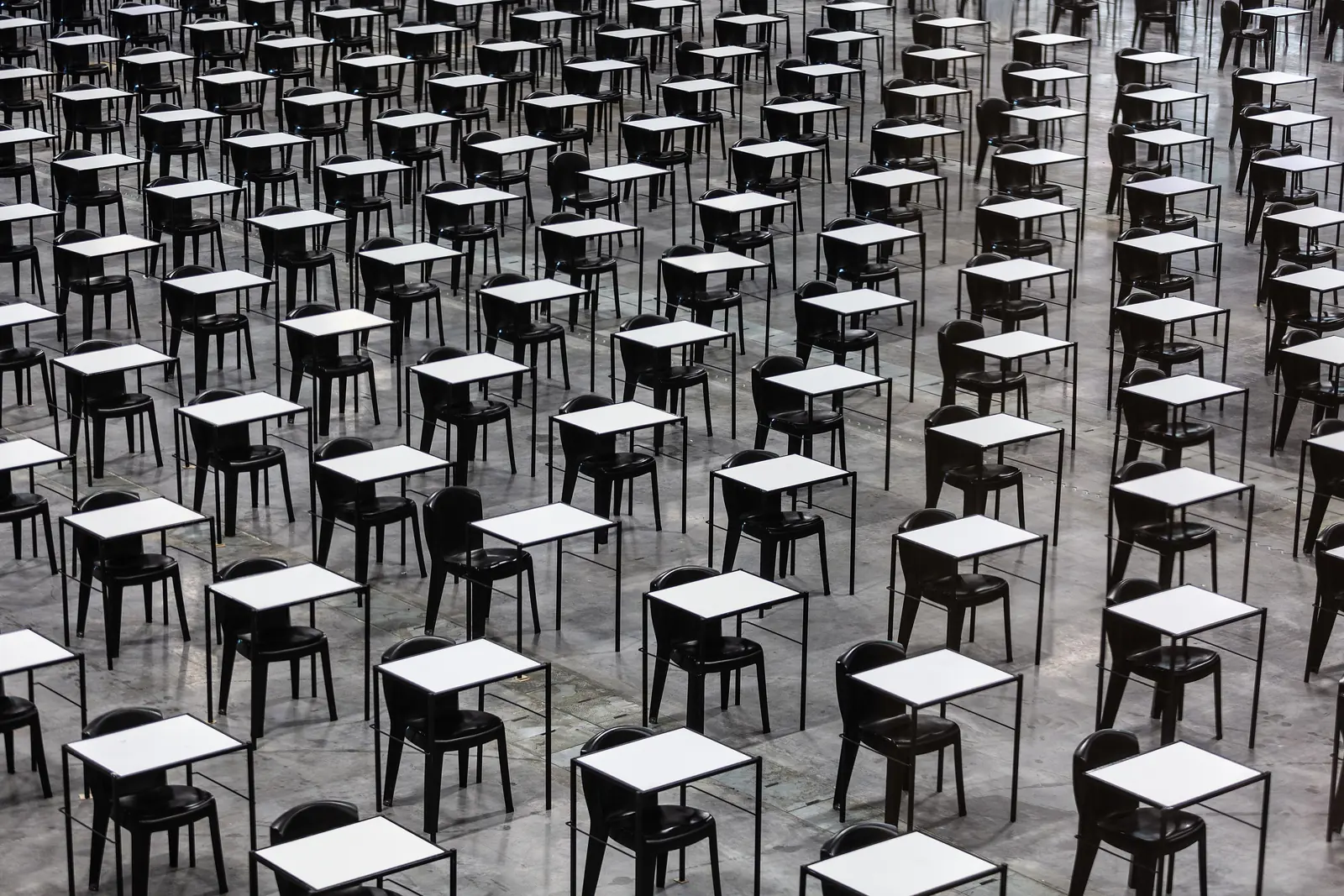
Desks set up for the written exams of a competitive entrance exam, in France, in June 2020. Photo Jérémy Barande, École polytechnique, CC BY-SA 2.0, via Wikimedia Commons.
Texts written with an AI carry marks: certain words, such as "delves" in English, became up to 28 times more frequent than expected in biomedical article abstracts in 2024, and each assistant has its own turns of phrase, to the point that a classifier identifies the author among 5 assistants in 97% of cases. This ranking is made between known assistants, on texts that were all written by an AI. Saying whether an individual text comes from a human or an AI is a different question, and automatic detectors get it wrong: in a 2023 study, 7 detectors wrongly classed, on average, 61% of English essays by non-native speakers as written by an AI, against 5% of those by US students.
Contents
Teachers, publishers and recruiters increasingly ask whether a text was written with an AI. There are 2 ways to answer: read the marks that models leave in their texts, or hand the text to an automatic detector. This explanation concerns texts; images call for other methods. The studies cited concern English: we have not found an equivalent survey for French.
Overrepresented words and phrases
Kobak and his co-authors counted the words in 15 million abstracts of biomedical articles published from 2010 to 2024 in the PubMed database. After the arrival of ChatGPT, at the end of 2022, some words became far more frequent than their trend would have led one to expect: in 2024, "delves" is 28 times more, "underscores" 13.8 times and "showcasing" 10.7 times. From this excess, the authors estimate that at least 13.5% of the abstracts of 2024 went through a language model, for writing or proofreading, and up to 40% in some subsets of journals or countries.
The contributors to English-language Wikipedia keep a list of the marks they meet in edits made with an AI. It cites words ("delve", "pivotal", "tapestry", "testament", "underscore"), the replacement of "is" by "serves as", parallelisms of the "not X, but Y" type, the repeated use of lists of 3 items, section titles with a capital on every word, and a final section on the "challenges" of the subject, always built on the same pattern. The list specifies that an isolated word proves nothing: it is the accumulation of these marks, in an edit made after 2022, that counts.
Phrasing specific to each assistant
Assistants do not all leave the same marks. Sun and his co-authors trained a classifier on answers from 5 assistants, ChatGPT, Claude, Grok, Gemini and DeepSeek: it identifies the original assistant in 97.1 % of cases, where chance would give 20%. The marks lie in vocabulary and construction more than in form: after a paraphrase by another model, the classifier is still right in 91.4% of cases, and in 91.8% after translation into Chinese. It falls to 58.1% when the text is summarised.
| Model | Overrepresented phrasing (in English) |
|---|---|
| ChatGPT | "such as", "certainly", "overall" |
| Claude | "here", "according to", "based on" |
| Llama | "including", "such as" |
| Gemma | "let me", "know if" |
Sun et al., 2025: ChatGPT and Claude among the 5 assistants (section 3.1), Llama and Gemma among the open models (appendix B.3).
Automatic detectors
A detector returns a score for a single text, which is harder than counting frequencies over millions. In 2023, Liang and his co-authors submitted to 7 widely used detectors texts written by humans: 91 TOEFL essays, the English exam for non-native speakers, collected from a Chinese forum, and 88 essays by US 8th-grade students, the equivalent of year 9. The detectors wrongly classed 61 % of the TOEFL essays as written by an AI, on average, against 5% of the US essays. 18 of the 91 TOEFL essays were flagged by all 7 detectors, and 89 by at least one. The authors explain this by simpler and more predictable vocabulary: after the vocabulary of these essays was enriched, the error rate falls to 12%.
Turnitin, publisher of a detector aimed at education, announced in June 2023 a false positive rate below 1% at document level, for documents containing at least 20% AI text, and, at sentence level, a probability of about 4% that a flagged sentence was in fact written by a human; 54% of the sentences wrongly flagged are next to a passage genuinely written by an AI. These rates are the publisher's, with no published external verification.
Our reading
For us, at Projet Celsius, the marks of AI texts are real and measurable, but they are measured on corpora or between known assistants. A word or a phrase proves nothing about an individual text, because humans use them too, and those who write most simply are the most often wrongly accused. A detector score is not enough, on its own, to justify a sanction.
The studies cited concern texts in English. The detectors tested by Liang et al. are those of 2023 and may have changed since; the Turnitin rates are the publisher's. The ranking by Sun et al. concerns chatbot answers under study conditions, not texts edited by their authors.
Sources
5 documents
- Kobak, González-Márquez, Horvát and Lause, Delving into LLM-assisted writing in biomedical publications through excess vocabulary, Science Advances, 2025 (arXiv version 2406.07016)2025entry 491
- English-language Wikipedia, Wikipedia:Signs of AI writing, project page, accessed on 14 November 20262026entry 495
- Sun, Yin, Xu, Kolter and Liu, Idiosyncrasies in Large Language Models, arXiv 2502.121502025entry 492
- Liang, Yuksekgonul, Mao, Wu and Zou, GPT detectors are biased against non-native English writers, Patterns, 2023 (arXiv version 2304.02819)2023entry 493
- Turnitin, Understanding the false positive rate for sentences of our AI writing detection capability, 14 June 20232023entry 494
Every figure was read in its source; the hub's methodology is described in Methodology and sources.
AI Impact, Projet Celsius, "How can you tell a text was written by an AI?", 14 November 2026. https://projetcelsius.com/en/ai/analyses/how-to-spot-ai-written-text/