
 Society14 November 2026
Does AI steal from authors?
Copying for training, memorisation in the model, reproduction in answers: position of the European courts and authors' means of proof




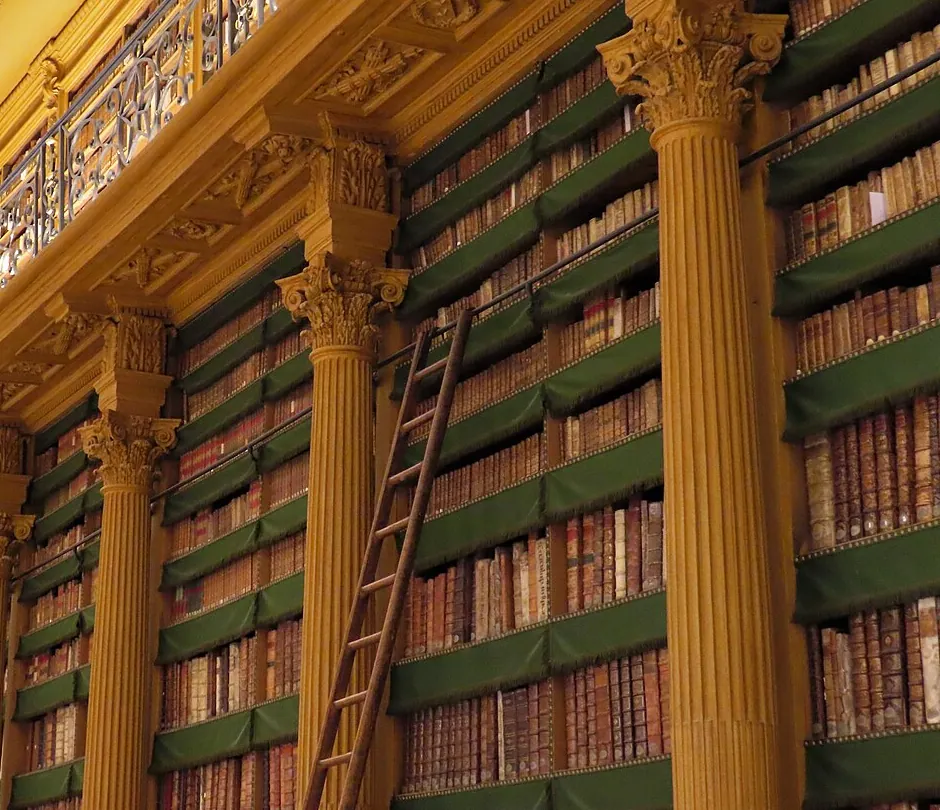
The shelves of the Mazarine Library in Paris, in 2025. Photo Rémih, CC BY-SA 4.0, cropped, via Wikimedia Commons.
European law distinguishes 3 acts. Copying a lawfully accessible work in order to train a model is permitted, unless the author has expressly opposed it, which for online content is done in particular by a machine-readable method. Keeping the work in the model's memory, then reproducing it in an answer, is a prohibited reproduction according to the Munich court, which ruled against OpenAI in November 2025 over song lyrics. The law therefore protects authors against copying that can be seen. It leaves them with no way of knowing whether their work was used for training: the summary that the European AI regulation requires providers to publish describes the main sources, not the works. We support a presumption of use, like the one the Senate voted for in April 2026, to which the provider can respond by showing its data.
Contents
"Theft" is not a copyright term. The law asks who reproduced a work, when, and whether an exception allowed it. For an AI model, it distinguishes 3 actions: copying the work to train, keeping it in memory in its parameters, reproducing it in an answer. European courts do not give the same answer to each.
Position of the courts on the 3 actions
| Action | Rule or decision | Answer | Status |
|---|---|---|---|
| Copying the work to train | Directive of 2019, Article 4; Hanseatic Higher Regional Court (Hamburg), Kneschke v LAION, 10 December 2025 | Permitted unless the author has expressly reserved the right; for online content, by machine-readable means | Appeal to the Federal Court of Justice allowed |
| Copying the work to train | Regional Court of Munich I, GEMA v OpenAI, 11 November 2025 | The text and data mining exception covers the copies made to build the training corpus, not reproduction in the model | Not final |
| Keeping the work in memory | Regional Court of Munich I, GEMA v OpenAI, 11 November 2025 | Unauthorised reproduction, in the model's parameters | Not final |
| Keeping the work in memory | High Court in London, Getty Images v Stability AI, 4 November 2025 | The model does not store the images: it is not a copy of them | Appeal allowed |
| Reproducing the work in an answer | Regional Court of Munich I, GEMA v OpenAI, 11 November 2025 | Unauthorised reproduction and making available; OpenAI liable, not the user | Not final |
First-instance or appeal decisions, none final as of 14 November 2026. The opinion of the Advocate General of the Court of Justice of the European Union of 3 November 2026 (Like Company v Google) does not bind the Court and concerns the rights of press publishers.
Copying to train. The 2019 European directive allows lawfully accessible works to be reproduced "for the purposes of text and data mining", provided that the author has not "expressly reserved" their use "in an appropriate manner, such as machine-readable means in the case of content made publicly available online". In December 2025, the Hanseatic Higher Regional Court (Hamburg) held lawful the copying of a photograph by the association LAION, which builds datasets used to train image models: the reservation displayed on the website of the agency distributing the photograph did not have the machine-readable form required by German law. The court also allowed the copying under the scientific research exception; the case concerns the building of a dataset, not the training of a model by a company. The Regional Court of Munich I accepts, for its part, that the text and data mining exception covers the copies made to build a training corpus. The Advocate General of the Court of Justice of the European Union suggested on 3 November 2026 that the training of a language model should, as a general rule, be covered by this exception, while judging the question hypothetical in the case before him.
Keeping in memory. A model can learn a text well enough to reproduce it. Researchers at Stanford and Cornell showed that Llama 3.1 70B, an open-weight model from Meta, allows long passages to be extracted from some books, including nearly all of the first Harry Potter and of 1984, while most of the books tested are not memorised. The Regional Court of Munich I drew a legal consequence: if a model reproduces song lyrics identically, they are reproduced in its parameters, and this reproduction is not covered by the text and data mining exception. The High Court in London ruled the opposite for an image model: Stable Diffusion "does not store" Getty's images and is therefore not an infringing copy of them. The 2 cases concern neither the same works nor the same right.
Reproducing. This is the action on which the position is clearest. In Munich, OpenAI is held liable for the lyrics of 9 songs that ChatGPT reproduced, and the court holds the provider responsible, not the user who asked the question. The European code of practice for general-purpose models, of July 2025, asks signatories for technical safeguards against such reproduction.
Authors' means of proof
To take action, an author must first show that their work was used. Reproduction can be observed: you ask the question and compare the text. Use for training does not show in the answers when the model has not memorised the work, which is the most frequent case. Only the provider knows what it copied.
The EU AI Act, applicable to general-purpose models since 2 August 2025, asks their providers for a copyright compliance policy and "a sufficiently detailed summary" of the training content. The summary template published by the Commission in July 2025 asks for the main data collections to be listed and for other sources to be explained: it does not ask for the list of works. The code of practice commits signatories to receiving complaints from rightsholders that are "sufficiently precise and adequately substantiated", which assumes that the author already has the means to substantiate them.
On 8 April 2026, the Senate voted unanimously for a bill that creates a presumption of use of works by an AI system when an indication makes it plausible: a technical expert report, reproduction of extracts, an output "in the style of" the author. This is a rebuttable presumption: the provider can prove the contrary. In the National Assembly, the cultural affairs committee adopted it on 2 June 2026; its examination in plenary did not finish on 11 June, and it is scheduled for 19 November 2026.
Providers' objection
The most serious objection comes from providers. The co-founder of Mistral AI, Arthur Mensch, called on 9 November 2026 on parliamentarians not to adopt the text: in his view, a presumption "triggered by a simple indication" reverses the burden of proof and would force a provider to expose its trade secrets, with a risk specific to France that its competitors trained elsewhere do not bear. We do not accept this. The presumption applies only before a judge, on an indication, for a specific work: the provider does not have to prove that it used nothing, but to show what its data contain for that work, when it alone is able to do so. It creates no new obligation to pay. And the EU AI Act already asks every provider of a general-purpose model, wherever it trains, for a policy of respect for authors' reservations and a public summary of its data.
Our position
For us at Projet Celsius, AI does not steal from authors in the sense in which the law understands it as long as it copies to learn a work that its author has not reserved; it harms them when it reproduces it, and the courts that have ruled on this point have said so. The problem is proof. European law lets the author make a reservation whose observance they cannot verify, and asks providers for a summary of their sources that does not make it possible to know whether a specific work was used. A rebuttable presumption of use, on the basis of an indication, like the one the Senate voted, rebalances this situation without prohibiting training. At European level, the same logic would require the summary provided for by the regulation to let an author find out, on request, whether their work is in a model's data.
Copyright falls outside the usual scope of this hub, which is devoted to the impact of AI. We find here a difficulty already met for electricity and water: providers alone hold the data that would make it possible to judge what they do, as we write in our viewpoint on ChatGPT's consumption.
No decision cited is final as of 14 November 2026. The European texts are cited from the text of the Official Journal, read on a copy, as EUR-Lex could not be opened; the Munich judgment from the GEMA press release and the legal journal LTO, its full text not having been read. The American decisions (Bartz v Anthropic, Kadrey v Meta), whose orders could not be opened, are not covered; the agreement between Anthropic and authors is presented in our blog article on the AI boycott.
Sources
12 documents
- Directive (EU) 2019/790 of 17 April 2019 on copyright and related rights in the Digital Single Market, Article 4 (reproduction on legislation.gov.uk)2019entry 560
- Regulation (EU) 2024/1689 on artificial intelligence, Article 53, obligations of providers of general-purpose AI models, unofficial consolidated text2026entry 284
- European Commission, Explanatory Notice and Template for the Public Summary of Training Content for general-purpose AI models2025entry 561
- European Commission, General-Purpose AI Code of Practice, Copyright chapter2025entry 562
- Hanseatisches Oberlandesgericht, KI und Urheberrecht : Berufung zurückgewiesen (5 U 104/24), press release2025entry 563
- Legal Tribune Online, LG München I : GEMA gegen OpenAI (42 O 14139/24)2025entry 564
- GEMA, Landmark ruling : GEMA against OpenAI2025entry 565
- High Court of Justice, Getty Images v Stability AI, [2025] EWHC 2863 (Ch)2025entry 566
- Court of Justice of the European Union, press release No 155/26, opinion of the Advocate General in Case C-250/25, Like Company v Google Ireland2026entry 567
- Cooper, Gokaslan, Ahmed et al., Extracting memorized pieces of (copyrighted) books from open-weight language models, arXiv 2505.125462025entry 568
- Livres Hebdo, Contenus culturels et IA : le long chemin d'une loi2026entry 569
- Livres Hebdo, IA et droit d'auteur : Arthur Mensch et Laure Darcos s'affrontent sur la régulation2026entry 570
Every figure was read in its source; the hub's methodology is described in Methodology and sources.
AI Impact, Projet Celsius, "Does AI steal from authors?", 14 November 2026. https://projetcelsius.com/en/ai/analyses/does-ai-steal-from-authors/