
 Electricity13 November 2026
Do we really know how much electricity ChatGPT uses?
What the providers of the major assistants publish, and what is missing




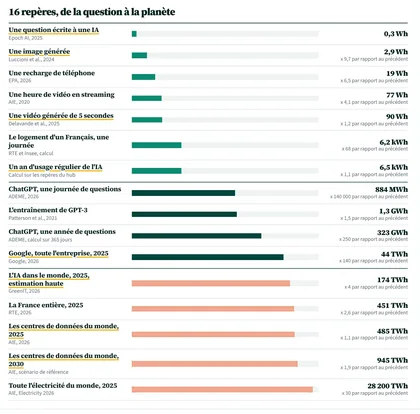
For a short written question to an assistant, the order of magnitude is known for 2025: about 0.3 Wh, based on a Google measurement on Gemini, an Epoch AI estimate for GPT-4o and a statement by OpenAI. OpenAI has published only one value, in a post by its chief executive in June 2025, with no method, and none for the GPT-5 models that have powered ChatGPT since August 2025. Of 8 major assistants, 2 providers publish a per-request value with their method; we found for none of them the total electricity of its service, nor that of images, videos and agents. We ask that every published figure say what it counts.
Contents
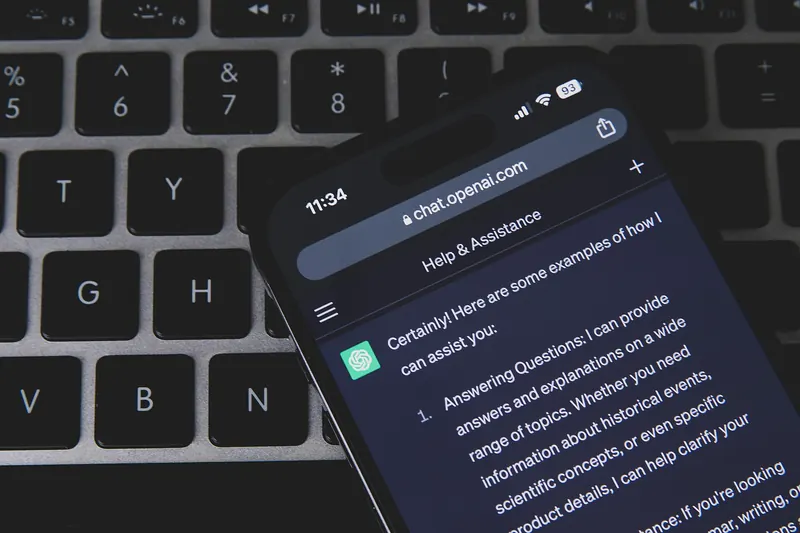
In June 2025, Sam Altman, the head of OpenAI, writes in a blog post that an average request to ChatGPT consumes "about 0.34 watt-hour", and about 0.3 mL of water. The post says neither what is counted, nor on which models, nor how. It is, to date, the only value given by OpenAI or its head; its training page on the environment, updated in June 2026, refers to the Epoch AI estimate, about 0.3 Wh, and states that its own measurements are not yet published.
For a short written question, the order of magnitude of 2025 is nevertheless known. The Google measurement on Gemini, the Epoch AI estimate for GPT-4o and the OpenAI statement converge around 0.3 Wh, the value used by the AI Impact Database, and detailed by our article on the consumption of a request. Since August 2025, ChatGPT has run on the GPT-5 family, for which OpenAI has published no value; an independent estimate gives 2.33 Wh for a request of average length to GPT-5 at minimal reasoning effort. This order of magnitude also says nothing about the total consumption of an assistant or that of heavier uses.
2 providers out of 8 publish a value with their method
For 8 major assistants (ChatGPT, Gemini, Copilot, Meta AI, Claude, Grok, DeepSeek and Vibe, formerly Le Chat), we looked for what their publisher has itself published on the electricity, water or carbon of a request, up to 13 November 2026.
| Assistant | Value published by the publisher | Published method | Date |
|---|---|---|---|
| Gemini (Google) | 0.24 Wh, 0.03 gCO2e and 0.26 mL for the median text request | Yes: detailed article, scope and formulas | August 2025, measurement from May 2025 |
| Vibe, formerly Le Chat (Mistral AI) | 1.14 gCO2e and 45 mL for a response of 400 tokens, over the life cycle | Yes: summary of the life cycle assessment, carried out with Carbone 4 and ADEME, reviewed by Resilio and Hubblo | July 2025 |
| ChatGPT (OpenAI) | 0.34 Wh for an average query | No | June 2025 |
| Copilot (Microsoft) | No value for Copilot; 0.16 to 0.60 Wh for a typical query to some of the largest language models | Study by Microsoft researchers published in Joule, which we have not read | June 2026 |
| Claude (Anthropic), Meta AI, Grok (xAI), DeepSeek | No value found | - | - |
Projet Celsius search of publishers' publications, as of 13 November 2026. A value may exist in a report we have not found.
The 2 values published with a method cannot be compared with one another. Google counts the electricity of the median request and emissions calculated with its renewable electricity contracts; Mistral AI counts the life cycle of a response of 400 tokens, including the manufacture of the servers. Our analysis of diverging estimates sets out these differences in scope.
This finding matches that of a team led by Sasha Luccioni of Hugging Face. On OpenRouter, a platform that gives access to many models through an API, 84% of the tokens processed in May 2025 by the 20 most-used models went through models with no published environmental information. For notable AI models, the team observes that such disclosures, which peaked in 2022, declined with the commercial models launched after ChatGPT. The 2 values published with a method date from 2025 and have not been updated for current models.
The total, the heavy uses and the location of the servers are not published
To go from a value per question to the consumption of an assistant, it would have to be multiplied by a number of requests that publishers sometimes announce, and by a mix of uses that they do not publish. We found, for none of the 8 publishers, the total electricity of its assistant.
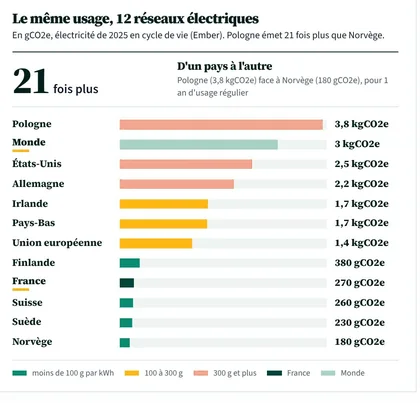
The uses that weigh the most have no value published by their publisher: image and video generation, reasoning mode, agents. Yet these are what make a year of use range from a few hundred grams to more than 100 kgCO2e. Finally, for a consumer user, we found none of the 8 assistants that states in which country its request is processed. Yet the country of the servers changes the CO2e of the same electricity by a factor of about 21, according to the AI Impact Database.
European law requires the energy of models to be documented, not published
Since 2 August 2025, the EU AI Act requires providers of general-purpose AI models to keep technical documentation that includes the known or estimated energy consumption of the model, in the part devoted to its development, and so to its training rather than its use. Models placed on the market before that date have until 2 August 2027. This documentation is handed over on request to the Commission's AI Office and to national authorities; it is not published. The code of practice of July 2025, which publishers sign voluntarily, merely encourages them to consider what they could make public.
In France, ADEME notes in its July 2026 opinion that the lack of transparency of the main players makes it harder to measure impacts. It calls for reliable and comparable figures, a multi-criteria life cycle assessment, and emissions calculated with the grid electricity where the servers are connected, rather than with power purchase agreements.
The commercial secrecy objection
The strongest objection is commercial secrecy. Publishing the electricity of a request, the number of requests and the location of the servers would give competitors the size of its models, its efficiency and its customer base, in a market where this information is valuable. The figures also change very fast: Google announces a 33-fold drop in the energy of the median Gemini request in one year, from May 2024 to May 2025.
It does not convince us, for 3 reasons. Google has published its method without publishing its volumes, and OpenAI already announces its own: 2.6 billion requests per day in July 2025, a figure that ADEME repeats. Publishing a method or a total therefore gives away no secret that these companies do not already give away. The speed of change argues for dated figures reviewed every year, rather than for no figures. And the AI Office can already request the energy of models: the question is what the public can see of it.
Our requests to providers
For a consumption figure to be verifiable, we ask assistant publishers for 5 items:
- the scope : what is counted (computation, idle servers, cooling, network, manufacturing) and what is not;
- the method and the date : measurement or estimate, median or mean, period observed;
- a value per type of use : short question, long document, image, video, reasoning, hour of agent work;
- grid electricity where the servers are connected, which ADEME recommends using rather than that of purchase contracts, and that of the contracts alongside it if the publisher wishes;
- the annual total of the assistant, with training and use separated.
The scope is the simplest item to publish, and it would be enough to make OpenAI's statement comparable with Google's measurement. Our viewpoint on guilt already formulates the request for a value per type of use. In the meantime, the hub gives for each value its source, its date and what it counts, and the AI Impact Database says, for each estimate, what it rests on.
The table of providers is the result of a search by Projet Celsius in the providers' publications as at 13 November 2026; a value published in a report that we have not found does not appear in it. Microsoft's range covers some of the largest language models, not Copilot; it comes from a study by Microsoft researchers that we have not read. The extracts from the European regulation are quoted from the text reproduced by artificialintelligenceact.eu, an unofficial reproduction.
Sources
14 documents
- Sam Altman (OpenAI), The Gentle Singularity2025entry 21
- OpenAI Academy, Environmental impact of AI, updated June 20262026entry 282
- Epoch AI, How much energy does ChatGPT use?2025entry 20
- Jegham, Abdelatti, Elmoubarki and Hendawi, How Hungry is AI? Benchmarking Energy, Water, and Carbon Footprint of LLM Inference, version 62025entry 239
- Elsworth et al. (Google), Measuring the environmental impact of delivering AI at Google scale2025entry 14
- Mistral AI, with Carbone 4 and ADEME, Our contribution to a global environmental standard for AI2025entry 17
- Microsoft, Scaling AI with 8 to 20x energy efficiency2026entry 283
- Luccioni, Gamazaychikov, Alves da Costa and Strubell, Misinformation by Omission: The Need for More Environmental Transparency in AI2025entry 25
- Regulation (EU) 2024/1689 on artificial intelligence, Article 53, obligations of providers of general-purpose AI models, unofficial consolidated text2026entry 284
- Regulation (EU) 2024/1689 on artificial intelligence, Annex XI, technical documentation of general-purpose AI models, unofficial consolidated text2026entry 285
- Regulation (EU) 2024/1689 on artificial intelligence, Article 113, entry into force and application, unofficial consolidated text after Regulation (EU) 2026/17442026entry 223
- AI Act, Article 111, models already on the market, text reproduced by the Future of Life Institute2026entry 195
- European Commission, code of practice for general-purpose AI2025entry 286
- ADEME, opinion on generative artificial intelligence2026entry 30
Every figure was read in its source; the hub's methodology is described in Methodology and sources.
AI Impact, Projet Celsius, "Do we really know how much electricity ChatGPT uses?", 13 November 2026. https://projetcelsius.com/en/ai/analyses/do-we-know-how-much-chatgpt-uses/