
 Uses13 November 2026
Should we feel guilty about using AI?
Perceptions, orders of magnitude and assistant settings





An LED filament bulb. In the 2009 survey cited here, most participants suggested switching off the light; the specialists recommended more efficient bulbs. Photo Pascal2187, CC BY-SA 4.0, via Wikimedia Commons.
In France, 54% of generative AI users believe it has more impact on the environment than a conventional search, and the figures in circulation almost all concern a single question asked, one of the actions that weigh the least. A year of use changes order of magnitude with agent hours, or when a large model reasons on every request, 2 settings whose default value is set by the provider and sometimes by the employer. Rather than guilt, we prefer 2 actions: knowing the weight of your own year, and making precise requests to those who set these settings.
Contents
In February 2009, 4 researchers surveyed 505 Americans online about the energy of their household activities, their travel and their recycling. Asked what the most effective thing they could do to save energy was, most cited a deprivation: switching off the light, driving less. The specialists recommended equipping instead, with more efficient bulbs and appliances.
The participants then estimated the consumption of 15 activities. They underestimated consumption and savings by a factor of 2.8 on average, with slight overestimates for low-consumption activities and large underestimates for high-consumption ones. In their answers, the activities looked far more alike than they really are.
Our reading is that the debate on AI reproduces this pattern. The figures in circulation almost all concern a single request: the electricity of one question, the water of an email written by an assistant, the cost of a thank-you, to which a Hugging Face team devoted a study in January 2026. In France, 54% of generative AI users believe it has more impact on the environment than a conventional search, according to the Baromètre du numérique. We found no survey that measures what French people know about the orders of magnitude of AI.
A year of use ranges from a few hundred grams to more than 100 kgCO2e
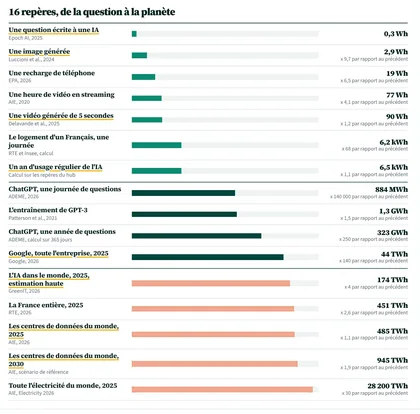
A quick question put to an assistant consumes about 0.3 Wh at the servers, according to the AI Impact Database. A year of ordinary personal use, which the Database builds from the Barometer's frequencies, consumes 750 Wh and weighs about 340 gCO2e with an average model and without reasoning, an assumption of the Database for lack of knowing each assistant's default setting. That is 0.004% of the 8.3 tCO2e of a French person's annual carbon footprint. These are estimates, which count only the electricity of the servers and the data centre. At this scale, one person's use weighs little, without being zero.
Not all uses weigh the same. In this same year, 2 video clips of 5 seconds and 1 deep research weigh more than 365 questions and 47 conversations combined. By the same estimate, a developer who hands about 2 h 40 a day to coding agents reaches 180 kgCO2e over the year, more than 500 times ordinary personal use and 2.2% of a French person's footprint. Our analysis of the weight of a year of use details these profiles.
In the Database, moving every request made to the assistant to a small model halves the personal year; giving up the 2 video clips reduces it by 27%, asking 2 times fewer questions by 7%. We find here the pattern of the 2009 survey, in which equipment weighed more than deprivation; here, the choice of model stands in for equipment. The settings also work the other way: applied to every request, extended reasoning, in which the model writes a long draft before answering, multiplies the year by 4, a large model by nearly 3, and the 2 together by 15. Our analysis of the actions ranks them in detail.
A year of ordinary personal use weighs about 340 gCO2e, of which 43% for 2 video clips and 1 deep research; extended reasoning multiplies it by 4, a large model by nearly 3, the 2 together by 15, and the year of a developer who runs agents reaches 180 kgCO2e.
The settings that weigh the most are decided for all users at once
Users do not always choose these settings alone. The model that answers and the reasoning mode have a default value, set by the assistant's provider. The use of AI itself is sometimes decided by others. In June 2025, 64% of generative AI users said they had decided to use it themselves; in 17% of cases, the employer had made its use compulsory, and 18% of users said that a platform they already used, search engine, messaging or social network, had imposed it on them.
Since then, Google has launched in France, on 22 July 2026, AI-written overviews at the top of its search results. Its announcement indicates no setting that lets internet users remove them. In the Database's personal year of use, search engine overviews make up about 6% of the electricity, without having been requested. The default setting of an assistant or a search engine, decided once, applies to all its users.
At the scale of the climate, other decisions escape the user even more, such as the origin of data centre electricity or the use of AI in oil exploration. Our analysis of AI and the climate crisis details them, and our point of view "Surface AI and deep AI" describes the AI that runs without an interface.
Guilt does not show in usage
The Barometer does not say whether the opinion of these 54% of users changes their uses. For us, the provider measures uses first: a worried user who carries on sends it the same signal as a calm one. Worry only counts when it becomes a precise request, like ADEME's.
The opposite position rests on 2 arguments, which our article on the boycott examines: data centres are built to meet a demand, which is the sum of uses; without guilt, nobody changes their habits.
The first argument is correct. ADEME applied the 0.34 Wh per request announced by Sam Altman, the head of OpenAI, to the 2.6 billion daily requests that ChatGPT claimed in July 2025. It deduces that these requests would require 884 MWh per day, the equivalent of the electricity consumption of 145,000 people in France. This total is made up of everyone's questions.
The second convinces us less. The 2009 survey showed that the idea of saving went first to deprivations, and that the participants most comfortable with numbers, like those most concerned about the environment, estimated consumption better. For us, it is information on orders of magnitude that is missing, more than the wish to do the right thing. Spread over each question, guilt falls first on the actions that weigh the least.
Knowing your year and making precise requests
The first action is up to each person: knowing once the order of magnitude of your year with the "My AI footprint" tool, identifying the uses that make it up, and keeping the heaviest for the tasks that require them.
The second is addressed to those who set the settings. ADEME put it this way in its July 2026 opinion:
"Training and awareness of a reasoned and controlled use of AI is also crucial, but users must be able to make informed choices: for example, to be able to disable, if they wish, the generative AI 'augmented' features in traditional digital services."
These choices require figures, which providers publish little. Google published in 2025 a measurement in production for the median text request to Gemini, 0.24 Wh. Sam Altman gave 0.34 Wh for an average ChatGPT request, without publishing a method. For an image, a video or the reasoning mode, we found no measurement published by the provider of an assistant.
We ask providers to publish the electricity of each type of use, with their method, and to allow the AI they switch on by default to be switched off. We ask employers, who choose their employees' assistant and its settings, to fix these settings in writing in a charter and to count AI in their Bilan Carbone®. The other levers, data centre electricity and model efficiency, are ranked in our analysis of AI decarbonisation.
The survey cited at the opening was conducted online in February 2009, among 505 Americans recruited through classified ads in 7 large cities, and concerns household energy: its application to AI is our reading. The years of use are estimates from the AI Impact Database, with an average model and without reasoning; they count only the electricity of servers and the data centre, without hardware manufacturing or training, and rest on assumed frequencies of use. ADEME's figure for ChatGPT applies a statement by OpenAI whose method is not published.
Sources
9 documents
- Attari, DeKay, Davidson and Bruine de Bruin, Public perceptions of energy consumption and savings, PNAS2010entry 240
- Arcep, Arcom, CGE and ANCT, Baromètre du numérique2026entry 57
- Delavande, Pierrard and Luccioni, Small Talk, Big Impact: The Energy Cost of Thanking AI2026entry 237
- Our World in Data, based on Ember, Lifecycle carbon intensity of electricity2026entry 34
- SDES and Insee, L'empreinte carbone de la France de 1990 à 20252026entry 53
- Google France, Les Aperçus IA et le Mode IA, now available in France2026entry 241
- ADEME, opinion on generative artificial intelligence2026entry 30
- Sam Altman (OpenAI), The Gentle Singularity2025entry 21
- Elsworth et al. (Google), Measuring the environmental impact of delivering AI at Google scale2025entry 14
Every figure was read in its source; the hub's methodology is described in Methodology and sources.
AI Impact, Projet Celsius, "Should we feel guilty about using AI?", 13 November 2026. https://projetcelsius.com/en/ai/analyses/should-you-feel-guilty-using-ai/




 Society
 Electricity