
 Uses13 November 2026
Which AI use charter should you adopt?
A 10-article template, the published charters and footprint accounting




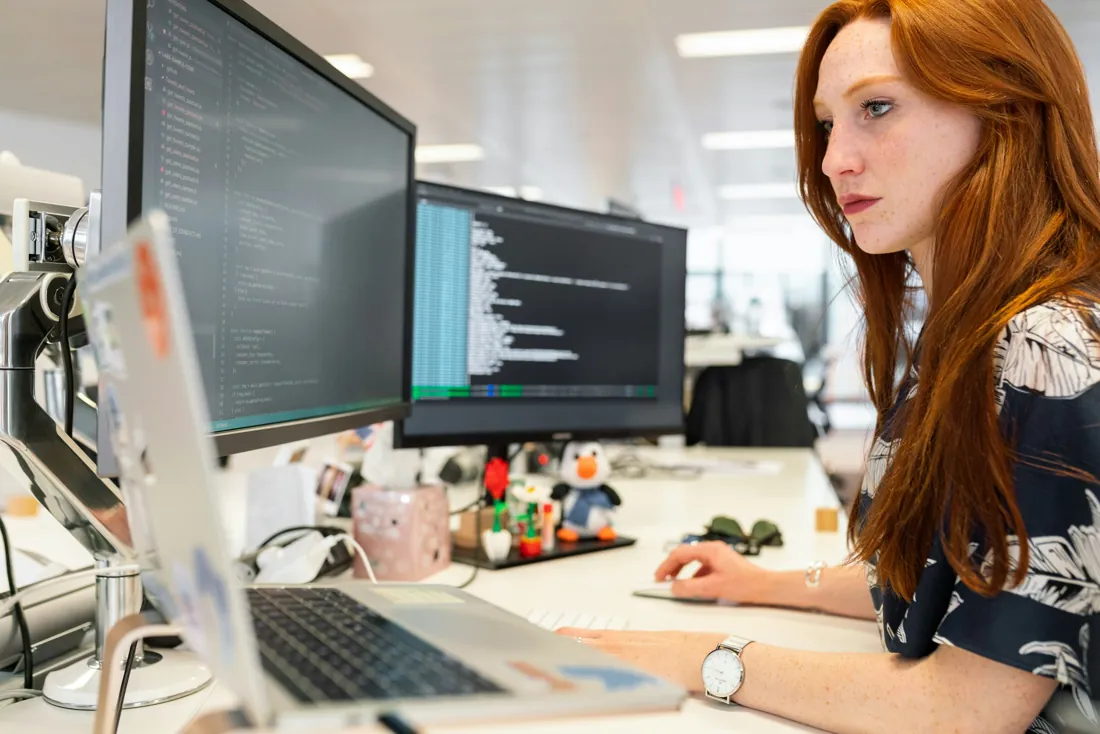
An open-plan office, in November 2016. Photo Nicolas G, CC BY-SA 4.0, via Wikimedia Commons.
An AI use charter sets out which tools to use, which data must never be entered into them, who checks the answers, when to disclose the use of AI and how staff are trained. The 16 published charters we compared agree on data, checking answers and disclosing AI use, and 14 call for restraint in use; none converts the use it governs into electricity or emissions. The model charter proposed here brings their best rules together in 10 articles ready to copy, and adds that calculation.
Contents
In France, public administrations publish their AI use charters. The interministerial digital directorate lists around thirty on its portal, from ministries to universities. In 2026, 75% of local authorities engaged in an AI project had started a charter or an internal reference document, according to the economic outlook report by the Banque des Territoires and the Observatoire Data Publica. Companies publish few of them: we found 2.
Use came before the charters. When the Doubs Department surveyed its staff in autumn 2024, nearly a quarter of the 561 respondents said they had already used AI in their work, even though no policy had been defined.
We read 16 charters published from 2024 to 2026: 5 from the State, including the DINUM interministerial guide, 4 from local authorities, 4 from bodies with a public service mission, 1 from a university and 2 from companies. The template that follows draws on their best rules, keeping their wording where it is accurate; each article is followed by what the law and the published charters say.
Of 16 published charters, none counts the footprint of the use it governs
| Template article | Make it a rule | Mention it | Say nothing about it |
|---|---|---|---|
| 1. Scope | 16 | 0 | 0 |
| 2. Authorised tools | 9 | 6 | 1 |
| 3. Data | 16 | 0 | 0 |
| 4. Checking and responsibility | 15 | 1 | 0 |
| 5. Decisions about a person | 11 | 3 | 2 |
| 6. Disclosing AI use | 15 | 1 | 0 |
| 7. Copyright | 9 | 4 | 3 |
| 8. Training | 11 | 4 | 1 |
| 9. Sobriety | 14 | 1 | 1 |
| 10. Accounting for use and its footprint | 0 | 6 | 10 |
Projet Celsius's reading of 16 charters published from 2024 to 2026. "Make it a rule": the charter sets an obligation, a prohibition or a commitment of the organisation; for tools, it designates a list or refers to one, even if only to "favour" them. "Mention it": it names the subject without making it a rule. The breakdown, charter by charter and by type of organisation, is in the infographic.

None converts use into electricity or emissions. 6 mention a review, an assessment or an inventory of uses; the Doubs Department goes furthest, with a committee tasked with publishing a yearly review of AI use, based on declarations from departments.
Charters do talk about the environment, however. The Seine-Maritime public service management centre asks its staff to limit their use "to what is strictly necessary so as not to increase the carbon footprint of the institution", without planning to measure it. The industrial group LISI asks that AI costs be "tracked over time", but not its footprint. For 36% of local authorities engaged in an AI project, "environmental impact (and its difficult measurement)" is an obstacle. None of the 3 free charter templates we read online has an article on this accounting.
8 of 16 charters extend to service providers or partners
This charter sets the rules for using artificial intelligence (AI) tools at work. It applies to anyone who works for the organisation, whatever their status, interns and temporary staff included; service providers' contracts refer to it. It covers any tool that produces text, images, sound, video or code, whether standalone or built into software already in use (email, office suite, business software). The organisation appoints an AI contact, reachable at [address], who answers questions, keeps the list of authorised tools and receives reports. The charter is given to each person on arrival and reviewed every year, in light of the review provided for in Article 10. Failure to comply exposes the person to the consequences provided for by [the internal rules or the rules applicable to staff].
Half of the charters extend to service providers, partners or subcontractors. The Ministry of Culture's charter applies "to anyone, whatever their status (tenured, non-tenured, private-sector employee, service provider, intern, apprentice...)", and the recommendations of the Doubs charter are binding on "all operators appointed by the Department". To make the charter apply to a service provider, the template writes it into the provider's contract.
AI built into software in use falls within the scope: Loire Forez Agglomération chose Copilot, built into its office suite, and the Alpes-de-Haute-Provence chose Gemini, Google's assistant.
9 of 16 charters name the authorised tools
Only the tools on the list of authorised tools, published on [intranet], are used for work. For each tool, the list states the data it may receive and the default settings fixed by the organisation. A tool that is not on the list receives only information that is already public. A personal account is not used for work. Anyone who wants to try a tool that is not on the list declares it to the AI contact beforehand. An AI agent, that is, a tool that acts on its own (sending a message, editing a file, publishing, paying), receives only the access its task needs; its actions are logged and a named person answers for them.
The DINUM interministerial guide, published in June 2026, reserves commercial tools for exceptions, under "two cumulative conditions: your administration explicitly authorises it; the information processed could be freely published on the Internet". The pass Culture charter allows trying a tool that has not been validated, "only after informing the IT department and the DPO, in particular by filling in a dedicated table on the intranet".
A tool used with a personal account escapes the organisation's contracts, and its use is not counted. The list of authorised tools is therefore also the first piece of the accounting in Article 10. For tools linked to email, files or internal software, the charter for State communicators asks that their access rights be "set so as to be limited to the strict operational need".
All 16 charters limit the information entrusted to AI tools
Information that could not be published on the organisation's website does not go into any tool that is not on the list of authorised tools. The following are never entered into an AI tool, unless the tool is authorised for that use: health data and other sensitive data within the meaning of Article 9 of the GDPR (origin, opinions, beliefs, trade union membership, sex life, genetic and biometric data), identifiers and passwords, information covered by a secret (professional, business, defence) or by a confidentiality agreement. In an authorised tool, personal data is reduced to what the task requires, and names are replaced by "Madam X", "the client" or "the user". Settings that let the provider reuse exchanges to train its models are switched off. In case of doubt, the person refrains and asks the AI contact or the data protection officer.
All 16 charters set this rule. The DINUM guide boils it down to one question: "Could I publish this information on a website accessible to everyone?". The Prime Minister's services spell it out: "working versions of a document that is to be published are not considered public data".
The pass Culture charter illustrates it: "every employee must behave with a non-validated GenAI as they would with a human being outside the organisation". The CNIL states in its 2024 Q&A: "In the general case, it is the user organisation that will bear legal responsibility in case of misuse of AI by its staff."
15 of 16 charters require AI answers to be checked
An AI answer is a draft. The person who uses it checks facts, figures, quotations and references against their source before any use, and compares a summary with the document summarised. They use AI only on subjects where they can judge the result. They remain the author of what they pass on, sign or publish, and answer for it as for any other work. A serious error, a data leak or discriminatory content produced by a tool is reported to the AI contact without delay.
The Alpes-de-Haute-Provence put it this way: "Use AI only in my fields of competence", with the aim of "being able to take a critical look at the answers produced". Loire Forez Agglomération asks that the summary be "reread and compared with the source document". The École nationale de la magistrature writes in its charter: "No legal reasoning may be based solely on the answer of a GenAI."
11 of 16 charters reserve decisions about a person for a human
No decision that has effects on a person (recruitment, evaluation, sanction, pay, granting or refusing a benefit) is taken solely on the basis of an AI result. AI tools are not used to sort, rank or score applications, or to evaluate a person's work or behaviour, unless the tool is validated for that use after an impact assessment and consultation of staff representatives. When a tool has helped prepare an individual decision, the person who decides keeps a record of the tool used, the result proposed and the reasons retained.
The GDPR gives everyone "the right not to be subject to a decision based solely on automated processing" that significantly affects them. The AI Act classifies as high-risk the systems intended for recruitment, application screening and performance evaluation, with obligations from 2 December 2027, according to the European Commission. For an administration, an individual decision taken on the basis of algorithmic processing must already say so (Article L. 311-3-1 of the Code of Relations between the Public and the Administration).
The Seine-Maritime management centre forbids processing in an AI tool any document "related to a recruitment process or to an application, including for an internship, to the career or to the pay of a person". The pass Culture charter excludes AI from annual reviews "for the entire process".
Each charter sets its own threshold for disclosing AI use
A document produced wholly or partly by an AI (analysis, note, letter, summary, image) carries a disclosure, even if it was edited afterwards: "Document written with the help of a generative AI tool and checked by [name or department]". Help limited to correcting, rephrasing or formatting a text written by the person does not require a disclosure. A generated image, sound or video showing real people, places or events always carries the disclosure. A person who interacts with an automated assistant is informed from the first message. In case of doubt, the document carries the disclosure.
Since 2 August 2026, the AI Act has required organisations that use AI to flag deepfakes, as well as generated texts "published with the purpose of informing the public on matters of public interest", unless they have undergone a "process of human review or editorial control" and a person bears editorial responsibility. The charters set their own, wider threshold.
The DINUM guide places the threshold at a "substantial role" for AI: no disclosure for rephrasing, a disclosure for content produced by AI, "even if adjusted afterwards". The Ministry of Culture exempts only internal documents that AI has merely formatted; the Alpes-de-Haute-Provence require the disclosure for any circulation, internal or external.
9 of 16 charters set a rule on copyright
Protected content to which the organisation does not hold the rights (article, report, image, music, code) is supplied only to an authorised tool that does not reuse exchanges to train its models. Generated content that reproduces an existing work beyond a short quotation, or code under licence, is not distributed. Before distributing a generated image or text, the person checks that the tool's terms of use allow this use.
The Intellectual Property Code sets the rule: "Any representation or reproduction, in whole or in part, made without the consent of the author or their successors in title is unlawful." The Ministry of Culture recommends supplying the tools with "no content protected by intellectual property rights", so that it is not used to train models, and asks staff to refrain from distributing "content that could constitute infringements of existing works". The software company Septeo adds the case of code, which "may be protected by a licence limiting the conditions of its use".
AI literacy has been an AI Act obligation since February 2025
Before using an AI tool at work, everyone receives training on how it works, its limits (errors, biases, data), the rules of this charter and the order of magnitude of its footprint. The training is updated every year and for each new tool. The AI contact keeps the list of people trained.
Article 4 of the AI Act has applied since 2 February 2025 to any organisation that deploys an AI system. Revised in July 2026, it asks the organisation to take "measures to promote the development of AI literacy" among its staff, without requiring it to "guarantee a specific level of AI literacy by an individual". It does not impose training as such: the European Commission states that no mandatory training is required, that an internal record of the actions is enough, and that the enforcement rules have applied since 2 August 2026. The CNIL recommends "mandatory training before these systems are used".
11 of 16 charters commit the organisation to training. The template makes training the means of meeting Article 4, and adds the order of magnitude of the footprint, as the Shift Project asks in a note of November 2026: "All AI training must teach how to measure the footprint of AI and sober, reasoned use."
Sobriety applies first to default settings and heavy uses
No one is required to use an AI tool when another solution exists. AI is used when it offers a gain that the usual tool does not: a search engine is enough for a simple piece of information, a translator for a short message, an image bank for an illustration. Where the tool allows it, the organisation sets each tool by default to the smallest model that is sufficient for everyday use, without reasoning mode; a larger model or reasoning is chosen for the tasks that call for it. Video generation, deep research and agents that work for several hours are reserved for uses that justify them, and their volumes are tracked under Article 10.
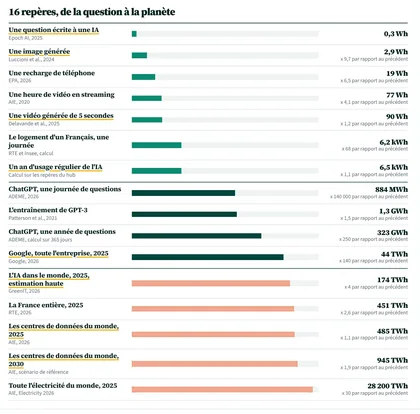
14 of 16 charters ask for sobriety, most often through small habits: better-written instructions, fewer queries or, in the pass Culture charter, "Never say 'hello', 'please' or 'thank you' to an AI". A measurement by Hugging Face researchers gives 0.245 Wh for a thank-you and the model's reply, on a small open model: one thank-you per working day would come to about 54 Wh a year.
With the AI Impact Database, we calculated the electricity used over a year of work by an office employee who uses AI, according to the setting applied to all their requests:
A 5-second video clip uses as much as 330 quick questions. The default setting therefore counts for more than polite phrases. The pass Culture charter also provides for this, by asking staff to choose the "lighter" versions in the tool's settings. The hub's analysis of a year of use details these profiles.
The 1st sentence of the template is taken from the Ministry of Culture, for which the use of an AI system "cannot therefore be imposed on an official if an alternative solution exists". Several charters justify sobriety with figures that circulate stripped of their scope, and whose origin the hub has traced: a bottle of water for a reply of about a hundred words, a phone charge for an image, which uses 2.9 Wh on average, about 15% of a charge.
Each year, the template counts use and its footprint, by tool and by service
10.1. Each year, the organisation counts its use of AI and the resulting footprint. 10.2. It keeps the register of tools in service: supplier, model, country where requests are processed when known, number of accounts or licences. 10.3. It records, by tool and by department, the number of active users and, where the tool allows it, the number of text, image and video requests, deep research queries and agent hours; failing that, it estimates them through a survey. 10.4. It converts these volumes into electricity and greenhouse gas emissions using published, dated factors, and states what it does not count. 10.5. Each year it asks its suppliers for the electricity consumption and emissions linked to its use, and records their reply or the absence of one. 10.6. The result appears in the charter's annual review and in the organisation's emissions assessment. The count is made by tool and by department, never by named person.
With the estimates of the AI Impact Database, AI use at work amounts to about 12 kgCO2e a year for an SME of 50 people, 145 kgCO2e for a company of 500 people and 1.4 tCO2e for a company of 5,000, counting server electricity only, with the world average electricity mix. A team of 10 developers working with coding agents uses 4 MWh a year, or 1.8 tCO2e, as much as or more than the everyday use of the company of 5,000 people: one hour of a coding agent uses as much as 2,240 quick questions.
The everyday use of the 5,000 people, occupation by occupation, with the AI services of a large organisation: 1.4 tCO2e, between 1.2 and 2.0.
A single team whose agents write, test and correct part of the code: 1.8 tCO2e, between 0.85 and 3.5.
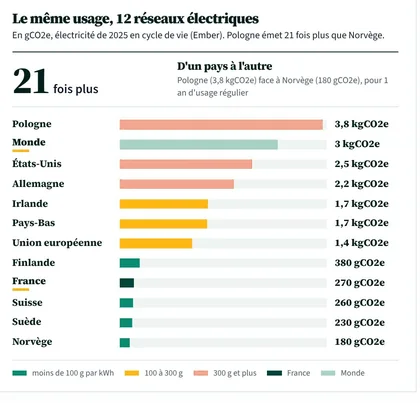
The register records the country where requests are processed: the same year of an office employee emits 589 gCO2e with the world average electricity mix and 53 g with servers in France, which the hub's tool can compare.
The tools' administration consoles report numbers of users and requests, rarely the model and never where the computation takes place (our article on measuring AI in business) ; the hub's estimation tool converts these volumes. A company enters the result in its Bilan Carbone® (our article). A municipality or group of municipalities with more than 50,000 inhabitants enters it in the annual review of its responsible digital strategy, which sets its "objectives for reducing the environmental footprint of digital technology" (law of 15 November 2021, Article 35).
In May 2026, Arcep noted "a lack of transparency from model designers and AI service providers about the environmental impacts of their models", hence the annual request to suppliers. Crédit Mutuel Alliance Fédérale, in a charter of commitments to its customers, is building "a centralised database" to list its AI solutions. Recorded per person, the count would become a means of monitoring employees' activity, subject to consultation of the social and economic committee (Article L. 2312-38 of the Labour Code).
In our view at Projet Celsius, Article 10 is the first one to add to an existing charter. It asks for little (a register, an annual record and published factors) and makes it possible to check from one year to the next what the other 9 articles have changed.
In a company, a charter that provides for sanctions follows the same procedure as the internal rules
In a company, a document that sets "general and permanent obligations" on discipline is an addition to the internal rules (Article L. 1321-5 of the Labour Code): it is submitted to the social and economic committee for its opinion and sent to the labour inspectorate. The committee is also consulted on "the introduction of new technologies" (Article L. 2312-8). In the public sector, the Département du Doubs presented its charter to its territorial social committee on 2 April 2026; only 26% of the authorities concerned have put AI on the agenda of social dialogue, according to the Banque des Territoires.
Several charters require a signature. Loire Forez Agglomération has each official sign its charter on taking up their post, and the Seine-Maritime management centre attaches a commitment form.
The comparison covers 16 charters published from 2024 to 2026 and read in full, one per organisation and only one per type of educational institution (the IRA of Bastia and the University of Lille, which we read, are not included); 2 of them are from companies. The classification of each article (rule, mention, silence) is our reading. The electricity and emissions values are estimates from the AI Impact Database: electricity for the servers and the data centre, excluding the manufacture of the machines and the training of the models. The AI Act is cited from an unofficial consolidated text; the European Commission confirms the revision of Article 4 and the date of Annex III. This guide does not replace legal advice.
Sources
37 documents
- DINUM, Portail des chartes IA dans l'administration, undated page2026entry 201
- DINUM, with the DITP and the DGAFP, Guide d'usage de l'IA pour les agents publics de l'État2026entry 202
- Services du Premier ministre (DSAF), Charte relative à l'utilisation de l'IA générative dans les services du Premier ministre2025entry 203
- Ministère de la Culture, Charte pour un usage raisonné et responsable de l'intelligence artificielle2026entry 204
- Ministère de l'Intérieur, Charte pour des usages éthiques de l'intelligence artificielle au Ministère de l'Intérieur2026entry 205
- Service d'information du Gouvernement, Charte pour un usage responsable de l'Intelligence artificielle pour les communicants de l'État2026entry 206
- Département du Val-de-Marne, Charte d'utilisation de l'intelligence artificielle2026entry 207
- Département du Doubs, Charte des usages de l'intelligence artificielle, and the study "L'impact de l'intelligence artificielle sur les agents territoriaux dans le Département du Doubs"2026entry 208
- Conseil départemental des Alpes-de-Haute-Provence, La charte de l'intelligence artificielle2025entry 209
- Loire Forez Agglomération, Charte d'usage de l'Intelligence Artificielle2026entry 210
- Centre de gestion de la fonction publique territoriale de la Seine-Maritime, Charte d'utilisation des intelligences artificielles à l'usage du personnel du CDG 762025entry 211
- pass Culture, Charte sur l'usage de l'intelligence artificielle générative au sein de pass Culture, version 1.02025entry 212
- EUROGIP, Charte d'utilisation : règlementation de l'usage de l'intelligence artificielle au sein d'EUROGIP, 2 June 20262026entry 213
- École nationale de la magistrature, Charte d'usage des outils d'intelligence artificielle générative applicable aux personnels, formateurs, apprenants2026entry 214
- Université Clermont Auvergne, Charte du bon usage de l'IA générative2025entry 215
- LISI, Charte d'utilisation de l'Intelligence Artificielle2024entry 216
- Septeo, Politique Intelligence Artificielle (charte éthique)2024entry 218
- Crédit Mutuel Alliance Fédérale, Pour une intelligence artificielle de confiance : nos engagements pour un usage responsable et éthique de l'IA et de la donnée2024entry 217
- Regulation (EU) 2024/1689 on artificial intelligence, Article 4, AI literacy, unofficial consolidated text after Regulation (EU) 2026/17442026entry 219
- European Commission, AI Literacy - Questions & Answers, updated October 20262026entry 220
- Regulation (EU) 2024/1689 on artificial intelligence, Article 50, transparency obligations, unofficial consolidated text2026entry 221
- Regulation (EU) 2024/1689 on artificial intelligence, Article 113, entry into force and application, unofficial consolidated text after Regulation (EU) 2026/17442026entry 222
- Regulation (EU) 2024/1689 on artificial intelligence, Annex III, high-risk AI systems, unofficial consolidated text2026entry 223
- European Commission, AI Act, Regulatory framework on AI, updated October 20262026entry 224
- General Data Protection Regulation, Article 9, special categories of data (text published by the CNIL)2016entry 225
- General Data Protection Regulation, Article 22, automated individual decision-making (text published by the CNIL)2016entry 226
- Code des relations entre le public et l'administration, Article L. 311-3-12016entry 227
- Code de la propriété intellectuelle, Article L. 122-41992entry 228
- Code du travail, Article L. 1321-5 (additions to the internal rules)2018entry 229
- Code du travail, Article L. 2312-8 (powers of the social and economic committee)2021entry 230
- Code du travail, Article L. 2312-38 (means of monitoring employees' activity)2018entry 231
- Loi n° 2021-1485 du 15 novembre 2021 visant à réduire l'empreinte environnementale du numérique en France, Article 352021entry 232
- CNIL, Les questions-réponses de la CNIL sur l'utilisation d'un système d'IA générative2024entry 233
- Banque des Territoires and Observatoire Data Publica, Tendances 2026 : data, intelligence artificielle et cybersécurité dans les territoires2026entry 234
- The Shift Project, Former à l'IA sans renoncer à la décarbonation2026entry 235
- Delavande, Pierrard and Luccioni, Small Talk, Big Impact: The Energy Cost of Thanking AI2026entry 236
- Arcep, press release on the report "Intelligence artificielle générative : quels défis environnementaux ?"2026entry 237
Every figure was read in its source; the hub's methodology is described in Methodology and sources.
AI Impact, Projet Celsius, "Which AI use charter should you adopt?", 13 November 2026. https://projetcelsius.com/en/ai/analyses/which-ai-use-charter-to-adopt/


 Climate