
 Uses13 November 2026
Which actions reduce the impact of your AI use the most?
Settings, uses and agent hours, over a year




A developer workstation with 2 screens. Photo Farzad Nazifi, public domain (CC0), via Wikimedia Commons.
Over a year of ordinary personal AI use, leaving reasoning on for every request adds 32% to server electricity at the average effect measured by PEReN, and multiplies it by 4 with extended reasoning; giving up all video reduces it by 27%, and one fewer thank-you a day by 2 to 11%. At the office, web search delegated to an assistant weighs the most; for people who run agents, agent hours make up 99% of the year. The order of actions therefore changes with the scale of use.
Contents
The advice in circulation for reducing the impact of your AI use is all alike: stop saying thank you, write short instructions, delete your conversations, limit videos. It is rarely quantified, and almost never related to what a person does with AI over a year. ADEME nevertheless judges this scale more representative, in its July 2026 opinion :
"Measuring the impacts of annual use, based on precise assumptions of varied requests, can thus be more representative of reality and further encourage behaviour change by comparing the impacts of different types of use."
We ran this calculation for 3 profiles from the AI Impact Database : a person who uses free offers at home, an office employee, a developer who hands tasks to agents. Their frequencies of use, down to the developer's 594 agent hours, are Projet Celsius assumptions based on surveys; the analysis of the weight of a year of use details what each year is made of. Here, each action is applied alone to the profile's year, and we measure what it removes. The gains do not add up.
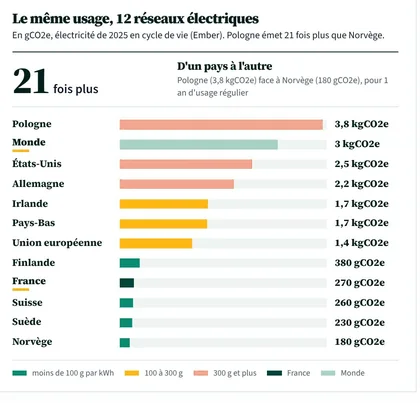
The electricity of the servers that process each request, data centre cooling included, converted into CO2e with the world average electricity of 2025, 458 gCO2e per kWh.
The manufacturing of servers and chips, model training, the network, the person's device. The values on this page are floors.
For personal use, the model setting weighs as much as video or more
The year of ordinary personal use consumes 750 Wh at the servers, with the average model and without reasoning. 2 video clips and 1 deep research make up 43% of it, the 365 quick questions 15%.
What each action removes, in Wh per year. For reasoning and model size, the reduction is counted from the year in which the setting applies to every request made to the assistant:
Reasoning and model size apply to every request made to the assistant. The Database counts in extended reasoning 10 times the electricity of a direct answer, and for a large frontier model about 4 times the electricity per token of the average model, according to the ML.ENERGY benchmark; the analysis of a year of use details these settings. At the average effect measured by PEReN, leaving reasoning on for every request costs as much as the year's clips. With extended reasoning, it costs more than any task you give up. No source says what share of requests goes through reasoning today.
Published measurements diverge, because they do not compare the same thing. The Pôle d'expertise de la régulation numérique (PEReN), a government service, turns reasoning on or off on the same open models: +92% on average, with a 95% interval ranging from −21% to +348%, and +849% on average on programming exercises. For GPT-5, an estimate published in 2025 gives, for a query of average length, 2.33 Wh at minimal reasoning effort and 17.15 Wh at high effort, more than 7 times more; minimal effort is not the absence of reasoning. Hugging Face measures 150 to 700 times more energy for 3 models tested with and then without reasoning, which then write 300 to 800 times more tokens.
For model size, the same 2025 estimate gives, for a short question, 0.052 Wh with Llama 3.1 8B and 2.2 Wh with Llama 3.1 405B, 43 times more, data centre included; the Database counts 0.05 Wh for a quick question put to a small-class model. A model of this size is not enough for every task. A 2025 study estimates that choosing for each task the smallest model that suffices would remove 27.8% of inference electricity worldwide, from 1 to 98% depending on the task. The 49% of the small model on every request is an upper bound.
PEReN draws a recommendation for users from this:
"An LLM user should therefore first make sure that such a model is suited to their use case, or that the 'reasoning' mode is switched off before using it."
At the office, web search delegated to AI weighs the most
The year of an office employee who uses AI consumes 1.3 kWh. 220 web searches delegated to an assistant make up 47% of it, each 9 times the 0.3 Wh that Google gave in 2009 for a conventional search.
| Action, applied alone | Reduction over the year |
|---|---|
| Return to a direct answer, from extended reasoning on every request | −4,600 Wh, −78% |
| Return to the average model, from a large model on every request | −3,300 Wh, −72% |
| Small model, if it were enough for every request | −920 Wh, −71% |
| Return to a direct answer, from average reasoning on every request | −470 Wh, −27% |
| 1 web search in 2 done without AI | −270 Wh, −21% |
| 2 times fewer quick questions | −79 Wh, −6% |
| 1 fewer thank-you per working day | −10 to −54 Wh, −0.7 to −4% |
Source: AI Impact Database, office employee over one year, ordinary use, engine 0.3.1, hub calculation. Server electricity, data centre included.
Doing one web search in 2 without AI removes 21%, 3 times more than dividing quick questions by 2. The small model, an upper bound, removes 71% here, more than at home, because office work counts neither clips nor images.
Part of the year does not depend on the employee. When the AI built into the office suite transcribes and summarises meetings without being asked, about 5 per week in the Database's assumptions, the year rises to 2.2 kWh, 71% more. This setting is decided when the organisation chooses the tool, like the model served by default; the hub's charter template proposes setting them for the whole organisation.
With agents, agent hours make up the year
The year of the developer who hands about 2 h 40 a day to agents, described in the analysis of a year of use, consumes 400 kWh, from 190 to 770 kWh depending on the cost of the context re-read from cache. Agent hours make up 99% of it.
54 Wh at most over the year, with the published thank-you measurement.
About 200 kWh and 90 kgCO2e less over the year.
At this scale, removing all the tasks done without agents, questions, conversations, searches and code suggestions, would remove less than 1% of the year. The action concerns the number of agent hours, and the model that runs them. The Database does not vary this model: its agent hour takes up the session of a frontier agent, and no published measurement covers the same work done by a smaller model.
The Database's agent hour takes up the estimate that climate scientist Zeke Hausfather draws from the tokens that he recorded over 8 weeks of 2026 with Claude Code. He recommends not launching agents for futile tasks and handing simple tasks to smaller models, which he says consume 5 to 7 times less per token than a frontier model, something he does more and more himself. He adds that he does not want to overstate its scope: the personal restraint of the small population of heavy users will not bend the curves. Since efficiency only determines the amount of intelligence obtained per unit of energy, the lever that matters most, in his view, is the carbon intensity of electricity (our translation).
The same action has a different weight from one profile to another
Side by side, the 3 profiles show that the effect of an action on the year depends on the share of the year made up by the task it affects, and that this share changes from one profile to another.
| Action, applied alone | Ordinary personal use, 750 Wh | Office employee, 1.3 kWh | Developer with agents, 400 kWh |
|---|---|---|---|
| Return to a direct answer, from reasoning on every request | −24 to −76% | −27 to −78% | not calculated |
| Small model, if it were enough for every request | −49 % | −71 % | not calculated |
| 2 times less of the heaviest task | −14%, video clips | −21%, web searches delegated to AI | −50%, agent hours |
| 2 times fewer quick questions | −7 % | −6 % | −0.04 % |
| Answers 2 times shorter to quick questions | −7 % | −6 % | −0.03 % |
| 1 fewer thank-you a day | −2 to −11% | −0.7 to −4% | −0.002 to −0.01% |
| Servers in the European Union, CO2e | −54 % | −54 % | −54 % |
Server electricity, except the last line. Each action is applied alone to the profile's year; the gains do not add up. Reasoning: from the average effect measured by PEReN to the Database's extended reasoning. Reasoning and model size are not applied to agent hours, which take up the session of a frontier agent. Hub calculation with the AI Impact Database, engine 0.3.1.
The thank-you is the clearest example. In the Database, a thank-you and its short answer consume 0.044 Wh. Researchers at Hugging Face measured 0.245 Wh on average over 10,000 conversations, under laboratory conditions: a small open model in FP32 precision, one request at a time, machine energy alone, the whole conversation re-read and an answer that could run to 256 tokens. The re-read context and the length of the answer account for most of the gap. In a year in which you say thank you every day, no longer saying it removes 2 to 11% of ordinary personal use, and at most 0.01% of the year of the developer with agents.
The same mechanism separates the effect of an action on one request from its effect on a year. In the Database, an answer 2 times shorter consumes 46% less. Applied to the 365 quick questions of the year, this action removes 7% of it, because quick questions make up 15% of the year.
The actions that the Database does not quantify, such as deleting your conversations, attaching a shorter document or running a model on your own computer, are covered in the blog article on the actions that reduce the impact of AI, which starts from a profile of 52 videos a year.
The country of the servers changes the CO2e without changing the electricity
The country of the servers does not change the electricity consumed; the CO2e follows the grid that supplies them. With European Union electricity, each of the 3 years emits 54% less than with the world average, and 91% less with French electricity, as shown by the analysis of a year of use.
For an individual, this lever works through the choice of assistant, and cannot be verified: the major assistants do not say in which country a given request is processed. An organisation, on the other hand, can write a hosting region into a contract, one of the levers of the analysis of AI decarbonisation. The providers of closed assistants do not publish the energy of an image, a video or the reasoning mode either. The AI Ranking rates the 10 main assistants on their sobriety, reasoning on by default included.
The settings that weigh the most are often set by the provider or the employer
The person does not always choose these settings. The model served and the reasoning are set by the provider, who may choose them itself depending on the request. AI-written overviews at the top of search engines make up 6% of the ordinary personal year without having been requested, and the office suite's AI adds 71% to the office employee's year.
ADEME notes this in its opinion, about AI built by default into digital services:
"Service designers must allow users to disable these features."
The 4 principles it gives to users concern model size, the length of the content requested, the precision of requests and video. None mentions the reasoning mode.
The actions on this page remove from a few grams to 2 kgCO2e a year for personal or office use, less than 0.03% of the 8.3 tCO2e of a French person's footprint, and about 90 kgCO2e for the developer who divides agent hours by 2. For us at Projet Celsius, a user's first action is to look at 2 settings, the model and the reasoning. Left at their highest on every request, they weigh more than any task you give up; at the average effect measured by PEReN, reasoning weighs as much as the year's clips. The second action is to identify what weighs in your year: clips and deep research at home, web searches at the office, agent hours for those who run agents. An organisation, which multiplies these values by its headcount, can set these settings for everyone. The "My AI footprint" tool calculates these levers for each person, from their own uses.
The years count the electricity of servers and the data centre, without hardware manufacturing or model training. The frequencies of use are Projet Celsius assumptions based on surveys, and the default settings of assistants are not published. The multipliers for reasoning and model size come from open models and estimates; the one for extended reasoning is among the most uncertain. The small model on every request is an upper bound, which assumes that such a model is enough for everything. The thank-you has 2 values, the Database's and a laboratory measurement on a small model. The agent hour rests on the estimate of a single user.
Sources
10 documents
- ADEME, opinion on generative artificial intelligence2026entry 30
- PEReN for Arcep, Étude IA et environnement, technical report2025entry 121
- Jegham, Abdelatti, Elmoubarki and Hendawi, How Hungry is AI? Benchmarking Energy, Water, and Carbon Footprint of LLM Inference, version 62025entry 239
- Hugging Face, AI Energy Score v22025entry 26
- Barros et al., Small is Sufficient: Reducing the World AI Energy Consumption Through Model Selection2025entry 29
- Delavande, Pierrard and Luccioni, Small Talk, Big Impact: The Energy Cost of Thanking AI2026entry 237
- Zeke Hausfather, The real energy use of agentic AI, The Climate Brink2026entry 120
- Arcep, Arcom, CGE and ANCT, Baromètre du numérique2026entry 57
- Our World in Data, based on Ember, Lifecycle carbon intensity of electricity2026entry 34
- SDES and Insee, L'empreinte carbone de la France de 1990 à 20252026entry 53
Every figure was read in its source; the hub's methodology is described in Methodology and sources.
AI Impact, Projet Celsius, "Which actions reduce the impact of your AI use the most?", 13 November 2026. https://projetcelsius.com/en/ai/analyses/which-actions-cut-ai-impact-most/


 Electricity