
 Electricity13 November 2026
Does AI running on your own computer use less?
The same answer, in a data centre and on your own machine




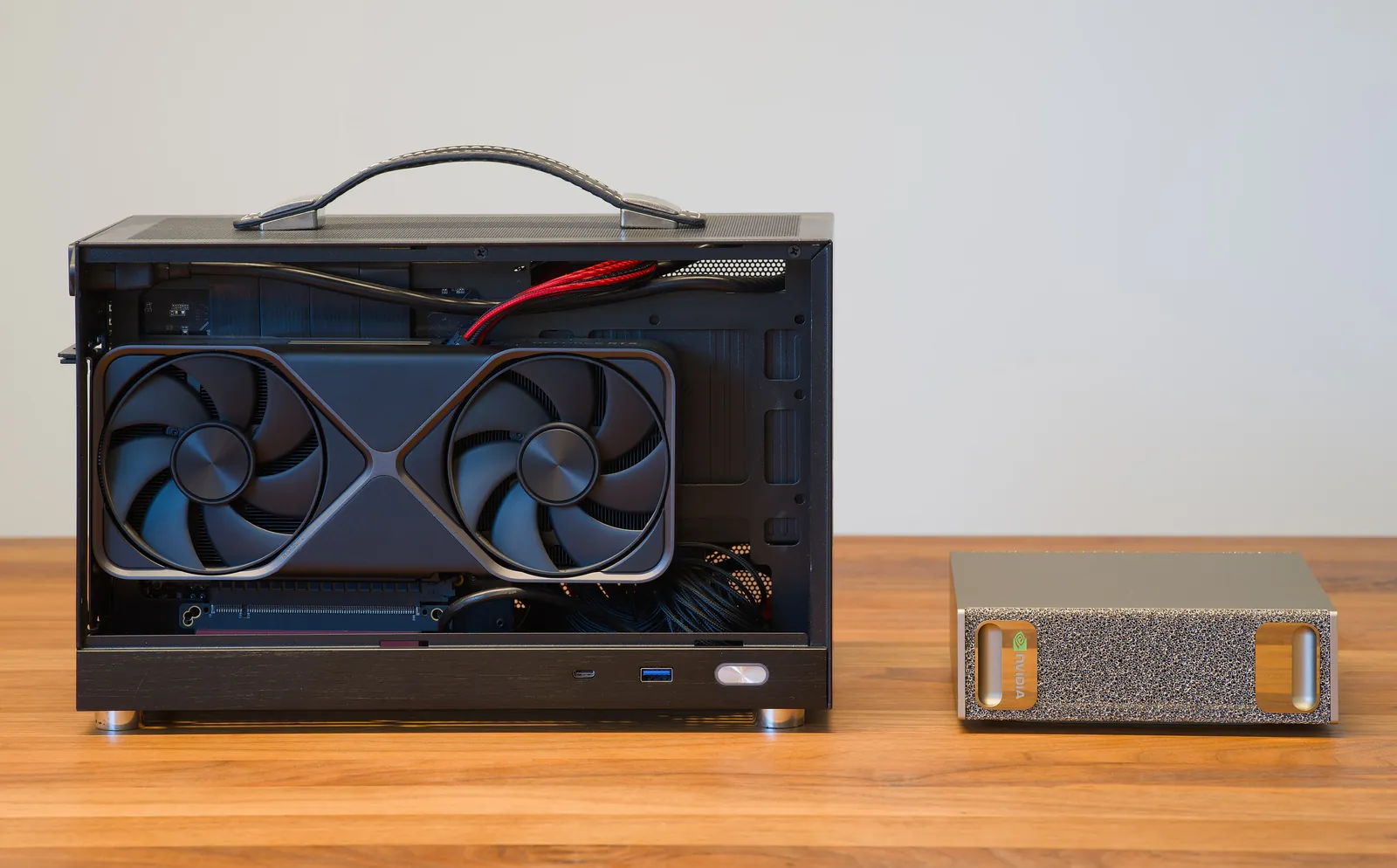
A small desktop computer opened up on its graphics card, next to a DGX Spark, a desktop AI computer sold by Nvidia, in May 2026. Photo Daniel Lu (dllu), CC BY-SA 4.0, via Wikimedia Commons.
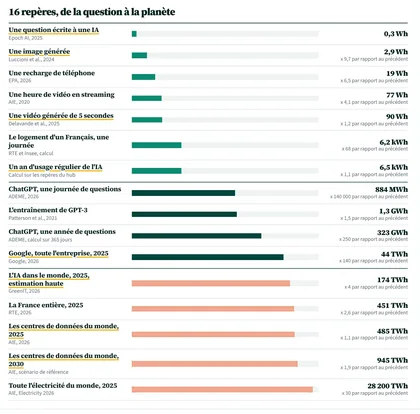
It uses less when its model is smaller than the one behind the online service: a model of 2 to 8 billion parameters uses 0.06 to 0.24 Wh for a half-page answer on a laptop, according to processor and graphics card measurements scaled to that length by our calculation, against 0.3 Wh estimated for an assistant's average model. Served to many users at once, the same small model would probably use less in a data centre, which shares each chip between several requests. At home, the electricity changes the CO2e, and a computer bought for this purpose adds a manufacturing footprint equal in CO2e to the electricity of 1.3 million answers from the average model, counted with the world average electricity (our calculation).
Contents
Free software makes it possible to install an open AI model on your computer, PC or Mac, and recent phones ship with one. The question comes back with these local AIs: does an answer computed at home, without a data centre, use less?
We followed the same answer along the 2 paths, in a single unit: the electricity of a half-page answer, 400 tokens (the word fragments the model writes), the quick question of the AI Impact Database.
In a data centre, the electricity of the chips, the servers, the machines kept in reserve and the building. On a computer, that of the processor and the graphics card during the calculation.
The screen and the rest of the device, switched on in both 2 cases, and for longer when the calculation runs on the machine; model training and, until the last part, hardware manufacturing.
For the same model, chip sharing favours the data centre
A computer serves only one person. A server processes several requests at the same time on the same chip, and shares its consumption between them. Researchers at Stanford and Together AI measured this on a data centre card, Nvidia's B200, with the same model of 8 billion parameters: the energy of a question falls from 6,449 to 548 joules when the card serves 64 at once instead of one, a division by 12. Their questions, conversations and reasoning have a length that is not published.
The same study also compares the chip of a Mac Studio with the B200, one request at a time. It attributes 240 to 305 W to the Mac's graphics part alone, more than the 145 W that Apple publishes at most for the whole machine in its base configuration; we do not retain its ratio between the 2 chips. With 145 W and the study's response times, the Mac would use about 6,200 joules per question with the same model of 8 billion parameters, as much as the B200 serving a single request, according to our calculation. One request at a time, no gap between the 2 chips is established.
Measurement, 2019 graphics card, one request at a time.
- counted: Processor and graphics card
- not counted: Memory, motherboard and screen
Database estimate, chips shared between many requests.
- counted: Chips, servers, reserve and building
- not counted: Measurement of this model in production
Served to many users, the same model would therefore probably use less in a data centre. The gap with a recent machine is not measured, and local hardware has progressed markedly since 2019, according to the same Stanford study.
In exchange, the data centre adds steps that the computer does not have. Google published the breakdown of the median question put to Gemini in May 2025, to our knowledge the only measurement of this kind published by a provider on its own service.
| Step | Electricity | Share of total |
|---|---|---|
| AI chips computing | 0.14 Wh | 58 % |
| Server processors and memory | 0.06 Wh | 25 % |
| Machines kept in reserve | 0.02 Wh | 10 % |
| Cooling and building losses | 0.02 Wh | 8 % |
| Total | 0.24 Wh | 100 % |
Median text question put to the Gemini app, May 2025, Google measurement. The network, the user's device, training and manufacturing are not counted. Shares rounded by Google.
Machines in reserve and the building make up 17% of the total. At a large operator, cooling adds about a tenth to server electricity; the Database retains this coefficient at 1.10, and notes that an unknown operator is counted at 1.56. The trip across the network weighs even less. The text of a question and its answer is about 2 kilobytes; even 100 kilobytes exchanged, counted with the factor established for 2015 by Aslan and his co-authors (0.06 kWh per gigabyte), make 0.006 Wh, 2% of a quick question, according to our calculation. This factor was then halving about every 2 years.
An installed AI uses less when its model is smaller
Installing an AI on your computer almost always amounts to changing model. The machine's memory sets the size of what it can run: the largest local model in the Stanford study, gpt-oss-120b, fits, compressed to 4 bits, in the 128 GB of memory of the study's Mac, and a phone with 8 GB runs compressed models of a few billion parameters. Most providers do not publish the size of their assistants' models; the Database puts the model served by default in a medium class, and frontier models at several hundred billion parameters.
| Model and machine | Electricity of a half-page answer | Nature of the figure |
|---|---|---|
| Large frontier model, data centre | 1.2 Wh | Database estimate |
| An assistant's average model, data centre | 0.3 Wh | Database estimate, calibrated on measurements and provider statements |
| Model of 8 billion parameters, laptop with a 2019 graphics card | 0.21 Wh | Measurement, scaled to 400 tokens |
| Models of 7 billion parameters, same laptop | 0.16 to 0.24 Wh | Measurements, scaled to 400 tokens |
| Models of 2 billion parameters, same laptop | 0.06 to 0.10 Wh | Measurements, scaled to 400 tokens |
| Model of 8 billion parameters, data centre | 0.05 Wh | Database estimate |
Data centre: AI Impact Database, engine 0.3.1, quick question, data centre included. Computer: Husom et al. (SINTEF), 2026, processor and graphics card only (Intel Core i7 10th generation, Nvidia Quadro RTX 4000), answers of 160 to 300 tokens scaled to 400 by our calculation. The 2 groups have neither the same hardware nor the same scope.
With a model of 2 to 8 billion parameters, the laptop uses 20 to 80% of the electricity of an assistant's average model, and 5 to 20% of that of a large model, according to our calculation. In their simulation of a service that sends each request to a small local model when it suffices, and to a large online model otherwise, the Stanford researchers obtain 60 to 80% less energy, and attribute most of the gain to model size rather than hardware efficiency. Their starting point is a service that would send every request to a model of 235 billion parameters. Our analysis of AI decarbonisation retains 27.8% for the smallest sufficient model, based on open models weighted by their downloads.
A small model does not always provide the same service. In the same study, a model of 8 billion parameters answers 57.5% of questions correctly, and gpt-oss-120b, the best local model taken alone, 71.4%, while Gemini 2.5 Pro gets 66.5 to 89.5% right depending on the benchmark. An insufficient answer is asked for again, and its electricity adds up.
These figures cannot be compared to the last decimal. The laptop measurement counts only the processor and the graphics card: it is a lower bound of what the socket draws, without the memory, the motherboard or charger losses. The data centre figures count the whole building. Its graphics card dates from 2019, and a recent machine uses markedly less, according to the same Stanford study. The Database values are estimates, which providers do not allow to be checked model by model.
The gain of an AI installed on your computer comes from the smaller model it runs; served to many users, the same model would probably use less in a data centre, according to the Database's estimate.
On a phone, the model is smaller still
Apple equips its devices with a model of about 3 billion parameters, stored on 2 bits each, and runs a larger model on its own servers. On an iPhone 16 Pro, the Stanford study runs a model of 4 billion parameters, compressed to 4 bits, at 9.5 W: 23 times less power than the Nvidia-card workstation tested with the same model, but 15 times more time, 37 seconds per question. That makes about 0.1 Wh per question of the study, according to our calculation. The phone answers 38% of questions correctly, against 44.5% for the workstation; per unit of energy, it nevertheless gives more good answers than the workstation.
French electricity divides the CO2e of an answer by 11
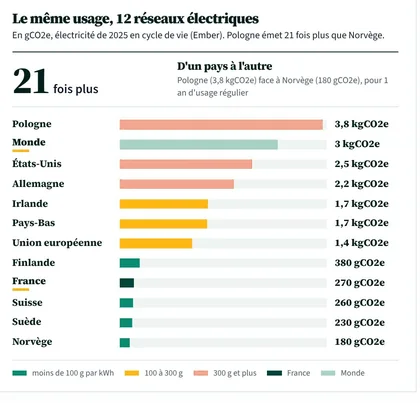
When calculated at home, an answer uses household electricity. In 2025, electricity produced in France emitted 41 gCO2e per kWh over its life cycle, 11 times less than the world average (458 g) and 9 times less than that of the United States (384 g). Providers do not publish the country where a question is processed; the Database counts world average electricity by default. The hub's map shows every country.
| Half-page answer | French electricity | World average electricity |
|---|---|---|
| Model with 8 billion parameters on a laptop (0.21 Wh) | 0.009 gCO2e | 0.096 gCO2e |
| Average assistant model in a data centre (0.3 Wh) | 0.012 gCO2e | 0.14 gCO2e |
Electricity only, life cycle production, 2025 (Ember, via Our World in Data). Hub calculation. Each column compares the 2 answers on equal electricity.
On equal electricity, the 2 answers keep the ratio of their watt-hours. An answer calculated in France benefits from French electricity, as would a data centre located in France.
Calculating at home also removes the water that the data centre consumes for cooling: 0.26 mL for the median Gemini question according to Google, about 5 drops. The water used by the power plants that produce the electricity remains in the 2 cases. Our article on the water footprint of AI details these scopes.
A computer bought for AI weighs more than its answers
A computer already in service has already been manufactured, and installing a model on it does not change its manufacturing. The count changes when the machine is bought for this purpose, with more memory or a graphics card.
According to ADEME, an average laptop weighs 182 kgCO2e for its manufacture and distribution, over a life cycle of 193 kg. Bought to run models and kept 5 years, the period used by ADEME, at 20 answers per day, it would carry about 5 gCO2e of manufacturing for each answer. That is 36 times the CO2e of the electricity of one answer from the average assistant model, counted with the world average, according to our calculation.
as much CO2e as the electricity of 1.3 million answers from the average assistant model, counted with world average electricity (our calculation).
In a data centre, the manufacturing of chips is shared between millions of requests: the Database counts an AI server used 69% of the time for 5 years. Google counts 0.01 gCO2e per Gemini question for its emissions other than electricity, manufacturing included.
For an organisation, the switch to local computing also moves the lines of the Bilan Carbone®: the purchased service leaves purchases, the electricity enters the Energy item and the machine enters fixed assets. Our analysis of AI in a Bilan Carbone® sets this out, including for a server installed on its own premises.
The choice of model matters more than where the calculation runs
For us at Projet Celsius, an AI installed on your own computer is justified first by other reasons: keeping your texts at home, working offline, not depending on any subscription. For electricity, it helps under 2 conditions: a model smaller than the one of the service it replaces, and a machine already bought. Served online to many users, a small model would probably use even less, according to the Database estimate. The choice of model and of reasoning mode remains what weighs most on the electricity of a use; our analysis of individual actions the figure over a year.
The data centre values are AI Impact Database estimates, calibrated on the only in-production measurement published by a provider to our knowledge (Google). The laptop values are measurements on a machine with a 2019 graphics card, processor and graphics card only, scaled to an answer of 400 tokens by our calculation; a recent machine uses less. Chip sharing is measured by a Stanford study on a single data centre card, with questions whose length is not published; its ratio between a Mac chip and a data centre chip is not retained, as the Mac power it publishes exceeds the maximum given by Apple for the whole machine. The CO2e ratios and the manufacturing share per answer are our calculation.
Sources
10 documents
- Saad-Falcon, Narayan et al. (Stanford University and Together AI), Intelligence per Watt: Measuring Intelligence Efficiency of Local AI, arXiv preprint, version 7 of October 20262026entry 242
- Husom, Goknil, Shar and Sen, The Price of Prompting: Profiling Energy Use in Large Language Models Inference, arXiv preprint, version 2 of March 20262026entry 243
- Elsworth et al. (Google), Measuring the environmental impact of delivering AI at Google scale2025entry 14
- Projet Celsius, AI Impact Database, environmental database of artificial intelligence, engine 0.3.12026entry 144
- Apple, Mac Studio power consumption and thermal output (BTU) information, accessed in November 20262026entry 246
- Aslan, Mayers, Koomey and France, Electricity Intensity of Internet Data Transmission: Untangling the Estimates, Journal of Industrial Ecology2018entry 244
- Apple, Apple Intelligence Foundation Language Models Tech Report 20252025entry 245
- Barros et al., Small is Sufficient: Reducing the World AI Energy Consumption Through Model Selection2025entry 29
- Our World in Data, based on Ember, Lifecycle carbon intensity of electricity2026entry 34
- ADEME, Impact CO22026entry 39
Every figure was read in its source; the hub's methodology is described in Methodology and sources.
AI Impact, Projet Celsius, "Does an AI installed on your computer use less?", 13 November 2026. https://projetcelsius.com/en/ai/analyses/does-local-ai-use-less-energy/
 Uses

 Water