
 Electricity13 November 2026
"Near data centres, electricity bills have risen by 36%"




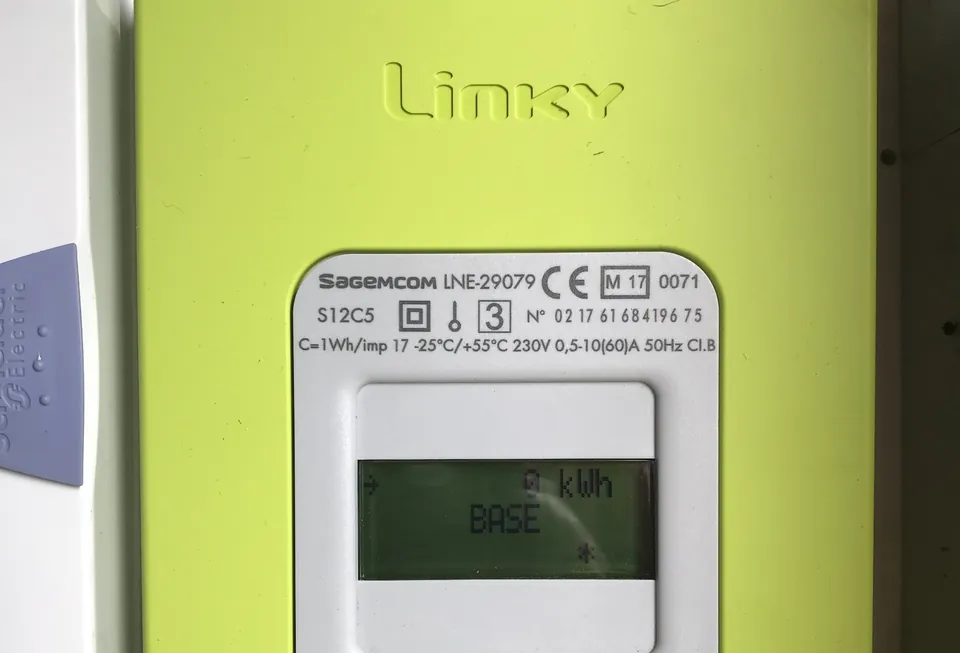
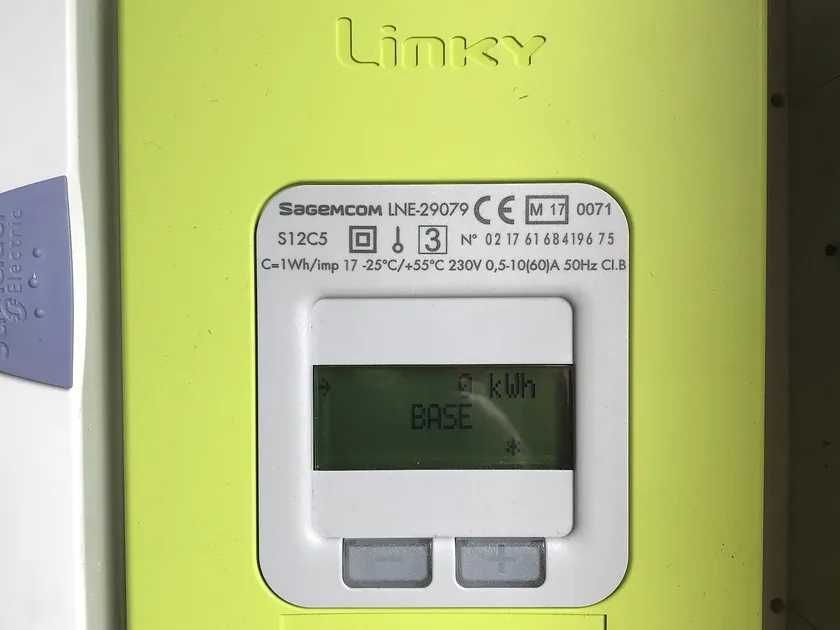
A Linky meter in a home in the Ain, in March 2018. Photo Benoît Prieur, CC0, via Wikimedia Commons.
The figure has circulated in France since January 2026, with no source cited, about US regions close to data centres. In the United States, the average household electricity price rose by 31% from 2020 to 2025 in current dollars, from all causes combined; in France, none of the 2 changes to the regulated tariff in 2026 cites data centres among its causes.
Contents
Origin of the figure
On 22 January 2026, Journal du Geek writes that "in some areas close to data centres, electricity bills rose by 36% between 2020 and 2025". The figure then appears in an article by Hello Watt published on 28 January, under the title "Votre facture d'électricité va-t-elle bondir de 36 % à cause de l'IA ?". Neither of the 2 articles names a study. The first links at the bottom of the page to an article in The Verge of 21 January 2026 on OpenAI's energy commitments, which gives no figure for an increase.
None of the studies we have read gives 36%. The closest value is a national average: according to the US Energy Information Administration (EIA), the average household electricity price rose from 13.15 to 17.23 cents per kWh from 2020 to 2025, an increase of 31 % in current dollars. Once inflation is deducted, Lawrence Berkeley National Laboratory (LBNL) counts a 3% rise in retail prices, all sectors, from 2019 to 2025. The most likely explanation for the "36%" is a national increase of this kind, later attributed to areas close to data centres.
US measurements
The US work that attributes an increase to data centres concerns wholesale prices and the cost of capacity, in the regions where the data centres are concentrated. For the wholesale price, the price at which suppliers buy electricity, a study by North Carolina State University, published in May 2026 in Environmental Research Letters, sees it rising by 6 to 29% on a national average by 2030 because of data centres and cryptocurrency mining, and by up to 57 % in some regions, notably Virginia, Pennsylvania, West Texas and New York. This is a projection, for a price that makes up only part of a household's bill.
The cost of capacity is paid by consumers to ensure that generation will follow the peak. PJM, which operates the grid in part of the eastern United States, buys this capacity at auction. Its market monitor attributes to data centre demand 29.4 billion dollars, or 46 %, of the capacity charges of the last 4 auctions. In the 1st half of 2026, it estimates that this demand raised PJM's total wholesale electricity cost by 9.7%, from 103.40 to 114.50 dollars per MWh.
- no study cited
- no published value that comes close locally
- + 3% once inflation is deducted, all sectors, 2019 to 2025
- PJM: + 9.7% of the wholesale cost in the 1st half of 2026, attributed to data centres
The French situation
In France, the Commission de régulation de l'énergie (CRE, the French energy regulator) proposed keeping the regulated sale tariff stable on 1 February 2026 (- 0.83 %): the end of regulated access to historic nuclear electricity (ARENH) lowered the cost of energy, and other items offset this fall. It proposed + 2.5 % on 1 August, owing to the network tariff and a new capacity mechanism; for a household consuming 4.5 MWh per year, the bill goes from 1,046 to 1,072 euros. Neither of the 2 proposals cites data centres.
The cost of the future grid has been quantified. Of the €16 billion that RTE plans by 2040 to connect consumers, producers and storage operators, about €10 billion will be paid by those who request the connection; €14 billion will go to adapting the extra-high-voltage grid to growing consumption, and will pass through the tariff. Through the grid tariff alone, the whole RTE and Enedis programme would raise the bill of an average household by 0.3 to 0.4% per year until 2040, excluding inflation and with supply and taxation unchanged. The CRE adds that this rise will be cushioned by the growth in consumption. Data centres are one source of demand among others there, with industry, hydrogen and electric mobility; our analysis of the electricity shortfall details the connections they have reserved.
Limits of the figure
US studies attribute to data centres increases in the wholesale price and the cost of capacity in the regions where they are concentrated. The average rise in a US household's bill has, for its part, several causes at once, including inflation.
For France, the absence of an increase attributed to data centres holds for 2026. As at 13 November 2026, we have found no public assessment of their future effect on prices. RTE forecasts the consumption of data centres on dedicated sites, 10 or 15 TWh in 2030 depending on the scenario, against 4 to 5 TWh in 2024, without drawing any price from it. In a post in the Bloc-notes Éco of the Banque de France published in November 2026, 2 authors note that the single national electricity price does not signal to operators the areas where the network is saturated.
A wholesale price, a capacity cost and a retail price cannot be compared directly, and an increase in current dollars includes inflation.
Sources
12 documents
- Journal du Geek, L'IA va-t-elle bientôt faire exploser nos factures d'électricité ?, 22 January 20262026entry 264
- Hello Watt, Votre facture d'électricité va-t-elle bondir de 36 % à cause de l'IA ?, updated on 13 April 20262026entry 265
- The Verge, OpenAI says its data centers will pay for their own energy and limit water usage, 21 January 20262026entry 272
- U.S. Energy Information Administration, Electric Power Annual, Table 2.4, Average Price of Electricity to Ultimate Customers by End-Use Sectors, 2015 through 20252026entry 266
- Lawrence Berkeley National Laboratory, Retail Electricity Price Trends and Drivers: Data Update, 2026 Edition2026entry 273
- North Carolina State University, Power System Costs and Emissions from Data Center and Cryptocurrency Mining Expansion in the United States, Environmental Research Letters, May 2026 (press release of 18 May 2026)2026entry 267
- Monitoring Analytics, PJM market monitor, presentation to the members committee, 27 July 20262026entry 274
- Commission de régulation de l'énergie, communiqué sur les tarifs réglementés de vente de l'électricité au 1er février 2026, 20 January 20262026entry 268
- Commission de régulation de l'énergie, La CRE propose une évolution du niveau moyen des tarifs réglementés de vente de l'électricité de + 2.5 % TTC au 1er août 2026, 16 July 20262026entry 269
- Commission de régulation de l'énergie, délibération n° 2026-22 du 20 février 2026 portant examen du schéma décennal de développement du réseau de RTE2026entry 270
- RTE, Bilan prévisionnel 2025, consommation2025entry 8
- Banque de France, Bloc-notes Éco, billet n° 470, Data centers et énergie : le coût écologique d'un signal-prix en panne, 4 November 20262026entry 271
Every figure was read in its source; the hub's methodology is described in Methodology and sources.
AI Impact, Projet Celsius, "Near data centres, electricity bills have risen by 36%", 13 November 2026. https://projetcelsius.com/en/ai/analyses/will-ai-raise-electricity-bills/