
 Electricity13 November 2026
Will AI cause electricity shortages?
Annual energy, peak power and room on the grid, in France, Ireland and the United States




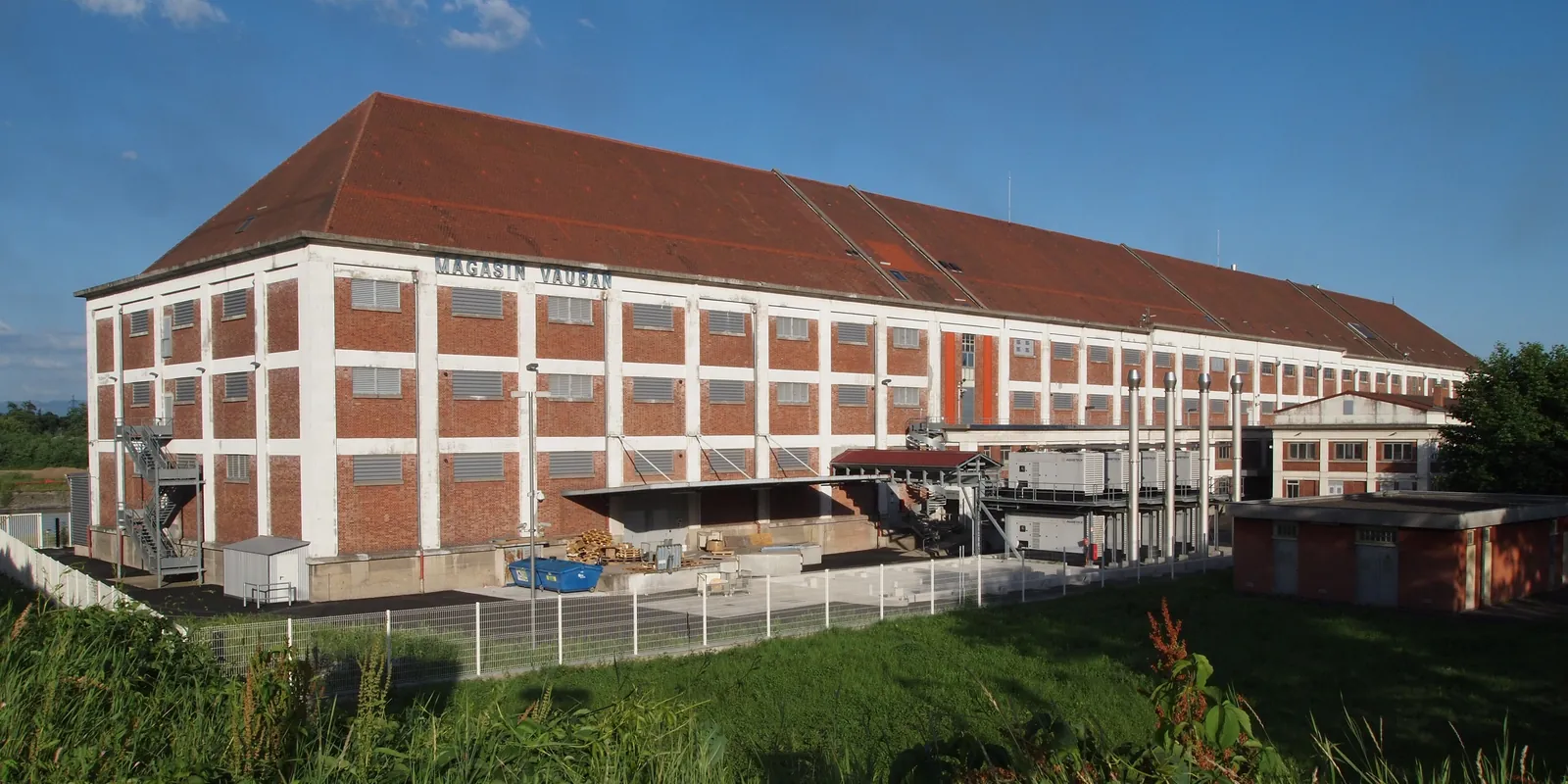
The Magasin Vauban, a former warehouse in the port of Strasbourg converted into a data centre, in 2013. Photo: Michael Kauffmann, CC BY 3.0, via Wikimedia Commons.
In annual energy terms, France will not run short of electricity because of data centres: it exported 92 TWh in 2025, about 20 times what its centres on dedicated sites consume, and RTE forecasts 10 or 15 TWh in 2030. The question concerns power and locations: projects had reserved nearly 18 GW of grid connection in May 2026, of which 7 in Île-de-France, and it is through power and connection that a grid becomes saturated, as in the Dublin region.
Contents
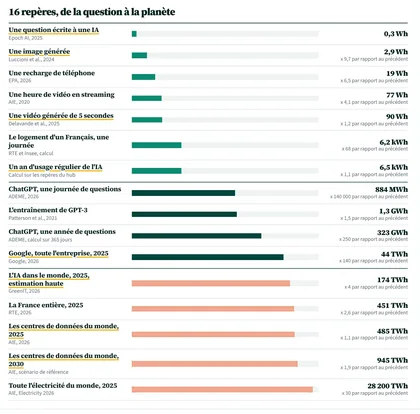
In 2025, the world's data centres consumed 485 TWh of electricity, slightly more than the whole of France, which consumed 451. It is also a little over 1.5% of the world's electricity. The 2 ways of putting it are both accurate, and the question of an electricity shortage requires specifying which quantity is meant.
Electricity is counted in 3 ways. Energy, in terawatt-hours (TWh), is what is consumed over a year. Power, in gigawatts (GW), is what is drawn from the grid at a given moment; the grid must be able to supply the peak of the year. Connection is the capacity of the lines and substations at the precise point where a site plugs in. A country may have enough energy over the year and lack power on a January morning, or room on the grid in a region.
Data centres in the worldwide rise in demand
The International Energy Agency (IEA) projects 945 TWh for the world's data centres in 2030, in its base case scenario; centres specialised in AI would account for about half of it. Consumption would therefore double in 5 years. The projections chart for 2030 compares it with the estimates of The Shift Project and GreenIT.
Relative to the rise in worldwide electricity demand, data centres would account for about a tenth of it by 2030 according to the IEA, less than industrial motors, air conditioning or electric vehicles. Their weight is concentrated in rich countries: more than 20% of the rise in advanced economies, about half in the United States.
Annual energy in France
In 2025, France produced 547 TWh of electricity, consumed 446 (451 once corrected for the weather) and exported a net balance of 92 TWh. Its data centres on dedicated sites consumed 4 to 5 TWh in 2024, about 1% of the country's consumption (our calculation); including companies' in-house centres, RTE counts 5 to 10 TWh.
RTE forecasts for dedicated sites 10 or 15 TWh in 2030 depending on the trajectory, then 21 or nearly 32 TWh in 2035. Even in the highest scenario, this remains about a third of what France exported in 2025 (our calculation). Exports are not a stock: the electricity exported is consumed by neighbouring countries, and what matters at the winter peak is the power available at that moment. But in annual energy terms, France will not run short of electricity because of data centres.
| Quantity | Value | Year |
|---|---|---|
| Electricity generation in France | 547 TWh | 2025 |
| Consumption, weather-corrected | 451 TWh | 2025 |
| Net exports | 92 TWh | 2025 |
| Data centres on dedicated sites | 4 to 5 TWh | 2024 |
| The same, RTE forecast | 10 or 15 TWh | 2030 |
| The same, RTE forecast | 21 or nearly 32 TWh | 2035 |
RTE, Bilan électrique 2025 and Bilan prévisionnel 2025. RTE's public information page uses a wider boundary, including in-house centres: about 10 TWh today, 2% of consumption, and 23 to 28 TWh in 2035. The hub uses the Bilan prévisionnel, which gives its assumptions.
Reserved power and room at peak
On 14 January 2025 at 9 o'clock, France drew 88 GW, its highest peak since 2021. In May 2026, RTE had reserved nearly 18 GW of connection for about 80 data centre projects, of which about 7 GW in Île-de-France and 6 GW in Hauts-de-France. At the end of 2024, some forty projects totalled about 5 GW.
These are reservations, not consumption. The centres connected to the transmission grid currently draw on average only 22% of their connection capacity. At that rate, 18 GW would make about 35 TWh per year (our calculation). RTE reports that operators expect this rate to rise towards 80% in 10 to 15 years; at 80%, 18 GW would draw about 14 GW. RTE does not assume that all projects will be completed: its high trajectory for 2030 assumes that about 60% of the projects planned on the transmission grid before that date, 4.3 GW, materialise.
The IEA estimates, as an indication, that the current French electricity system could accommodate about 6.5 GW of additional data centre load, 7.5% of the peak, provided that they reduce their consumption at critical hours, for the equivalent of 0.25% of their annual consumption. Expressed as power drawn, the 18 GW reserved would amount to 0.6 to 2.2 times this room, depending on the utilisation rate (our calculation). The same study ranks France among the least exposed of the 13 grids it examines. To connect part of them quickly, the Commission de régulation de l'énergie approved in May 2025 an accelerated procedure for consumers of 400 MW to 1 GW, on sites identified by the State, with commissioning targeted for 2028-2029.
- 7.5% of the national peak
- in the current electricity system
- 18 GW reserved with RTE in May 2026, about 80 projects
- of which 7 GW in Île-de-France
The case of Ireland
In Ireland, data centres consumed 5% of the electricity measured at meters in 2015, and 23 % in 2025. Their peak reached about 1 GW in June 2026, on an all-island grid whose peak is about 7.5 GW. In May 2026, the grid operator, EirGrid, considers the Dublin region saturated for large connections; about 2 GW of centres already contracted there would make up nearly a third of Irish demand once connected, if they used all their contracted power.
Since the regulator's decision published on 12 December 2025, each application is examined according to whether the location is constrained or not. A new centre must provide generation or storage, on site or nearby, and cover at least 80% of its annual consumption with new renewable electricity. France, at about 1% of its consumption, is not in the situation of Ireland. But the 7 GW reserved in Île-de-France raise, at the scale of a region, a question of the same kind: EirGrid compares the demand of the whole of Ireland with half that of Île-de-France.
 Electricity
Data centres' share of electricity
Share of national electricity consumption, latest published year · 2023 to 2025, depending on the country
Source: CSO; CBS; LBNL; IEA; RTE, Projet Celsius calculation · projetcelsius.com/en/ai · CC BY 4.0
The United States and gas
In the United States, the July 2026 capacity auction of the PJM grid, which serves 67 million people in 13 states, closed at the price cap, with 6.8 GW less than the level judged necessary for its reliability. PJM cites the addition of large data centres to its demand forecasts. Our note on the electricity bill deals with the effect of these auctions on prices.
Some operators plan their own generation. At the end of 2025, 252 GW of gas-fired power stations were in development in the United States, announced, permitted or under construction, of which more than a third were intended to supply data centres directly, according to Global Energy Monitor. These are projects: according to the IEA, about 10% of the gas turbines ordered in the United States in 2025 were tracked as intended directly for data centres.
Worldwide, the IEA expects the electricity generated from gas for data centres to more than double by 2030, to about 340 TWh, compared with 360 TWh for renewables. For the climate, the origin of the electricity that meets the new demand matters as much as its quantity.
Our reading
For us, at Projet Celsius, the French question concerns power and locations. Data centres will not make France run short of electricity over the year; they may, however, occupy, at peak hours and in a few regions, a place that the electrification of transport, heating and industry also requires. Our explainer on the location of data centres compares these criteria from one country to another. For a data centre project, 3 pieces of information say more than an annual average: the substation where it connects, what it does at peak hours, and the other connections waiting at that substation.
Reserved power is not power drawn, and power is not energy: 18 GW reserved make neither 18 GW at peak nor 158 TWh per year. Not all data centres are AI centres.
Sources
14 documents
- IEA, Key Questions on Energy and AI2026entry 2
- IEA, Energy and AI2025entry 1
- IEA, Electricity 20262026entry 3
- IEA, Powering Artificial Intelligence, 14 October 20262026entry 333
- RTE, Bilan électrique 20252026entry 9
- RTE, Bilan électrique 2025, rapport complet2026entry 332
- RTE, Bilan prévisionnel 2025, consommation2025entry 8
- RTE, Les data centers en chiffres clés, page mise à jour en mai 20262026entry 331
- Commission de régulation de l'énergie, press release on the fast-track connection procedure, 7 May 20252025entry 323
- Central Statistics Office (Ireland), Data Centres Metered Electricity Consumption 20252026entry 10
- EirGrid, Data Centre Constrained Area Overview2026entry 334
- Commission for Regulation of Utilities (Irlande), decision CRU/2025236, Large Energy User connection policy, 12 December 20252025entry 325
- PJM, résultats de l'enchère de capacité 2028/2029, 14 July 20262026entry 335
- Global Energy Monitor, Betting big on data centers, U.S. now leads world for new gas power development2026entry 336
Every figure was read in its source; the hub's methodology is described in Methodology and sources.
AI Impact, Projet Celsius, "L'IA va-t-elle nous faire manquer d'électricité ?", 13 November 2026. https://projetcelsius.com/en/ai/analyses/will-ai-cause-electricity-shortages/