
 Hardware19 November 2026
Why does AI push up the price of computers and phones?
The memory that factories reserve for AI servers, its price, and what the increase changes for the footprint of devices
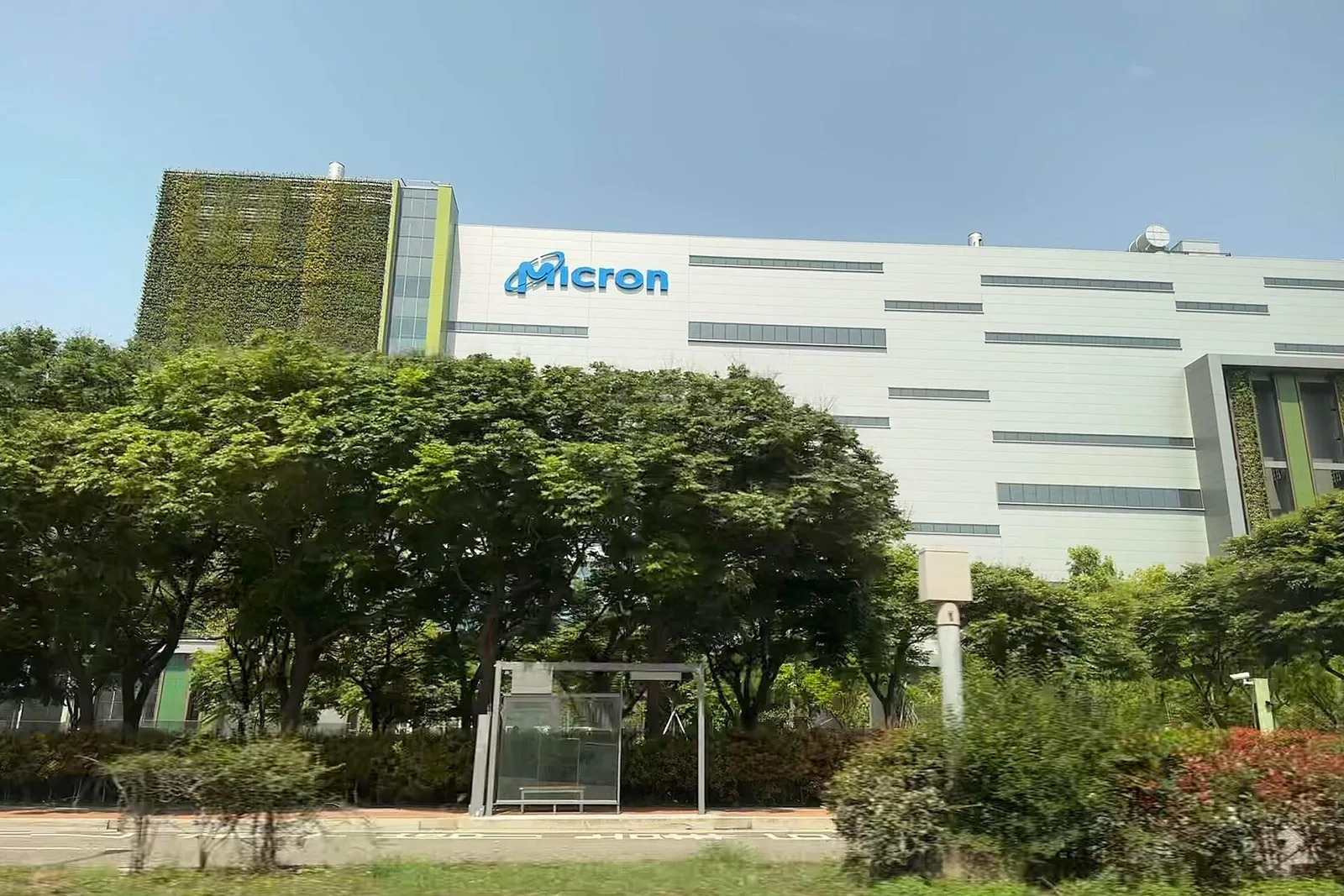
A Micron factory, one of the 3 major RAM manufacturers, in Taichung, Taiwan, in 2023. Photo Thingreenline4546, CC BY-SA 4.0, cropped, via Wikimedia Commons.
Because the same factories make the memory of AI servers and that of computers and phones, and they serve the servers first. At the end of 2026, the HBM memory of AI chips would take 22% of the DRAM wafers of the 3 major manufacturers for 9% of the gigabytes produced, according to TrendForce. The contract price of mainstream memory nearly tripled between summer 2025 and March 2026, and IDC forecasts smartphones 27.6% more expensive on average in 2026. Manufacturing already accounts for most of a device's footprint: 79.3 of the 80.2 kgCO2e of a smartphone, according to ADEME (the French Agency for Ecological Transition).
Contents
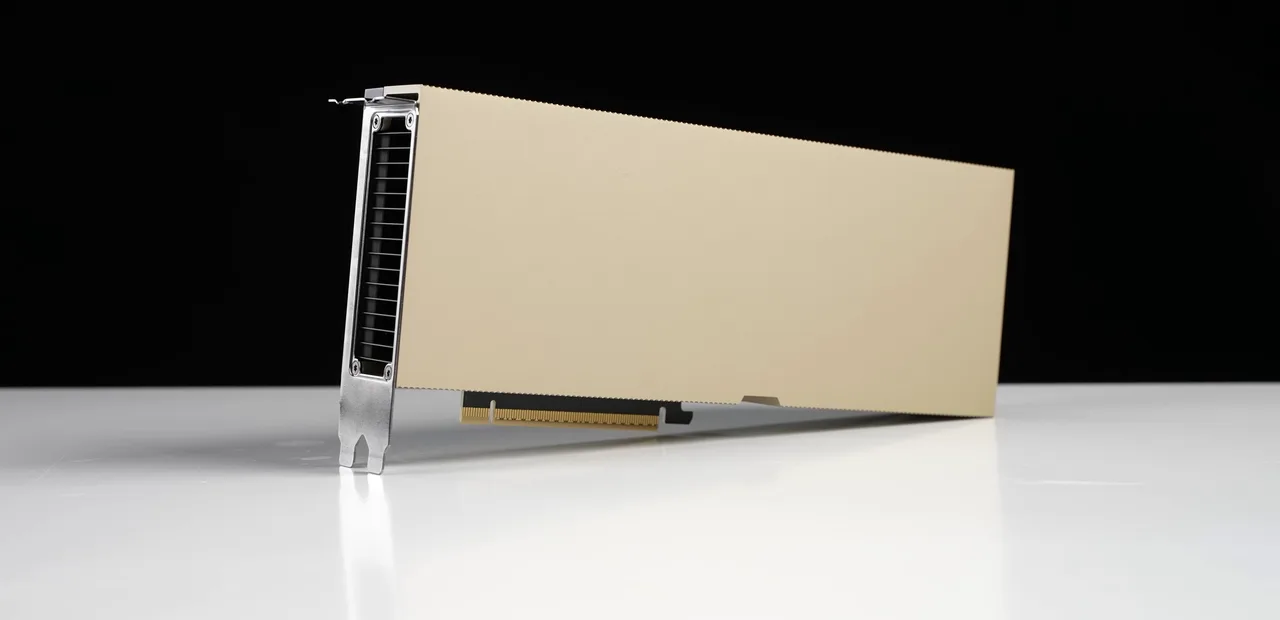
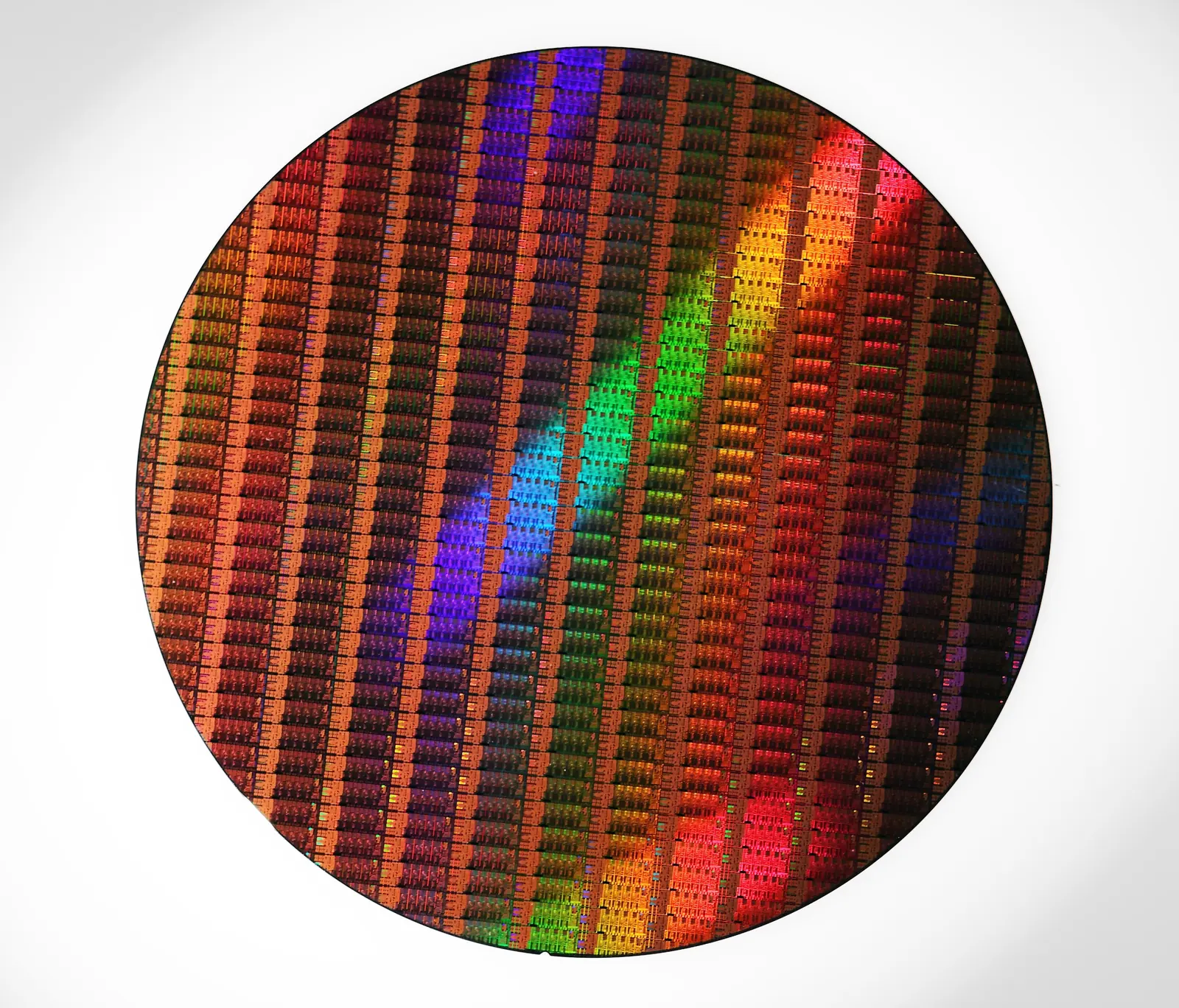
In a factory making random-access memory (DRAM), each silicon wafer can become the memory of a laptop, a phone or an ordinary server, or the HBM memory stacked around the compute chips of AI servers, as on the H100 cards. The manufacturer divides its wafers between these products, and this split changes the volume: one gigabyte of HBM takes about 3 times as many wafers as one gigabyte of mainstream memory, according to our calculation from TrendForce estimates.
Since the second half of 2025, Samsung, SK hynix and Micron, which made nearly 90% of DRAM revenue in the 1st quarter of 2026, have given priority to servers. Fewer wafers are left for devices, and their price rises. The next infographic sets the share of wafers taken by HBM against the price of mainstream DRAM, the kind used in computers, phones and ordinary servers.
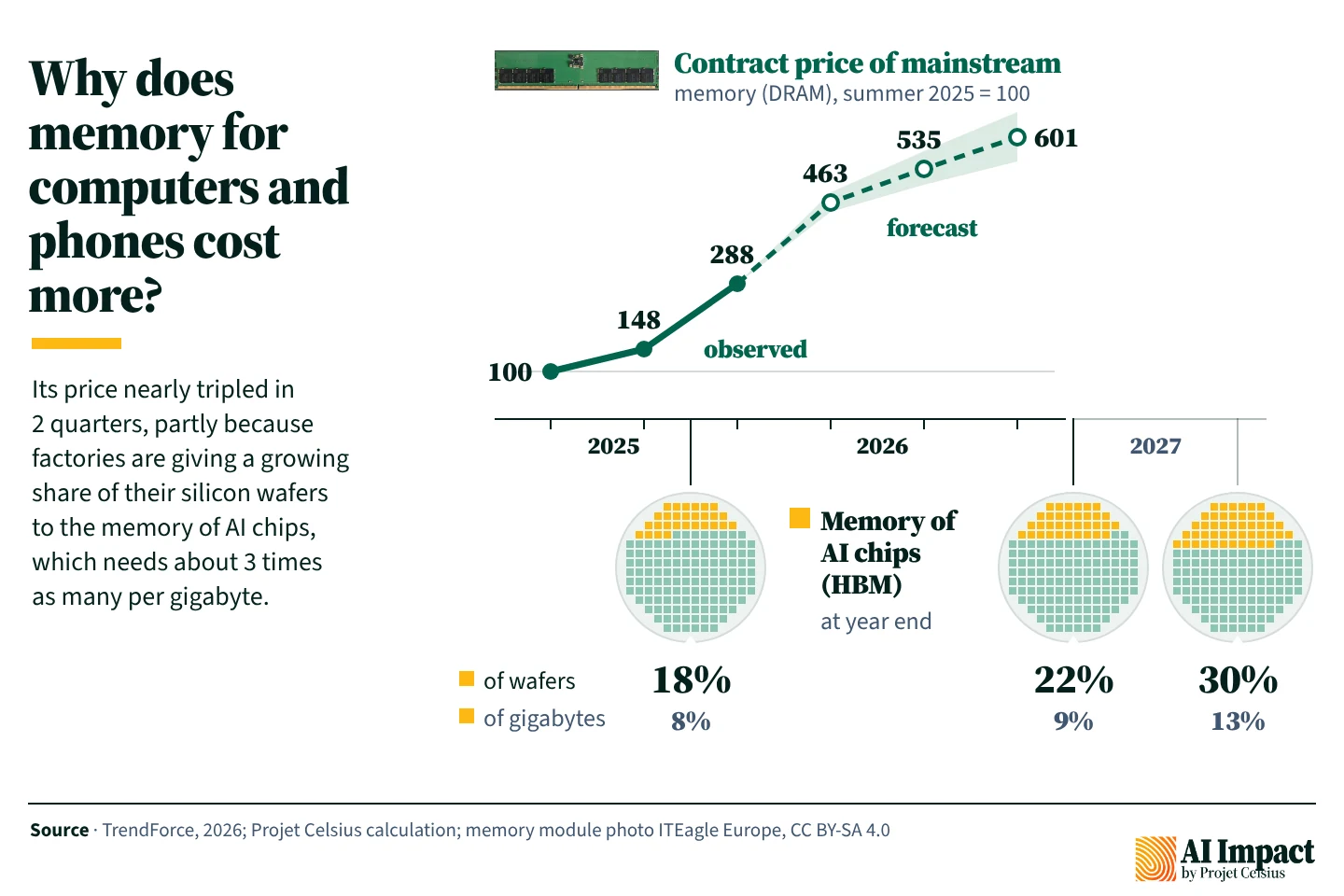
AI chip memory takes 22% of wafers for 9% of gigabytes
HBM, or high-bandwidth memory, is the RAM stacked around the compute chip of AI cards; an H100 reads it at 3.35 terabytes per second. TrendForce estimates that HBM will occupy about 22% of the DRAM wafers of the 3 major manufacturers at the end of 2026, for 9% of the gigabytes produced; at the end of 2027, 30% of wafers for 13% of gigabytes. One gigabyte of HBM therefore takes about 3 times as many wafers as one gigabyte of mainstream memory (our calculation). In its prepared remarks to investors of June 2026, Micron writes that this ratio increases with each generation of HBM and weighs on the supply of the other memories.
Manufacturers have 3 reasons to serve servers first:
- the price: according to TrendForce, in the 1st quarter of 2026, a wafer sold as 64 GB memory modules for servers already earned more than a wafer of HBM; demand from ordinary servers, which run inference and agents, therefore weighs as well;
- the contracts: the large data centre operators sign agreements lasting several years; SK hynix has agreements covering more than half of its 2027 and 2028 capacity;
- the factories: building a clean room takes years; SK hynix sees demand exceeding supply until 2030, and Micron says in September 2026 that it does not see when balance will return.
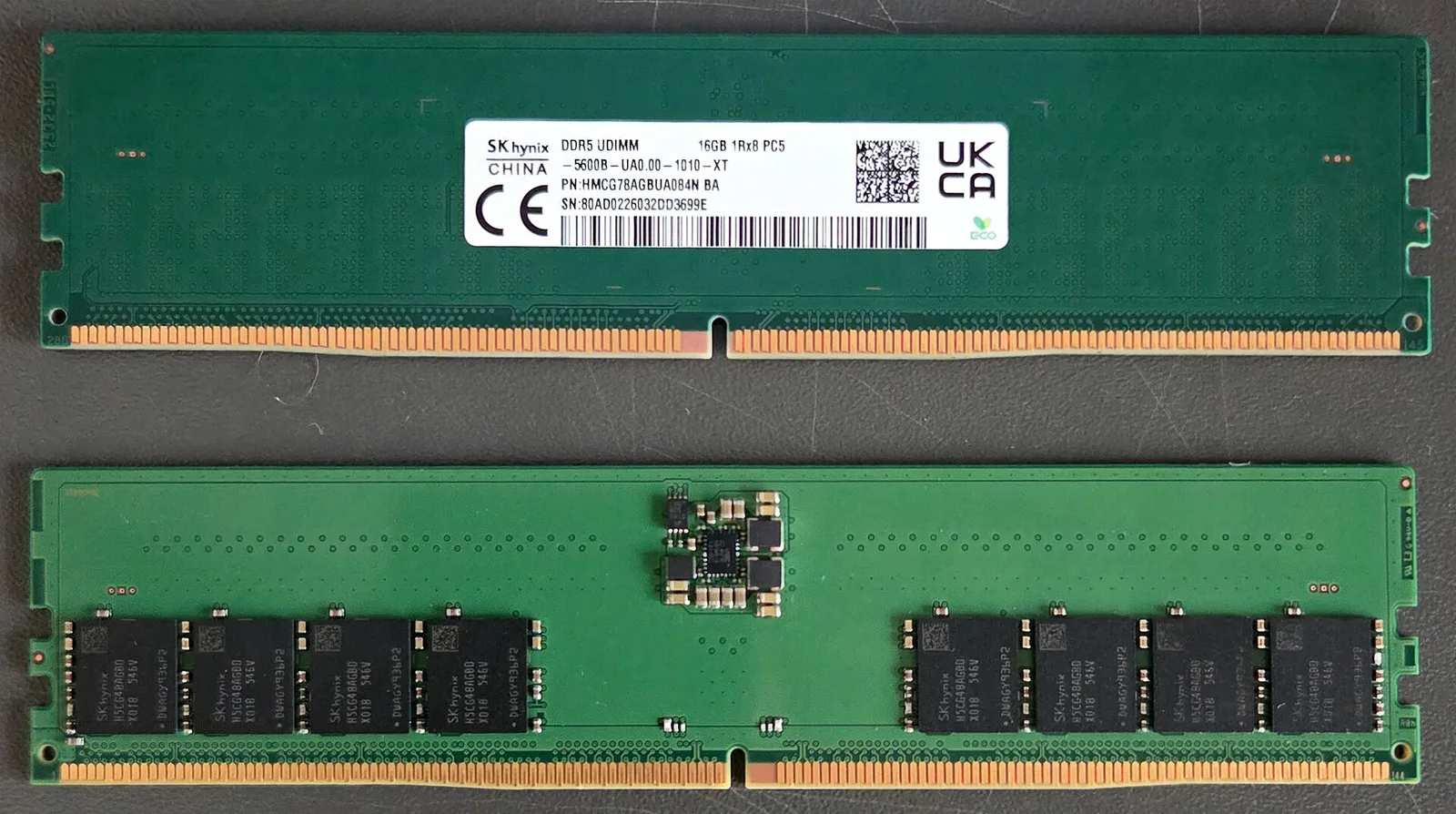
On 3 December 2025, Micron announced its exit from the consumer market: after 29 years, its memory and storage products for individuals, sold under the Crucial brand, were to be delivered to shops only until the end of February 2026, in order, according to the company, to better supply its large customers in the fastest-growing segments.
The price of mainstream DRAM has nearly tripled in 2 quarters
TrendForce, a Taiwanese firm that tracks the memory market, publishes each quarter the change in the contract price, the one that makers of computers, phones and servers pay their suppliers. For mainstream DRAM, all DRAM excluding HBM:
| Quarter | Increase over the quarter | Status | Index, summer 2025 = 100 |
|---|---|---|---|
| 4th quarter 2025 | +45 to 50% | observed | 148 |
| 1st quarter 2026 | +93 to 98% | observed | 288 |
| 2nd quarter 2026 | +58 to 63% | forecast | 463 |
| 3rd quarter 2026 | +13 to 18% | forecast | 535 |
| 4th quarter 2026 | +10 to 15% | forecast | 601 |
Contract price of mainstream DRAM, excluding HBM, from the TrendForce releases of 26 February, 31 March, 1 June, 3 July and 30 September 2026. A forecast increase is made at the start of the quarter; no observed increase has been published for the 2nd and 3rd quarters of 2026. The index compounds the midpoints of the ranges, our calculation; with their bounds, it runs from 280 to 297 in the 1st quarter of 2026 and from 550 to 657 in the 4th.
Observed increases and forecast increases
The first 2 increases are observed: the price nearly tripled between the 3rd quarter of 2025 and the 1st quarter of 2026 (our calculation). The next 3 are forecasts made at the start of the quarter; if they come true, the price at the end of 2026 will be about 6 times that of summer 2025. The pace is slowing because buyers of computers and phones are reaching the limit of what they can pay, TrendForce wrote in July. In September, it added that the supply of PC memory could fall in 2027, as capacity shifts to servers.
NAND, the storage memory of SSDs and phones, follows the same path: a forecast increase of 70 to 75% in the 2nd quarter of 2026, then 10 to 15% and 15 to 20%. No fall is announced: TrendForce expects a further acceleration in the DRAM increase in the 1st quarter of 2027.
Device makers are passing on the increase
In a computer or a phone, RAM and storage used to be one component among others. In February 2026, HP told its investors that memory and storage, about 15 to 18% of the cost of the components of its PCs in the quarter ended in October 2025, the last of its fiscal year, would make up about 35% over its fiscal year 2026, after a doubling of the cost of memory in a single quarter.
IDC's market research quantifies the pass-through to prices for 2026, as forecasts:
- smartphones : an average price of $581, up 27.6%, and 16.7% fewer devices sold, the steepest decline ever recorded;
- computers : an average price up 17% and 11.3% fewer devices sold.
The cheapest devices are the hardest hit, because memory weighs the most in them. At the low end, it makes up more than 65% of the cost of a smartphone's components, according to IDC, and shipments of smartphones under $100 fell by almost 60% over a year in the 2nd quarter of 2026. Raspberry Pi, which makes small single-board computers, has raised its prices several times, citing competition from AI infrastructure for memory factories:
- announced on 9 January 2025
- latest increase of $80, for lack of another source of 16 GB chips
At Samsung, which makes both memory and phones, the semiconductor division made an operating profit of 106.5 trillion won in the 3rd quarter of 2026, and the phones and networks division an operating loss of 0.6 trillion won, with a year-on-year decline that the company attributes to cost pressures.
Phones built with reused memory
Some makers of entry-level phones fit memory chips recovered from old devices and resoldered: 3 to 4% of smartphones in 2026 and 7 to 9% in 2027, according to TrendForce, which warns that their reliability is less certain and that the lifespan of the devices may suffer.
Manufacturing accounts for most of a device's footprint
The price increase does not change the main part of a device's footprint, which remains its manufacturing. According to ADEME, a smartphone has a life-cycle footprint of 80.2 kgCO2e, of which 79.3 kgCO2e for its manufacture and distribution, 99%; a laptop, 193 kgCO2e, of which 182 for manufacturing. The next chart compares 5 devices: the dark part of each bar, manufacturing, makes up 76% to 99% of the footprint.
 Hardware
The footprint of digital devices
Life cycle of a device, in kgCO2e, of which manufacturing · Impact CO2 values consulted in October 2026
Source: ADEME, Impact CO2 · projetcelsius.com/en/ai · CC BY 4.0
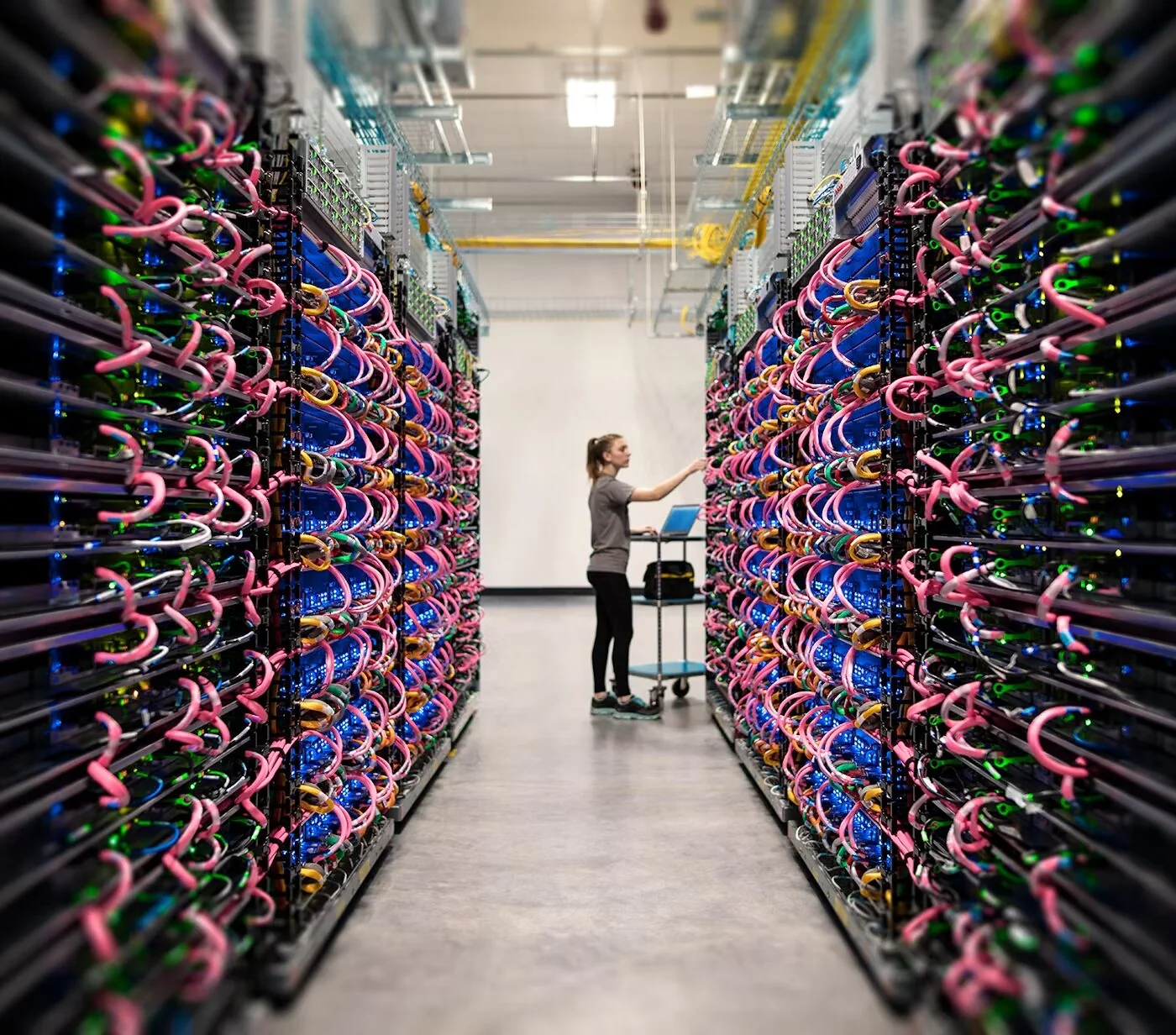
The memory that goes to servers is still manufacturing. On the Nvidia HGX H100 baseboard, which carries 8 AI chips, memory makes up 42% of the 1,312 kgCO2e of manufacturing, and 49% of the 2,274 kgCO2e on the next generation, the B200 (our analysis of AI manufacturing). As one gigabyte of HBM takes about 3 times as many wafers, its manufacture probably mobilises more factory capacity, electricity and water than one gigabyte of mainstream memory; no published measurement quantifies it.
On the device side, IDC forecasts around 200 million fewer smartphones sold in 2026 than in 2025 (our calculation). The effect on the footprint depends on what replaces them. A phone kept for longer adds little: over its 2.5 years of use, ADEME counts less than 1 kgCO2e for it outside manufacturing. A purchase merely postponed to 2027 changes nothing.
Our view
The rise in the price of memory shows that AI is also taking a share of semiconductor factories, in addition to the electricity and water of its data centres. That share used to go to computers and phones, and the price of devices is the most visible sign of it for the general public. It ties in with the action that weighs most on a person's digital footprint, because manufacturing accounts for most of a device's footprint: keeping it for longer (the figures on digital technology on our blog). Before buying, ask yourself 3 questions:
- can the current device last 1 or 2 more years, with a new battery or a repair?
- how much memory does the use really need, since memory is what pushes the price up?
- would a refurbished device do?
3 of the 5 quarterly increases in the DRAM price are TrendForce forecasts, and the contract prices it publishes are surveys of buyers and sellers; the shop price follows with a lag. The HBM share of wafers is an estimate. The increase also comes from the memory of ordinary servers, not only from that of AI chips.

He holds a doctorate from École polytechnique and an engineering degree from ESPCI Paris, and co-founded Projet Celsius, which he chairs. He is a lead trainer in Bilan Carbone® and life cycle assessment at the Institut de Formation Carbone.
His page and articles →Contact him →LinkedIn ↗
An engineer from UTBM and life cycle assessment trainer at the Institut de Formation Carbone, he carries out the life cycle assessments at Projet Celsius.
His page and articles →Contact him →LinkedIn ↗Sources
22 documents
- TrendForce, Tight DRAM Supply Gives Suppliers Greater Pricing Power in HBM2026entry 649
- TrendForce, Price Rally Drives 4Q25 DRAM Revenue Up 29.4%2026entry 659
- TrendForce, Rapid Contract Price Surge Drives 1Q26 DRAM Industry Up 81% QoQ2026entry 653
- TrendForce, AI Server Demand to Drive Memory Contract Price Increases in 2Q262026entry 660
- TrendForce, AI Server Demand Continues to Support Memory Prices in 3Q262026entry 650
- TrendForce, AI Server Demand Sustains Memory Contract Price Increases in 4Q262026entry 651
- TrendForce, Persistently High DRAM Prices Drive Adoption of Reballed Memory2026entry 652
- Micron, Micron Announces Exit from Crucial Consumer Business2025entry 658
- Micron, Fiscal Q3 2026 Earnings Call Prepared Remarks2026entry 654
- Micron, Fiscal Q4 2026 Earnings Call Prepared Remarks2026entry 655
Every figure was read in its source; the hub's methodology is described in Methodology and sources.
Guillaume Pakula and Sébastien Pierfederici, Why does AI push up the price of computers and phones?, AI Impact, Projet Celsius, 19 November 2026. https://projetcelsius.com/en/ai/analyses/why-ai-raises-computer-and-phone-prices/