
 Hardware13 November 2026
Why does AI need graphics cards?
Computation, memory, electricity and manufacture of an H100 card




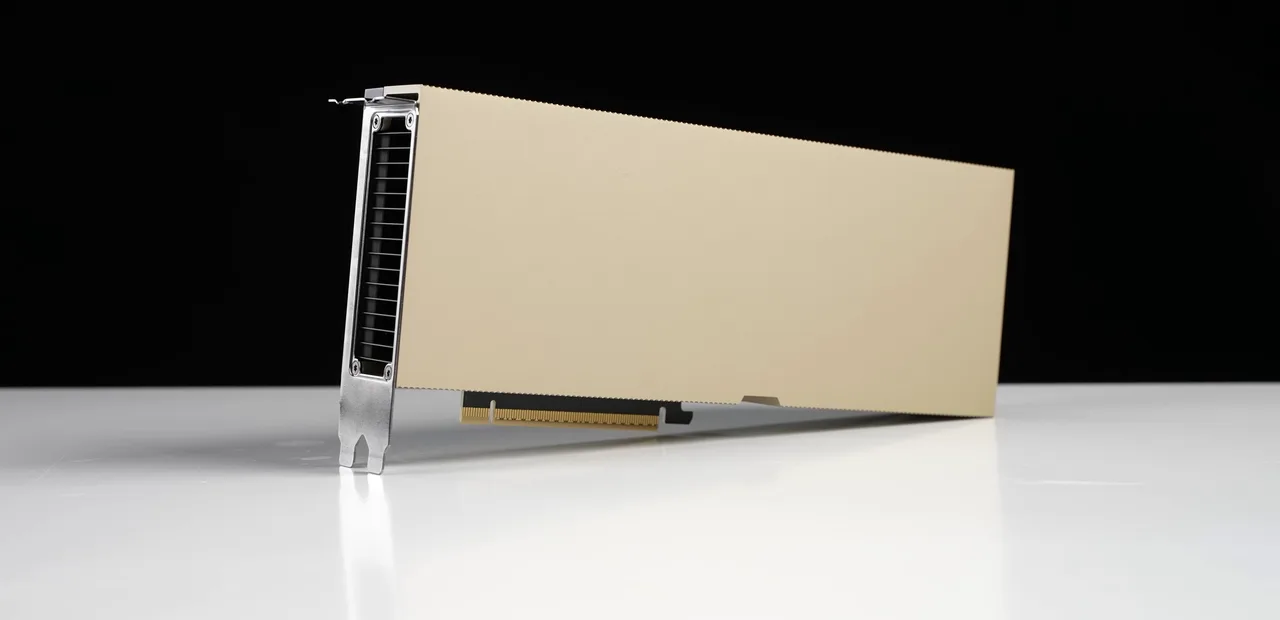
A Nvidia H100 graphics card in PCIe format, the version for ordinary servers, of 350 W; the figures in the text refer to the SXM version, fitted 8 to a board in AI servers. Image taken from a video by Geekerwan (极客湾), June 2023, CC BY 3.0, via Wikimedia Commons.
To write each word, a dense language model performs one multiplication and one addition for each of its billions of parameters, and must read all of them back from memory. A graphics card performs these operations by the thousand at the same time; the H100 SXM, fitted 8 to a board in AI servers, reads its memory at 3.35 terabytes per second. One hour of work by this card uses about 0.99 kWh, including its share of the server and the data centre, according to the AI Impact Database estimate; its manufacture emitted 164 to 235 kgCO2e according to estimates from Nvidia and ADEME.
Contents
A language model is a very large set of numbers, its parameters, arranged in tables called matrices. The calculation that follows applies to a so-called dense model, which uses all its parameters for each word; mixture-of-experts models use only some of them, for example 13 billion out of 47 for Mixtral 8x7B from Mistral AI. To write a word, or more precisely a piece of a word, the model passes the preceding text through these tables: each parameter is multiplied by a number, then the result is added to the others. The Nvidia guide to this calculation sums it up as follows: each multiplication followed by an addition counts as 2 operations.
For a model of 70 billion parameters, this comes to about 140 billion operations per word. These operations are independent of one another and can be carried out at the same time. This is the work that graphics cards were designed for, originally to calculate the points of an image in parallel, and which they now do for neural networks.
Parallel computation
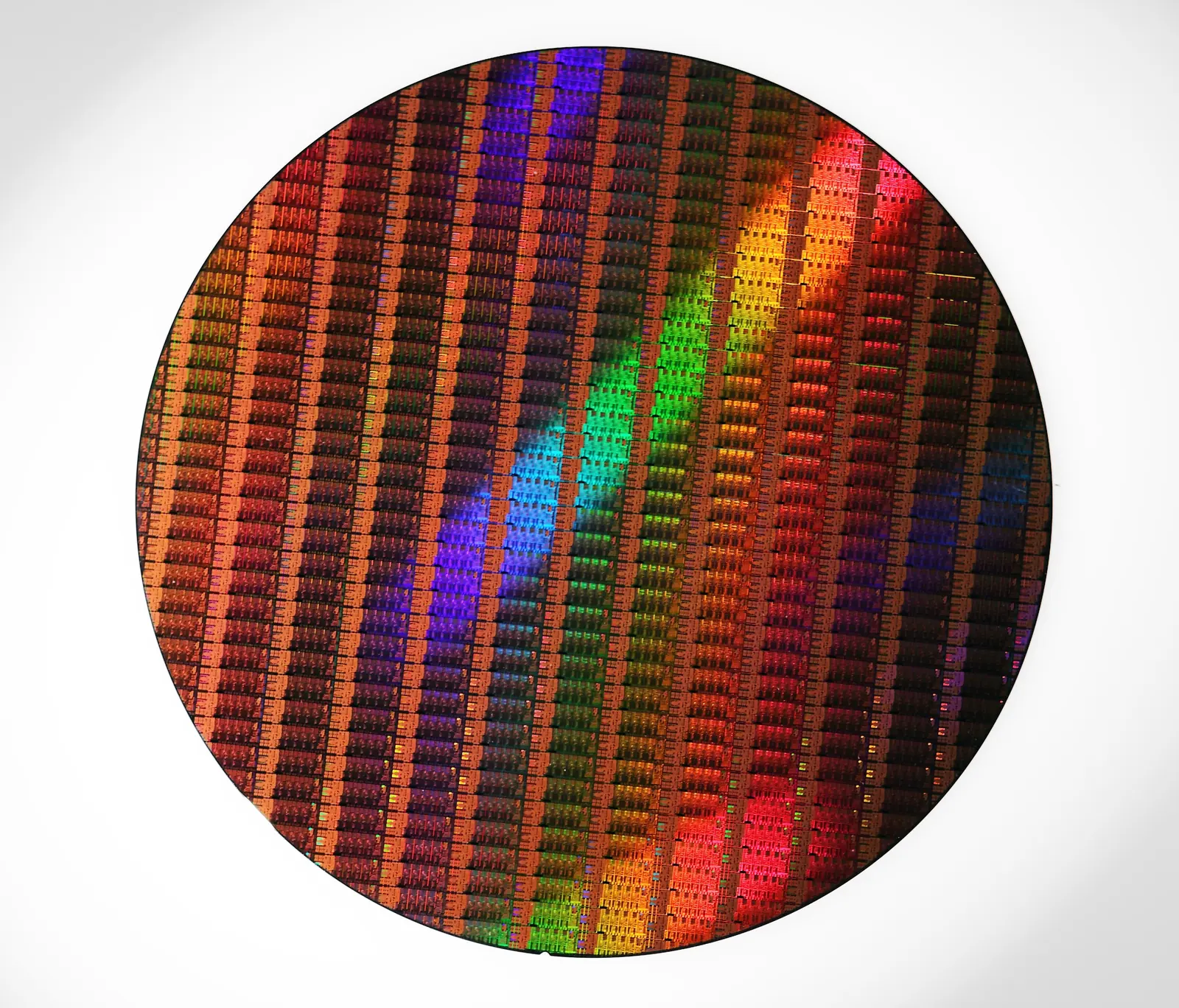
The Nvidia H100 card, in its SXM version fitted 8 to a board in AI servers, carries a chip of 80 billion transistors, etched by TSMC. It has 16,896 compute cores and 528 cores specialised in matrix products, which Nvidia calls Tensor Cores. Its Tensor Cores perform up to 989,000 billion operations per second on 16-bit numbers, and twice that on 8-bit numbers. At the start of 2025, the generation of the H100 and its variants accounted for 77% of the computing power of all Nvidia AI chips in service, according to Epoch AI.
A computer or server processor can chain together varied tasks, but it carries out far fewer operations side by side. For a neural network, where the same operations are repeated on billions of numbers, the number of operations carried out at the same time is what counts.
Card memory
To write each word, the card must read all the parameters of a dense model back from its memory. An H100 carries 80 GB of HBM3 memory, stacked around the chip, which it reads at 3.35 terabytes per second. A model of 70 billion parameters stored on 16 bits, or 2 bytes each, occupies 140 GB: it needs at least 2 cards.
Our calculation, as an order of magnitude, for a single request at a time on these 2 cards: reading the 140 GB takes about 21 thousandths of a second, and performing the 140 billion operations takes about 70 millionths of a second. The card therefore waits for its memory about 300 times longer than it computes. The Nvidia guide states that a matrix-vector product is always limited by memory; this is the shape of the computation when writing a single word for a single request.
| Step, for 1 word | Quantity | Throughput of 2 H100 cards | Duration |
|---|---|---|---|
| Reading the model parameters | 140 GB | 6.7 TB/s | about 21 ms |
| Performing the operations | 140 billion | 1,978,000 billion per second | about 0.07 ms |
Our calculation, for a model of 70 billion parameters stored on 16 bits, one request at a time, not counting the memory of the text already read. Maximum throughputs from Nvidia; in service, they are not sustained continuously.
This is why AI services group together the requests of many users: a single reading of the parameters then serves to write a word for each of them, and the electricity per request falls. Our analysis of AI installed on your own computer measures this effect. Memory is also the largest manufacturing item of the H100 baseboard according to Nvidia, with 42% of emissions, ahead of the chips, 25%.
Electricity use of a card in 1 hour
An H100 SXM has a rated power of 700 W. It does not work alone: the Nvidia DGX H100 server, which combines 8 of them, consumes at most 10.2 kW with its processors, memory, network and fans, or 1,275 W per card. Measurements published by Microsoft researchers on the previous generation find a power that reaches or exceeds the rated power when the model reads the request, and lower when it writes the response.
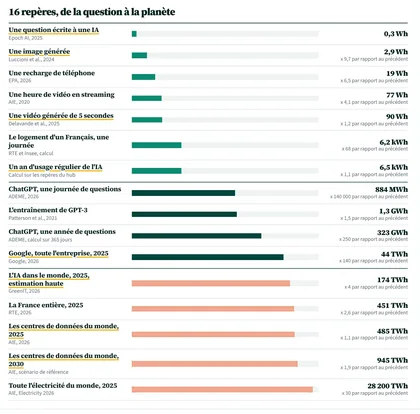
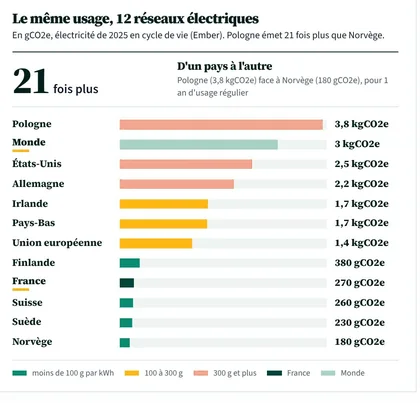
The AI Impact Database uses 900 Wh for one card-hour, 70% of the card's share of the server's maximum power, 1,275 W, the average load used by Epoch AI. With cooling and the rest of the data centre, the hour comes to 0.99 kWh, or 0.45 kgCO2e with the world average electricity, as much as 3 km in a petrol or diesel car, including the manufacture of the car, and not counting the manufacture of the server. These are estimates: no measurement of the average consumption of an H100 in service has been published.
One H100 card-hour, data centre included, compared with benchmarks (kgCO2e, world average electricity)
Manufacturing emissions of a card
In 2025, Nvidia published the manufacturing footprint of its HGX H100 baseboard, which carries 8 cards: 1,312 kgCO2e, from raw material extraction to assembly, or 164 kgCO2e per card. Memory is the largest item, at 42%, ahead of the compute and network chips, 25%. ADEME, with its own model, estimates a single H100 card at 235 kgCO2e, and notes that Nvidia's method is not very transparent.
 Hardware
Manufacture of an AI server, by component
Nvidia HGX H100 baseboard with 8 graphics cards, 1,312 kgCO2e, share of each component · Sheet published by Nvidia
Source: Nvidia, HGX H100 Product Carbon Footprint · projetcelsius.com/en/ai · CC BY 4.0
The whole server emits more in manufacture than its baseboard and its 8 cards, according to a simplified GreenIT study. GreenIT estimates the manufacture, distribution and end of life of an entry-level server with 8 H100 cards at 8,341 kgCO2e, about 1,000 kg per card. Spread over 5 years of service at 69% utilisation, this manufacture represents about 35 gCO2e per card-hour, or about 8% more than the electricity for that hour with the world average electricity, and 17% with that of the European Union.
Cards shipped by Nvidia
Epoch AI estimates, from Nvidia's financial results, that the company shipped about 4.5 million data centre cards in 2025, compared with 1.3 million in 2023. The maximum power of the cards shipped in 2025 alone reaches 4.9 GW, not counting servers or cooling. These are estimates, with an uncertainty that is often a factor of 2. Greenpeace East Asia estimates the electricity consumed to manufacture AI chips at 218 GWh in 2023 for Nvidia alone, and at 983.9 GWh in 2024 for Nvidia and AMD; the chart of electricity used to manufacture chips shows these 2 years and the share of the increase that comes from adding AMD.
Our reading
For us at Projet Celsius, the graphics card illustrates 2 features of the footprint of AI. The first: with the world average electricity, the electricity of one card-hour emits about 13 times more than the share of server manufacture that falls to it, and about 6 times more with that of the European Union; the size of the model and the number of requests served set the number of cards used. The second: memory limits the writing speed, and it is also the largest manufacturing item of the H100 baseboard according to Nvidia (42%) as well as of the next generation, the HGX B200 (49%), whose manufacture emits 1.7 times more. These figures come from Nvidia's sheets, the only ones published for these cards.
The consumption of one card-hour is an estimate: the average load of 70% comes from measurements on the previous generation, and no published measurement covers an H100 in service. The manufacture of a card ranges from 164 to 235 kgCO2e depending on the method, and about 1,000 kg for its share of the whole server, including distribution and end of life, according to a simplified GreenIT study.
Sources
16 documents
- Nvidia, Matrix Multiplication Background User's Guide2023entry 354
- Nvidia, NVIDIA Hopper Architecture In-Depth, technical blog post2022entry 352
- Nvidia, NVIDIA H100 Tensor Core GPU, technical specifications2023entry 351
- Nvidia, DGX H100/H200 User Guide, Introduction to the NVIDIA DGX H100/H200 System2024entry 353
- Epoch AI, How much energy does ChatGPT use?2025entry 20
- Patel et al. (Microsoft Azure), Characterizing Power Management Opportunities for LLMs in the Cloud2024entry 357
- Projet Celsius, AI Impact Database, environmental database of artificial intelligence, engine 0.3.12026entry 144
- ADEME, Impact CO2, transport2026entry 122
- Nvidia, HGX H100 Product Carbon Footprint Summary2025entry 18
- Nvidia, HGX B200 Product Carbon Footprint Summary2025entry 19
- ADEME, Analyse de cycle de vie de GPU pour l'intelligence artificielle, February 2026 (copy hosted by lafibre.info)2026entry 355
- GreenIT, Impacts environnementaux et sanitaires de l'intelligence artificielle dans le monde en 2025 et 20302026entry 6
- Epoch AI, AI chip sales, estimates by chip and by quarter (CSV file)2026entry 356
- Epoch AI, The stock of computing power from NVIDIA chips is doubling every 10 months2025entry 358
- Greenpeace East Asia, Chipping Point2025entry 44
- Jiang et al. (Mistral AI), Mixtral of Experts, arXiv preprint2024entry 359
Every figure was read in its source; the hub's methodology is described in Methodology and sources.
AI Impact, Projet Celsius, "Why does AI need graphics cards?", 13 November 2026. https://projetcelsius.com/en/ai/analyses/why-ai-needs-graphics-cards/
 Water

 Electricity