
 Climate13 November 2026
How could AI amplify the climate crisis?
Electricity, uses and climate policies, from 2025 to 2040




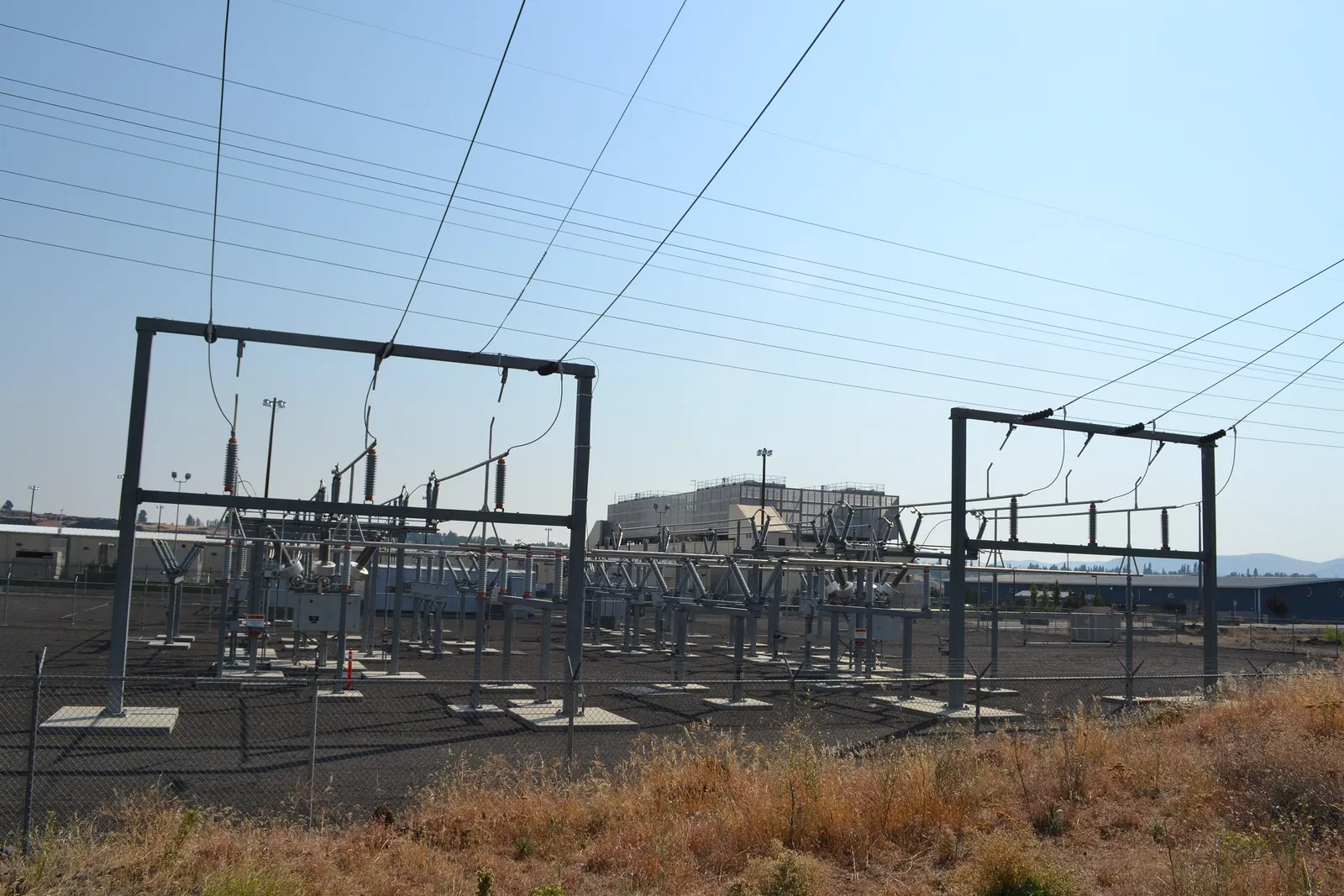
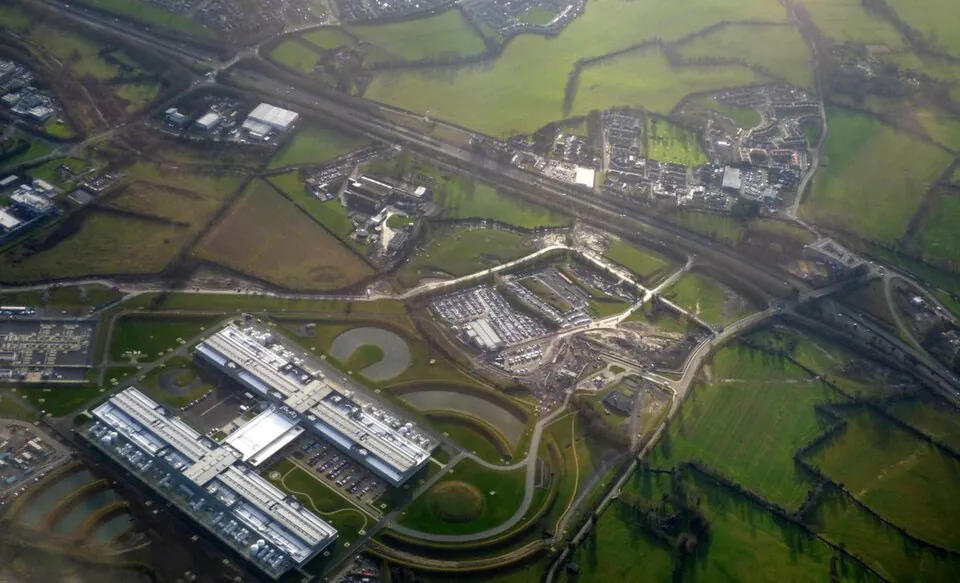
The electrical substation of the Google data centre in The Dalles, Oregon, in 2011. Photo Visitor7, CC BY-SA 3.0, via Wikimedia Commons.
One study gives AI 2 climate futures: 11% more CO2, cumulated from 2025 to 2040, or 1.4% less. The amount of electricity consumed explains only part of the gap. The rest comes down to where that electricity comes from, how AI is used and its effects on public debate.
Contents
Will AI push global emissions up, or bring them down? For 3 years, the question has set the terawatt-hours of data centres against the promises of optimisation. In February 2026, 11 researchers, from Imperial College, Oxford and the Potsdam institute among others, put online a study that quantifies the 2 together.
A powerful AI, electricity partly supplied by fossil-fuel plants, climate policies weakened.
An equally powerful AI, with efficiency standards, electricity low-carbon and strong governance.
This 11% figure calls for 3 precautions. It covers CO2 alone, cumulated from 2025 to 2040, and is read as a difference from a reference scenario in which AI would have no effect: it says neither what will happen, nor the share of AI in the emissions of 2040. It is the least favourable of 4 scenarios, built from the estimates of 17 experts. Finally, the study is a preprint, which other researchers have not yet reviewed, and its authors ask that it be treated as exploratory work.
Its value lies in adding together what AI consumes and what it makes people do. The authors draw a suggestion from it: the indirect effects could weigh more than electricity, on which almost all the attention is focused.
Between the worst and the best scenario, AI is equally powerful
The scenarios differ mainly in the rules that govern AI. In 3 of the 4, it is powerful and present everywhere. What varies is the governance of AI, the room left to climate policy and the origin of the electricity.
| Scenario | What characterises it | Cumulative CO2, 2025 to 2040 |
|---|---|---|
| AI against the climate | AI governance almost absent, electricity partly supplied by fossil-fuel plants, disinformation, climate targets set aside | 11% more |
| AI race | Competition between companies and between countries, growth before efficiency standards, real gains in several sectors | 6% more |
| Disappointing AI | Slower progress than announced, electricity demand at the bottom of projections, few indirect effects | Readable on a figure only, not given in the text |
| AI aligned with the climate | Strong governance, efficiency standards for data centres, low-carbon electricity | 1.4% less |
Source: Beath et al., preprint, February 2026. Difference from a reference scenario with no effect of AI. The scenario names are our translation.
In the least favourable scenario, emissions in 2030 exceed those of the reference scenario by 8%, and afterwards fall by only 4% over 10 years, whereas the reference falls by 12%. According to the authors, these results suggest that, within the range explored, the risks of an increase outweigh the chances of a decrease.
With an AI equally powerful in all 2 cases, the study obtains 11% more CO2 or 1.4% less, depending on its assumptions about governance, climate policy and the origin of the electricity.
The electricity of AI adds 0 to 6%, depending on what powers it
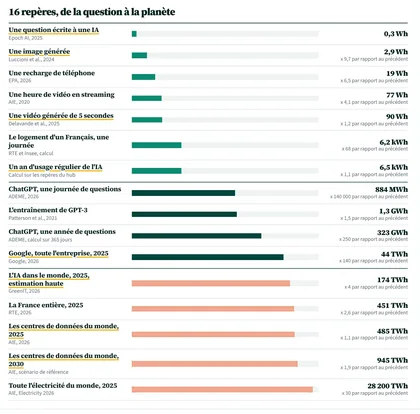
The electricity demand of AI is the most studied effect. The experts surveyed put it at 1,395 TWh in 2030 and 3,224 TWh in 2040, as a median value. That is 4.5% and then 10.4% of what the world consumed in electricity in 2024.
The effect on the climate then depends on the origin of that electricity. If climate policies are not extended beyond 2030, high demand supplied by dedicated fossil-fuel plants adds 6% to cumulative emissions. Drawn from the grid at least cost, it adds 2.7%, because the cheapest new capacity is renewable. Supplied by nuclear or renewables, it adds nothing in the model.
CO2 added from 2025 to 2040 by high AI electricity demand, depending on the origin of that electricity, without extension of climate policies after 2030.
According to the Shift Project, more than half of the electricity consumed by data centres worldwide came from fossil sources in 2024, and their footprint could reach 920 million tonnes of CO2e per year in 2030.
The climatologist Valérie Masson-Delmotte, who co-chaired Working Group I of the IPCC from 2015 to 2023, makes the same observation in a review of the state of data centres presented on 30 May 2026. She sees in it an "issue for the use of low-carbon electricity as a substitute for fossil fuels", notes the "massive relaunch of gas infrastructure" in the United States, and observes that the decarbonisation targets of Google and Microsoft for 2030 are "compromised" by generative AI.
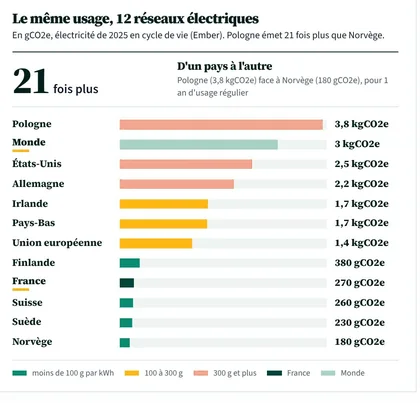
The origin of the electricity therefore matters as much as its quantity. That is why the hub publishes the carbon intensity of electricity country by country, and why the same question put to an AI does not carry the same weight depending on the grid that powers it.
AI in the service of oil and gas could weigh more than data centres
An AI that helps find a deposit, drill faster or operate a well better makes oil and gas cheaper to produce, and a fall in costs can push production up. This mechanism, flagged as early as 2024 in a commentary in the journal Nature, was quantified in August 2026 by a study published in npj Climate Action.
Its authors feed into a model of the global economy the productivity gains that AI would bring to the energy sectors, fossil and renewable. The emissions enabled by the gains in the fossil sector, before deducting avoided emissions, range from 0.6 to 2.4 billion tonnes of CO2 per year. That is 3.3 to 13.3 times the International Energy Agency's estimate for data centres, 0.18 billion tonne, which the authors cite. Once avoided emissions are deducted, a net increase of 0.47 to 1.8 billion tonne per year remains, or 1.2 to 4.8% of global energy-related CO2 emissions in 2024.
CO2 emissions per year, in billions of tonnes: data centres, and the emissions enabled by AI productivity gains in the fossil sector, before deducting avoided emissions.
The range is wide because it depends on assumptions about the size of the gains. The model describes an economic equilibrium, with no date, and it is calibrated on the economy of 2017, with an electricity mix adjusted to that of 2024. In every case studied, as soon as AI brings any gain to the fossil sector, the emissions it enables exceed those it avoids in renewables. To obtain a net decrease, renewables would have to gain 4 to 5 times more than the fossil sector. 2 of the authors declare a link with the Enabled Emissions Campaign, a non-profit research and advocacy project.
These emissions are poorly covered by footprints. They appear in the oil producer's footprint, lost in its volumes sold. They do not appear in that of the company that sells it the tool: an AI provider counts its servers, their electricity and their manufacture, and no mandatory category of the GHG Protocol asks it to count what its customers produce with its models. The authors ask that public policy make them a category of their own, that of enabled emissions.
Our reading: the case resembles that of banks, which count the emissions of companies and of the projects they finance. The difference is that a financed emission is calculated pro rata to a financing, whereas an enabled emission is a supplement estimated by a model. The question joins that of the place of AI in a Bilan Carbone®.
Autonomous transport is the first indirect effect of the model
The experts surveyed also cite the self-driving car. They estimate that it would bring down the cost of passenger transport by 27.1% in 2040 and push demand up by 21.8%, as median values. Tested with an average AI electricity demand, this effect takes cumulative emissions from 2025 to 2040 to more than 6% above the reference. It is the strongest of the indirect effects tested one by one.
Economists call this mechanism the rebound effect: what becomes cheaper is consumed more. The authors cite another example, the consumption of goods stimulated by advertising and online communication, and specify that they did not model it. The 11% figure therefore does not include it.
These effects are the least well known. In the same review, Valérie Masson-Delmotte writes that the indirect effects of digital technology, including induction and rebound effects, are "difficult to assess", drawing on Arcep.
Weakened climate policies, an unquantified risk
The 11% scenario contains an ingredient that is not a quantity of energy. AI plays a large part in the circulation of information there; disinformation and polarisation weaken the consensus on climate targets, which governments set aside. The authors do not quantify this mechanism directly: it shapes the assumptions of the scenario, and they consider it hard to represent in a model.
They note a second brake, political as well. Efficiency standards and rules on low-carbon electricity can be challenged in the name of the competitiveness of companies and countries. The authors add that they also push towards more frugal systems.
AI could also remove several billion tonnes a year
Other work quantifies possible reductions. The Grantham Research Institute, with the economist Nicholas Stern, estimates that AI could reduce global emissions by 3.2 to 5.4 billion tonnes of CO2e per year by 2035, in only 3 sectors: electricity, transport and food. That would be more than the increase due to data centres and AI.
The 2 studies do not measure the same thing. The Grantham study adds up potentials, sector by sector. The February 2026 study runs a model in which efficiency gains trigger rebounds, and finds only 1.4% reduction in its best scenario. They set the same condition: the Grantham study gives governments a decisive role and speaks of an "active State", the February study of strong governance and international cooperation.
None of the 2 studies expects emissions to fall from the technology alone.
Regulating AI for the climate takes 4 decisions
The work cited here points to 4 decisions, each tied to one of the mechanisms.
| Decision | What it targets | Who calls for it |
|---|---|---|
| Supply data centres with low-carbon electricity | The direct effect, from 0 to 6% in the model depending on the origin of the electricity | Beath et al. |
| Set efficiency standards and a reporting obligation | Know what models and data centres consume | Beath et al.; Luers et al., for measurement and reporting standards; the Shift Project, for a mandatory and audited census of data centres |
| Count enabled emissions and regulate uses in the service of fossil fuels | The effect of oil and gas | Alpine et al. |
| Anticipate rebounds sector by sector | Autonomous transport, through taxation and regulation | Beath et al. |
Sources: the studies cited in this analysis.
The hub counts the electricity, water and CO2e of a question put to an AI. This work invites us to count direct and indirect effects together. Our reading is that the footprint of AI has 3 tiers: what it consumes, what it makes possible to do, what it changes in public debate. The hub measures the first; the second could weigh more according to these studies, and the third is not quantified.
AI can therefore amplify the climate crisis: in the least favourable of the scenarios studied, by 11% of cumulative CO2 emissions from 2025 to 2040. Part of this risk comes from its uses, in addition to its electricity consumption.
The main study is a preprint, which other researchers have not yet reviewed. Its percentages cover CO2 alone, cumulated from 2025 to 2040, and are to be read as differences from a reference scenario: they are neither forecasts nor annual emissions. The study on oil and gas describes an economic equilibrium, with no date, and 2 of its authors declare a link with a campaign devoted to enabled emissions. The comparison with banks and the 3 tiers of the footprint are our reading.
Sources
6 documents
- Beath, Mittal, Gambhir et al., Artificial intelligence drives divergent emission futures, Research Square preprint2026entry 89
- Alpine, Geldner, Alpine, Chepeliev et al., AI-driven productivity gains enable more CO2 emissions than they avoid in a global energy-economy model, npj Climate Action, August 2026 (corrected in September 2026)2026entry 90
- Pierfederici, Stern, Romani et al., Green and intelligent: the role of AI in the climate transition, Grantham Research Institute2025entry 91
- Luers, Koomey, Masanet et al., Will AI accelerate or delay the race to net-zero emissions?, commentary in Nature2024entry 92
- The Shift Project, Intelligence artificielle, données, calculs : quelles infrastructures dans un monde décarboné ?2025entry 4
- Valérie Masson-Delmotte, Enjeux environnementaux des data centers, presentation at the general assembly of Essonne Nature Environnement2026entry 93
Every figure was read in its source; the hub's methodology is described in Methodology and sources.
AI Impact, Projet Celsius, "Comment l'IA pourrait-elle amplifier la crise climatique ?", 13 November 2026. https://projetcelsius.com/en/ai/analyses/comment-l-ia-pourrait-amplifier-la-crise-climatique/