
 Society13 November 2026
Why are data centre projects opposed in France?
Power, land, water, jobs and decision in 3 French projects, read in their public files




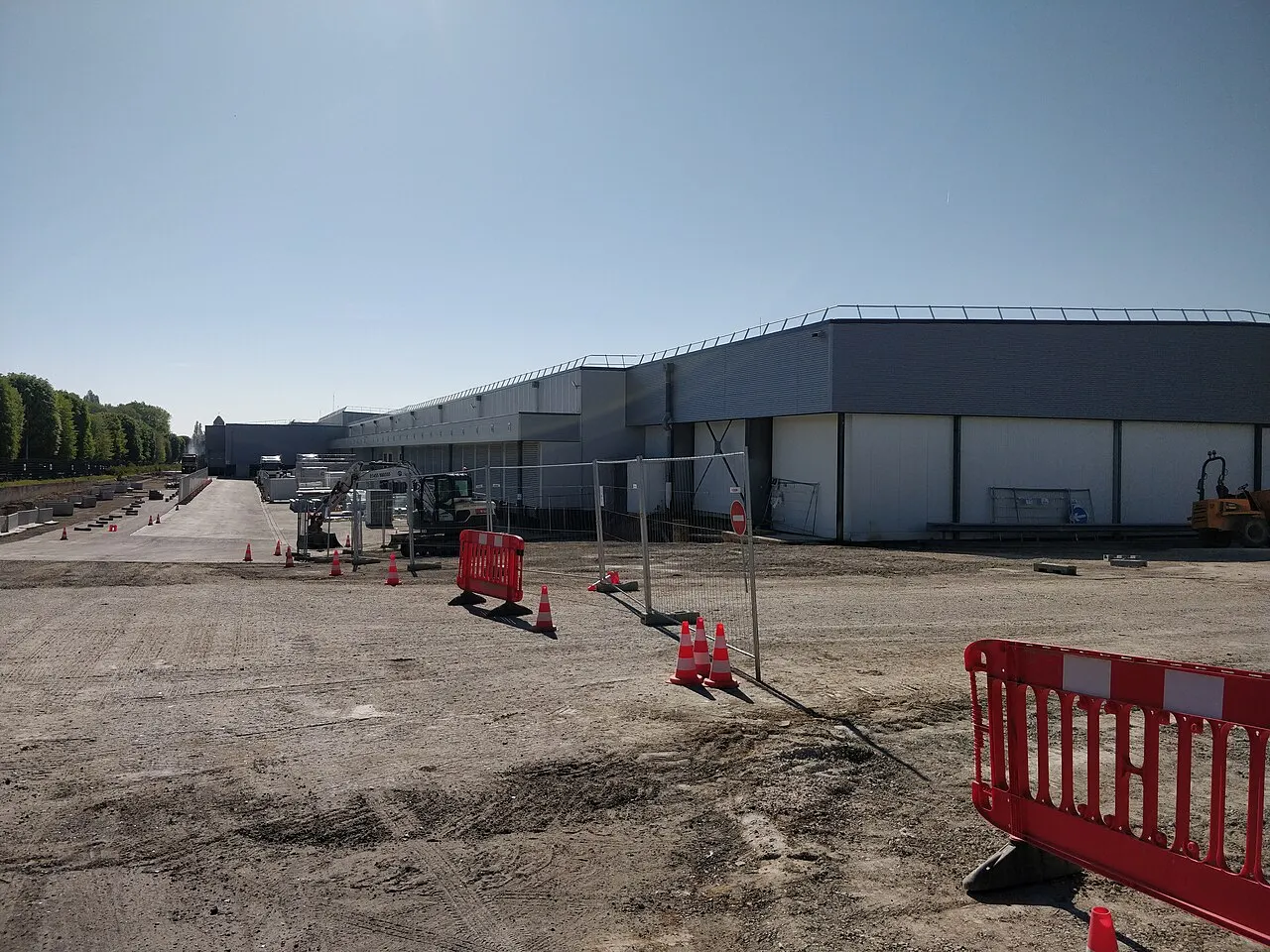
A data centre under construction at Wissous (Essonne), in April 2021. Photo unrelated to the projects cited. Photo: Like tears in rain, CC BY-SA 4.0, via Wikimedia Commons.
A large data centre asks a territory for electrical power, land and sometimes water. At Fouju, in Seine-et-Marne, the Campus IA project plans up to 1,400 MW on 70 hectares of farmland, for several hundred direct jobs. The environmental authority found shortcomings in the Petit-Landau and Marseille files; the Fouju file received observations that the government referred to the prefect, who takes the decision.
Contents
In May 2026, data centre projects had reserved nearly 18 GW of grid connection with RTE, for about 80 projects. Several have met local opposition: groups of residents and associations, petitions, resolutions by elected officials, questions in Parliament. To understand what is being objected to, we read the files of 3 projects at different stages, in their public documents: consultation file, environmental authority opinion, local council resolutions, government replies.
The Campus IA project, at Fouju in Seine-et-Marne, led by the Emirati fund MGX, Bpifrance, Mistral AI and Nvidia, obtained its environmental authorisations on 29 July 2026. For Microsoft's project at Petit-Landau and Hombourg, in the Haut-Rhin, we did not find a decision by the prefect as of 13 November 2026. MRS5, Digital Realty's 5th centre in Marseille, is under construction.
3 projects in the same units
| Campus IA, Fouju (77) | Microsoft, Petit-Landau (68) | Digital Realty MRS5, Marseille (13) | |
|---|---|---|---|
| Electrical power | 240 MW at end 2027, 700 MW at end 2029, up to 1,400 MW | unpublished | 22 MW |
| Annual consumption announced | unpublished | about 1,500 GWh | 231 GWh |
| Land | 70 ha of farmland | 36 ha of farmland, about ten of them organic | 1.1 ha of port brownfield site |
| Water | phase 1: dry cooling, no local water withdrawal; mixed solutions considered later | 8,200 m³ at filling, about 1,100 m³ per year | water from a former mine gallery for half of the cooling, public network for sanitary and fire uses |
| Direct jobs announced | several hundred | 150 to 200 | 40, and 160 indirect |
| Tax revenue quantified | no | no | no |
| Environmental authority opinion | text not found; observations referred to the prefect | major shortcomings; suspension of the review recommended to the prefect | electricity consumption not stated in the study |
Values announced by the developers or taken up by the authorities, in the public documents read on 13 November 2026: consultation file and RTE press release (Fouju); resolution of Mulhouse Alsace Agglomération of 22 June 2026 and press release of the Grand Est environmental authority (Petit-Landau); opinion of the Provence-Alpes-Côte d'Azur environmental authority, reply statement and Digital Realty brochure (Marseille). For Fouju, opponents cite 89 hectares in total.
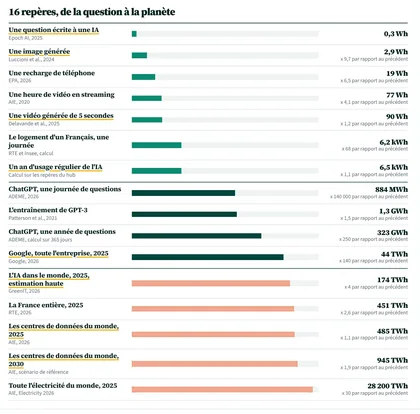
The Microsoft project would use as much electricity as more than 280,000 households, about 80% of household consumption in the Haut-Rhin, according to the Grand Est environmental authority. For Fouju, the developer does not publish an annual consumption. Data centres connected to the transmission grid currently draw on average 22% of their connection capacity, and their operators expect about 80% within 10 to 15 years, according to RTE. At these rates, 700 MW would amount to 1.3 to 4.9 TWh a year (our calculation).
Grievances noted in the 3 files
Farmland. Fouju and Petit-Landau are being built on cultivated land. At Petit-Landau, the environmental authority notes that more than half of the area will be sealed. The developers and local authorities reply that this land was earmarked for economic activity: at Fouju, a logistics project was due to be built there; at Petit-Landau, the territorial coherence scheme classifies the area as a strategic economic zone, and the departmental commission gave a favourable opinion on the agricultural compensation. The Marseille project occupies an industrial brownfield site.
Electricity and climate. The Grand Est environmental authority lists energy consumption and the contribution to climate change among the major shortcomings of the Microsoft file; the Provence-Alpes-Côte d'Azur authority noted that the MRS5 study did not state the site's total electricity consumption, which the developer provided later. Microsoft says it intends to cover its consumption through low-carbon electricity purchase contracts.
Cooling and air. Fouju has chosen water-free cooling, with rooftop refrigeration units containing 601 tonnes of refrigerant gas: opponents are concerned about leaks and PFAS. At Petit-Landau, the environmental authority estimates, by comparison with similar installations, that the backup generators could add about 20% to current nitrogen oxide emissions in Alsace, and notes that the entire hazard study was kept confidential.
Heat. At Fouju, the government lists 3 options studied by Campus IA: the Melun Val-de-Seine heat network, the future Crisenoy prison and greenhouses. At Petit-Landau, the elected officials behind a motion object to the lack of a connection to a heat network; the urban community replies that studies found the heat, at 30 °C, unsuitable for district heating, and that use for market gardening is being considered. In Marseille, the environmental authority mentions the connection of the extension of the cooling loop of the Digital Realty data centres, supplied with water from a former mine gallery, to the Massileo heat network. Our explainer on the heat of data centres shows why it remains little used.
Public information. The Fouju public inquiry lasted 31 days, the legal minimum being 30; a senator for Seine-et-Marne judged it insufficient, and the opponents' group called it "rushed". The online petition against the project had more than 47,000 signatures in August 2026. The inquiry commissioners gave a favourable opinion.
Governance. The Senate question and the Petit-Landau motion also raise the role of foreign capital in these projects and decisions seen as imposed; the Senate question reports that, according to the environmental authority, the Fouju site would have been classified Seveso had it been declared in a single file.
Who decides, and on what criteria
The environmental authority issues a non-binding opinion: the developer responds in writing, and the prefect decides on the environmental authorisation. At Petit-Landau, the urban community gave a favourable opinion on 22 June 2026, citing the lack of an alternative site, 150 to 200 jobs and an investment of nearly 2 billion euros, and noting that the environmental authority's opinion is not binding; it rejected, by 75 votes and 7 proxies to 10, a motion by councillors asking the prefect to follow that opinion. The municipality or the inter-municipal body brings the local land-use plan into line; RTE builds the connection.
The State intervenes upstream. The accelerated connection procedure approved by the Commission de régulation de l'énergie in May 2025 applies to sites identified by the State; Fouju was its first application. The law on the simplification of economic life of 26 May 2026 makes it possible to classify a data centre by decree as a project of major national interest, according to its importance for the digital transition, the ecological transition or national sovereignty; the prefect then becomes competent for the building permit. On 30 July 2026, the government stated that Campus IA had not requested this status. The public consultation at Fouju, under the aegis of the Commission nationale du débat public, was voluntary: the project was not subject to it.
Our reading
In our view at Projet Celsius, the files we read show a gap in what is quantified: the power, land and grid capacity asked of the territory are quantified, up to the equivalent of the consumption of hundreds of thousands of households; the tax revenue and the use of the heat are not. Opponents add governance concerns. The files would gain from giving, in the same units, the resources provided by the territory and the benefits it receives, tax revenue included. Our analysis on the electricity shortage deals with the place of these projects on the grid.
The power, consumption and jobs figures in this table are announced by the project developers; none is measured. The text of the environmental authority's opinion on Fouju could not be found: only its quotations by third parties are known.
Sources
13 documents
- RTE, Les data centers en chiffres clés, page mise à jour en mai 20262026entry 331
- Campus IA, dossier de concertation préalable, Commission nationale du débat public2025entry 337
- RTE and Campus IA, communiqué sur le raccordement accéléré de Campus IA, 26 January 20262026entry 338
- Mulhouse Alsace Agglomération, délibération du conseil d'agglomération du 22 June 2026 sur le projet de centre de données de Microsoft à Petit-Landau et Hombourg2026entry 339
- Mulhouse Alsace Agglomération, vœu relatif au projet de Microsoft, séance du 22 June 20262026entry 340
- Mission régionale d'autorité environnementale Grand Est, communiqué de la séance du 19 March 20262026entry 341
- Mission régionale d'autorité environnementale Provence-Alpes-Côte d'Azur, avis n° 2024APPACA16 sur le projet MRS5 de Digital Realty, 4 April 20242024entry 342
- Digital Realty, mémoire en réponse à l'autorité environnementale sur MRS52024entry 343
- RTE, Bilan électrique 2025, rapport complet2026entry 332
- Next, La préfecture de Seine-et-Marne autorise l'installation de Campus IA à Fouju, 13 August 20262026entry 344
- Senate, question écrite n° 08929 sur le projet de centre de données de Fouju, 28 May 2026, et réponse du ministère chargé de l'IA et du numérique, 30 July 20262026entry 345
- Assemblée nationale, question orale n° 501, Centre de données à Fouju, et réponse du gouvernement, 14 January 20262026entry 346
- Cabinet Gossement Avocats, Centres de données : ce que change la loi de simplification de la vie économique2026entry 347
Every figure was read in its source; the hub's methodology is described in Methodology and sources.
AI Impact, Projet Celsius, "Why are data centre projects opposed in France?", 13 November 2026. https://projetcelsius.com/en/ai/analyses/why-data-centre-projects-face-opposition-in-france/
 Electricity