
 Uses14 November 2026
Can you trust an AI's answers, and where does it go wrong most often?
Error rates measured by type of question, typical errors and settings that make them vary




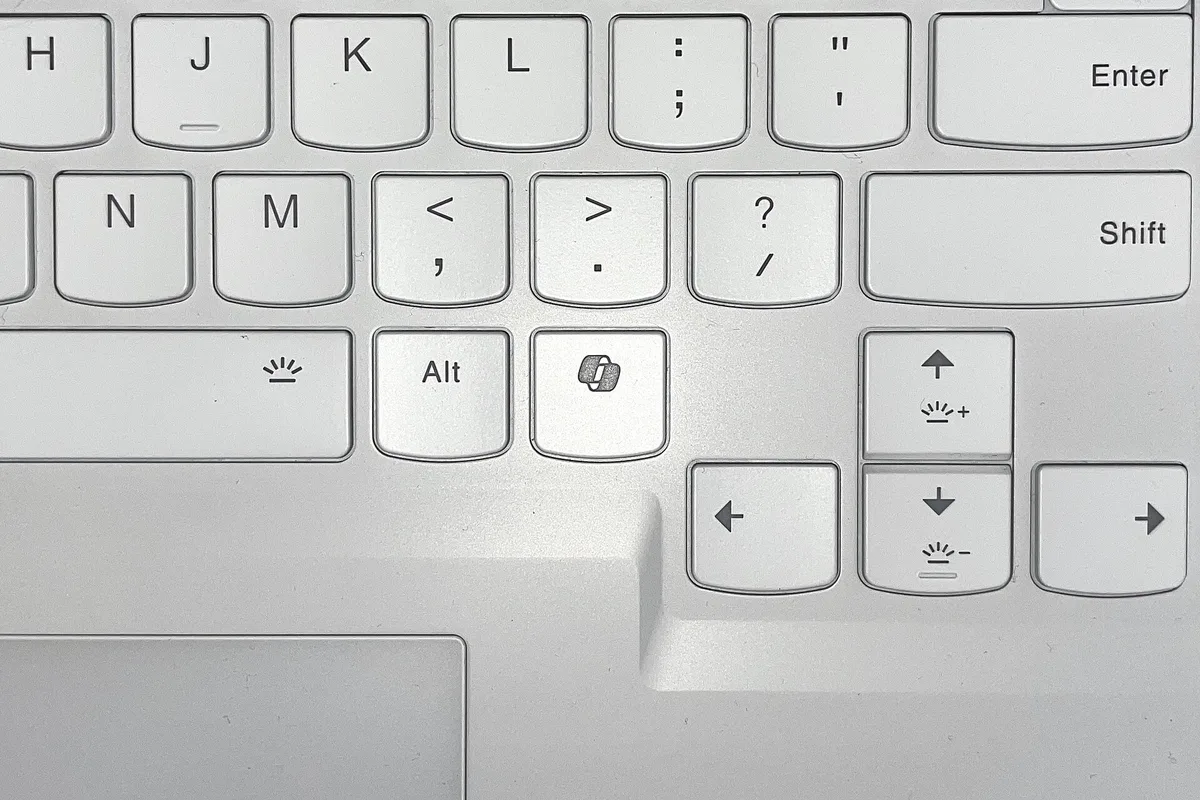
The Copilot key of a 2024 Lenovo Legion 7i laptop. Photo DigitalIceAge, CC BY 4.0, reduced, via Wikimedia Commons.
An AI makes few mistakes when it summarises a text it is given: 3 to 15% of summaries from current models contain an error, according to the Vectara ranking. It makes many more when it answers a precise question from memory: on difficult factual questions, without a web search, GPT-5 and GPT-4o answer 40 to 52% of questions wrongly. Tracing the source of an article is the least reliable task: more than 60% of incorrect answers in the Tow Center test. These measures cannot be compared with one another. We draw an order of magnitude from them: a supplied text first, then a web search whose sources you open, then the model's memory; news and source retrieval remain fragile even when the assistant searches the web.
Contents
A language model writes the most probable continuation of a text. When the information is in the text it is given, it rephrases it; when it is not, it reconstructs it from what it read during training, and it can write a plausible but wrong answer. Researchers call these errors "hallucinations". Researchers at OpenAI and Georgia Tech see them, in a preprint, as a consequence of training and evaluations, which reward a guessed answer over an admission of ignorance. The error rate therefore depends mainly on what the model is asked.
Error rates measured by type of question
| Type of question | Measured error rate | What is counted | Source |
|---|---|---|---|
| Summarising a supplied document | 3 to 15% for current models; from 1.8 to 24.2% depending on the model | summaries that contain a fact absent from the document | Vectara, October 2026 |
| Everyday questions with web search | 4.5 to 12.9% depending on the model | claims with an error, minor or major; real ChatGPT conversations | OpenAI, August 2025 |
| Short, difficult factual questions, without search | 40 to 52% for GPT-5 and GPT-4o | questions that receive a wrong answer, out of all questions | OpenAI, SimpleQA, 2025 |
| Questions on current affairs | nearly half of the answers | answers with at least one significant problem of accuracy, sourcing or context | EBU and BBC, October 2025 |
| Finding the source of an article excerpt | more than 60%; from 37 to 94% depending on the tool | answers that get the article, the publisher or the address wrong | Tow Center, March 2025 |
Ranked from most to least reliable, in our reading as an order of magnitude. The measures cannot be compared with one another: tasks, models, definitions of error and scoring methods differ. The EBU and Tow Center rows concern assistants that search the web.
Summarising a supplied text is the most reliable use. The Vectara ranking has each model summarise more than 7,700 articles, with the instruction to use only the text, and counts the summaries that add an absent fact: from 3 to 15% for most current models. Reasoning models do no better on this exercise: 18.6% for o4-mini, 23.3% for o3-pro.
Answering with a web search gives the lowest rates published by OpenAI. In a sample of real ChatGPT conversations, with search enabled, 4.5% of GPT-5 Thinking's claims contain an error, minor or major, against 9.6% for the fast GPT-5 model and 12.9% for GPT-4o. From 4.8% (GPT-5 Thinking) to 20.6% (GPT-4o) of answers contain at least one major error. These rates are graded by another model, which checks each claim on the web, and published by the publisher on its own models.
Answering a precise question from memory is less reliable. OpenAI's SimpleQA test asks about 4,000 factual questions with short answers. Without search, GPT-5 Thinking answers 40% of questions wrongly, the fast GPT-5 model 47%, GPT-4o 52%. A model that says it does not know lowers this rate: a question left unanswered does not count as an error. gpt-5-thinking-mini thus falls to 26% by abstaining on half of the questions.
News and sources are the most fragile. The European Broadcasting Union and 22 public service media from 18 countries assessed more than 3,000 answers from ChatGPT, Copilot, Gemini and Perplexity to questions on current affairs, in 14 languages: nearly half of the answers had at least one significant problem, about a third a serious sourcing problem, a fifth a serious accuracy problem, including outdated information. The Tow Center at Columbia University asked 8 AI search engines to find the title, publisher, date and address of articles from an excerpt: more than 60% of the answers were incorrect, from 37% for Perplexity to 94% for Grok 3. The assistants tested in these 2 studies searched the web: search is not enough when the question concerns current affairs or a precise source.
Typical errors
Invented or broken sources. In the Tow Center test, more than half of the answers from Gemini and Grok 3 cited invented or dead addresses; 154 of Grok 3's citations out of 200 led to an error page. Asking an AI for its sources is therefore not enough: you have to open the links.
References that do not exist. The database kept by Damien Charlotin, a researcher at HEC Paris, records 2,292 court decisions as of 12 November 2026 in which the court noted, or suspected, content invented by an AI in a party's filings, most often case law or quotations that do not exist. This count of discovered cases does not give a rate.
Outdated information. A model only knows what it read before the end of its training; without search, it answers on current affairs with old facts, one of the causes of the accuracy errors identified by the EBU.
Factors that make errors vary
What lowers them. Web search, when compared on the same test. On biographies of public figures (FActScore), the share of erroneous claims by GPT-5 Thinking goes from 3.7% without search to 1.0% with it, and that of o3 from 24.2% to 5.7%, according to the GPT-5 system card. No public measurement found compares the same questions with and without a supplied text. In the same card, GPT-5 Thinking makes 2 times fewer erroneous claims than the fast GPT-5 model, 4.5% against 9.6%; these are 2 different models, and o3, which also reasons, makes 12.7%, as many as GPT-4o.
What raises them. Knowledge questions about people: on OpenAI's PersonQA test, o1 has a hallucination rate of 16%, o3 33%, o4-mini 48%. OpenAI notes that small models know fewer things and make more mistakes on these questions, and that o3, which makes more claims, makes more correct ones and more wrong ones; reasoning therefore does not reduce errors in every case. On summarisation, the effect of size reverses: at OpenAI, the smallest model of the GPT-5.4 family produces 3.1% of erroneous summaries and the largest 8.3% (Vectara).
Reasoning also has an electricity cost: a model that reasons writes a hidden draft before answering; our explanation explains why this uses more energy, and our analysis on choosing a model sets reliability and energy use side by side, task by task.
Our reading
For us at Projet Celsius, you can trust an AI to the extent that you can check what it says. It is most reliable when it works on a text you give it, fairly reliable when it searches the web and cites pages you can open, and unreliable when it answers from memory on a precise fact, a person or a reference, or when you ask it for current events or a specific source, even with a search. The published rates come mostly from the vendors and a few independent teams, on different tests; none tells a user the probability that the answer in front of them is wrong.
The rates cited cannot be compared with one another: tasks, models, dates and definitions of error differ, and several are measured by a grading model. The OpenAI rates concern its own models. Calculation and dates, measured by mathematics tests that do not relate to everyday uses, are not covered here.
Sources
7 documents
- Kalai, Nachum, Vempala and Zhang, Why Language Models Hallucinate, arXiv 2509.046642025entry 496
- Vectara, Hallucination Leaderboard (HHEM evaluation model), updated on 22 October 20262026entry 497
- OpenAI, GPT-5 System Card2025entry 498
- OpenAI, OpenAI o3 and o4-mini System Card2025entry 499
- EBU and BBC, News Integrity in AI Assistants2025entry 500
- Jaźwińska and Chandrasekar, We Compared Eight AI Search Engines. They're All Bad at Citing News, Columbia Journalism Review2025entry 501
- Damien Charlotin, AI Hallucination Cases, updated on 12 November 20262026entry 502
Every figure was read in its source; the hub's methodology is described in Methodology and sources.
AI Impact, Projet Celsius, "Can you trust an AI's answers, and where does it go wrong most?", 14 November 2026. https://projetcelsius.com/en/ai/analyses/can-you-trust-ai-answers/


 Society