
 Climate13 November 2026
Does AI pollute more than aviation?
Emissions of the 2 sectors worldwide, in 2025 and in 2030, then at the scale of one person




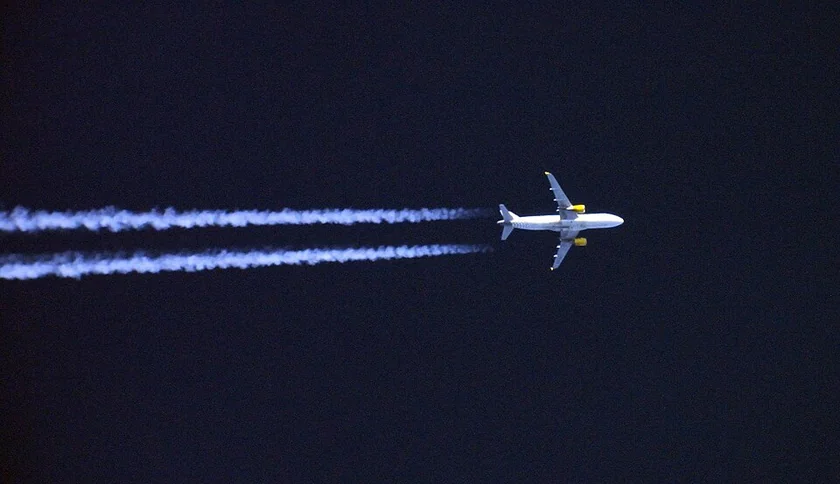
A Vueling Airbus A320 at altitude, followed by its contrails. Photo by Sébastien Lebrigand, CC BY-SA 2.0, via Wikimedia Commons.
AI emits less than aviation. According to the GreenIT estimate, it emitted about 99 million tonnes of CO2e in 2025, and aviation emitted 942 million tonnes of CO2 in 2024, not counting its contrails. The GreenIT projection for 2030, 636 million tonnes, stays below that level. According to our calculation, one return trip between Paris and New York weighs as much as about 6,100 years of everyday AI use.
Contents
The comparison circulates in 2 forms: "digital technology pollutes more than aviation" and, since the arrival of ChatGPT, "AI pollutes more than aviation". The first can be verified for aviation's CO2 alone; with its contrails, the gap narrows. The second cannot be verified today, nor in 2030 in the GreenIT projection. At the scale of one person, a long-haul flight weighs thousands of times one year of everyday AI use.
AI emits about 10 times less than aviation
Flights worldwide emitted 942 million tonnes of CO2 in 2024, according to ATAG, the organisation that brings together the aviation sector, compared with 882 million in 2023. This is about 2% of the CO2 emitted by human activities. For AI, the only worldwide life cycle estimate we have found is that of GreenIT: 99 million tonnes of CO2e in 2025, counting the manufacture and electricity of servers, storage, network and data centres. AI therefore emits about a tenth of the CO2 of aviation.
The International Energy Agency (IEA) counts differently: 180 million tonnes of CO2 in 2024 for the electricity of all the world's data centres, of which AI is only a part. This wider scope, which includes all the other digital uses hosted in these centres, represents about a fifth of the CO2 of aviation.
Aviation warms the climate about 3 times more than its CO2 alone
The 942 million tonnes count only the CO2 from engines. An aircraft at altitude also leaves contrails, which form clouds, and nitrogen oxides. The reference study on these effects, published by Lee and co-authors in 2021, estimates that they make up 2 thirds of the radiative forcing of aviation in 2018: the total radiative forcing of aviation was about 3 times that of its CO2 alone. This ratio is not a CO2e equivalence factor, which depends on the period over which one counts, but it shows that a comparison in CO2 alone underestimates the weight of aviation.
At the scale of a single flight, ADEME counts these effects in the Base Carbone: for a long-haul flight, its factor with contrails is 1.8 times the factor without contrails. The worldwide comparison on this page, which sets aviation's CO2 alone against the life cycle of the servers, storage, network and data centres of AI, is therefore favourable to aviation.
Digital technology as a whole emits 2 times the CO2 of aviation
The sentence "digital technology pollutes more than aviation" comes from another scope: telephones, computers, televisions, networks and all data centres. GreenIT estimates it at 1,832 million tonnes of CO2e in 2023, 3.4% of global emissions, about 2 times the CO2 of aviation. Computer centres account for 22.8% of it. With its non-CO2 effects, about 3 times its CO2 alone according to Lee and co-authors, aviation would weigh on the climate as much as digital technology, or even more. Other estimates range from 1.4 to 3.9% of global emissions depending on the scope; the chart of digital technology in global emissions compares them.
In 2030, AI would remain below today's aviation
GreenIT projects 636 million tonnes of CO2e for AI in 2030, 6 times more than in 2025. It assumes servers used 24 hours out of 24 and electricity that does not decarbonise, and exceeds the IEA projections for all data centres together. The IEA, for all data centres, forecasts a peak of about 320 million tonnes of CO2 around 2030 in its base case scenario, and a plateau of about 475 million at the start of the 2030s in its high-growth scenario. ATAG does not publish a projection of aviation emissions for 2030; they increased by 7% between 2023 and 2024.
Emissions of AI and data centres in 2030, compared with aviation in 2024 (million tonnes)
Between 2025 and 2030, in this projection, the gap narrows: AI emissions grow there by about 45% a year; the analysis " How could AI amplify the climate crisis? " examines what would make it weigh more.
For one person, a flight weighs thousands of years of AI use
A return trip Paris - New York, about 11,700 km, emits 2.1 tonnes of CO2e per passenger with the ADEME Base Carbone factors, contrails included, and 1.1 tonne without them. This is about 25% of the annual carbon footprint of a French person, 8.3 tCO2e. A one-way flight Paris - Marseille emits about 150 kgCO2e with contrails.
On the other side, one year of everyday personal AI use weighs about 340 gCO2e for the electricity of the servers, according to the AI Impact Database. According to our calculation, it would take about 6,100 years of this use to equal a return trip to New York. The heaviest profile in the Database, a developer who hands tasks to code agents every day, reaches 180 kgCO2e a year: slightly more than a one-way flight Paris - Marseille, 11 to 12 times less than a return trip to New York.
| Action or use | kgCO2e | Equivalent in years of everyday AI use |
|---|---|---|
| Return trip Paris - New York, with contrails | 2,077 | about 6,100 |
| Return trip Paris - New York, without contrails | 1,142 | about 3,400 |
| One-way flight Paris - Marseille, with contrails | 147 | about 430 |
| 1 year of a developer with code agents | 180 | about 530 |
| 1 year of everyday personal AI use | 0.34 | 1 |
Our calculation. Flights: Base Carbone factors for an aircraft with 101 to 220 seats, great-circle distances of 5,834 km and 652 km; with an aircraft of more than 220 seats, the return trip Paris - New York weighs 1.8 t with contrails. AI: AI Impact Database, electricity of servers and data centre only, world average electricity; the manufacture of servers and the training of models are not counted.
Our reading
For us at Projet Celsius, the comparison with aviation reads differently depending on the scale. For one person, a transatlantic return flight weighs more than a year of AI use, even for the most intensive profile in the Database, with only server electricity counted. Worldwide, AI emits about one tenth of the CO2 of aviation today, but its emissions are growing faster: in GreenIT's projection, about 45% a year between 2025 and 2030, against 7% for aviation between 2023 and 2024. We will update this page with each new estimate from GreenIT, the IEA and ATAG.
The scopes are not identical: AI is counted over its life cycle (manufacture and electricity) and in CO2e, worldwide aviation in CO2 only, without its contrails. The 99 and 636 MtCO2e for AI come from a single study, that of GreenIT, and 636 is a projection at constant electricity. The year of AI use counts only the electricity of the servers.
Sources
12 documents
- ATAG, Facts and figures2026entry 52
- ATAG, Aviation and climate change, entry no. 2, aviation emissions 20232024entry 51
- GreenIT, Impacts environnementaux et sanitaires de l'intelligence artificielle dans le monde en 2025 et 20302026entry 6
- IEA, Energy and AI2025entry 1
- Lee et al., The contribution of global aviation to anthropogenic climate forcing for 2000 to 2018, Atmospheric Environment, vol. 2442021entry 407
- GreenIT, Impacts environnementaux du numérique dans le monde2025entry 7
- ADEME, Base Carbone, avion de 101 à 220 sièges, plus de 5,000 km, avec traînées2025entry 408
- ADEME, Base Carbone, avion de 101 à 220 sièges, plus de 5,000 km, sans traînées2025entry 410
- ADEME, Base Carbone, avion de plus de 220 sièges, plus de 5,000 km, avec traînées2025entry 411
- ADEME, Base Carbone, avion de 101 à 220 sièges, 500 à 1,000 km, avec traînées2025entry 409
- Projet Celsius, AI Impact Database, environmental database of artificial intelligence, engine 0.3.12026entry 144
- SDES and Insee, L'empreinte carbone de la France de 1990 à 20252026entry 53
Every figure was read in its source; the hub's methodology is described in Methodology and sources.
AI Impact, Projet Celsius, "Does AI pollute more than aviation?", 13 November 2026. https://projetcelsius.com/en/ai/analyses/does-ai-pollute-more-than-aviation/



 Hardware