
 Uses13 November 2026
What is frugal AI?
The AFNOR framework: its 3 conditions, its 31 good practices and what it does not measure




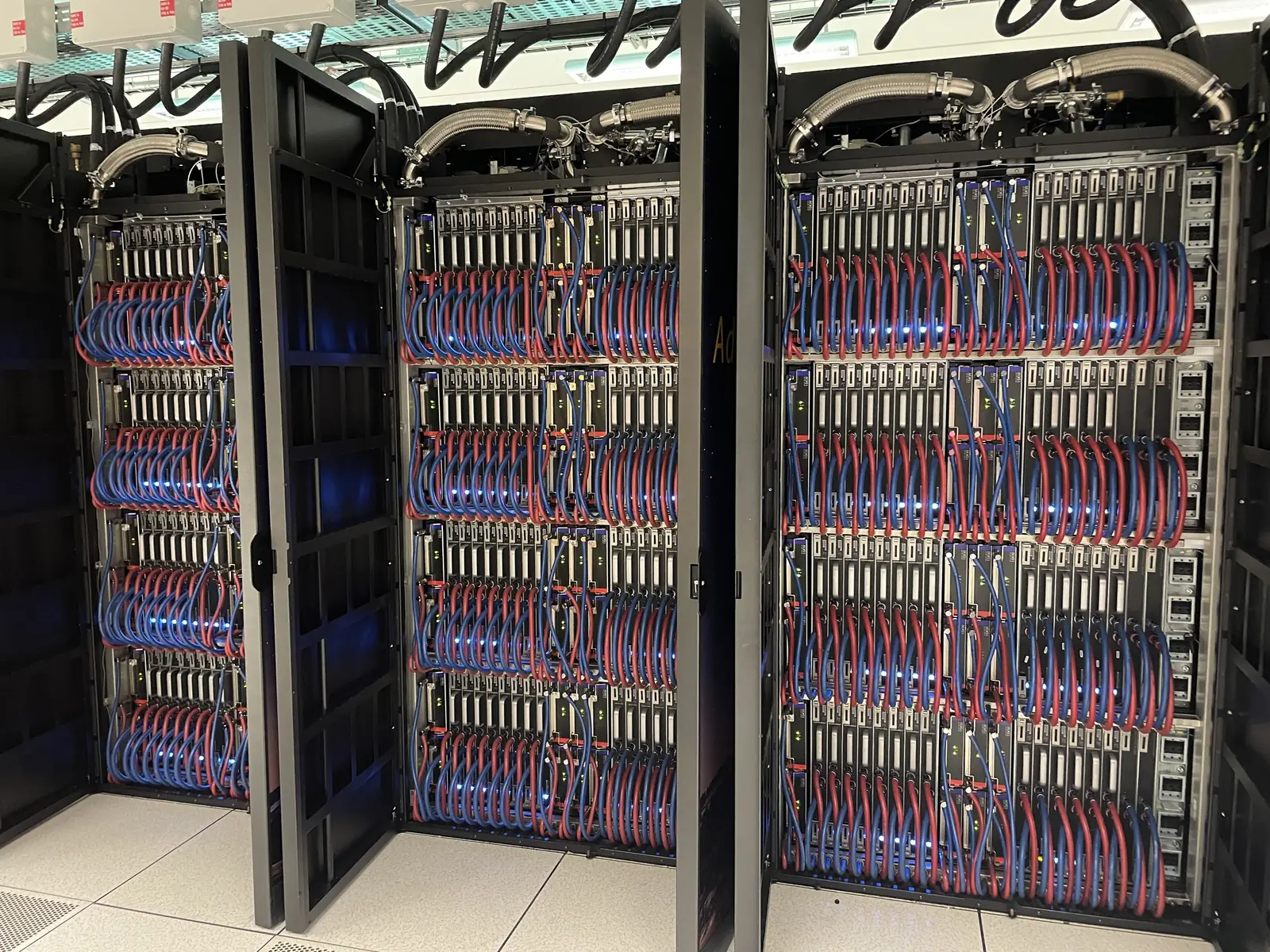
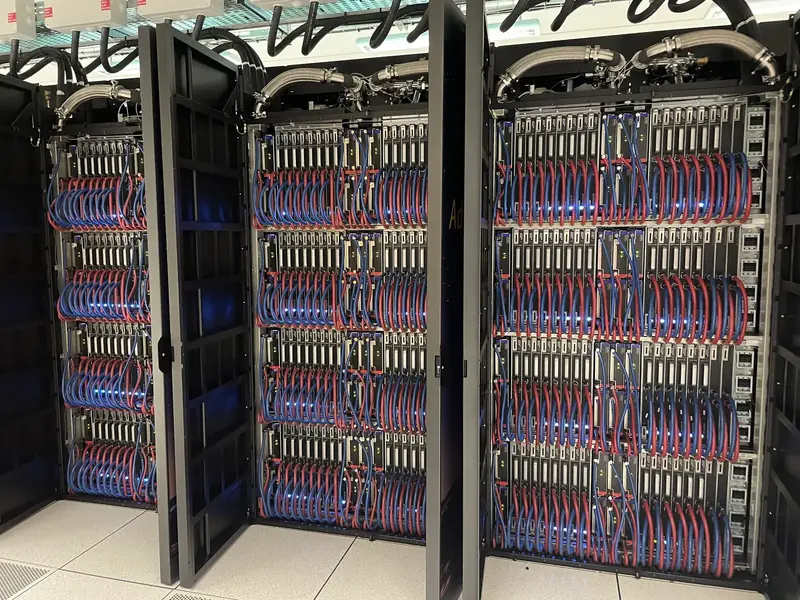
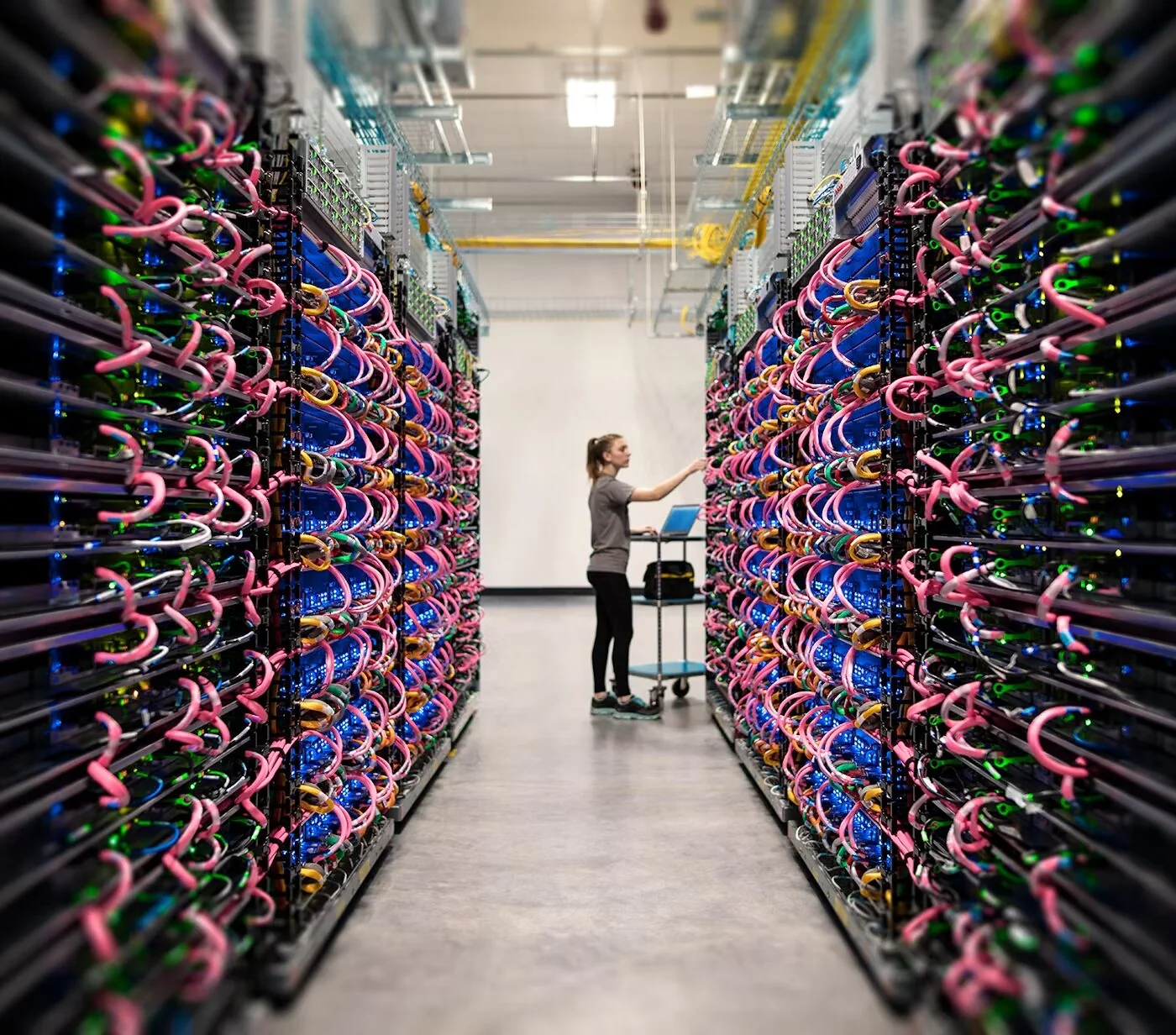
Racks of the Adastra supercomputer, installed by GENCI at CINES in Montpellier. Photo Rambiera, CC BY-SA 4.0, via Wikimedia Commons.
In France, the term refers to AFNOR Spec 2314, a voluntary framework published in June 2024: an AI service is frugal when it has been shown that AI was needed rather than a less resource-intensive solution, when good practices are applied and when uses aim to stay within planetary boundaries. The framework gives a measurement method and 31 good practices but no threshold: frugality is an approach, with no level to reach and no mandatory verification.
Contents
The expression "frugal AI" comes in France from a specific document: the Référentiel général pour l'IA frugale, published in June 2024 as AFNOR Spec 2314. It was led by the Ecolab of the French Ministry of Ecological Transition and drafted from January to June 2024 by a working group of companies, start-ups, public bodies and laboratories, with the support of Hub France IA, EcoInfo, ADEME and Arcep. Its 100 pages contain definitions, a measurement method, 31 good practices and rules for communication.
An "AFNOR Spec" is not a standard. The document states that the AFNOR Spec "must not be presented as a French standard or as equivalent to a French standard" and that its content "binds only its authors" (our translation). It is voluntary and aims to prepare future European and international standards. In addition, a draft European standard on assessing the environmental impact of AI systems, prEN 18287, has been in preparation at the joint technical committee of CEN and CENELEC since October 2025; we found no document linking it to the framework.
A frugal service meets 3 conditions
The framework defines the frugality of an AI service as the overall reduction of its resource needs and impacts, obtained by redefining uses or performance requirements. An AI service is frugal when 3 conditions are met.
- It has been demonstrated that an AI system is needed, rather than another, less resource-intensive solution, for the same objective.
- Good practices are adopted by the producer, the provider and the customer of the service to reduce its impacts.
- Uses and needs have been questioned beforehand and aim to stay within planetary boundaries.
The document distinguishes frugality from efficiency. An efficient system applies known optimisations to consume less at each use, the need remaining fixed. A frugal service accepts a result judged sufficient and reasons about its total consumption: to take an example of our own, a model that consumes 2 times less per query, but is served 10 times more often, would be efficient without being frugal. The first condition may lead to not using AI at all; the framework states that "the injunction to develop an AI service must be open to challenge" (our translation).
Distribution of good practices by stage
The 31 good practices come mostly from testimonies and interviews with the organisations in the working group. They are sorted into 7 themes (relevance of AI, governance, skills, data, model performance, equipment, measurement) and placed on the stages of an AI system's life cycle, from launch to decommissioning. A single practice often applies to several stages: 19 of the 31 concern design and development.
| Project stage | Practices | Examples |
|---|---|---|
| All stages (governance) | 9 | Examine frugality in each project (BP12); steer environmental performance (BP13); train stakeholders (BP14); plan for end of life (BP11) |
| 1. Launch | 6 | Analyse the need (BP01); choose the solution considering alternatives to AI (BP02); optimise the use of existing equipment (BP20) |
| 2. Design and development | 19 | Control the volume of data (BP06); compress models (BP03); reuse already trained models (BP29); favour more frugal models (BP30) |
| 3. Verification and validation | 4 | Estimate the model's consumption in advance (BP23) |
| 4. Deployment | 4 | Favour existing devices for inference (BP22) |
| 5. Operation and monitoring | 5 | Adapt measurement to the stakes (BP25); ensure the frugality of infrastructure (BP24) |
| 6. Continuous validation | 6 | Compare models to keep the best balance between performance and resources (BP31) |
| 7. Reassessment | 8 | Define criteria that justify new training (BP04) |
| 8. Decommissioning | 6 | Define data storage rules (BP10); compress data (BP15) |
Number of distinct good practices attached to each life cycle stage, our count from the table on page 40 of the framework; a practice may cover several stages. The titles of the examples are shortened.
Design and development concentrate the most practices, and the framework concludes that design and governance weigh on the whole life cycle of a project. Participants also rated each practice on its frugality gain and its implementation effort. 5 practices rank among both the 10 strongest in gain and the 10 easiest: analyse the need (BP01), plan for end of life (BP11), optimise the use of existing equipment (BP20), reuse already trained models (BP29) and favour more frugal models (BP30). The framework recommends starting with them.
The measurement required is a life cycle assessment
To assess an AI service, the framework relies on life cycle assessment and on the ADEME framework for digital services. The unit of measurement is the service delivered over one year: the year's inferences, training and other fixed costs, and each new training run, including those that did not succeed. The system boundary covers users' devices, networks and data centres.
4 indicators have priority: climate change, depletion of mineral and metal resources, primary energy and final energy. Water comes at medium priority, with acidification, fine particles and ionising radiation. Measured data are preferred to set values, such as the maximum thermal power announced for a chip (TDP).
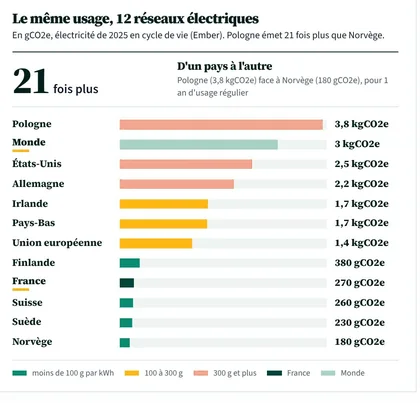
For electricity, the framework favours the grid emission factors where the service and its components operate, rather than market-based ones that take purchase contracts into account. To claim that a service has a positive balance on an impact category, it excludes offsetting, the purchase of low-carbon or renewable electricity and the recovery of heat from servers. This is the same rule the hub applies when it recalculates providers' figures depending on the grid.
Mistral AI states that it followed the framework's method for the life cycle assessment of its Mistral Large 2 model, published in July 2025 with Carbone 4 and ADEME and reviewed by Resilio and Hubblo. It is the only public application of the framework by a model provider that we have found.
The framework sets no threshold
The text gives no target value: no electricity consumption, emissions or water volume above which a service would be frugal. It states that the assessment of an AI service "can only be relative (between two systems) and not absolute" (our translation). A service is frugal by the approach it follows; to claim it, it must publish its life cycle impacts, with no level required.
The ranking of good practices rests on opinions. The framework itself cites its limits: "absence of indicators and measurements", an approach "based on expert opinion", questionable representativeness of the working group and the "failure to take rebound effects into account" (our translation). The gain from a practice is therefore not quantified; the document suggests quantifying it in updates to the compendium, and we found none.
No verification is required. The framework provides for no certification or label. To communicate on the frugal nature of a service, it asks for a life cycle assessment to be published with the 4 priority indicators, the detail of the good practices applied and the expected indirect effects; it also asks to state whether the assessment underwent a "critical review by an external third party or not" (our translation), and recommends renewing it at least once a year. It excludes social and ethical questions from its scope and takes no position on the usefulness of services by sector, such as health or security.
Since 22 May 2026, the "Territoires d'IA" funding window of the Banque des Territoires has co-financed 30 to 50% of the licences and software for sovereign AI of local authorities, and part of their deployment. A frugal AI approach adds 10 points to the co-financing rate, up to 50%. The specification defines it by the first sentence of the AFNOR definition, without its 3 conditions. The supporting evidence required is a document attesting the approach, such as the application of good practices from the framework or a digital sobriety charter, with no third-party verification and no consumption threshold.
Our reading
At Projet Celsius, we find the standard useful for its first condition and for its method: demonstrating that an AI is needed, then measuring the service over a year, with grid electricity, which the standard favours and which we always apply. The "frugal" label is not enough, on its own, to compare 2 services. Against it, we ask for the evaluation that the standard requires to award it, with the service's consumption related to its use (per query or per year), the analysis that justifies the use of AI, the location of the servers and the date of the evaluation, as our viewpoint on the transparency of providers asks for assistants. Sobriety in an organisation's rules, with measurement of use, is covered in our charter template.
The 31 good practices and their ranking come from the opinions of the working group participants, with no measurement of the gain from each. The framework suggested updating the compendium every year; we found only one edition, that of June 2024.
Sources
4 documents
- AFNOR Spec 2314, Référentiel général pour l'IA frugale, Ecolab du ministère de la Transition écologique2024entry 348
- CEN/CLC/JTC 21, prEN 18287, Requirements and guidance for the environmental impact evaluation of artificial intelligence systems and services, draft standard2026entry 349
- Mistral AI, with Carbone 4 and ADEME, Our contribution to a global environmental standard for AI2025entry 17
- Banque des Territoires, cahier des charges du guichet de cofinancement « Territoires d'IA », version 1.1 of 10 July 20262026entry 350
Every figure was read in its source; the hub's methodology is described in Methodology and sources.
AI Impact, Projet Celsius, "What is frugal AI?", 13 November 2026. https://projetcelsius.com/en/ai/analyses/what-is-frugal-ai/