
 Uses13 November 2026
Who uses AI the most in France?
Frequency of use, volume of requests and electricity consumed




A phone held up in front of a light show, in Pattaya, Thailand, in November 2024. Photo PattayaPatrol, CC BY-SA 4.0, via Wikimedia Commons.
In 2025, 48% of French people aged 12 and over used generative AI, and about 1 in 6 used it every day, more often among young people, graduates and managers. According to our estimate, made with the profiles of the AI Impact Database and assuming that the most frequent users are also those who ask for the most, these daily users consume 70 to 85% of the electricity of personal use, because the heaviest tasks are worth hundreds to thousands of questions. By the same calculation, one year of a developer who hands tasks to agents every day consumes as much as the personal use of 500 to 1,000 French people.
Contents
Incomes and carbon emissions are described by the share that each group of the population carries. AI is described mostly by averages, so many watt-hours per question, so many French users, which poorly reflect a use that some have tried once in the year and that others run for hours every day.
These averages mix 3 quantities: the share of people who use AI, which surveys measure; the volume that each asks of it, which no French survey measures; the electricity of these requests, which depends on their nature as much as on their number. This analysis takes them one after the other.
The share of French people who use generative AI, the frequency they report and the time they spend on it; outside France, the distribution of requests between users.
The electricity of each group, calculated by Projet Celsius with the profiles of the AI Impact Database : servers and data centre, without the manufacturing of hardware or the training of models.
Nearly one in 2 French people uses generative AI, 1 in 6 every day
In June 2025, 48% of people aged 12 and over reported having used generative AI in the year, against 20% in 2023, according to the Baromètre du numérique, the annual Crédoc survey. Among these users, 34% use it every day, 30% 1 to 2 times a week, 20% several times a month and 15% less often.
Applied to all those aged 12 and over, these answers give 4 groups (our calculation; the total is 99% because of survey rounding).
The survey counts all uses, private and professional: 42% of French people use it in their private life, 30% of working people in their work. 18% of users say that a platform they already used, search engine, messaging or social network, imposed generative AI on them.
Use follows age, qualification and occupation
Share of people who used generative AI in 2025, by age.
The gap between those aged 18-24 and those aged 70 and over went from 55 to 70 points in 2 years. Frequency widens it: 51% of users aged 18 to 24 use it every day, 27% of those aged 40 to 59, so that 43% of those aged 18-24 use generative AI every day, against 13% of those aged 40-59 (our calculation).
Occupation, qualification and place of residence work in the same direction: 76% of managers use it, against 38% of manual workers. According to Eurostat, in 2025, between 25 and 54 years old, 56% of higher education graduates had used a generative AI tool in the last 3 months, against 22% of those with few or no qualifications; 46% of inhabitants of cities aged 16 to 74, against 28% of those in rural areas.
The time spent, measured by Médiamétrie on the devices of 15,000 panellists, also follows age: 1 h 26 per month and per visitor of AI services in 2025, 1 h 55 among those aged 15-24, 2 h 40 among those aged 12-17.
In the published data, 10% of users account for nearly 2 thirds of use
No French survey measures the number of requests per user, although a person who asks 2 questions a day and another who has an assistant work for hours all 2 answer "every day".
3 datasets published outside France describe this distribution. Epoch AI, a research institute, tracks the histories of 5,000 American ChatGPT users. In December 2025, the median user exchanged 36 messages in the month, questions and answers counted, and the average was 158. Across the full histories of the panel, the 10% most active sent 63% of requests. At Cursor, an AI-assisted code editor provider, the 10% most active users consumed nearly 2 thirds of the tokens over 4 weeks of summer 2026. In companies that are customers of OpenAI, the employee at the 95th percentile sends 6 times more messages than the median employee, and 17 times more for code.
Share of total use carried by the 10% most active users.
These measurements do not apply to France, and the Epoch AI panel, older and more highly qualified than all users, is not weighted. All 3 describe use concentrated in a minority.
Electricity follows tasks more than frequency
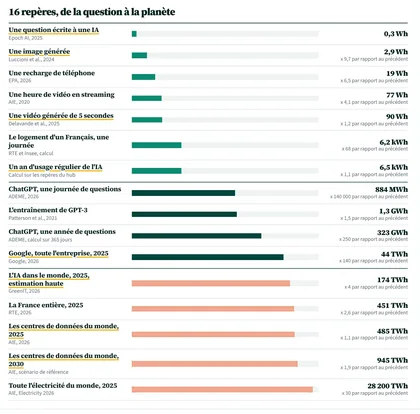
In the AI Impact Database, the electricity of a task ranges from 0.3 Wh for a quick question to 99 Wh for a video clip of 5 seconds and 670 Wh for one hour of a code agent, 2,200 times more; the analysis of the weight of a year of use sets out these values.
The volume and the nature of requests go together. Without search engine previews, the year of personal use of the free offers consumes 83 Wh for the least active third of users, 710 Wh for the median and 4 kWh for the most active tenth. From the median to the most active tenth, questions are multiplied by 4 and video clips by 10: about twenty clips make up half of the intensive year.
The 1 h 26 per month from Médiamétrie count the time spent in front of the service, without the calculation done for the person: a clip of 5 seconds is requested in one sentence, and a code agent works while the person does something else.
According to our estimate, daily users consume 70 to 85% of the electricity of personal use
We assigned each group of the Baromètre one of the 3 levels of use of the Database, defined by the rank of the user, assuming that the most frequent are also those who make the most requests. Those who use it less than once a week, 35% of users, form the least active third; the median uses it 1 to 2 times a week; the most active tenth is among the daily users, whose others are counted at the median level, then intensive, which gives a range. The frequency of the Baromètre covers all uses, private and professional; each group nevertheless receives the personal use profile of the free offers of the Database.
| Reported frequency of use | Share of those aged 12 and over | Database level | Electricity per person per year | Share of electricity, estimate |
|---|---|---|---|---|
| Never | 52 % | none | 0 | 0 % |
| Less than once a week | 17 % | least active third | 83 Wh | 2 to 4% |
| 1 to 2 times a week | 14 % | median | 710 Wh | 13 to 26% |
| Every day | 16 % | median or intensive; intensive for the most active tenth | 710 Wh to 4 kWh | 70 to 85% |
Population: Crédoc, June 2025, all uses. Electricity: Projet Celsius estimate, free personal use from the AI Impact Database (engine 0.3.1), without search engine previews.
Reported use, measured by Crédoc in June 2025.
Estimate by Projet Celsius with the profiles of the AI Impact Database.
At the other end, the 69% of French people who do not use it or use it less than once a week consume 2 to 4% of it. On average, without previews, the personal use of AI consumes 390 to 770 Wh per year per French person aged 12 and over, user or not.
The range probably underestimates concentration: in the Epoch AI panel, the 10% most active send on average 15 times as many requests as the other 90% (our calculation), whereas the most active tenth in our estimate consumes 3 to 9 times the average of the other users. Search engine previews, about 44 Wh per year in the Database, remain outside the calculation, as it is not known who receives them.
According to our estimate, 1 French person in 6 consumes 70 to 85% of the electricity of the personal use of AI, and 7 in 10 consume 2 to 4%.
According to our estimate, a year of a developer with agents consumes as much as the personal use of 500 to 1,000 French people
In the Database, the typical year of a developer who hands tasks to code agents counts 594 agent hours and consumes 400 kWh, of which 99% for the agents. Relative to the average of our estimate, it equals the personal use of 500 to 1,000 French people: 1 to 2 people in 1,000 working this way would be enough to double the electricity of the personal use of AI in France. This typical year is itself an assumption; with the Database range, 185 to 765 kWh, the ratio would go from about 240 to 2,000.
400 kWh for the typical year of the Database (594 agent hours), against 390 to 770 Wh per French person.
No survey says how many people work this way. The Baromètre indicates that 8% of users program or process data with AI every day, about 4% of the population, without saying with which tools.
Our reading
For us at Projet Celsius, an average per French person poorly describes the footprint of AI. According to our estimate, electricity is concentrated in a minority of daily users and in the heaviest tasks: videos, in-depth searches and above all agent hours. Our analysis of the actions ranks what reduces a year's footprint the most, for 3 usage profiles.
Half of the population does not use it, first the oldest, the least qualified and inhabitants of rural areas. Young people are, proportionally, the most numerous to use it every day. 19% of users pay for a subscription, about 9% of the population, and heavy uses go with a subscription: 61% of those who program with AI every day have one, as do 55% of those who create images or videos every day.
Each provider knows the volume requested by each of its users, the data that would move this distribution from estimate to measurement; we will update this analysis if one of them publishes it for France. The "My AI footprint" tool calculates the year of each person.
The share of the population comes from a self-reported survey (Crédoc, June 2025). The share of electricity is a Projet Celsius estimate: it assumes that the most frequent users are also those who make the most requests, and uses the 3 levels of use of the AI Impact Database, whose frequencies are assumptions. It applies personal use profiles of the free offers, without work, paid subscriptions, agents or search engine previews, to groups defined by the frequency of all uses, work included. It counts neither the manufacturing of hardware nor the training of models. The measurements of the distribution of requests come from the United States and from a code editor provider.
Sources
7 documents
- Arcep, Arcom, CGE and ANCT, Baromètre du numérique2026entry 57
- Eurostat, Usage des outils d'IA générative par les particuliers (isoc_ai_iaiu)2026entry 255
- Arcom, Baromètre d'audience des services d'intelligence artificielle, 1re édition, from Médiamétrie2026entry 256
- Das, Edelman and Falkman Olsson, Introducing the ChatGPT usage explorer, Epoch AI2026entry 257
- Cursor, The asymmetry of token consumption2026entry 258
- OpenAI, The State of Enterprise AI2025entry 259
- Projet Celsius, AI Impact Database, environmental database of artificial intelligence, engine 0.3.12026entry 144
Every figure was read in its source; the hub's methodology is described in Methodology and sources.
AI Impact, Projet Celsius, "Who uses AI the most in France?", 13 November 2026. https://projetcelsius.com/en/ai/analyses/who-uses-ai-most-in-france/