UsesGPT-6.1 Sol
A 250-word response, with the global electricity mix
0.39 gCO2e
equivalent to 2.7 m by combustion-engine car
0.78 Wh of electricity
GPT-6.1 Sol emits 19 times more than Claude Haiku 5.5

UsesGPT-6.1 Sol
A 250-word response, with the global electricity mix
0.39 gCO2e
equivalent to 2.7 m by combustion-engine car
0.78 Wh of electricity
GPT-6.1 Sol emits 19 times more than Claude Haiku 5.5
250 words with GPT-6.1 Sol, several times a day.
From a tweet to a book, in gCO2e, with the global electricity mix. With Claude Opus 5.5, a short book weighs 710 times a tweet. Clicking a cell makes it the question of the page.
| Models, from the most frugal to the heaviest | A tweet50 tokens | A short email170 tokens | 250 words400 tokens | An article1,500 tokens | A report5,000 tokens | A book50,000 tokens |
|---|---|---|---|---|---|---|
4 cells exceed one kilometre by petrol car with the global electricity mix: a short book with Gemini 3.1 Pro, Gemini 4 Argon, Claude Fable 5.1 and GPT-6 Astra.
EcoLogits estimates, database of 14 October 2026, with the global electricity mix. Gemini 4 Argon, too recent, provisionally takes the value of Gemini 3.1 Pro. CC BY 4.0, with processing by Projet Celsius.
GPT-6 Astra emits 180 times more than Claude Haiku 5.5.
The scale is logarithmic: each major tick multiplies the weight by 10. On a linear scale, 8 of the 16 models would fit in the first tenth of the ruler.
EcoLogits estimates, database of 14 October 2026. CC BY 4.0, with processing by Projet Celsius. Petrol car: 142 g per kilometre (ADEME, Impact CO2).
Image for a 250-word response with GPT-6.1 Sol worldwide, of 6 benchmark models

PNG of 1,080 × 1,080 px, with its source and its CC BY 4.0 licence.
An amortised share of the GPUs and servers: from 3 to 17% of the total with the global electricity mix, from 25 to 69% in France.
The GPUs and the rest of the server, then the cooling and the losses of the data centre (PUE), at the electricity mix of the chosen location.
EcoLogits does not count it. Mistral AI published in 2025 a per-answer figure that includes it, for Mistral Large 2.
The question, the attached documents and the conversation reread at each turn: EcoLogits counts only the tokens written.
The transport of data and the device that displays the answer.
poids = (M0 + E0 × tokens) × ((1 - fab) × mix / 458 + fab)
M0: the fixed part of a request, in gCO2e. E0: the weight of a token written. fab: the manufacturing share, which does not change with location. mix: the electricity of the location, in gCO2e/kWh (458 worldwide).
A French word counts for about 1.6 token (convention of the AI Impact Database): 400 tokens for an answer of 250 words.
These estimates come from EcoLogits, model by model. The AI Impact Database starts from published measurements: a quick question is worth 0.3 Wh there, that is 0.14 gCO2e with the global electricity mix, electricity alone.
Why the estimates diverge →For a closed model, EcoLogits estimates its size, notably from its price. Around the central value, its bounds range from 0 (Gemma 4 31B, the 3 Mistral models) to ± 74% (Gemini 3.5 Flash-Lite). With these bounds, the ratio of 180 between GPT-6 Astra and Claude Haiku 5.5 ranges from 75 to 460.
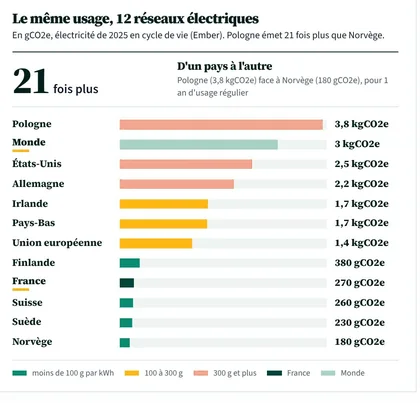
The location where each answer is computed is not published by the providers: the values are given with the global electricity mix. Without settings, EcoLogits places the servers in the United States, and in Sweden for Mistral AI.
M0 and E0 are fitted on EcoLogits values between 100 and 500 tokens: beyond that, the weight is extended in a straight line. A short book is written in several answers.
The manufacturing share reuses EcoLogits' factors for GPUs and servers, which we have not verified at their source.
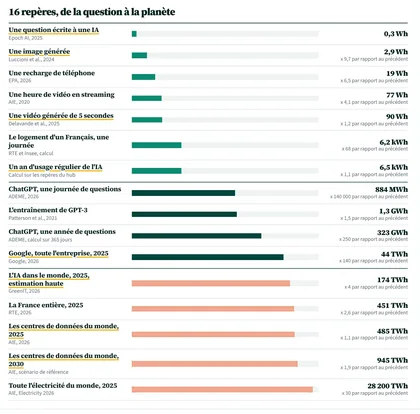
UsesElectricity used by a question, an image, a videoabout300timesa 5-second video versus one questionChart
UsesElectricity used by a generated video, 7 models measured× 3,000from 0.14 Wh to over 415 Wh per videoChart
UsesElectricity by type of AI taskover1,000timesimage generation versus text classificationChart
UsesReasoning mode multiplies energy use
Where does this figure come from?
Uses20 October 2026"A generated image is a phone charge"The comparison did the rounds of the media in late 2023. It came from a serious study, but from its preliminary version, from the most power-hungry generator, and from a phone charge counted as 12 Wh.
Where does this figure come from?
Uses20 October 2026"A generated video uses 1 kWh"The figure has been circulating since 2025, often attached to Sora. It comes from a real measurement, but one made on a different, open model, in a particularly heavy version. Measurements of 7 generators range from 0.14 to 415 Wh.
AI Impact DatabaseAll the figures, their methodology and their sources.
AI Ranking10 assistants rated out of 100: performance, ethics and environment.
AnalysesThe signed pieces: analyses, viewpoints, "Where does this figure come from?".
Charts and mapsThe reference visuals, with their data and sources.
ToolsYou are hereOpen calculations, your assumptions on the left, the result on the right.


An error, a source to add, a methodology question, a press request: write to us. Guillaume Pakula, Clément Reynaud, Sébastien Pierfederici and Alexandre Veilly will reply.
Projet Celsius, which runs this hub, also helps companies measure and reduce the footprint of their AI use.
Accounting for AI in your Bilan Carbone® ↗