
 Climate13 November 2026
What is the most serious environmental risk of AI?
Electricity, CO2, water, metals and land, compared by their magnitude, scale and reversibility




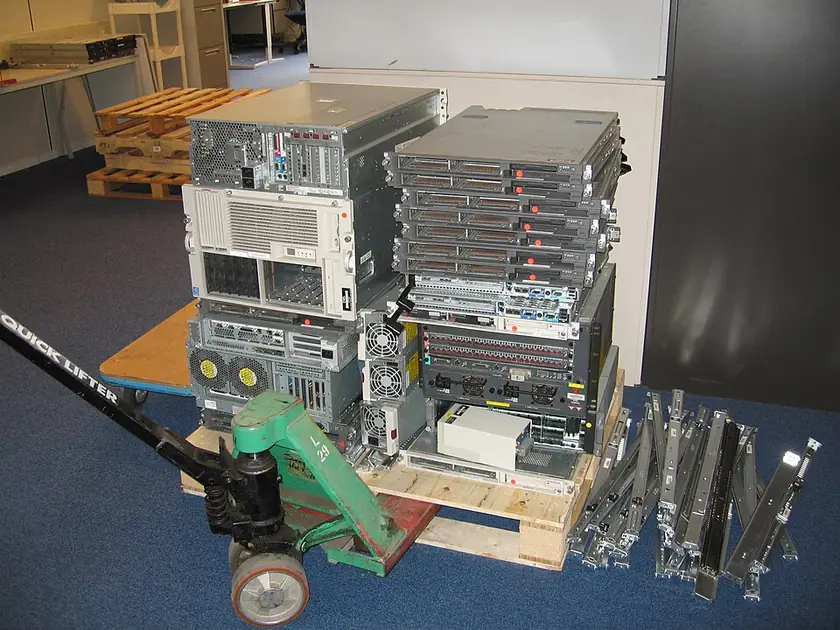
Discarded servers on a pallet. Photo Jemimus, CC BY 2.0, via Wikimedia Commons.
Among the direct pressures of AI on the environment, the CO2 emissions from its electricity are the most serious: they weigh the most in GreenIT's life cycle assessment, which brings all pressures to a common scale, they act on the climate of the whole planet, and part of the CO2 remains in the atmosphere for centuries. Water and land are serious risks at local level, where data centres are concentrated. Metals weigh little in volume, but their supply is concentrated in a few countries.
Contents
AI weighs on the environment through 5 direct pressures: the electricity it consumes, the CO2 emitted to produce that electricity and the hardware, the water for cooling and manufacturing, the metals in its chips and servers, and the land occupied by its data centres. The figures for each circulate separately, in different units. Electricity is the origin of most of the other pressures: we treat it here for what it does to grids, and CO2 for what it does to the climate, without adding the two. To compare them, we ranked them by 3 criteria: their magnitude, that is, their share of the world or national total; their scale, local or global; and the duration and reversibility of their effects. Indirect effects, such as AI in the service of oil and gas extraction, are covered in the analysis on the climate crisis.
The 5 pressures by the 3 criteria
| Pressure | Magnitude | Scale | Duration and reversibility |
|---|---|---|---|
| CO2 | 180 MtCO2 for data centres in 2024, 0.5% of combustion CO2; 99 MtCO2e for AI in 2025 (estimate) | global | part of the CO2 remains for centuries to millennia; irreversible effects on the scale of centuries |
| Electricity | 1.5% of global demand in 2025, about 3% in 2030 | local: 20 to 30% of demand in the regions where data centres are concentrated | reversible on the scale of a decade, but it prolongs and prompts the building of power plants |
| Water | 560 billion litres consumed by data centres in 2023, worldwide | local: 2 thirds of the data centres built or planned since 2022 in the United States are in areas of water stress | reversible on the scale of a season or a year, except in an aquifer already in deficit |
| Metals and waste | 11% of current gallium demand in 2030; 1.2 to 5 Mt of cumulative electronic waste from 2020 to 2030 | global, with a concentrated supply: China refines 98% of gallium | lasting for dispersed metals; 22.3% of electronic waste recycled in a documented way in 2022 |
| Land | no national figure; 0.4 to 11 km² for the largest US campuses | local | lasting sealing of a plot of land; no source on its reversibility |
Our ranking. Sources: IEA, Energy and AI (2025) and Key Questions on Energy and AI (2026); GreenIT (2026); WRI (2026); Wang et al. (2024); Epoch AI (2025); IPCC, AR6 (2021). The Duration and reversibility column is our assessment, except for CO2 (IPCC).
CO2 from electricity
Data centres emitted around 180 million tonnes of CO2 in 2024 for their electricity, according to the IEA, 0.5% of global combustion emissions; AI is only a part of this. GreenIT estimates AI emissions at 99 million tonnes of CO2e in 2025, manufacturing included, and 636 million in 2030 in its projection at constant electricity mix. This is small on a global scale, and it is growing fast: the IEA expects gas and coal to cover more than 40% of the increase in data centre demand by 2030.
Each pressure, set against its own global total, cannot be compared with the others: 0.5% of combustion emissions for data centre CO2, 1.5% of electricity demand, 11% of current gallium demand in 2030. Only a weighting brings them to a common scale: in GreenIT's, global warming accounts for 35% of the footprint of AI, metals 2% and water deprivation 1%. CO2 then stands out by its duration. CO2 mixes throughout the atmosphere, wherever it is emitted, and part of it remains there for between one year and several thousand years, according to the IPCC. The changes caused by greenhouse gases, of which CO2 is the main one, in the ocean, the ice and sea level are irreversible on a scale of centuries. Part of the CO2 emitted in 2026 by a data centre's electricity will still be acting on the climate at the end of the century. GreenIT also points out that about 65% of this weighted footprint is not climate-related: freshwater eutrophication accounts for 23%, depletion of fossil resources 17% and fine particles 15%. These come mainly from the same source, since the use phase of servers, that is their electricity, accounts for 92% of impacts in 2025. Air and water pollution from power plants is not part of our ranking, which sticks to the 5 most frequently cited pressures.
Electricity
Worldwide, data centres consumed a little over 1.5% of electricity in 2025, and they account for only about a tenth of the increase in global demand by 2030, less than air conditioning or electric cars. But they are concentrated: according to the IEA, they account for up to 20 to 30% of electricity demand in the regions that host them. This is where the pressure is visible, on grids, on prices and on the construction of power plants. The analysis of the electricity shortage and the one on bills gives the cases.
The pressure on electricity is partly reversible: consumption can fall or move within a few years. What it triggers is less so. A gas plant built to meet data centre demand keeps emitting for as long as it operates, and its CO2 adds to the first risk.
Water and land
The world's data centres consumed about 560 billion litres of water in 2023, according to the IEA, counting the water used for electricity and chip manufacturing. Globally, this is small next to agriculture. The risk lies in location: in the United States, 2 thirds of the centres built or planned since 2022 are in water-stressed areas, according to the World Resources Institute, which draws on a 2025 Bloomberg analysis. In GreenIT's weighted analysis, the risk of water deprivation accounts for only 1% of the global footprint of AI, because it is averaged across the planet. For a given basin, it can be the first. The analysis of data centre water use examines 6 cases.
Land is the least measured pressure. There is no national figure for the area occupied by data centres, in France or in the United States; Arcep notes in 2026 that the literature remains sparse. The largest US AI campuses cover 0.4 to 11 km², according to Epoch AI's satellite surveys. The risk is local and lasting for land that has been built over; it is the origin of several challenges to projects in France.
Metals and electronic waste
Data centres will consume little metal on a global scale: in 2030, according to the IEA, up to 2% of current copper demand, more than 3% of that of rare earths, and 11% of that of gallium. Gallium shows the risk: China refines 98% of it. Electronic waste from generative AI would reach 1.2 to 5 million tonnes cumulatively from 2020 to 2030, according to Wang and co-authors, less than a tenth of what the world produced in the single year 2022, 62 million tonnes, of which 22.3% was collected and recycled in a documented way. The metal in waste that leaves these channels is hard to recover, which is what makes this pressure lasting despite its small volume.

 Hardware
Electronic waste and AI
Waste electrical and electronic equipment, in million tonnes · 2020 to 2030
Source: ITU and UNITAR, 2024; Wang et al., 2024 · projetcelsius.com/en/ai · CC BY 4.0
Our reading
For us at Projet Celsius, the most serious environmental risk of AI is the CO2 from the electricity that powers it, and first of all that of the gas and coal plants that meet its demand. It is the only direct effect that carries the most weight in the weighted footprint, acts across the whole planet and lasts for centuries. Water and land matter just as much to the inhabitants of a basin or a municipality, and they are judged site by site. For metals, the risk lies in supply and recycling more than in volumes. Beyond these direct pressures, the indirect effects of AI on the economy may weigh more: they are the subject of the analysis on the climate crisis.
The ranking is ours and rests on quantities of different natures: it is not to be read as a sum. GreenIT's weighting is a methodological choice of the study, among other possible ones, and it alone makes it possible to compare magnitudes; GreenIT counts servers, storage, network and data centres, excluding users' devices. No aggregate figure exists for the land area of data centres; the electronic waste of AI rests only on the study by Wang and co-authors, of which only the abstract could be reviewed.
Sources
11 documents
- IEA, Energy and AI2025entry 1
- IEA, Key Questions on Energy and AI2026entry 2
- GreenIT, Impacts environnementaux et sanitaires de l'intelligence artificielle dans le monde en 2025 et 20302026entry 6
- GIEC, AR6, Working Group I, Résumé à l'intention des décideurs2021entry 461
- GIEC, AR6, Working Group I, chapter 5, Global Carbon and Other Biogeochemical Cycles and Feedbacks2021entry 462
- WRI, From Energy Use to Air Quality, the Many Ways Data Centers Affect US Communities2026entry 463
- Siddik, Shehabi and Marston, The environmental footprint of data centers in the United States, Environmental Research Letters2021entry 307
- Arcep, Intelligence artificielle et environnement (mesures du PEReN)2026entry 27
- Epoch AI, The largest AI data center campuses will soon be a fifth the size of Manhattan2025entry 464
- Wang et al., E-waste challenges of generative artificial intelligence, Nature Computational Science2024entry 43
- ITU and UNITAR, The Global E-waste Monitor 20242024entry 42
Every figure was read in its source; the hub's methodology is described in Methodology and sources.
AI Impact, Projet Celsius, "What is the most serious environmental risk of AI?", 13 November 2026. https://projetcelsius.com/en/ai/analyses/ai-most-serious-environmental-risk/
 Water