
 Uses14 November 2026
How should AI be counted in a local authority's responsible digital report?
What the law requires, the data to collect, the factors and a completed AI line for an inter-municipal authority with 1,500 staff





Nantes city hall. Photo Selbymay, public domain, via Wikimedia Commons.
Since 1 January 2025, municipalities and inter-municipal authorities with more than 50,000 inhabitants must have a responsible digital strategy and report on it each year. The law, its decree and the reference guide for local authorities do not say how to count AI in it, and the ADEME and Arcep study on the digital footprint in France does not take the development of generative AI into account. For each use, you need an annual volume, the country of the servers and a factor from the AI Impact Database; for an inter-municipal authority with 1,500 staff, everyday uses consume about 650 kWh a year according to our estimate.
Contents
56% of local authorities with more than 3,500 inhabitants started an AI project in 2026, and 36% of those see its environmental impact, "and the difficulty of measuring it", as an obstacle (our analysis of AI adoption by local authorities). The largest already have a framework for counting: the annual report of their responsible digital strategy. This guide sets out what that framework requires and proposes the AI line it lacks.
Obligations under the law and the decree
Article 35 of the law of 15 November 2021 aimed at reducing the environmental footprint of digital technology, known as the REEN law, requires municipalities with more than 50,000 inhabitants and inter-municipal authorities with their own tax powers and more than 50,000 inhabitants to define, by 1 January 2025 at the latest, a responsible digital strategy, with their objectives for reducing the environmental footprint of digital technology and the measures to achieve them. This strategy is reported on annually in the report on the sustainable development situation (article L. 2311-1-1 of the Code général des collectivités territoriales). Departments and regions are not covered.
The decree of 29 July 2022 specifies that the preliminary work programme includes an assessment of the environmental impact of digital technology and its uses in the area, and that the strategy sets objectives, associated monitoring indicators and measures. It gives no indicator, no scope and no calculation method.
| Text or guide | Mention of AI | Method for counting it |
|---|---|---|
| REEN law, article 35 (2021) | none | none |
| Decree no. 2022-1084 (2022) | none | none |
| Guide "La stratégie numérique responsable de la collectivité en 10 étapes" (2023) | none | none; the diagnostic offered "is an assessment tool, not a measurement tool" |
| ADEME and Arcep study on the digital footprint in France (January 2025) | as a limitation: "generative AI development is not taken into account" | none |
| Référentiel général d'écoconception de services numériques, version 2 (2024) | yes, for anyone designing a service | inference consumption indicators, on the designer's side |
| Fiche d'achat responsable de solutions d'IA de l'État (November 2025) | yes | a clause asking the supplier for its emissions, water and electricity |
Texts opened on 13 November 2026. None says how a local authority should count its own AI uses.
The indicators cited by the 2023 guide relate to hardware and staff: number of staff trained, average lifespan of the equipment, consumption of server rooms. Among the published strategies we have read, those of Angers Loire Métropole, Montpellier Méditerranée Métropole and Métropole Rouen Normandie mention AI as a subject to govern, without listing it among the items measured.
Data to collect
The AI line is built use by use, like the AI item of a Bilan Carbone®, with one difference: a local authority also serves the public, and its services open to the public are included in the count. For each use, you need an annual volume and the country where the servers run.
| Use | Volume to record | Where to find it |
|---|---|---|
| Staff assistant (drafting, summaries, questions) | staff using each tool, and if possible the number of requests | tool administration console, number of licences or accounts |
| Meeting transcription and summaries | hours of meetings transcribed | videoconferencing or transcription tool |
| Assistant on internal documents | questions per year, pages indexed | service log, supplier |
| Online reception assistant | conversations per year | service dashboard, supplier |
| Automatic website translation | pages translated per language | website manager |
| Model hosted in the server room | measured electricity of the servers that run it | server room meter, already in the report |
For each line, also note the country of the servers, which the contract or the host provides.
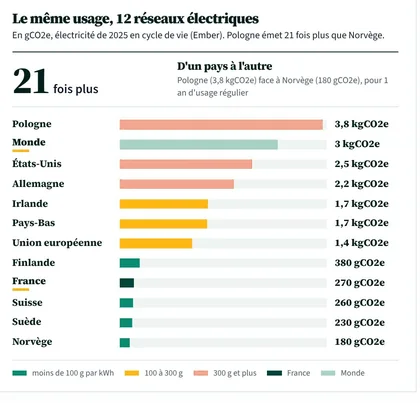
The country of the servers matters more than any other setting: for the same electricity consumed, emissions are about 9 times higher with the world average electricity, 458 gCO2e per kWh, than with French electricity at the ADEME factor, 51.9 g, the one a regulatory carbon footprint requires. Administration consoles give the number of users and requests; the model and the country of the servers have to be requested from the supplier, and the State's purchasing sheet offers a clause asking the supplier for this information, which the local authority can reuse at each contract renewal. A model hosted on the local authority's own servers is already in the consumption of its server room: the AI line flags it so as not to count it 2 times.
AI line for an inter-municipal authority with 1,500 staff
The following example completes the line for a typical inter-municipal authority with 1,500 staff, which has made an assistant available to its staff, transcribed the meetings of 200 of them, opened an assistant on its internal documents and a reception assistant on its website, and translated its website. Each value comes from an entry in the AI Impact Database, with its default settings, scaled to the volumes in the example.
| Use | Volume assumption | Electricity (kWh per year) | Servers in France, ADEME factor (kgCO2e) | World average electricity (kgCO2e) |
|---|---|---|---|---|
| Staff assistant | 1,500 staff, civil service average, users or not | 358 | 19 | 164 |
| Meeting transcription | 200 people, 3 hours per week | 156 | 8 | 72 |
| Internal document assistant | 150 users, 2 questions per day, 20,000 pages | 75 | 4 | 34 |
| Online reception assistant | 50,000 conversations per year | 61 | 3 | 28 |
| Website translation | 500 pages, 5 languages | 1.5 | 0.1 | 0.7 |
| Total for the AI line | about 650 | about 34 | about 300 |
Our calculation from entries IA-0515, IA-0412, IA-0406, IA-0407 and IA-0411 of the AI Impact Database (engine 0.3.1): servers and data centre, excluding server manufacturing and model training. Estimates.
The staff assistant accounts for more than half of the line. Its value starts from the civil service average: about 240 Wh per staff member per year, users or not, based on the Database entry on public sector staff, which breaks down the 5.85 million staff by occupation. An office worker who uses it every day consumes more, about 1.3 kWh a year according to our analysis by occupation ; a local authority that knows its number of active users can start again from this value with the hub's estimation tool. The transcription is the Database's for 200 people instead of 100; the document assistant takes the Database as it stands, 150 users and 20,000 pages indexed 2 times a year.
The order of magnitude changes in 2 cases. An model hosted in the server room, on 2 GPUs switched on all year, consumes about 10,400 kWh per year, 16 times the line in the example. Some coding agents, which write, test and fix code by chaining tasks, bring the use of one developer to about 400 kWh a year. These 2 cases are the ones to spot first in the inventory.
The decree also refers to uses in the area. If the local authority chooses to count its inhabitants' use of AI, the order of magnitude changes again: the Database estimates the personal use, studies and work of the inhabitants of a town of 100,000 inhabitants at about 41 MWh a year, more than 60 times the line in the example, including the work of the staff who live there. We recommend presenting them separately, since the local authority has no direct control over them.
Monitoring indicators
The decree asks for indicators associated with the objectives. For the AI line, we propose 4, which can be collected each year from the same sources: the electricity of the line in kWh and its emissions in kgCO2e; the share of uses served by servers located in France; the number of active staff users per tool; the list of uses hosted in-house or entrusted to autonomous agents. The last 2 flag the uses that can change the scale of the line. Our model charter proposes an article that does this count each year.
Our reading
For us, at Projet Celsius, the AI line of a local authority is small for the everyday use of its staff, in the order of a few hundred kilowatt-hours for 1,500 staff, and it may stay that way. Its main purpose is to take an inventory of tools, to know the country of the servers and to spot in good time the 2 uses that change its scale, models hosted in-house and coding agents. The annual report that the law already requires is the right place to keep it.
The values in the example are estimates from the AI Impact Database scaled to typical volumes; a local authority should redo them with its own volumes. They count the electricity of the servers and the data centre, excluding server manufacturing and model training. The legal texts are summarised from the version read on 13 November 2026; their wording prevails.
Sources
9 documents
- Loi n° 2021-1485 du 15 novembre 2021 visant à réduire l'empreinte environnementale du numérique en France, Article 352021entry 233
- Code général des collectivités territoriales, article L. 2311-1-12026entry 467
- Décret n° 2022-1084 du 29 juillet 2022 relatif à l'élaboration d'une stratégie numérique responsable par les communes et les intercommunalités de plus de 50,000 habitants2022entry 468
- Institut du Numérique Responsable, Les Interconnectés et Banque des Territoires, La stratégie numérique responsable de la collectivité en 10 étapes2023entry 469
- ADEME, Évaluation de l'impact environnemental du numérique en France2025entry 38
- Arcep, Arcom, ADEME and DINUM, Référentiel général d'écoconception de services numériques, version 22024entry 470
- MiNumEco, Ecolab du CGDD and Direction des achats de l'État, Fiche pratique pour l'achat responsable de solutions d'IA2025entry 471
- Banque des Territoires and Observatoire Data Publica, Tendances 2026 : data, intelligence artificielle et cybersécurité dans les territoires2026entry 235
- Projet Celsius, AI Impact Database, environmental database of artificial intelligence, engine 0.3.12026entry 144
Every figure was read in its source; the hub's methodology is described in Methodology and sources.
AI Impact, Projet Celsius, "How should AI be counted in a local authority's responsible digital report?", 14 November 2026. https://projetcelsius.com/en/ai/analyses/counting-ai-in-a-council-digital-report/