
 Uses14 November 2026
How are local authorities adopting AI?
Projects, areas, authorised tools, governance and measurement of effects, from the 2026 Observatoire Data Publica survey





The Hauts-de-France Regional Council building in Lille, seen from the belfry in August 2018. Photo Jamain, CC BY-SA 4.0, via Wikimedia Commons.
In 2026, 56% of local authorities with more than 3,500 inhabitants had launched at least one AI project, compared with 28% in 2023, according to the Observatoire Data Publica survey of 382 local authorities. Their projects concern internal management first (54% of them) and relations with users (31%), and almost all use generative AI. Three quarters of the authorities involved have begun work on a charter or reference document, but 40% have no tool to monitor the effects of their projects, and environmental impact and its measurement hold back 36% of them.
Contents
Since 2022, the Observatoire Data Publica has surveyed French local authorities every year on their use of data and AI; the Banque des Territoires publishes the summary. The 2026 edition rests on 382 local authorities and local public bodies surveyed in June and July 2026, from municipalities to regions. The survey counts projects in trial or in service, not the use an employee makes of an assistant on their own initiative. Its adoption rate leaves out municipalities with fewer than 3,500 inhabitants, which make up 31% of respondents.
Local authorities involved in an AI project, from 2023 to 2026
Local authorities with more than 3,500 inhabitants that have launched at least one AI project
The share of authorities involved doubled in 3 years, and its progress is slowing: 13 points from 2024 to 2025, 7 points from 2025 to 2026. 20% plan to launch one within the year; with them, the proportion has stood at around 3 authorities out of 4 since 2025. Adoption follows size: in 2026, all regions, 94% of metropolitan authorities and 70% of departments have a project, compared with 40% of departments in 2025.
Almost all of these authorities use generative AI, the kind that writes, summarises and answers: 86% of the authorities involved are testing or deploying it, against 52% in 2024. Older AI, which recognises images or forecasts consumption, also exists, in fewer projects. Political sponsorship remains a minority: 35% of authorities say that AI is driven by their elected officials, 67% of regions and 44% of metropolitan authorities.
Areas of AI projects
Areas of AI projects in 2026, as a share of the authorities involved (multiple answers possible)
Local authority AI first serves their own offices: 54% of the authorities involved use it for internal management, against 45% in 2024, and 31% for relations with users, against 20%. The other areas concern 4 to 12% each.
The survey does not break internal management down by department. The authorities that give testimony in the note describe office uses: drafting letters and minutes, legal analysis, translation and help with analysing tenders in Cannes, where more than 1,000 staff have been trained; drafting job offers and matching CVs to job descriptions in Saint-Cloud, with measured time savings for the first and "more mixed" results for the second; meeting summaries in the Loiret; an internal assistant, hosted in local data centres, at Rennes Métropole. Communication is the only department measured separately: in 96% of the 219 authorities surveyed by Cap'Com and the Observatoire in spring 2026, communication staff produce text or images with generative AI.
Uses aimed at the public are rarer: handling road reports, diagnosing the state of roads from images. These are 2 of the first 4 use cases of the Territoires d'IA programme of the Banque des Territoires, launched in May 2026, along with help with the financial analysis of medico-social establishments and assistance for rural town hall secretaries.
Tools authorised by local authorities
30% of authorities have drawn up a list of AI tools authorised or made available to their staff. Among them, 55% cite Copilot, Microsoft's assistant built into office software, and 52% Mistral, the French publisher; they are followed by Claude (23%), ChatGPT (21%) and Gemini (16%), and the French service DelibIA, which relies on Mistral (18%). The note sees Mistral's place as a choice of sovereignty. In the Ipsos poll published with it, 94% of French people consider it a priority that public service data be hosted in France or in Europe. Our analysis on French AI shows that, for the climate, the location of the servers matters and the nationality of the publisher does not enter the calculation.
In communication, these uses often remain free: in the Cap'Com survey, 58% of the 137 use cases described by communication departments rely on a free tool, and only 8% of organisations pay for licences. 41% of the authorities involved say they find it hard to choose between offers. The uses that staff make on their own initiative, which the survey does not measure, are judged important by the people interviewed in the note; our analysis on AI at work brings together what is known about them elsewhere.
Governance of uses
| Approach | Share of authorities involved |
|---|---|
| Internal charter or reference document | 75 % |
| Internal working group | 70 % |
| Staff training plan | 68 % |
| Roadmap, choice of tools, experimentation scheme | 52 to 55% each |
| AI placed on the social dialogue agenda | 26 % |
| One or more recruitments | 14 % |
Observatoire Data Publica, survey of June and July 2026. The publication assigns 55% and 52% to the roadmap and the choice of tools in a different order depending on the text and the chart: we group them.
Local authorities set rules before they measure. In 2025, 57% of the authorities concerned wanted to adopt a reference document; in 2026, 75% had set about it. 68% plan to train their staff, an obligation under the European AI regulation since February 2025 for organisations that deploy it. Social dialogue follows at a distance: 26% have put AI on the agenda of the bodies that represent staff. Our model charter compares 16 published charters, 4 of them from local authorities.
Residents expect these rules. In the Ipsos poll of July 2026 published with the survey, 92% of French people want a charter of authorised or prohibited uses in the public service, 93% want to be informed when an AI is used, and 81% prefer to deal with an official rather than with a messaging service run by an AI.
Measuring effects and footprint
40% of the authorities involved do not yet have a tool to monitor the effects of their projects. Among all the authorities involved, 39% cite significant time savings, 24% faster procedures, 10% better service quality and 5% savings; 28% judge the effects very limited.
Authorities that cite environmental impact and its measurement among their obstacles
Environmental impact holds back 36% of the authorities involved, against 31% of those that have not started: it is one of the obstacles cited more often once the project has been launched, like access to quality data (44% against 28%) and fear of disappointing results (25% against 20%). The note adds "and its difficult measurement": none of the authorities that give testimony in the note provides the electricity or emissions of their uses, and the publication gives no figure for them. Our model charter offers an article that does this count every year. Rennes Métropole describes its assistant as "significantly less energy-hungry" than the large American models, with no measurement to support it. Residents are attentive to this: 79% of French people consider that the public service should limit the massive use of data and the use of AI because of their environmental impact, even if it reduces its efficiency; they were 75 to 77% from 2022 to 2025.
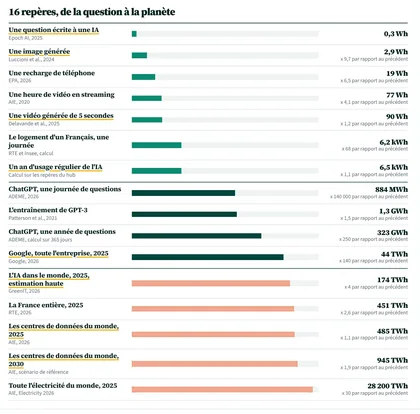
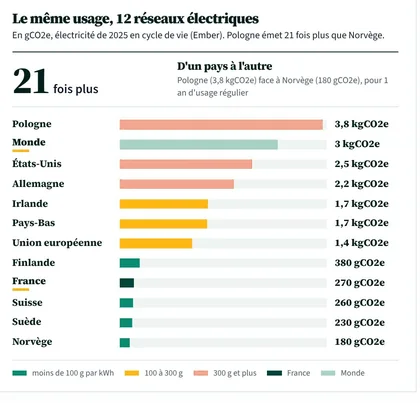
The order of magnitude can be calculated. The AI Impact Database estimates the use of AI at work by the 5.85 million French public employees at about 1,400 MWh per year, or about 240 Wh per employee, users or not, with the usual uses of an assistant. This average applies to the whole civil service; a local authority, without teachers or carers, has a different mix of occupations. For a local authority of 1,000 employees, this comes to about 240 kWh per year: about 10 kgCO2e if the servers run on French electricity, about 110 kgCO2e on the world average electricity. It is an estimate: it counts neither the services that the authority deploys for its users, nor the autonomous assistants that chain tasks, which bring a developer's use to about 400 kWh per year on their own, nor the manufacture of workstations.
Our reading
For us, at Projet Celsius, local authorities have adopted AI quickly and set rules early: half of those with more than 3,500 inhabitants have a project, three quarters of these have begun work on a charter, and use remains first that of an office assistant. They still measure little. On the environment, the order of magnitude can be calculated: for the everyday use of their staff, electricity is counted in hundreds of kilowatt-hours per year for 1,000 employees, and the location of the servers changes emissions by a factor of 11. Electricity rises with services open to the public, autonomous assistants that chain tasks and models hosted in-house; these are what must be counted first, with figures that most providers do not yet give.
The survey counts declared projects, not the individual use made by staff. Its adoption rate excludes municipalities with fewer than 3,500 inhabitants. Its chart and its text differ on internal management (59 and 54%) and on the order of 2 measures, as flagged on the page. The electricity of staff use is an estimate by the AI Impact Database, excluding services open to the public.
Sources
4 documents
- Banque des Territoires and Observatoire Data Publica, Tendances 2026 : data, intelligence artificielle et cybersécurité dans les territoires2026entry 235
- Observatoire Data Publica, Baromètre 2026 de la donnée, de l'IA et de la cybersécurité dans les collectivités2026entry 449
- Cap'Com and Observatoire Data Publica, L'utilisation de l'IA générative par les communicants du service public local2026entry 450
- Projet Celsius, AI Impact Database, environmental database of artificial intelligence, engine 0.3.12026entry 144
Every figure was read in its source; the hub's methodology is described in Methodology and sources.
AI Impact, Projet Celsius, "How are local authorities adopting AI?", 14 November 2026. https://projetcelsius.com/en/ai/analyses/how-local-authorities-are-adopting-ai/