
 Climate13 November 2026
Is a French AI better for the climate?
An answer of 250 words, by model and server location




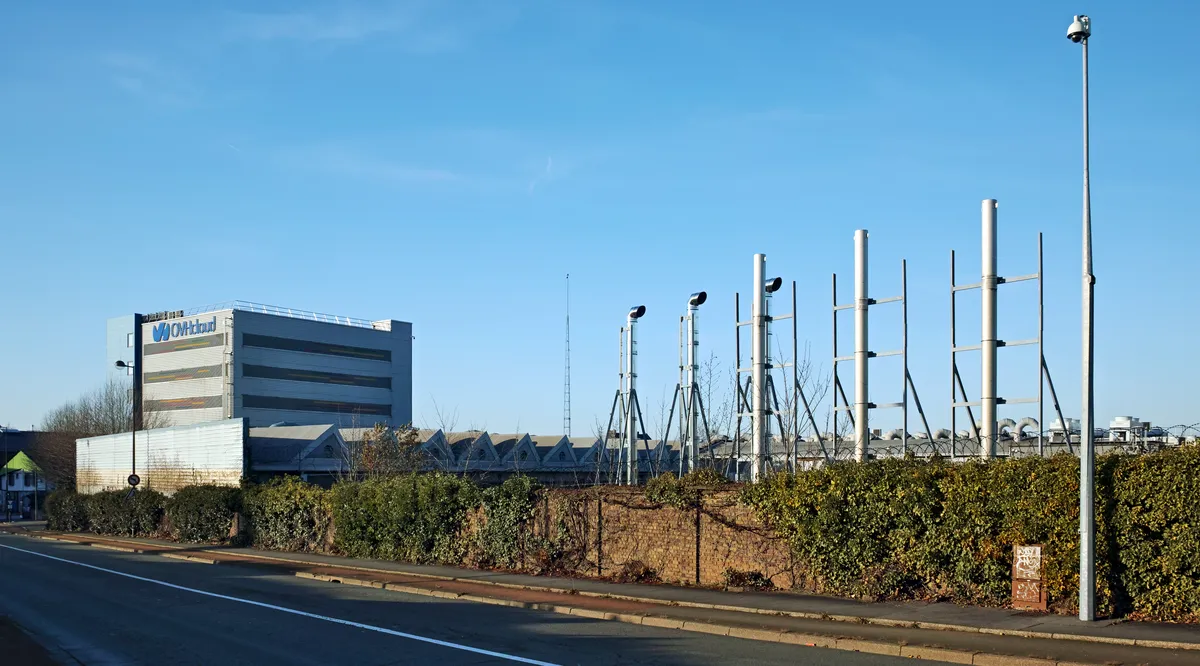
The data centre site of OVHcloud, a French host, in Roubaix, in December 2023. Photo unrelated to the providers cited. Photo Velvet, CC BY-SA 4.0, via Wikimedia Commons.
The emissions of an AI answer depend on the model that produces it and on the electricity grid of its servers; the country of the provider's head office plays no part in the calculation. For the same model, servers in the United States rather than in France multiply the emissions of a 250-word answer by 3.6 to 7.2, and from one model to another, at the same provider, the gap reaches 140 times, according to EcoLogits estimates. Mistral AI names its default model, publishes its size and hosts its data in the European Union, without saying where its answers are computed.
Contents
"Which AI is French?", "is the Claude AI French?": these questions are among those that Google suggests when you start a search about AI. Among the 10 assistants of the AI Ranking, only one is published in France: Vibe, formerly Le Chat, from Mistral AI. Claude is published by the American company Anthropic.
The idea that a French AI would emit less has a basis. French electricity is one of the least carbon-intensive in Europe: producing 1 kWh there emitted 41 gCO2e in 2025, against 384 in the United States. The emissions of an answer come from the electricity consumed by the servers that calculate it, at the factor of the grid that supplies them, and from a share of the manufacturing of those servers. They therefore depend on the model that answers and on where it runs; the country of the provider's headquarters does not enter the calculation.
To compare the 2 in a single unit, we took an answer of 400 tokens, the length of the life cycle assessment of Mistral AI, which the AI Impact Database counts as 250 words. Its emissions are estimated by EcoLogits, an open tool that calculates the electricity and a share of the manufacturing of the servers from the size of each model, for the 16 models of the hub's tool, where the calculation is redone. The electricity is converted with the average intensity of the grid of each location, over the life cycle, according to Ember. Neither the training of the models, nor the journey of the question through the internet network, nor the user's device are counted.
At a single provider, the model changes an answer by up to 140 times
Each provider offers several models, from the lightest to the largest, which do not provide the same service. For an answer of the same length, the gap between the lightest and the heaviest of the models in the hub tool ranges from 13 times at Mistral AI to 140 times at Anthropic, according to EcoLogits estimates.
| Provider, country of headquarters | Lightest model | Heaviest model | Gap |
|---|---|---|---|
| Anthropic, United States | Claude Haiku 5.5: 0.021 g | Claude Fable 5.1: 2.9 g | 140 times |
| OpenAI, United States | GPT-6 Luna: 0.029 g | GPT-6 Astra: 3.6 g | 130 times |
| Google, United States | Gemma 4 31B: 0.024 g | Gemini 3.1 Pro: 2.5 g | 110 times |
| Mistral AI, France | Mistral Small 4: 0.047 g | Mistral Large 4: 0.62 g | 13 times |
gCO2e for an answer of 400 tokens (250 words), world average electricity (458 gCO2e per kWh), server manufacturing included. EcoLogits estimates (model database of 14 October 2026) for the 16 models of the hub tool, excluding Gemini 4 Argon, whose value is provisional. Gemma 4 31B is an open model from Google, distinct from the Gemini models. The tool does not include the smallest Mistral AI models: with Ministral 3B (0.011 g), its gap would be 58 times.
The gap mainly follows the number of parameters that the model activates to write each word, published for the Mistral AI models included here and estimated for the others. Mistral AI draws the same conclusion from its life cycle assessment:
"A model 10 times larger will produce impacts an order of magnitude higher than those of a smaller model, for the same quantity of tokens generated."
Mistral AI made Mistral Medium 3.5, an open model with 128 billion parameters, the default model of Le Chat on 22 May 2026, 6 days before renaming it Vibe; no announcement noted since has changed this default. According to EcoLogits, its typical answer emits 0.11 g at the world mix, for 0.22 Wh of electricity, a value close to the quick question of the AI Impact Database (0.3 Wh). The other assistants do not say which model answers by default. The free offer of Claude includes Sonnet and Haiku, that of Gemini a Flash-Lite model without a version number, and that of ChatGPT GPT-6 Luna, a small model, the only GPT-6 model open to the free offer according to the table on its pricing page.
Mistral AI publishes the size of the models included here, and EcoLogits derives a single value from it. The size of the closed models of Anthropic, OpenAI and Google is not published: EcoLogits estimates it and gives a range, from 0.23 to 0.35 g for Claude Sonnet 5.5 on the typical answer.
Between France and the United States, electricity changes the emissions of the same answer by 3.6 to 7.2 times
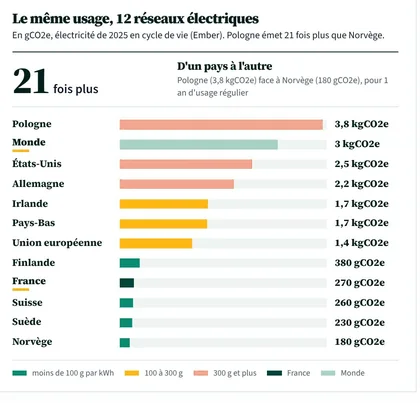
The second factor is the grid that supplies the servers. Producing 1 kWh of electricity emitted 9 times more greenhouse gases in the United States than in France in 2025, and 1.8 times more than the European Union average.
Electricity produced in 2025, in gCO2e per kWh, over the life cycle (Ember, values of the AI Impact Database).
The Union average covers large gaps, from 35 g in Sweden to 589 g in Poland. In Ireland, where data centres consumed 23% of the electricity recorded at the country's meters in 2025, it is 257 g. Servers installed in Europe can therefore run on electricity close to that of France or close to that of the United States.
The default model of Vibe on the electricity of France, 41 g per kWh.
The same model on the electricity of the United States, 384 g per kWh.
According to the same estimate, the model emits 0.050 g at the average grid of the Union. The gap between France and the United States is smaller than that of the grids, because the manufacturing of the servers does not change with location: it makes up 3% of this answer at the world mix and a quarter in France. Depending on the models in the tool, the gap ranges from 3.6 times, for Gemma 4 31B, to 7.2 times, for Mistral Medium 3.5; it is smaller for small models, where manufacturing weighs more.
The gap between models is wider than that between grids, but these models do not provide the same service. At equal service, choosing the smallest sufficient model for each task would remove of the order of 28% of emissions, against 79% for electricity like that of France, according to our analysis of AI decarbonisation.
Providers publish at best a region, rarely a country
To know the electricity of an answer, you would need to know in which country it was calculated. None of the 4 providers publishes this for its consumer assistant, and the location where data is hosted does not say where answers are calculated.
| Provider | Server location, according to its pages | Electricity of the location, gCO2e per kWh |
|---|---|---|
| Mistral AI (France) | Data hosted by default in the European Union, with temporary transfers possible; location of the calculation of Vibe answers not published; for developers, calculation in Europe or the United States, at choice, without a country | 210 if answers are calculated in the Union (assumption) |
| Google (United States) | Average of its data centres, according to their grid, in 2024; location of a question not published | 345, depending on the grid |
| Anthropic (United States) | For developers, data stored in the United States and calculation "in any available geography" by default, or in the United States only; at AWS and Google Cloud, choice of a country in Europe | not published; 384 in the United States |
| OpenAI (United States) | Location not published for ChatGPT | 384, the United States assumed |
Provider pages consulted on 13 November 2026; the OpenAI page on hosting in Europe refused to be read. Electricity: Ember, 2025, life cycle; for Google, the factor from its August 2025 article, which counts the electricity production of the grid without its life cycle and without purchase agreements.
Mistral AI has named 2 sites. At Les Ulis, in Essonne, a 10 MW centre dedicated to calculating answers was scheduled to open in the 3rd quarter of 2026. At Borlänge, in Sweden, a centre built with EcoDataCenter is due to open in 2027. If Vibe answers were calculated there, their electricity would be that of France, 41 g, or of Sweden, 35 g. Mistral AI does not say what share of its answers would go through them. In the absence of a published location, the AI Ranking uses the Union average for Vibe, based on the hosting of its data, and the AI Impact Database uses the world average, as for all assistants.
An organisation can have its requests calculated in a region it chooses: in Europe or the United States at Mistral AI, in a country in Europe for Claude, through AWS or Google Cloud.
Free offer against free offer, the Vibe model sits in the middle
Comparing assistants requires comparing comparable offers. On world average electricity, the hub's default value when the location is not published, here are the EcoLogits estimates for an answer of 250 words from the models of the free offers, server manufacturing included, in gCO2e.
The default model of Vibe is estimated 2.8 times lighter than Claude Sonnet 5.5 (2.2 to 3.3 times with the EcoLogits range), and heavier than the small models that ChatGPT and Gemini open up: 3.7 times GPT-6 Luna, and 2 times Gemini 3.5 Flash-Lite at the central value, whose range goes from 0.013 to 0.088 g. As Gemini does not publish the version of its Flash-Lite, the 3.5 serves here as a reference. Claude Haiku 5.5, also open on the free tier, is the lightest of the 5.
Location can widen or narrow these gaps. According to EcoLogits, if Vibe answers are calculated in the Union, where its data is hosted, they emit 0.050 g; if those of ChatGPT and Claude are calculated in the United States, GPT-6 Luna emits 0.025 g and Claude Sonnet 5.5 0.25 g. These are assumptions: none of the 4 providers publishes the calculation location of its consumer assistant.
According to EcoLogits estimates, the default model of Vibe emits more than the small models of the free offers of ChatGPT and Gemini, and less than Claude Sonnet 5.5.
The life cycle assessment of Mistral AI cannot be placed next to these estimates
Mistral AI is the only provider to have published a life cycle assessment of its model, carried out with Carbone 4 and ADEME and reviewed by 2 consultancies: 1.14 gCO2e for an answer of 400 tokens for Le Chat, in July 2025, server manufacturing included. Google publishes 0.03 gCO2e for the median question asked to Gemini, with the electricity of its purchase agreements and the manufacturing of its chips. The 2 figures count neither the same scope nor the same electricity as the estimates on this page. Our analysis of diverging estimates sets out these gaps.
The Mistral AI analysis counts electricity according to the grid of the servers, without naming that grid. The AI Ranking, which also scores heavy uses and the provider's approach, ranks Vibe 2nd of the 10 assistants for the environment, behind Gemini. Our article on ecological AI compares what the services that call themselves sober publish.
Choosing an assistant for the climate
A person controls first the choice of model: the lightest one that is enough for the request, when the assistant offers it; our analysis of everyday actions puts a figure on this choice over a year of use. A person cannot check where the servers of a consumer assistant run. The hub tool redoes the calculation for 12 countries and zones, and the carbon intensity map of electricity shows every country.
An organisation can write the calculation region into its contract, at Mistral AI as at Anthropic, through AWS or Google Cloud, then count their uses in their Bilan Carbone® with the electricity of that region.
For us at Projet Celsius, an AI is not better for the climate because it is French. Vibe currently has 2 verifiable particularities: a named default model whose size is published, and data hosted by default in the European Union. If its answers are also calculated there, their electricity emits on average 1.8 times less than in the United States; Mistral AI does not say so. Its default model is not the lightest of the free offers: ChatGPT and Gemini open models there that are estimated to be lighter. These points depend on decisions by the provider; Anthropic also offers calculation in Europe, through AWS and Google Cloud. Other reasons for choosing a European AI, such as the law that applies to data or sovereignty, are not weighed here. For the climate, the 2 questions to ask a provider, French or not, concern the model that answers and the country where it is calculated.
The values by model are EcoLogits estimates: for the closed models of Anthropic, OpenAI and Google, whose size is not published, EcoLogits estimates it and gives a range. They count the electricity of the servers to write the answer and a share of their manufacturing, without the question or the documents read, training, the internet network or the device. The electricity is that of the average grid of each location (Ember, 2025, life cycle), without power purchase agreements. None of the 4 providers publishes the country where an answer from its assistant is calculated: for Vibe, calculation in the Union is an assumption drawn from the hosting of its data, and the other locations are also assumptions.
Sources
13 documents
- EcoLogits, model database of 14 October 20262026entry 95
- Our World in Data, based on Ember, Lifecycle carbon intensity of electricity2026entry 34
- Mistral AI, with Carbone 4 and ADEME, Our contribution to a global environmental standard for AI2025entry 17
- Mistral AI, Remote agents in Vibe. Powered by Mistral Medium 3.52026entry 247
- Mistral AI, Vibe gets to work (Le Chat devient Vibe)2026entry 248
- Mistral AI, Where do you store my data or my Organization's data?2026entry 249
- Mistral AI, In-region inference, open models, and new European infrastructure for sovereign AI2026entry 250
- Mistral AI, AI Now Summit 20262026entry 251
- EcoDataCenter, Mistral AI and EcoDataCenter Partner to Build AI-focused Data Center in Sweden2026entry 252
- Anthropic, Data residency, documentation de la plateforme Claude, accessed in November 20262026entry 253
- Anthropic, Deploy Claude confidently, wherever you are (conformité régionale), accessed in November 20262026entry 254
- Elsworth et al. (Google), Measuring the environmental impact of delivering AI at Google scale2025entry 14
- Central Statistics Office (Ireland), Data Centres Metered Electricity Consumption 20252026entry 10
Every figure was read in its source; the hub's methodology is described in Methodology and sources.
AI Impact, Projet Celsius, "Is a French AI better for the climate?", 13 November 2026. https://projetcelsius.com/en/ai/analyses/is-a-french-ai-better-for-the-climate/
 Uses
 Electricity