
 Climate18 November 2026
Do Chinese AI models like DeepSeek pollute less?
An answer from DeepSeek, Kimi or Qwen against Claude and Mistral, by model, answer length and country of the servers
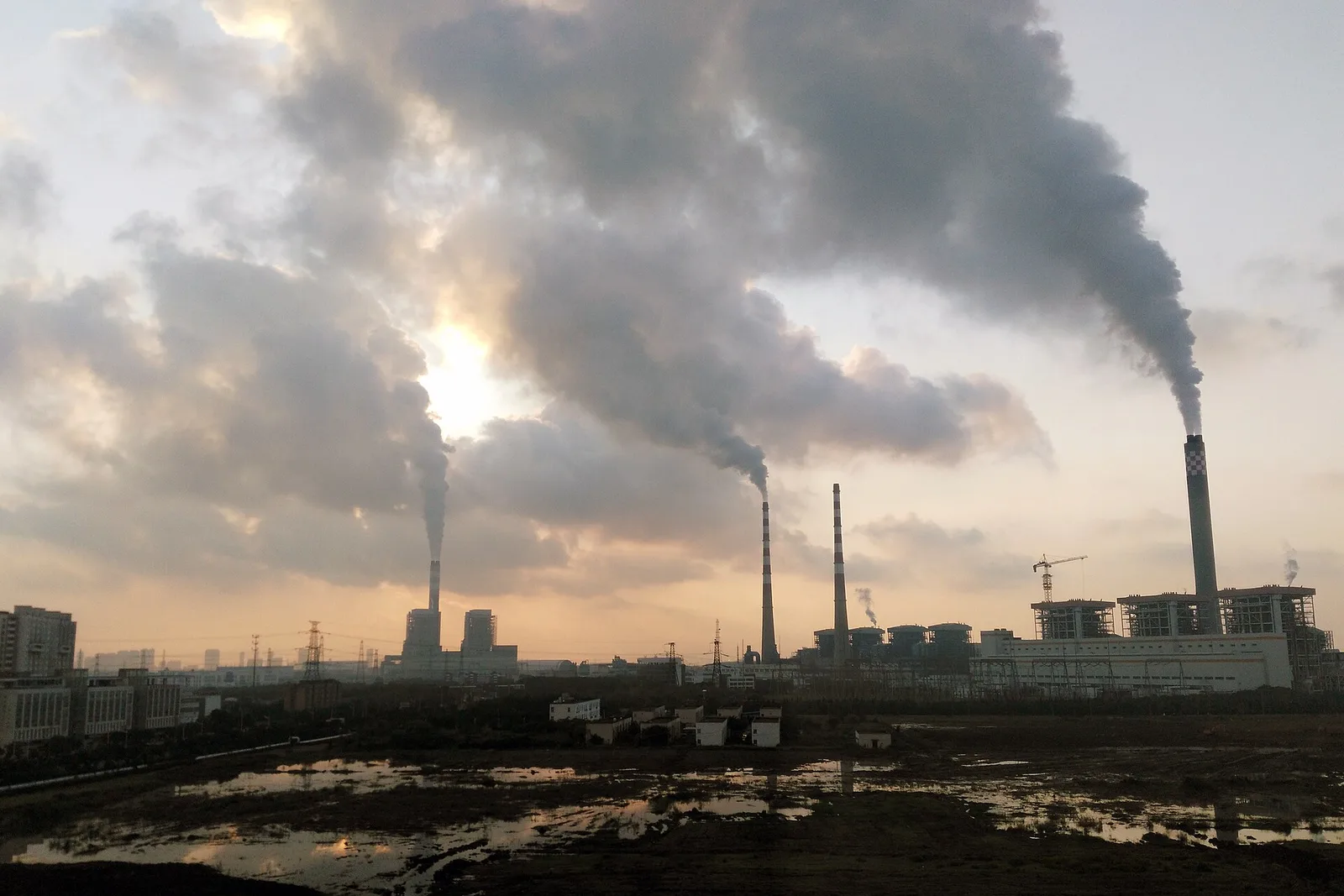
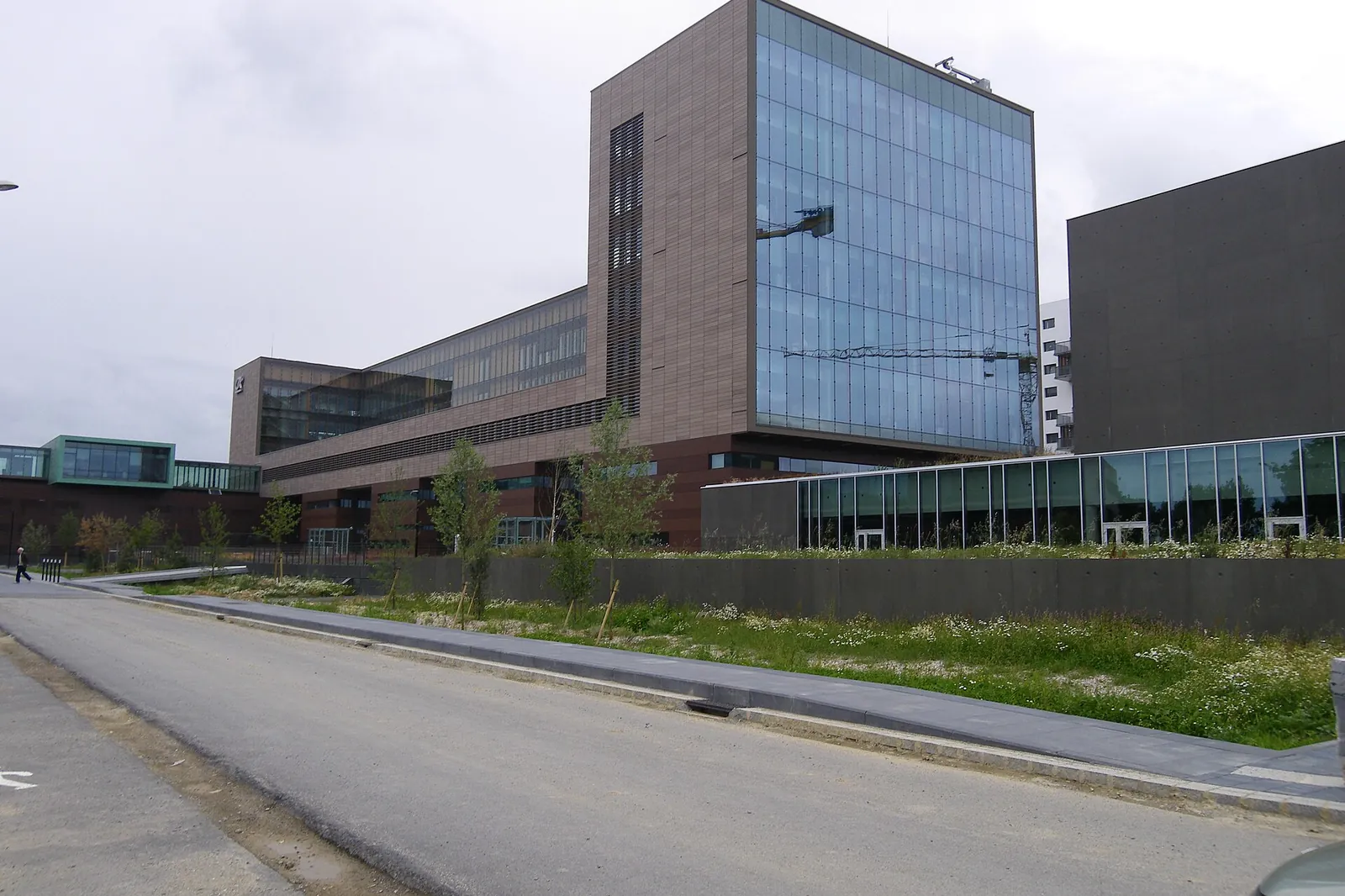
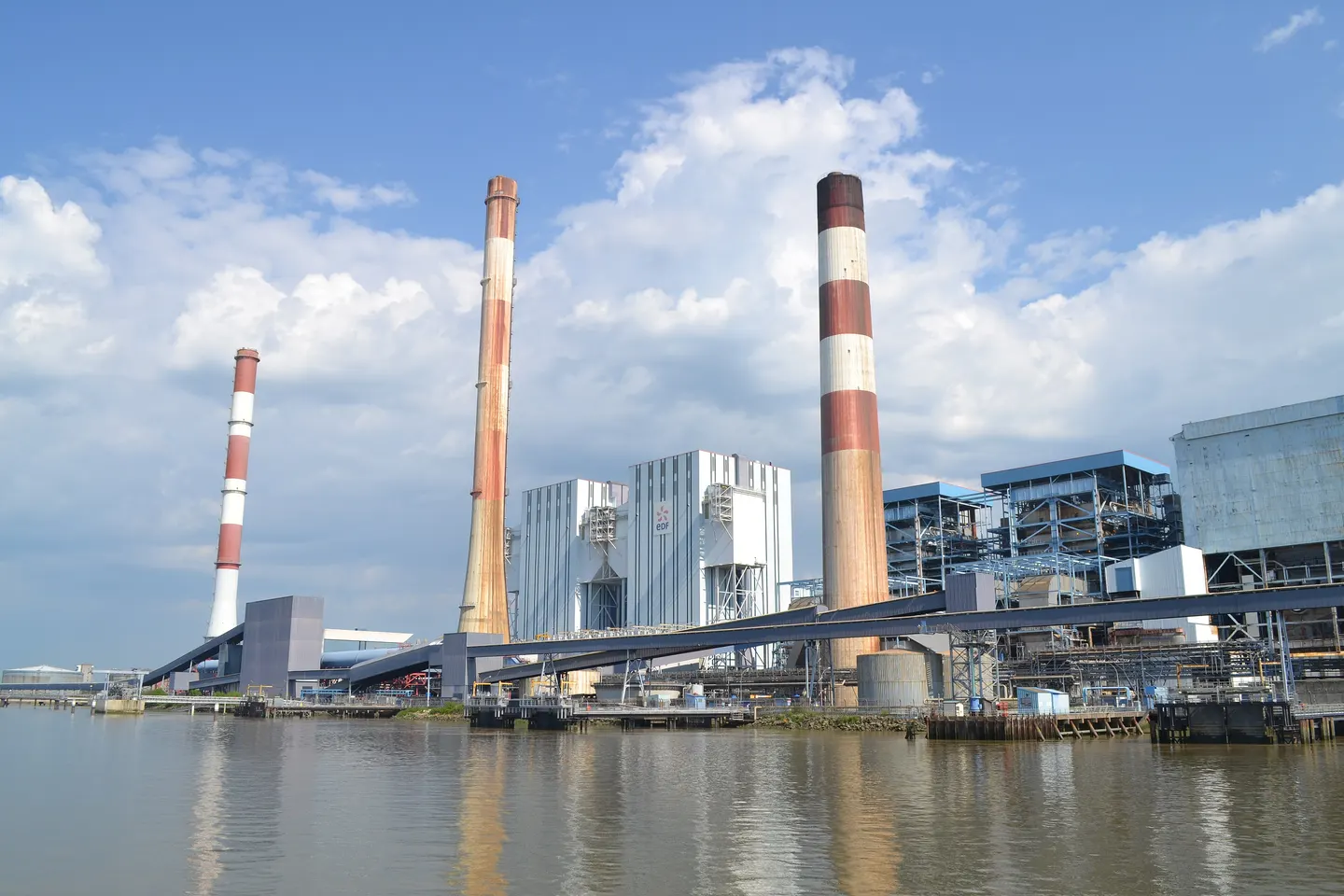
A thermal power station in Nantong, in Jiangsu, in September 2016. Producing 1 kWh emitted 525 gCO2e in China in 2025, according to Ember. Photo Kristoferb, CC BY-SA 4.0, cropped, via Wikimedia Commons.
No, not by nature. DeepSeek V4.1 Flash activates only 16 billion of its 552 billion parameters to write each word, but computed in China, on a grid that emitted 525 gCO2e per kWh in 2025, its 250-word answer emits 0.72 gCO2e, as much as that of Claude Opus 5.5 computed in the United States, according to EcoLogits estimates. The largest open Chinese models, Kimi K3 and Qwen3.8, need more electricity per answer than all the models in our comparison tool, and answer length depends on the setting more than on the country. The same DeepSeek model served in France would emit nearly 5 times less.
Contents
An answer of 250 words from DeepSeek V4.1 Flash, the model DeepSeek has served on its website, app and API since 17 October 2026, needs about 1.2 Wh of electricity at the servers, according to the EcoLogits estimate. Its emissions depend on the grid that supplies these servers:
- 0.72 gCO2e in China, where DeepSeek says it processes and stores its users' data;
- 0.56 g in the United States;
- 0.15 g in France.
An answer of the same length written by Anthropic's Claude Opus 5.5 and computed in the United States emits 0.74 g, from 0.52 to 0.96 g depending on the size EcoLogits attributes to it, as Anthropic does not publish it. Computed in China, the Chinese model's answer emits as much as that of a large American model served in the United States.
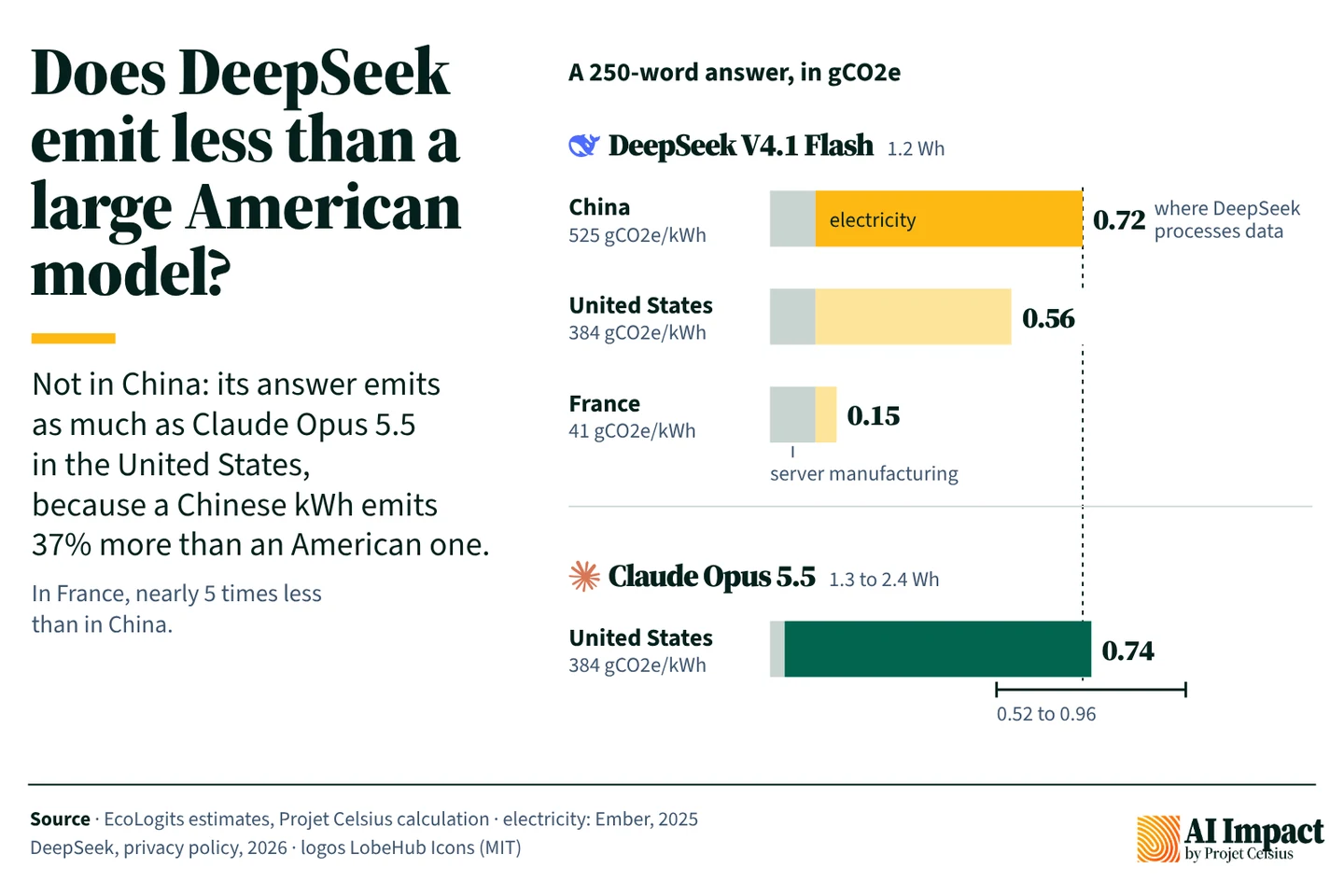
These values are calculated as in our footprint-by-model tool, with EcoLogits, an open tool that estimates server electricity and a share of server manufacturing from the size of each model. As the Chinese models are not in its database, we added them with the sizes published by their providers. Electricity is converted with the average carbon intensity of each country's grid in 2025, according to Ember. Neither training, nor the internet network, nor the user's device is counted.
Chinese models activate only part of their parameters
DeepSeek, Moonshot AI (Kimi) and Alibaba (Qwen) publish mixture-of-experts models. Each layer of the network is split into hundreds of sub-networks, and for each word, a router selects only a few of them. Computation follows the activated parameters, which are fewer than the whole model:
- DeepSeek V4.1 Flash: 16 billion active parameters to write, out of 552 billion;
- Kimi K3: 104 billion out of 2,800 billion;
- Qwen3.8, Alibaba's largest open model: 95 billion out of 2,400 billion.
The whole model stays in memory
The servers must keep the whole model in memory, and EcoLogits counts the graphics cards needed to load it. DeepSeek V4.1 Flash therefore needs about 1.2 Wh per answer, as much as Mistral Large 4, and slightly less than the bottom of the range for Claude Opus 5.5, from 1.3 to 2.4 Wh. Kimi K3 and Qwen3.8 need from 9 to 10 Wh, more than the heaviest of the 16 models in our tool, GPT-6 Astra (7.6 Wh). A small number of active parameters reduces the computation for each word; the electricity for an answer also depends on the total size of the model.
| Model (active parameters out of total) | Electricity | Servers in China | In the United States | In France |
|---|---|---|---|---|
| Claude Sonnet 5.5 (estimated size) | 0.47 to 0.73 Wh | 0.33 g | 0.25 g | 0.041 g |
| DeepSeek V4.1 Flash (16 out of 552 billion) | 1.2 Wh | 0.72 g | 0.56 g | 0.15 g |
| Mistral Large 4 (52 out of 1,050 billion) | 1.3 Wh | 0.71 g | 0.53 g | 0.099 g |
| Claude Opus 5.5 (estimated size) | 1.3 to 2.4 Wh | 1.0 g | 0.74 g | 0.11 g |
| Qwen3.8 (95 out of 2,400 billion) | 9.1 to 9.5 Wh | 5.7 g | 4.4 g | 1.25 g |
| Kimi K3 (104 out of 2,800 billion) | 9.6 to 10 Wh | 6.1 g | 4.7 g | 1.3 g |
An answer of 400 tokens (250 words), in gCO2e, server manufacturing included; EcoLogits estimates, central value. The Chinese models are added by us with their published sizes; the size of Anthropic's models, which is not published, is estimated by EcoLogits. Grid electricity in 2025: China 525, United States 384, France 41 gCO2e per kWh (Ember).
In service, DeepSeek reports a much lower cost than the estimate
DeepSeek published in February 2025 enough to calculate the electricity use of its service. For 24 hours, on 27 and 28 February 2025, its V3 and R1 models occupied on average 226.75 servers of 8 H800 cards, to read 608 billion tokens and write 168 billion, website, app and API included.
With the values of the AI Impact Database (900 Wh per card-hour, server included, and 10% for the data centre), this service used about 43,000 kWh a day. Putting all this electricity on the tokens written, an answer of 250 words needed at most 0.10 Wh, from 0.08 to 0.21 Wh depending on server power and the data centre (our calculation). For the same model, EcoLogits gives 1.5 Wh, 7 to 18 times more.
| Methodology | What is counted | 250-word answer |
|---|---|---|
| Estimation EcoLogits, DeepSeek-V3 | servers and data centre; 16-bit model, 64 requests at a time | 1.5 Wh |
| ML.ENERGY benchmark, DeepSeek V3.1 | graphics cards alone; 8 B200 cards, 64 requests at a time | 0.32 Wh |
| DeepSeek service, V3 and R1, 27 and 28 February 2025 | servers and data centre; all the electricity put on the tokens written (our calculation) | at most 0.10 Wh (0.08 to 0.21) |
DeepSeek's service is converted with the values of the AI Impact Database: 900 Wh per H100 card-hour, server included (700 to 1,275 Wh, based on the maximum power of 10.2 kW of a server with 8 cards given by Nvidia), and a data centre that adds 10% (56% at the top of the range). DeepSeek publishes neither the power of its servers nor the efficiency of its data centres.
The gap comes from how the model is served. EcoLogits assumes a model loaded in 16 bits on the number of H100 cards needed to hold it, which process 64 requests at a time. DeepSeek spreads its experts across groups of 18 servers and batches a very large number of requests. Google, which measured 0.24 Wh for the median question put to Gemini, also serves at large scale; OpenAI announces an average without a method, and Anthropic publishes nothing. EcoLogits remains the only method applied in the same way to all models, and is used here to compare them with each other.
In China, 1 kWh emits 37% more than in the United States
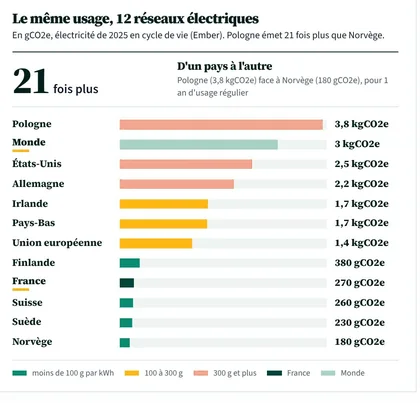
According to Ember, producing 1 kWh emitted 525 gCO2e in China in 2025, on a power plant life cycle basis, against 555 in 2024. That is 1.37 times the United States and 13 times France.
Electricity produced in 2025, in gCO2e per kWh, life cycle (Ember).
In its privacy policy, DeepSeek writes that it collects, processes and stores its users' data in the People's Republic of China. For Kimi and Qwen, we could not find a document saying where answers are computed. The 4 Western providers we studied do not say so either for their consumer assistants, as shown by our analysis of French AI.
The gap between countries is smaller on an answer than on electricity, because server manufacturing does not change with location: for DeepSeek V4.1 Flash, it accounts for 0.10 g out of 0.72 in China, and 2 thirds of the 0.15 g in France.
The answers of Chinese models are not always longer
The emissions of an answer follow its length: 2 times more words written, roughly 2 times more electricity. The available measurements do not all point the same way:
- on the same conversation questions, the benchmark ML.ENERGY recorded answers of 849 tokens on average for DeepSeek V3.1 and 876 for Qwen3 235B, against 352 for Meta's Llama 3.1 70B: 2.4 times more;
- to bring its intelligence index to the maximum reasoning setting, Artificial Analysis counted 174 million tokens written by DeepSeek V4.1 Flash, against 218 million for Claude Opus 5.5;
- DeepSeek announces that its 17 October 2026 version writes shorter answers than the previous one.
Length depends mainly on the reasoning setting, which the user chooses in some assistants and which the provider fixes in others. It does not follow the nationality of the model.
DeepSeek-V3's $5.6 million covers the final training run alone
The figure comes from the DeepSeek-V3 Technical Report, published on 27 December 2024. DeepSeek counts 2.788 million H800 card-hours there and applies an assumed rental price of $2 an hour, that is $5.576 million. The report itself states what it leaves out:
"Note that the aforementioned costs include only the official training of DeepSeek-V3, excluding the costs associated with prior research and ablation experiments on architectures, algorithms, or data."
Ablation experiments are trials in which an element is removed to measure its effect. The purchase of the 2,048 cards, salaries and data are not counted either. The $5.6 million is a rental price applied to the hours of the last training run.
How much electricity do these hours represent?
With the Database values, these hours come to about 2.8 GWh, data centre included, from 2.1 to 3.9 GWh depending on the assumptions (our calculation). On the Chinese grid, assuming training took place there, that is about 1,450 tCO2e, the annual footprint of 175 French people. It is also a little over 3 days of ChatGPT's electricity use, according to ADEME's calculation.
| Final training run | Graphics card hours | Electricity | Status |
|---|---|---|---|
| DeepSeek-V3, 14,800 billion tokens | 2.79 million (H800) | 2.8 GWh (2.1 to 3.9) | hours published by DeepSeek; electricity, our calculation |
| Llama 3.1 405B, about 15,000 billion tokens | 30.84 million (H100) | 30.5 GWh | hours published by Meta; electricity, our calculation |
| GPT-4 | about 57 million (A100) | 32.8 GWh | estimate by researchers, OpenAI publishes nothing |
Electricity calculated with the values of the AI Impact Database: 900 Wh per card-hour, server included, and 10% for the data centre; the range for DeepSeek-V3 runs from 700 Wh with 10% to 900 Wh with 56%. The Database treats an H800 card-hour as an H100 one. GPT-4: estimate by Morand, Névéol and Ligozat (2025), taken up by the Database.
Meta published 30.84 million H100 card-hours for Llama 3.1 405B, trained on about 15,000 billion tokens, against 14,800 billion for DeepSeek-V3: 11 times more hours for a similar volume of text. The computing saving of DeepSeek-V3 comes from its mixture-of-experts architecture, 37 billion active parameters out of 671, more than from the rental price used. The Database lists the published training runs by model.
An open Chinese model can be served outside China
The weights of DeepSeek V4.1 Flash are published under an MIT licence: any host can serve it. Artificial Analysis lists 20 hosts that offer it in addition to DeepSeek, American, European and Chinese. Served on a grid like that of France, its 250-word answer would emit 0.15 gCO2e, nearly 5 times less than in China. A host does not always publish the country of the server that answers: for an organisation, the computing region is set out in the contract. Our tool on the country of the servers redoes this calculation for other countries.
The DeepSeek entry in our AI Ranking covers the rest: security, use of data, the provider's approach.
Our view
A model's nationality matters mainly, in our view, through the place where it is served. The Swiss assistants Lumo and Euria give the opposite case, on a low-carbon grid. DeepSeek showed that a mixture-of-experts architecture reduces the computation of a training run and, by its own figures, that of an answer in service. On the same calculation method, however, its model served in China emits as much per answer as a large American model served in the United States, and the largest Chinese models are among the heaviest. For a Chinese AI as for any other, 3 questions cover the essentials:
- What is the size of the model, in total and active parameters?
- In which country is the answer computed?
- How many words does it write at the chosen setting?
The per-answer values are EcoLogits estimates, made by us for the Chinese models, which are absent from its database, from their published sizes. They count a 16-bit model on H100 cards; according to its own figures, DeepSeek's service used 7 to 18 times less per answer in 2025. The size of Anthropic's models is not published: EcoLogits estimates it. We could not read the country of computation for Kimi and Qwen, and DeepSeek does not publish that of the training of DeepSeek-V3. Water and chip manufacturing beyond the share counted by EcoLogits are not covered here.
He holds a doctorate from École polytechnique and an engineering degree from ESPCI Paris, and co-founded Projet Celsius, which he chairs. He is a lead trainer in Bilan Carbone® and life cycle assessment at the Institut de Formation Carbone.
His page and articles →Contact him →LinkedIn ↗
An engineer from UTBM and life cycle assessment trainer at the Institut de Formation Carbone, he carries out the life cycle assessments at Projet Celsius.
His page and articles →Contact him →LinkedIn ↗Sources
17 documents
- EcoLogits, model database of 14 October 20262026entry 95
- Our World in Data, based on Ember, Lifecycle carbon intensity of electricity2026entry 34
- DeepSeek, DeepSeek-V4.1-Flash-1017: Wish-Driven Programming Made Real2026entry 580
- DeepSeek, DeepSeek-V4.1-Flash model card2026entry 581
- Moonshot AI, Kimi K3 model card2026entry 582
- Qwen (Alibaba), Qwen3.8-2.4T-A95B model card2026entry 583
- DeepSeek, Day 6: One More Thing, DeepSeek-V3/R1 Inference System Overview2025entry 584
- ML.ENERGY Leaderboard, conversation task (LM Arena Chat)2026entry 586
- Nvidia, DGX H100/H200 User Guide, Introduction to the NVIDIA DGX H100/H200 System2024entry 355
- DeepSeek, Privacy Policy2026entry 177
Every figure was read in its source; the hub's methodology is described in Methodology and sources.
Guillaume Pakula and Sébastien Pierfederici, Do Chinese AI models like DeepSeek pollute less?, AI Impact, Projet Celsius, 18 November 2026. https://projetcelsius.com/en/ai/analyses/do-chinese-ai-models-pollute-less/