
 Uses18 November 2026
Do the Swiss AI assistants Lumo and Euria use less energy?
The promises of Proton and Infomaniak, what they publish, and a typical question estimated with the AI Impact Database
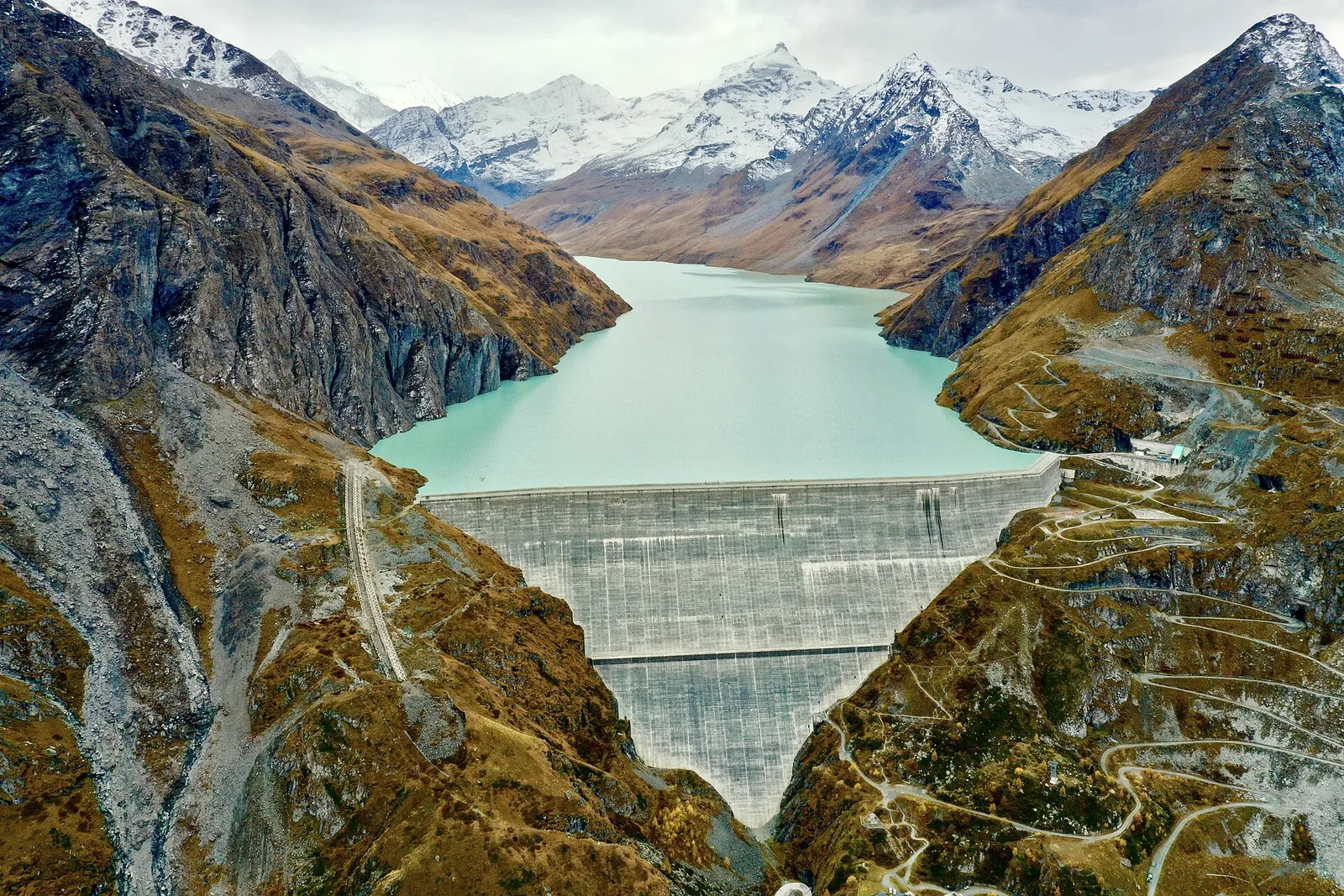
The Grande-Dixence dam, in Valais, in October 2019. Generating 1 kWh emitted 39 gCO2e in Switzerland in 2025, according to Ember. Photo Jérémy Toma, CC BY-SA 4.0, via Wikimedia Commons.
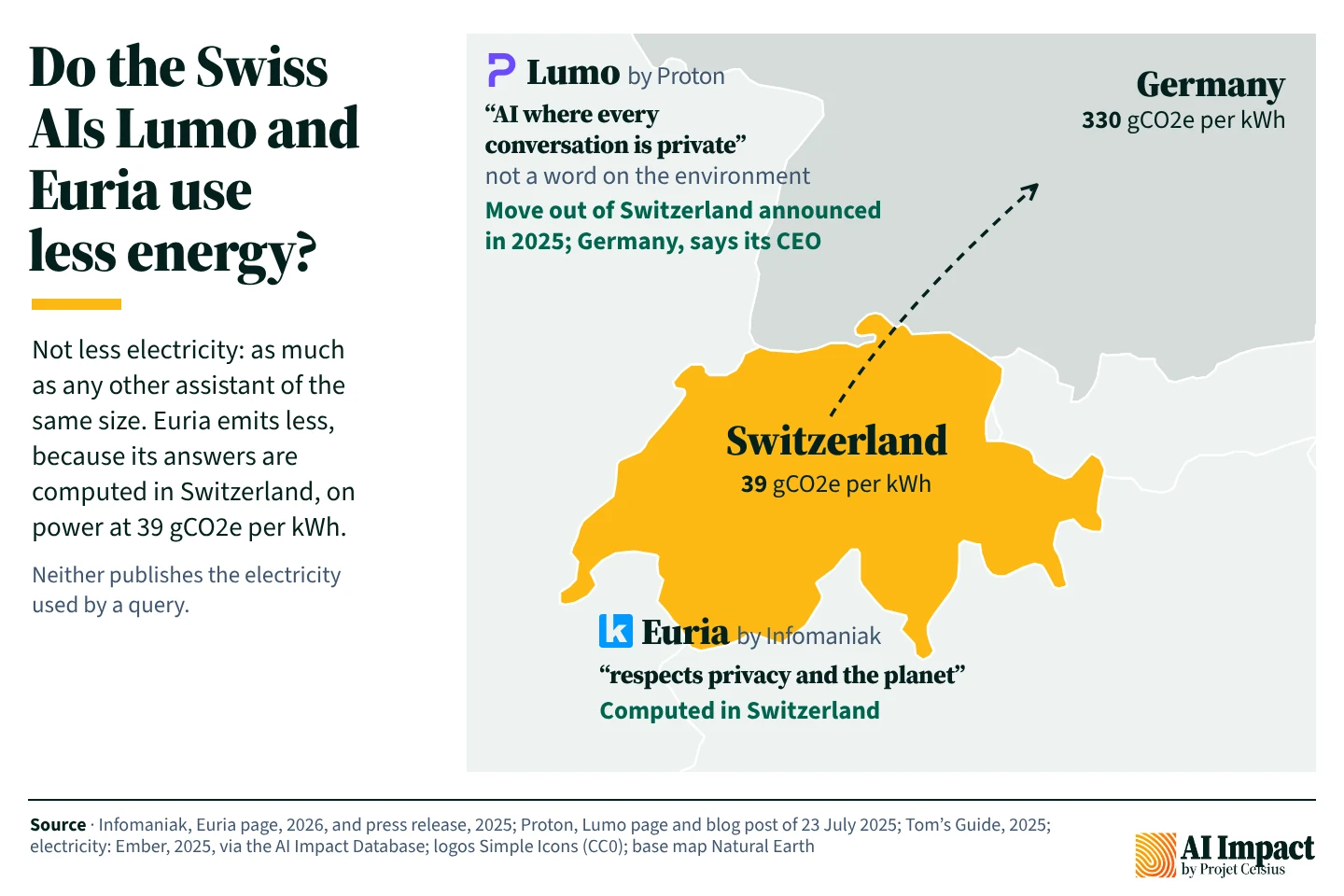
Neither Lumo nor Euria publishes the electricity of a question, and that electricity depends first on the size of the model that answers: at equal size, it is the same as for other assistants, from 0.05 to 1.2 Wh depending on the model in the AI Impact Database. Euria emits less because it runs in Switzerland, on electricity at 39 gCO2e per kWh: about 0.012 g for a typical question, 12 times less than on the average world grid, by our calculation. Lumo, Proton's assistant, makes no environmental promise, and Proton announced in 2025 that it would run it outside Switzerland.
Contents
"The sovereign AI assistant that respects privacy and the planet" (our translation): this is how Infomaniak, a hosting provider based in Geneva, presents Euria on its website. Under the heading "Respectful of the environment" (our translation), its page adds:
"Infomaniak's AI is powered exclusively by local renewable energy. By choosing Euria, you help heat homes." (our translation)
At launch, on 9 December 2025, its founder Boris Siegenthaler wrote that Euria "shows that an AI can be powerful while being more sustainable for the planet" (our translation). Proton, the other Swiss provider, promises nothing of the kind for Lumo. Its page talks about privacy, "AI where every conversation is private", and about a service "Built and based in Europe". None of the Lumo pages we read makes any claim about energy, climate or the environment.
The 2 assistants are nevertheless linked in searches: "ia suisse écologique", "ia suisse éthique" and "ia suisse chauffage" (French-language queries) are among Google's suggestions on 18 November 2026. Neither is in the AI Ranking of the hub. The next infographic sets each promise against what the provider publishes and what can be measured.
Which models do Lumo and Euria run?
The electricity of an answer depends first on the size of the model that computes it: from one model to another at the same provider, the gap reaches 140 times, as shown by our analysis of French AI. The 2 providers serve open models, which anyone can download, without saying which one answers by default:
- Lumo : Proton names Qwen 3.5 and GLM 5.3 for text, Apertus 1.5 and 2 image models. It says it chooses, for each request, "the model most capable of dealing with your request", without publishing the size of the versions it serves.
- Euria: Infomaniak offers Apertus, the model from EPFL, ETH Zurich and the Swiss National Supercomputing Centre, in a selector. Its guide describes models "selected for their performance and energy efficiency" (our translation), without listing them.
The the catalogue that Infomaniak sells to developers gives an idea: 7 text models, of which 6 carry their size in their name, from 14 billion parameters (Ministral 3 14B) to 397 billion, of which 17 billion active to write each word (Qwen3.5-397B-A17B); the name of the 7th, Kimi K2.6, does not give it. Nothing indicates which ones serve Euria by default.
| Assistant | Model that answers | Figure per question | Country of computation |
|---|---|---|---|
| Euria (Infomaniak) | Apertus as a choice, default not named | none | Switzerland |
| Lumo (Proton) | families named, sizes not published | none | Europe, outside Switzerland according to Proton |
| Gemini (Google) | Flash-Lite, no version given, on the free plan | 0.24 Wh, measured | not published |
| ChatGPT (OpenAI) | GPT-6 Luna on the free plan | 0.34 Wh, no method | not published |
| Vibe (Mistral AI) | Mistral Medium 3.5 | 1.14 gCO2e, life cycle assessment | not published, data in the Union |
What the providers publish, read on 18 November 2026 for Euria and Lumo; for the 3 others, hub values (AI Ranking and the analysis on French AIs).
Euria is the only one of the 5 whose provider publishes the country where answers are computed: according to Infomaniak, request processing takes place "exclusively in Infomaniak's data centers in Switzerland" (our translation). Neither of the 2 Swiss assistants publishes a per-question figure.
How much does a question to Lumo or Euria use?
In the absence of a published figure, we took the quick question from the AI Impact Database: a question of 100 tokens, an answer of 400 tokens, about half a page, data centre included. The Database calculates it for 3 model sizes, which the bars below compare with the 2 figures published by Google and OpenAI.
Electricity of a typical question, in Wh: the 3 model sizes of the AI Impact Database (Projet Celsius calculation) and the figures published for Gemini and ChatGPT.
A small model has about 8 billion active parameters; the medium model is the default of mainstream assistants; a large model has several hundred billion. The computation of an answer depends on the chips, the size of the model and the length of the text; the provider's country does not enter into it. With the same model size, a question to Lumo or Euria uses as much electricity as a question to any other assistant. Without the size of the model that answers, the estimate remains a range, from 0.05 to 1.2 Wh, a ratio of 1 to 24.
Infomaniak puts forward another lever: Euria launches a web search only when it judges it necessary, which would give "less energy consumed" (our translation). The company publishes no figure to support this.
What does Swiss electricity change?
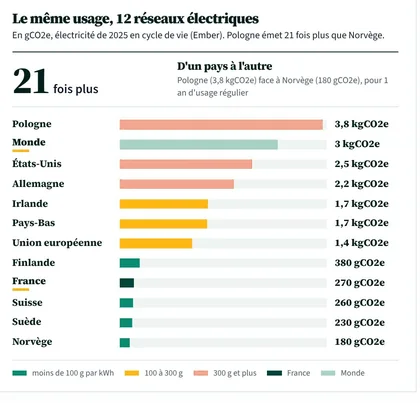
The second factor is the electricity grid of the servers. Generating 1 kWh emitted 39 gCO2e in Switzerland in 2025, about as much as in France (41 g), against 330 in Germany and 458 on the world average, according to Ember. For the same typical question of 0.3 Wh, here is what the Database gives depending on the servers' country.
Emissions of a typical 0.3 Wh question, in gCO2e, by server grid (AI Impact Database, Ember 2025 electricity over the life cycle, Projet Celsius calculation).
For the same question, Euria emits about 12 times less than an assistant on the average world grid, the value the hub uses when the country is not published. The advantage comes from the Swiss grid. Infomaniak also buys certificates: in 2024, 38% of its electricity was labelled Naturemade Star, 56% was TÜV SÜD certified hydropower and 6% was solar produced on its roofs, according to its impact report. These purchases fall under the contract-based method and do not change the calculation based on the grid.
For Lumo, the country matters more. On launch day, 23 July 2025, Proton wrote :
"Proton is moving most of its physical infrastructure out of Switzerland. Lumo will be the first product to move."
Its CEO, Andy Yen, named Germany, according to Tom's Guide. If Lumo computes its answers there, a typical question emits 0.099 g, 8 times more than in Switzerland. Proton does not name the country on the Lumo pages, which state only servers controlled by the company. The hub's tool on the country of the servers repeats this calculation for 12 countries and zones.
Does the heat recovered in Geneva reduce the footprint of a question?
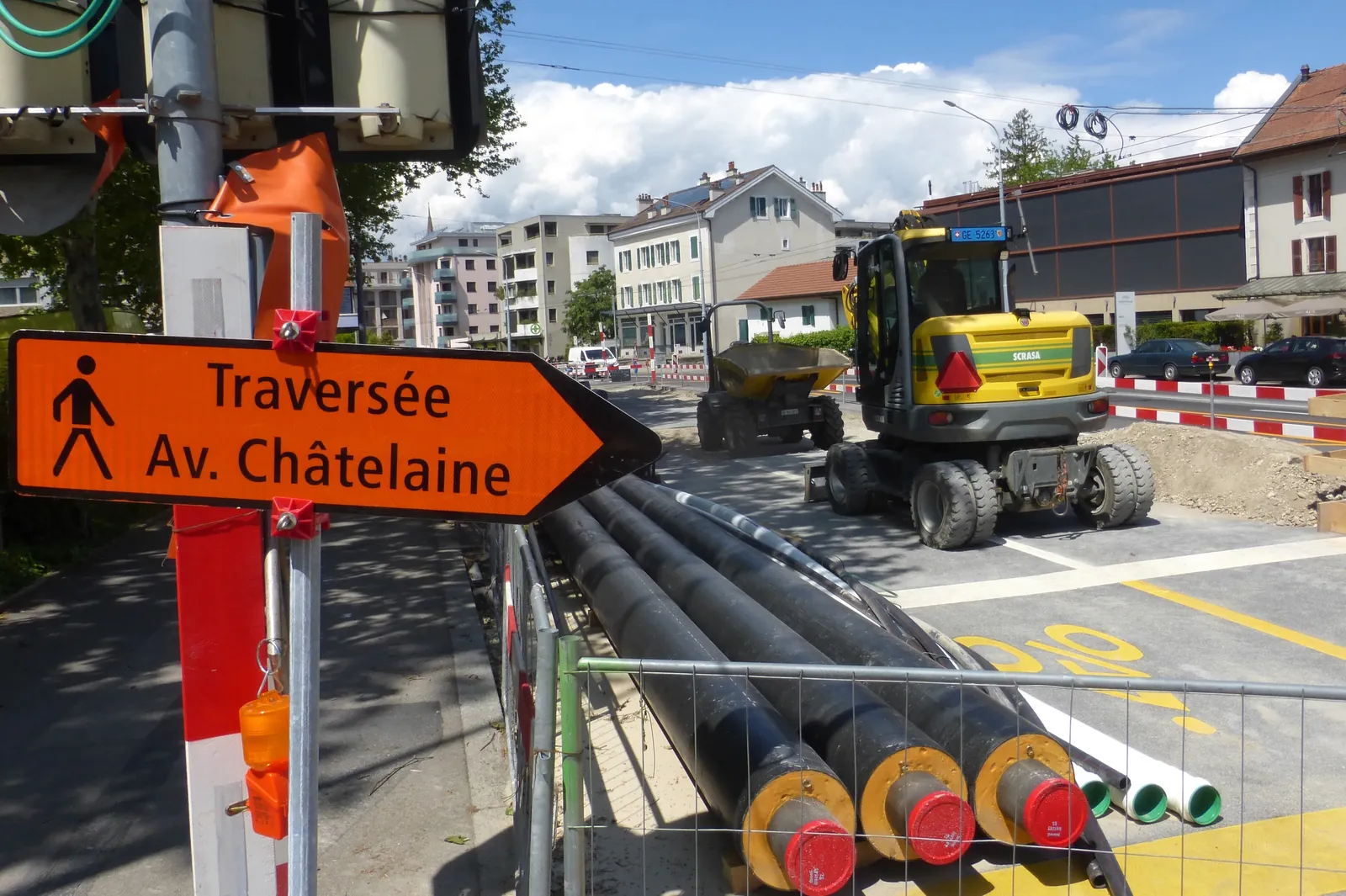
Infomaniak links Euria to D4, its data centre built beneath a Geneva eco-district, which it presents as "the data center that powers Euria" (our translation). The heat from the servers is raised in temperature by heat pumps and sent into the district heating network of the Services industriels de Genève.
The announced figures
- Since 11 November 2024, "all the electricity consumed" (our translation) would be fed back as heat, according to the inauguration press release.
- At full load, the centre would supply 1.7 MW of heat, enough to heat 6,000 homes and avoid 3,600 tCO2e of natural gas a year.
- This full load is targeted by 2028: in January 2025, the centre was running at 25% of its capacity.
The measured figures
- In 2024, 65% of the centre's electricity was recovered as heat, according to Infomaniak's impact report, which explains it by a heat network not yet fully operational.
- The average PUE of Infomaniak's centres, the building's electricity relative to that of the servers, was 1.085 in 2024; their water consumption, 0.0145 litre per kWh in 2023. Brought back to a typical question, this water comes to about 0.004 mL, by our calculation, against 0.26 mL measured by Google for Gemini.
- D4's indicators are displayed in real time on the project website, documented by students from EPFL, IMD and the University of Lausanne. We did not record an annual value.
The recovered heat does not reduce the electricity of a question: the servers use as much, and their heat replaces gas in Geneva's heating. The gain is counted on the city's side. Centres that do this remain rare: in the European Union, 1.8% of data centre heat was reused in 2024, as set out in our analysis of heating a city with a data centre. Infomaniak also says it offsets 200% of its emissions through forestry projects; an offset does not change what an answer emits either.
Our view
In our view, Euria has a verifiable advantage: a published country of computation, Switzerland, whose electricity is among the least carbon-intensive in Europe. The country of computation weighs in the same way on Chinese AIs, served on a grid 13 times more carbon-intensive than in France. This advantage weighs more on a question than the recovered heat, which the promise highlights and which stood at 65% in 2024. Lumo is a confidential AI published in Switzerland; Proton does not present it as eco-friendly, and has it computed elsewhere. To judge an assistant, Swiss or not, 3 questions are enough:
- Which model answers, and of what size?
- In which country is the answer computed?
- How much does a question use, and with what method is this figure obtained?
Euria answers question 2. Neither of the 2 providers yet answers the other 2. Our article on ecological AI asks these questions of other services that call themselves frugal.
The per-question values are AI Impact Database estimates (engine 0.3.1), for a question of 100 tokens and an answer of 400, data centre included, excluding server manufacturing, training, the internet network and the user's device. The size of the models served by Lumo and Euria is not published. The electricity is that of each country's average grid, over the life cycle, from Ember (2025), without trade between countries. Lumo's country of computation is an assumption based on a statement by its CEO to the press.

He holds a doctorate from École polytechnique and an engineering degree from ESPCI Paris, and co-founded Projet Celsius, which he chairs. He is a lead trainer in Bilan Carbone® and life cycle assessment at the Institut de Formation Carbone.
His page and articles →Contact him →LinkedIn ↗
An engineer from UTBM and life cycle assessment trainer at the Institut de Formation Carbone, he carries out the life cycle assessments at Projet Celsius.
His page and articles →Contact him →LinkedIn ↗Sources
17 documents
- Infomaniak, Euria : l'assistant IA souverain et gratuit pour ne plus dépendre des géants américains, 9 December 20252025entry 643
- Infomaniak, Euria, l'IA éthique, presentation page2026entry 637
- Infomaniak, Impact Report 20242025entry 647
- Infomaniak, Infomaniak inaugure un data center revalorisant 100 % de son énergie, press release of 28 January 20252025entry 645
- Proton, Lumo, assistant presentation page2026entry 639
- Proton, How Lumo protects your privacy, help page (models used)2026entry 640
- Proton (Eamonn Maguire), Introducing Lumo, a privacy-first AI assistant, 23 July 20252025entry 641
- Our World in Data, based on Ember, Lifecycle carbon intensity of electricity2026entry 34
- Elsworth et al. (Google), Measuring the environmental impact of delivering AI at Google scale2025entry 14
- Tom's Guide, Proton refuses to be 'held hostage' by controversial Swiss surveillance law, 14 August 20252025entry 642
Every figure was read in its source; the hub's methodology is described in Methodology and sources.
Guillaume Pakula and Sébastien Pierfederici, Do the Swiss AI assistants Lumo and Euria use less energy?, AI Impact, Projet Celsius, 18 November 2026. https://projetcelsius.com/en/ai/analyses/swiss-ai-assistants-lumo-euria/