
 Uses18 November 2026
How much energy does Copilot, Microsoft's AI, use?
The electricity, water and carbon of a question, what Microsoft publishes and our estimate
An open-plan office, in 2016. Photo Nicolas G, CC BY-SA 4.0, scaled down, via Wikimedia Commons.
Microsoft does not publish what a question to Copilot uses. Its environmental report gives the electricity and water of its data centres, site by site, and a single worked example for Copilot, with no methodology. By our estimate, a short question uses about 0.3 Wh, emits 0.14 gCO2e with average world electricity and withdraws 0.09 mL of water on average at Microsoft's sites, from 0.004 mL in Dublin to 0.31 mL in Phoenix among its 10 largest sites. Over a licence year, meeting summaries and deep research weigh far more than questions.
Contents
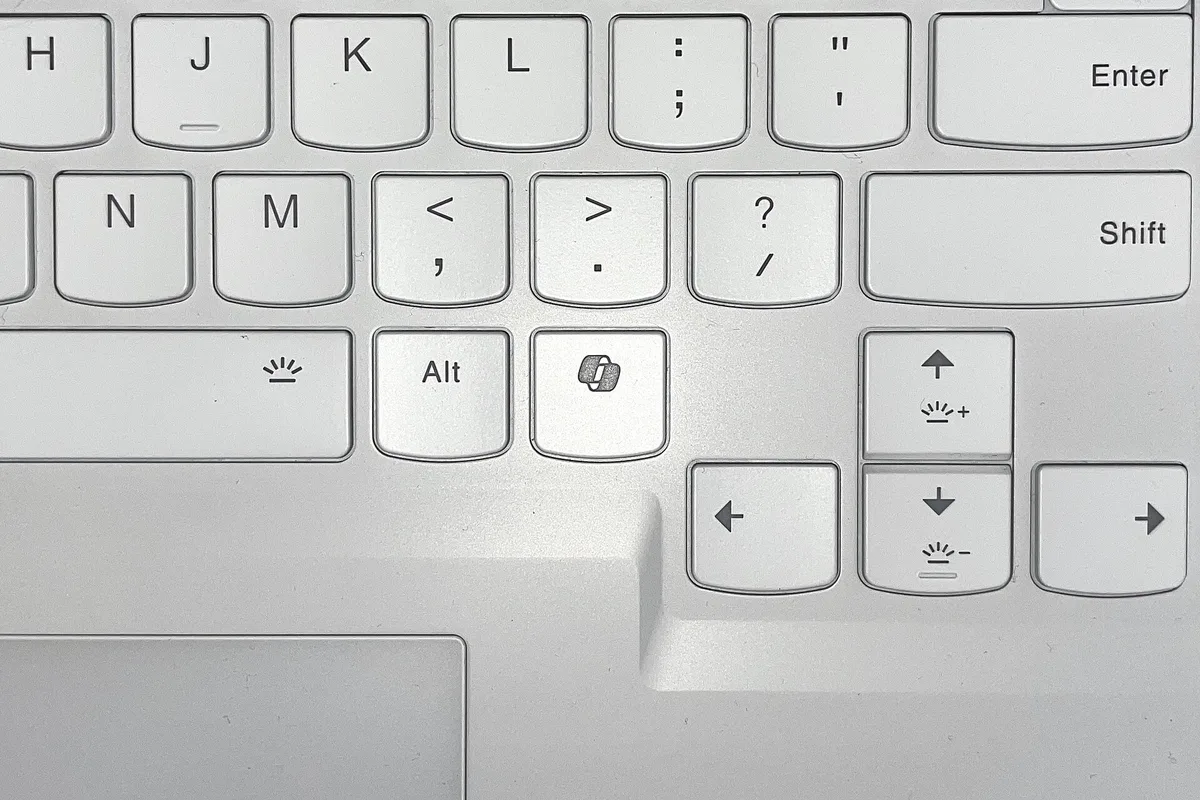
Since 2024, many new computers running Windows 11 have a Copilot key to the right of the space bar, which Microsoft presents as the first significant change to the PC keyboard in nearly 30 years. Copilot is also in Windows and in Edge, and in Word, Excel, PowerPoint and Outlook: since January 2025, it is included in Microsoft 365 Personal and Family subscriptions, whose price rose by 3 dollars a month in the United States. Outside the European Economic Area, Microsoft installs the Microsoft 365 Copilot app by default on Windows PCs that have the Microsoft 365 apps, unless the administrator objects. Microsoft counts more than 1.6 billion Windows devices active each month, and more than 30 million paid Microsoft 365 Copilot licences (annual report 2026).
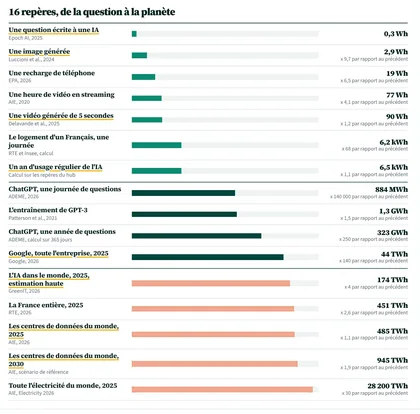
Copilot is therefore often there before anyone looks for it. The infographic below sets what Microsoft publishes on its energy use against what can be estimated for one question.
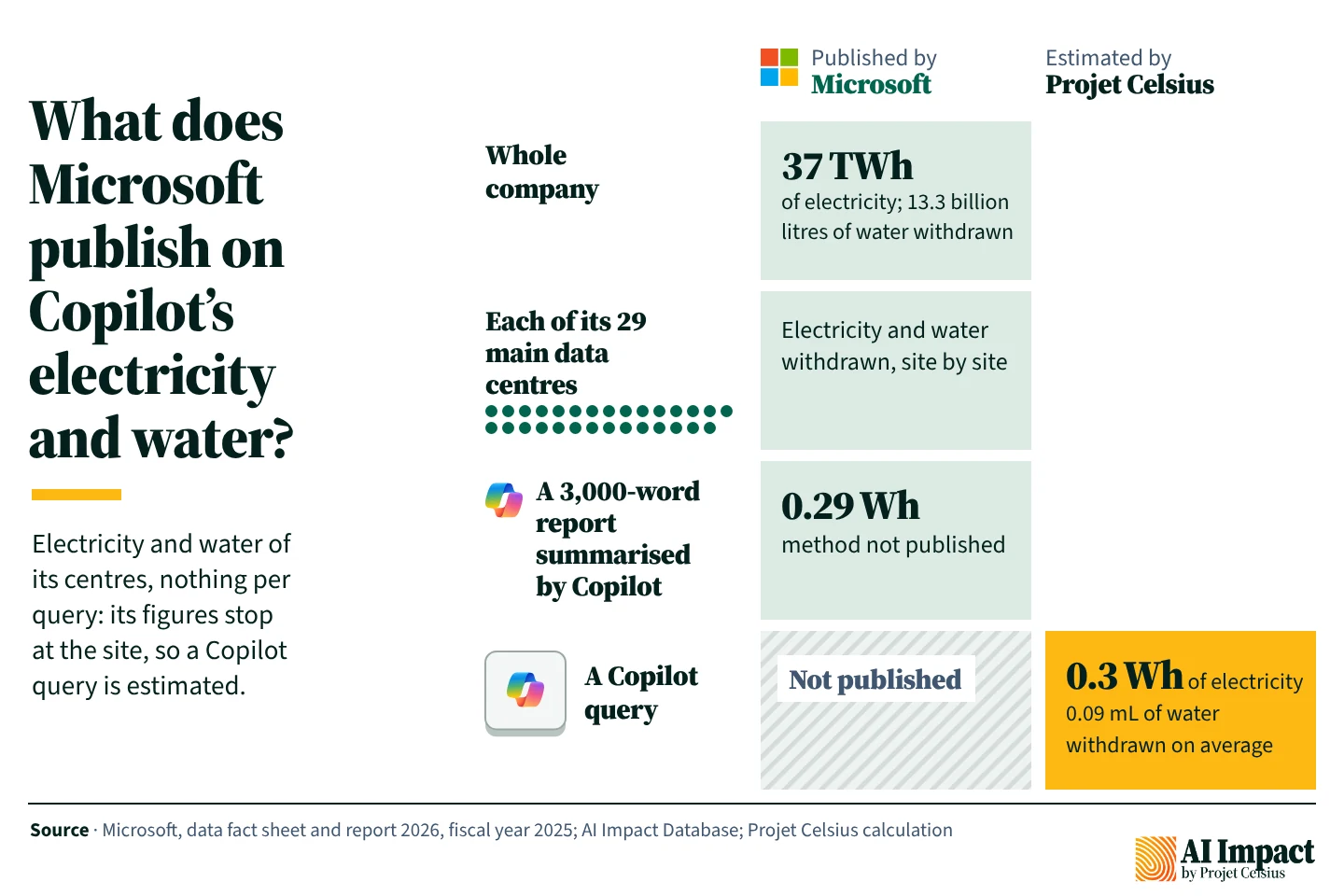
Microsoft publishes the electricity and water of each of its large sites
The 2026 environmental report from Microsoft and its data fact sheet cover the financial year ended June 2025. They give:
- the electricity of the whole company: 37 TWh, data centres and offices included, more than 3 times that of financial year 2020;
- the water of all its sites: 13.3 billion litres withdrawn, of which 8.2 billion consumed, that is, not returned to the environment;
- the electricity and water withdrawal of 29 data centre sites, from Dublin to Phoenix;
- the efficiency of its data centres: a PUE of 1.17 and 0.27 litre of water per kWh of server energy, on a world average (Microsoft's data centre page).
A single figure for Copilot
The report cites an experiment run by the company. 5 people summarised a 3,000-word technical report in 200 words, in a median of 41 minutes, using an estimated 13.7 Wh of laptop energy. Copilot made the same summary in under a minute, with 0.29 Wh of data centre energy. The report does not say which model answered, what the figure counts, or how it was obtained. Microsoft publishes no per-question value for Copilot with its methodology, nor the number of questions asked, nor the model that answers, nor the country where the answer is computed.
Researchers at Microsoft estimate in the journal Joule, in 2026, the median of a query to a frontier model of more than 200 billion parameters at 0.31 Wh, 0.16 to 0.60 Wh for the central half of queries, with no value specific to Copilot. Our analysis of what providers publish places Microsoft among the 6 providers of large assistants that do not publish a value per request with their methodology.
Copilot answers with models from OpenAI, Anthropic and Microsoft
Microsoft does not develop on its own the models that answer in Copilot. 3 families are used there:
- OpenAI: GPT-5 reached Microsoft 365 Copilot on 7 August 2025, with a router that sends simple questions to a fast model and complex questions to a model that reasons;
- Anthropic: Claude models are offered in Copilot, with Anthropic working as a subprocessor for Microsoft;
- Microsoft: its first in-house models, presented in August 2025, including MAI-Voice-1, which provides the voice of Copilot Daily; MAI-1-preview is announced for Copilot.
For any given question, Microsoft does not say which model answers. Yet the electricity of an answer depends first on the model and on reasoning. On the open models measured by PEReN, the State's expert service, reasoning increases energy by 92% on average, and by 849% on average for code generation, the task most affected. With a router, the same question can therefore cost more or less depending on the model it picks.
A short question to Copilot uses about 0.3 Wh
In the absence of a published value, we start from the AI Impact Database, which uses 0.3 Wh for a short question and its answer of about half a page, data centre included. This value rests on Google's measurement in production, 0.24 Wh for the median Gemini question, and on the estimates of Epoch AI and Microsoft researchers, which agree. The example in Microsoft's report, 0.29 Wh for a summary, falls in the same order of magnitude. Our article on the energy use of a query sets out these figures.
Carbon depends on the zone of the servers
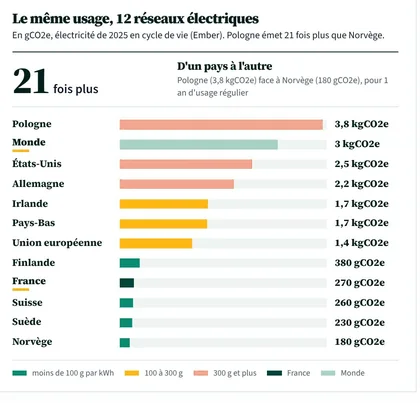
The same electricity emits more or less depending on the grid the servers are connected to. For a 0.3 Wh question, by our calculation:
| Server zone | gCO2e per kWh, 2025 | gCO2e per question |
|---|---|---|
| World average | 458 | 0.14 |
| United States | 384 | 0.12 |
| European Union | 210 | 0.06 |
| France | 41 | 0.01 |
Electricity generated, life cycle (Ember and Our World in Data, AI Impact Database). Excluding the manufacturing of servers, model training and the user's device.
For Microsoft 365 Copilot, Microsoft commits to processing the requests of its European customers in the European Union, excluding Anthropic models; for them, a question emits about 0.06 gCO2e. For the consumer Copilot app, we found no indication of the country of processing.
The water of a question depends on the data centre that answers
Microsoft publishes, for 29 data centre sites, the electricity consumed and the water withdrawn during its financial year 2025. Dividing one by the other, then applying 0.3 Wh, gives the water withdrawn on site for one question, depending on the data centre that answers. The next infographic shows the 10 largest sites, those that used more than 0.7 TWh in the year.
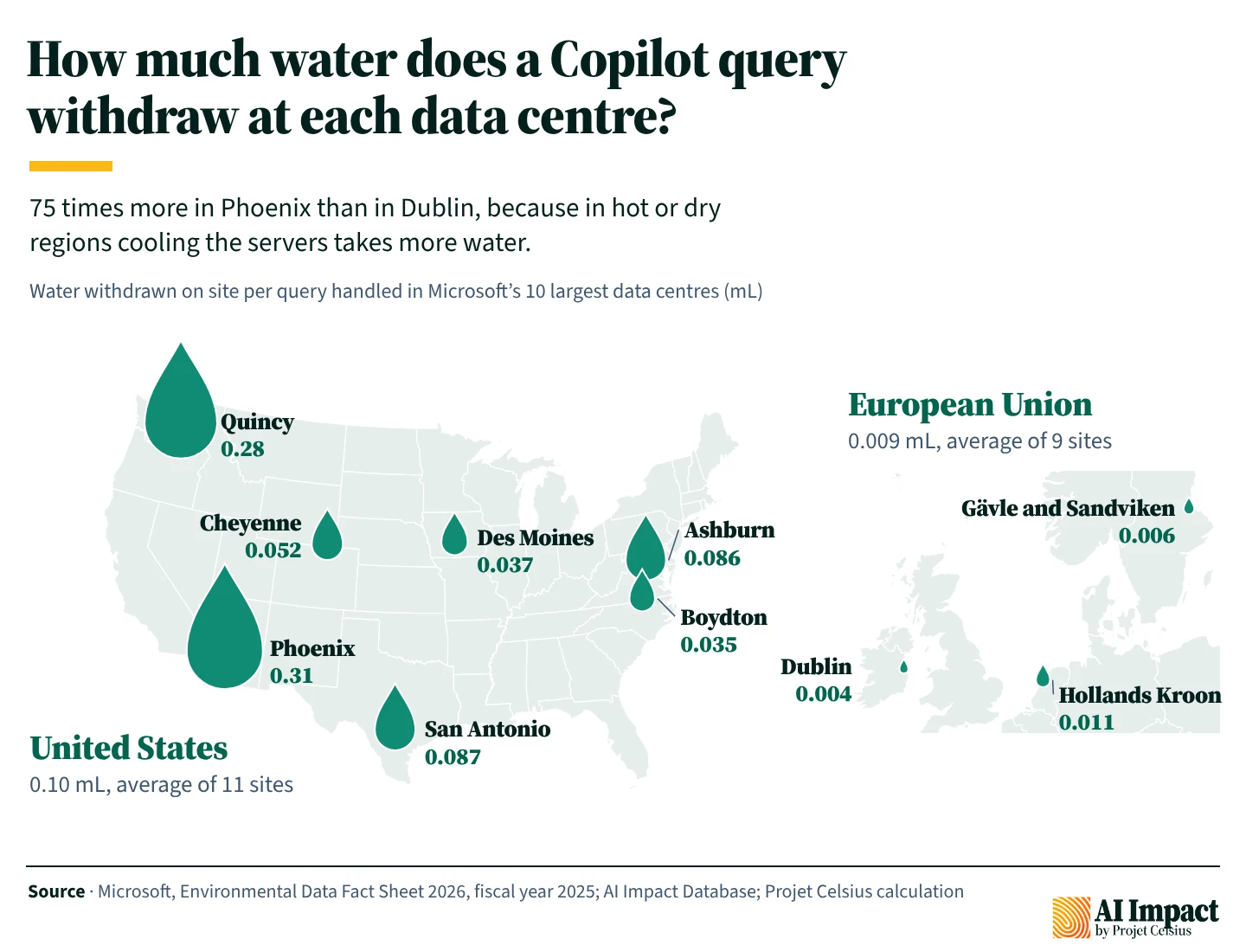
Across the 29 sites, the average is 0.09 mL of water withdrawn per question, fewer than 2 drops. It hides a gap of about 75 times between the large sites: 0.004 mL in Dublin, 0.006 mL in Gävle, in Sweden, 0.28 mL in Quincy, in Washington State, and 0.31 mL in Phoenix, in Arizona. The 9 European Union sites withdraw 0.009 mL per question on average, the United States sites 0.10 mL. Microsoft links these gaps to the climate of each region, its temperature and humidity; its ratios by region point the same way, 0.03 litre per kWh of server energy in Europe, the Middle East and Africa, against 0.34 in the Americas.
Limits of the calculation
- Water consumed: Microsoft publishes it only for all its sites together, where it makes up 62% of the water withdrawn;
- the water of power plants: in the United States, producing the electricity of data centres consumed about 4.5 litres per kWh in 2023, according to the Lawrence Berkeley National Laboratory, or about 1.4 mL for one question, 15 times the site's average water;
- the manufacturing of chips and servers.
For comparison, Google measures 0.26 mL of water consumed on site for the median Gemini question. Our analysis of AI's water use follows these 3 paths of water, from the site to the power plant and the factory.
Over a licence year, summarised meetings weigh more than questions
A short question is only part of the use. In Word, Outlook or Teams, Copilot also summarises meetings, email threads and documents, and launches deep research. The AI Impact Database estimates each of these uses, data centre included:
| Use | Electricity | In short questions |
|---|---|---|
| Write an email | 0.23 Wh | about 1 |
| Ask a quick question | 0.3 Wh | 1 |
| Summarise a 30-page document | 4.9 Wh | 16 |
| Transcribe and summarise a one-hour meeting | 30 Wh | 100 |
| Carry out deep research | 99 Wh | 330 |
| Microsoft 365 Copilot licence, 1 year, regular use | 2.9 kWh | about 9,600 |
Projet Celsius estimates, medium-sized model, without reasoning.
Good for a Microsoft 365 Copilot licence used at the regular level, the Database counts 2.9 kWh a year, or 1.3 kgCO2e with average world electricity, 9 km by car, and 0.60 kgCO2e with that of the European Union. The year's 528 questions account for only 6%; summarised meetings make up 38% and deep research 36%. These frequencies are assumptions. The Database assumes that most meetings are summarised by the suite's AI without anyone asking for it; Microsoft publishes only a ceiling, 25 deep research runs per month.
For a company, our analysis of the Bilan Carbone® puts these licences in perspective: 200 Microsoft 365 Copilot licences served in the European Union emit about 0.12 tCO2e a year, 0.007% of the median footprint of a services company with 200 employees.
Our view
For us, a question to Copilot uses about as much as a question to the other major assistants, about 0.3 Wh. Its water depends mainly on the site that answers, and Microsoft publishes enough figures, site by site, to make this calculation. It does not publish what is specific to Copilot: the number of questions and tasks the tool handles, including those it launches itself, and the model that answers.
Faced with a figure for Copilot's energy use, ask 3 questions:
- Does it apply to a short question, a summary, a deep research run or a licence year?
- Is the water withdrawn or consumed, at the site alone or with the electricity?
- In which zone are the servers answering?
The 0.3 Wh value is the AI Impact Database figure for a short question to a medium-sized model; Microsoft does not say which model answers, and reasoning mode can multiply it. The water per question is our calculation from the water withdrawn and the electricity published by Microsoft for 29 sites it owns, financial year 2025; Microsoft estimates part of these volumes with a model. The 0.29 Wh example comes from Microsoft's environmental report, with no published methodology. The frequencies for a licence year are assumptions.

He holds a doctorate from École polytechnique and an engineering degree from ESPCI Paris, and co-founded Projet Celsius, which he chairs. He is a lead trainer in Bilan Carbone® and life cycle assessment at the Institut de Formation Carbone.
His page and articles →Contact him →LinkedIn ↗
An engineer from Polytech Paris-Saclay and Bilan Carbone® methodology lead, he leads the carbon studies at Projet Celsius.
His page and articles →Contact him →LinkedIn ↗Sources
18 documents
- Microsoft, Windows Experience Blog, Introducing a new Copilot key to kick off the year of AI-powered Windows PCs, 4 January 20242024entry 605
- Microsoft, Copilot is now included in Microsoft 365 Personal and Family, 16 January 20252025entry 606
- Microsoft Learn, Deploy the Microsoft 365 Copilot app, automatic installation and exclusion of the European Economic Area, accessed in November 20262026entry 607
- Microsoft, annual report 2026, shareholder letter2026entry 608
- Microsoft, 2026 Environmental Sustainability Report2026entry 426
- Microsoft, 2026 Environmental Sustainability Report, Data Fact Sheet2026entry 15
- Microsoft, Datacenter efficiency, PUE and WUE by region, fiscal years 2024 and 20252025entry 383
- Oviedo, Kazhamiaka, Choukse et al. (Microsoft), Energy use of AI inference, efficiency pathways, and test-time scaling, Joule2026entry 198
- Microsoft, Available today: GPT-5 in Microsoft 365 Copilot, 7 August 20252025entry 609
- Microsoft Learn, Claude models from Anthropic in Microsoft Online Services2026entry 193
Every figure was read in its source; the hub's methodology is described in Methodology and sources.
Guillaume Pakula and Alexandre Veilly, How much energy does Copilot, Microsoft's AI, use?, AI Impact, Projet Celsius, 18 November 2026. https://projetcelsius.com/en/ai/analyses/how-much-energy-does-copilot-use/