
 Uses18 November 2026
Does an AI running on my phone use less energy than ChatGPT?
The same answer, computed on the phone and in a data centre
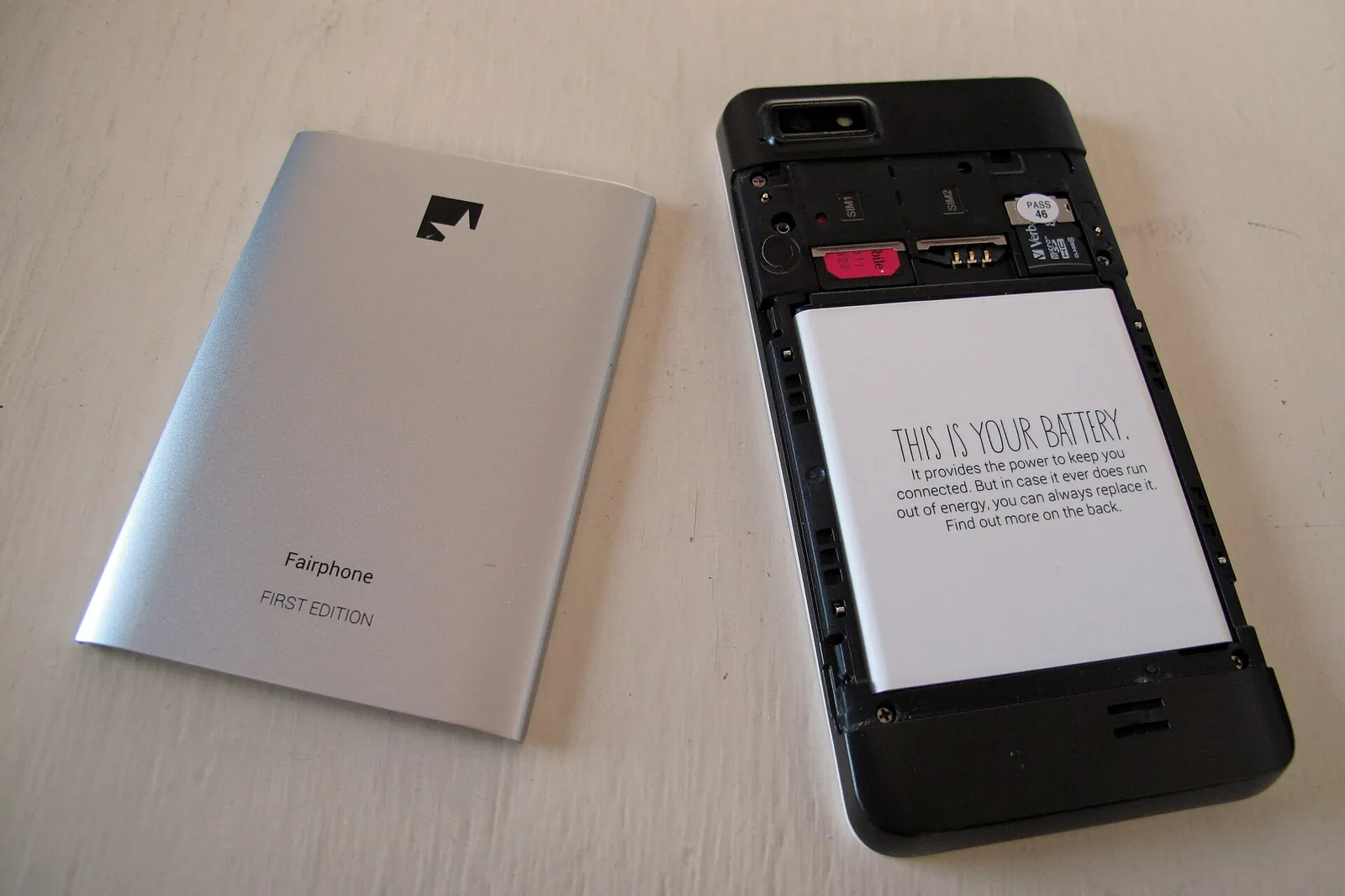
The first Fairphone, back cover open on its removable battery, in 2014. Photo Sandra Fauconnier, CC BY 3.0, via Wikimedia Commons.
Yes for electricity, because the installed model is much smaller: a half-page answer computed on the phone takes 0.2 to 0.8% of its battery, 0.03 to 0.13 Wh, against about 0.3 Wh in a data centre for an assistant like ChatGPT. With the same model, a server shared between many requests uses 2 to 3 times less energy than the phone. And counted by battery wear, manufacturing the phone weighs more than the electricity of the answers.
Contents
On a Pixel 8, a half-page answer, 400 tokens (the word fragments the model writes), generated by Gemini Nano, the model Google installs on its phones, takes about 0.2% of the battery, according to the Greenspector measurement. With the open models of 1 to 4 billion parameters that Greenspector and the LaBRI of the University of Bordeaux measured on this phone and on an iPhone 14, it is 0.2 to 0.8%. Asked of ChatGPT, a question costs almost nothing in battery: on a Galaxy S10, Greenspector measures 0.02% per answer, 29 times less on average than the models installed on the same device.
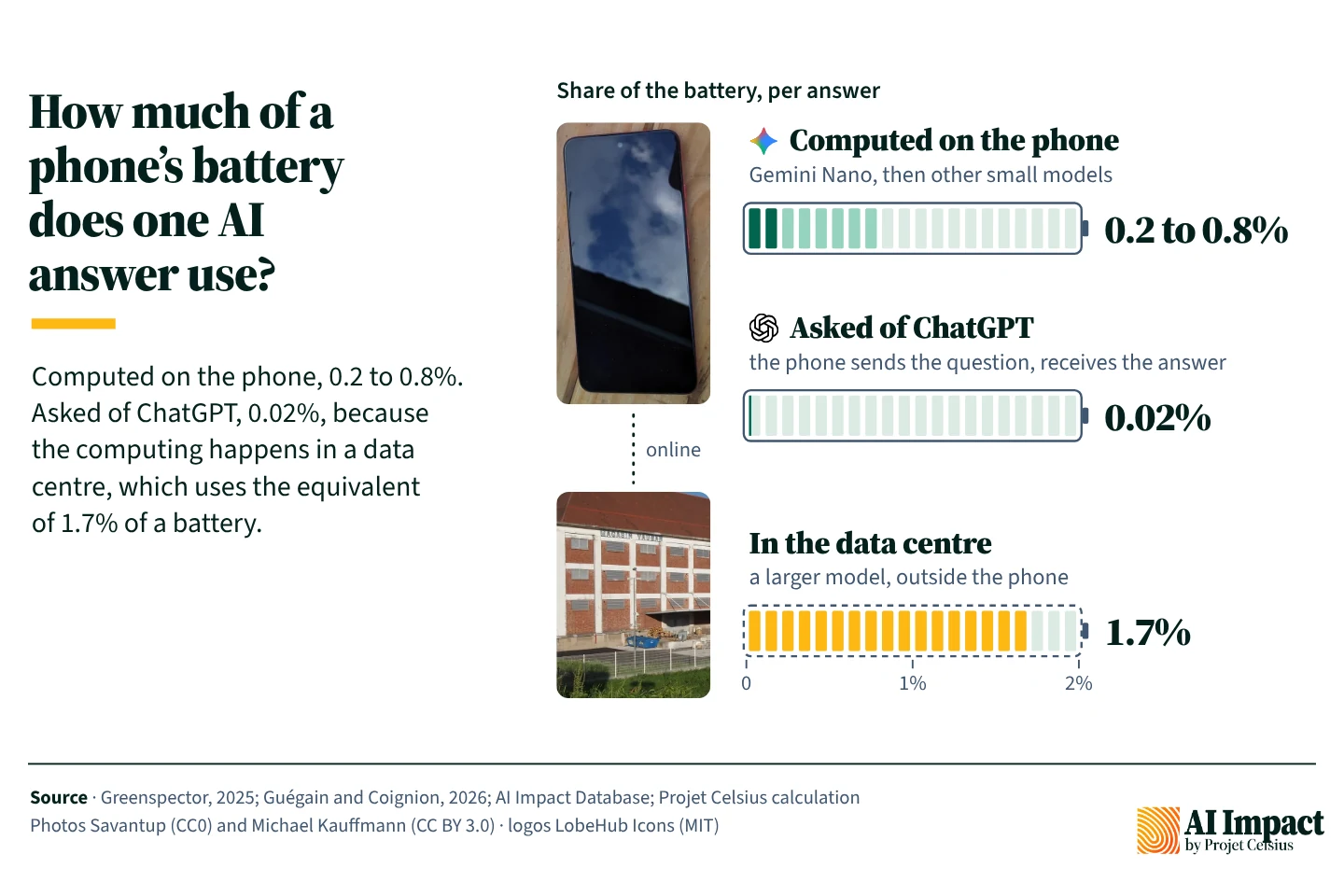
As the infographic shows, the phone keeps all the energy of its answer for itself, while ChatGPT spends its own in a data centre, about 0.3 Wh for a quick question according to the AI Impact Database, the equivalent of 1.7% of the battery of a Pixel 8. Added together, the online answer uses 2 to 9 times more electricity than the local answer, by our calculation.
On the phone, the whole battery during the answer, screen included. In the data centre, the chips, the servers, the machines on standby and the building.
Model training, the network, and, until section 3, the manufacturing of the phone and the servers.
The phone uses less because its model is smaller
A phone's memory sets the size of the model it can run. The providers that install an AI on the device publish that size:
- Apple: a model of about 3 billion parameters, trained to be stored on 2 bits per parameter, and a larger model on its own servers;
- Google: Gemini Nano, in 2 versions of 1.8 and 3.25 billion parameters;
- OpenAI: neither the size of the model served by ChatGPT, nor the method of its 0.34 Wh per average query.
The Database places the model served by default by an assistant in a medium class, clearly larger than that of the phone models. Our article on what a ChatGPT query uses sets out where the 0.3 Wh come from. Installing an AI on your phone therefore amounts to changing models, and it is this change that saves the electricity.
What do you lose with a small model?
In the Greenspector and LaBRI study, going from the small to the large model of each family increases the share of correct answers by 88.5% on average. On an iPhone 16 Pro, the Stanford and Together AI team measures 0.1 Wh per question for a model of 4 billion parameters, which answers 38% of the questions in its test set correctly, against 44.5% for the same model on a workstation; our analysis of AI installed on a computer sets out this measurement. An insufficient answer is asked again, and its electricity adds up.
A phone computes for a single person. A server handles several requests at once on the same chip and shares its consumption between them. Guégain and Coignion ran the same models on the 2 phones and on a data centre card, the Nvidia A100, first one request at a time, then in batches of 100.
| Machine | Electricity of an answer | Share of the battery |
|---|---|---|
| iPhone 14 | 0.072 Wh | 0.56% |
| Pixel 8 | 0.099 Wh | 0.56% |
| Server, batches of 100 requests | 0.028 Wh | |
| Server, one request at a time | 0.156 Wh |
Llama 3.2, 3 billion parameters, compressed to 4 bits, answer of 400 tokens. Phones: whole battery, screen included; server: processor and GPU, without the building. Guégain and Coignion, replication package, hub calculation.
Across the 18 configurations of the study, moving from the iPhone 14 to the shared server saves 48% of energy on average, and 65% from the Pixel 8. The server that serves only one person is the least efficient of the 4: it uses 5.4 times more than the same shared server, and more than the phones. The advantage of the data centre therefore comes from sharing its chips.
The server measurement counts only the processor and the GPU. With the building coefficient the Database uses for a large operator (1.10), the shared answer goes from 0.028 to 0.031 Wh, still 2 to 3 times less than on the phones. The authors add a limitation: the phones use llama.cpp and the server vLLM, and part of the gap may come from this software.
The battery wears out, and manufacturing weighs more than electricity
99% of a smartphone's footprint comes from its manufacturing: 79.3 kgCO2e out of 80.2, according to ADEME; our chart on the life cycle of devices compares it with other devices. The battery, for its part, withstands a limited number of full charges. Since 20 June 2025, the European ecodesign regulation requires a smartphone sold in the Union to reach at least 800 cycles while keeping 80% of its capacity.
How many cycles for 20 answers a day?
20 half-page answers a day, computed on the phone at 0.5% of battery each, use 10% of the battery a day, or 36.5 cycles a year, 4.6% of the regulation's 800 cycles, by our calculation. If battery wear decides when the phone is replaced, this share of its lifetime carries the same share of its manufacturing: 3.6 kgCO2e a year. The electricity of the same answers weighs 27 gCO2e with French electricity and 300 g with the world average.
A year of 20 half-page answers a day, in kgCO2e. Manufacturing: 79.3 kgCO2e (ADEME) multiplied by the share of the 800 cycles used up; electricity of France, 41 gCO2e/kWh, and world average, 458 g (2025); online, the Database's quick question. Hub calculation.
Guégain and Coignion make this count for each token. With the wear rule, an answer computed on the phone emits 5 to 7 times more than an answer from the same model on a shared server, and manufacturing makes up 84 to 87% of its footprint. Varying the number of cycles, the electricity, the lifetime of the server and the building coefficient, no realistic assumption reverses the order. They recommend first choosing the smallest model that suffices for the task, then running it on a server.
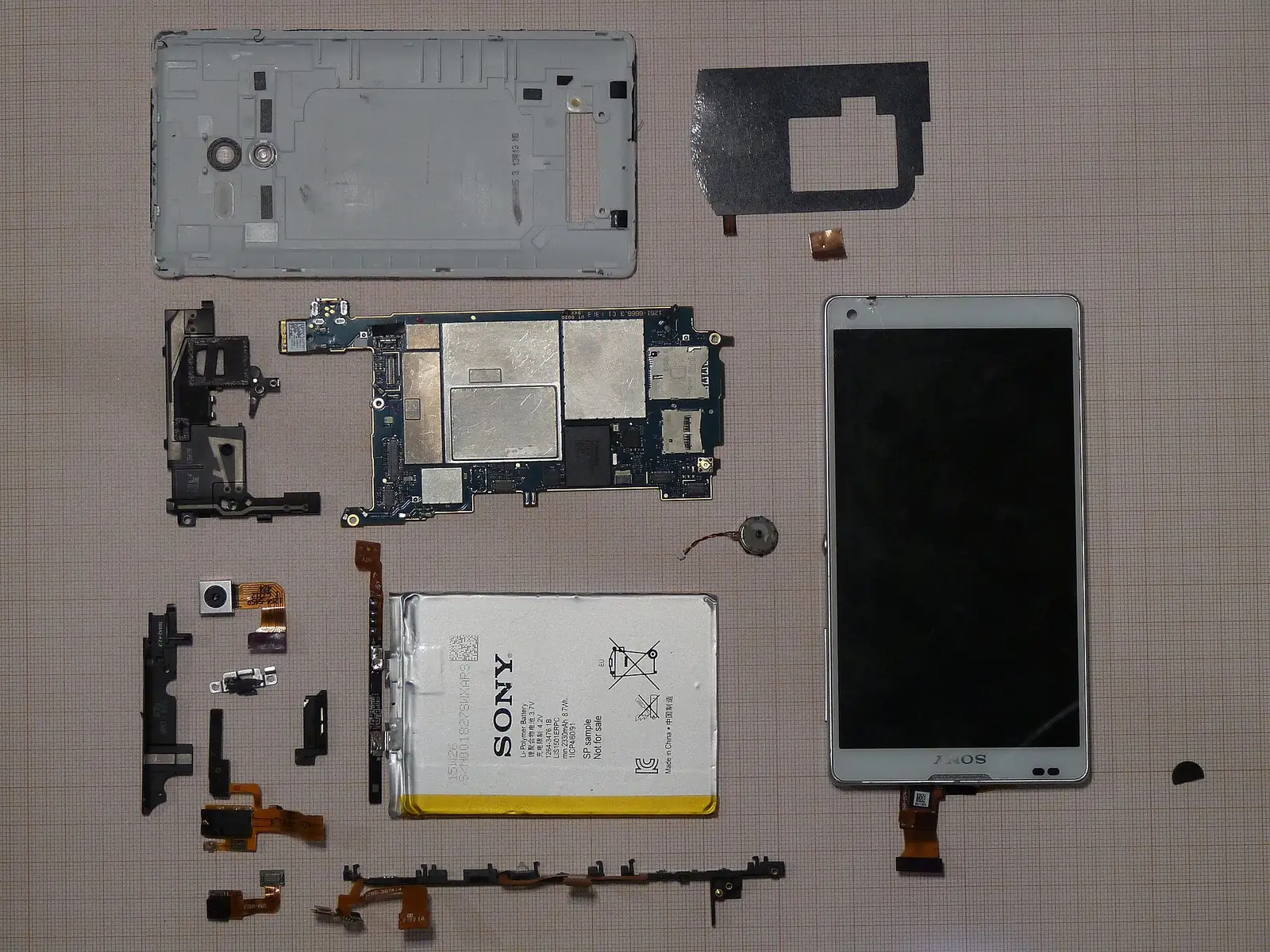
This count assumes that the phone is sent for recycling when its battery weakens. A phone replaced for another reason, or whose battery is changed, does not carry this share of manufacturing. The European rules that make batteries replaceable from 2027 are set out in our article on removable batteries.
The phone's lifetime matters more than where the computation takes place
The electricity of an answer remains low in both of the 2 cases: a few hundredths to a few tenths of a watt-hour, less than 2% of a phone charge. Computing on the phone is justified first by other reasons, keeping your texts at home and working without a connection, and our analysis of the data entrusted to an AI sets them out. for the footprint, the action that counts is keeping your phone, and not changing it to get an AI feature: manufacturing a smartphone emits as much CO2e as the electricity of about 570,000 quick online questions, counted with the world average, by our calculation. Before switching on a local AI, 3 questions are worth asking:
- Is the installed model enough for the task, or will you have to ask again elsewhere?
- How many answers a day, and what share of the battery does that represent?
- Does the current phone run the feature, or would you need to buy another?
The measurements cover phones from 2019 to 2023; Greenspector measures 2.2 to 3.8 times less energy when a model runs on the phone's graphics processor or AI accelerator rather than on its main processor. The battery shares count the whole phone, screen included, and Guégain and Coignion's energy per token does not count reading the question. The phone-side share of an online question comes from short answers on a Galaxy S10. The 0.3 Wh of an online question is a Database estimate, which OpenAI does not allow us to verify. The share of manufacturing attributed to wear, the conversions to Wh and CO2e and the equivalence of 570,000 questions are our calculation.

He holds a doctorate from École polytechnique and an engineering degree from ESPCI Paris, and co-founded Projet Celsius, which he chairs. He is a lead trainer in Bilan Carbone® and life cycle assessment at the Institut de Formation Carbone.
His page and articles →Contact him →LinkedIn ↗
An engineer from UTBM and life cycle assessment trainer at the Institut de Formation Carbone, he carries out the life cycle assessments at Projet Celsius.
His page and articles →Contact him →LinkedIn ↗Sources
12 documents
- Guégain (Greenspector) and Coignion (LaBRI, University of Bordeaux), The Battery Price of edge AI: A study of the Environmental Impact of LLM Inference on Mobile Devices, arXiv preprint2026entry 635
- Greenspector, What is the environmental impact of local AI on our smartphones?2025entry 634
- Greenspector, The environmental impact of local text AI2025entry 631
- Projet Celsius, AI Impact Database, environmental database of artificial intelligence, engine 0.3.12026entry 144
- Sam Altman (OpenAI), The Gentle Singularity2025entry 21
- Apple, Apple Intelligence Foundation Language Models Tech Report 20252025entry 245
- Gemini Team (Google), Gemini: A Family of Highly Capable Multimodal Models, arXiv preprint2023entry 632
- Saad-Falcon, Narayan et al. (Stanford University and Together AI), Intelligence per Watt: Measuring Intelligence Efficiency of Local AI, arXiv preprint, version 7 of October 20262026entry 242
- Commission Regulation (EU) 2023/1670 of 16 June 2023 laying down ecodesign requirements for smartphones, mobile phones and tablets2023entry 636
- ADEME, Impact CO22026entry 39
Every figure was read in its source; the hub's methodology is described in Methodology and sources.
Guillaume Pakula and Sébastien Pierfederici, Does an AI running on my phone use less energy than ChatGPT?, AI Impact, Projet Celsius, 18 November 2026. https://projetcelsius.com/en/ai/analyses/does-phone-ai-use-less-energy/