
 Climate13 November 2026
What can AI do for the climate? The 10 possible benefits, ranked and quantified
For each use, the measured, estimated or announced gain, with the emissions of AI alongside




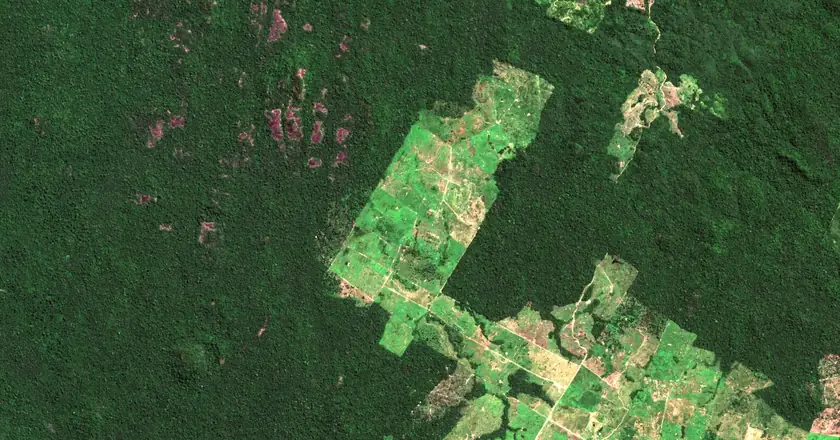
Deforestation in the Amazon seen by the Sentinel-2 satellite, near 5 degrees south latitude. Image Sentinel Hub, CC BY 2.0, via Wikimedia Commons.
Of 10 uses of AI in the service of the climate, 3 have a gain measured in real cases: aircraft contrails, forest monitoring and building air conditioning. 5 rest on estimates, 2 on an announcement or on no quantified gain. The International Energy Agency estimates that existing AI applications could avoid 1.4 billion tonnes of CO2 in 2035, and the Grantham Research Institute 3.2 to 5.4 billion tonnes of CO2e per year in 3 sectors. The IEA warns that, without new conditions, the effect of these applications could remain marginal.
Contents
AI companies present their technology as an aid for the climate: according to a report by the consultancy BCG and Google, it could help reduce global emissions by 5 to 10% by 2030. The report does not publish its method and refers to an earlier study by the same consultancy. To measure what AI contributes, we took the published figures use by use, and classified each according to its nature.
An effect observed in a real case: a trial, a comparison with a control group, a before-and-after follow-up.
An effect calculated by a model, a scenario or an attribution method, without observation in the field.
A figure published by a company without a verifiable method, or a discovery whose effect on emissions is not quantified.
The ranking of the 10 uses
Uses are ranked first by the nature of the best published evidence: measured, estimated, then announced or without a quantified gain. Within the same nature, measured gains are ranked by the strength of the publication (peer-reviewed trial, reviewed study, preprint and vendor case), estimated gains by the published tonnage, where it exists. The ranking is ours; each figure refers to its source.
| Rank | Use | Published gain | Nature | Type of AI |
|---|---|---|---|---|
| 1 | Avoiding aircraft condensation trails | 54 to 64% fewer contrails over 22 trial flights; 11.6% over 1,232 designated flights, of which 112 were diverted (preprint) | measured | forecasting, specialised model |
| 2 | Monitoring forests | 18% lower probability of deforestation, in Africa only | measured | satellite image classification |
| 3 | Controlling heating and air conditioning in buildings | 9 and 13% less energy over 2 sites (preprint); 15.8% in one building, according to the vendor | measured | reinforcement learning, specialised model |
| 4 | Forecasting wind power and managing grids | 1.8 GtCO2e per year in 2035 for electricity; +20% in value announced by Google for 700 MW of wind turbines | estimated | forecasting, specialised model |
| 5 | Helping to develop alternative proteins | 0.9 to 1.6 GtCO2e per year in 2035 | estimated | discovery, specialised model |
| 6 | Detecting methane leaks | about 60 MtCO2e avoidable through continuous leak detection, which AI helps to extend | estimated | specialised deep learning |
| 7 | Optimising transport and logistics | 5 to 10% efficiency; 3 MtCO2e declared by Google for its routes in 2025 | estimated | traffic forecasting, specialised model |
| 8 | Optimising industry | 2 to 6% savings in heavy industry | estimated | specialised model |
| 9 | Cooling data centres | up to 40% of a centre's cooling energy, in 2016 | announced | specialised model |
| 10 | Discovering materials | 2.2 million crystals predicted, 736 made; no CO2 gain | no quantified gain | graph networks |
Our ranking. Sources: Sonabend et al. 2024; Luo et al. 2022; BrainBox AI; DeepMind 2016, 2019 and 2023; Moffette et al. 2021; IEA, Energy and AI, 2025; Google, 2026 report; Stern et al. (Grantham Research Institute), 2025. The network of 1,232 flights comes from Sankar et al., 2026 preprint.
Measured gains
The best-established result concerns condensation trails, which form clouds and warm the climate (the comparison of AI and aviation gives their weight). In 2023, Google and American Airlines diverted 22 flights according to a forecast of the areas where contrails form, and compared them with 22 control flights: the diverted flights formed 54 to 64% fewer contrails, for 2% more fuel. A second trial, run at the scale of an airline's network and published as a preprint in 2026, designated 1,232 flights for avoidance, of which 112 were actually diverted: the reduction is 11.6% overall and 62% on the diverted flights, with no significant difference in fuel. The effect on warming was not measured.
Forest monitoring was evaluated in a study published in Nature Climate Change, which compared areas subscribed to satellite deforestation alerts with others, in 22 tropical countries. In Africa, the alerts reduced the probability of deforestation by 18%; the study finds no effect on the other continents. It measures the effect of the alerts, without isolating that of the AI that produces them.
For buildings, a trial run by DeepMind, Google and the manufacturer Trane on 2 sites, the chiller plant of a university campus and a commercial building, reduced their cooling energy by 9 and 13% compared with Trane's usual controllers, over 3 months; the results are published as a preprint. The cases published by the vendors of these systems go further, such as 15.8% less heating, ventilation and air conditioning electricity in a New York building, without third-party verification. The most-cited figure, 40% less cooling energy in a Google data centre, comes from a 2016 blog post that compares periods with and without the model, without publishing the data; it is equivalent, according to Google, to 15% of the site's energy overhead excluding IT. Apart from the case published by BrainBox AI, 37 tCO2e in 11 months, none of these results quantifies the tonnes of CO2e avoided.
Estimated gains
The figures that concern millions or billions of tonnes are estimates. The IEA estimates that continuous detection and repair of methane leaks at oil and gas sites, which AI helps to extend, would avoid nearly 2 million tonnes of methane, about 60 MtCO2e; it cites efficiency gains of 5 to 10% in transport and 2 to 6% in heavy industry. In total, the AI applications that already exist could avoid 1.4 billion tonnes of CO2 in 2035 in the IEA's widespread adoption scenario, which assumes their deployment in part of factories, fleets and buildings, without rebound effects, which the IEA considers uncertain. This is about 4% of energy sector emissions that year.
The Grantham Research Institute, with the economist Nicholas Stern, estimates the potential of 3 sectors alone, electricity, meat and dairy products, and light vehicles, at 3.2 to 5.4 billion tonnes of CO2e per year in 2035. Google states that 9 of its products helped avoid 41 million tonnes of CO2e in 2025, of which 27.8 million for Google Earth's help in siting solar and wind plants; the company specifies that these figures have not been independently verified.
Published potentials for 2035 and emissions of data centres and AI, in millions of tonnes per year (estimates)
Published potentials and AI emissions
Set side by side, the potentials exceed the emissions that the same studies forecast for AI. The IEA says so itself: its 1.4 billion tonnes would exceed by 3 to 5 times the emissions from the electricity of all data centres in 2035, 300 to 500 million tonnes of CO2 according to its scenarios. In the same report, the IEA judges as overstated both the fears that AI will accelerate climate change and the expectation that it will solve it alone. The Grantham Research Institute sets against its 3.2 to 5.4 billion tonnes a rise of 0.4 to 1.6 billion tonnes of CO2e due to data centres and AI. The IEA adds that no momentum today guarantees the adoption of these applications, and that their total effect, even in 2035, "could be marginal" without new conditions.
The 2 quantities cannot be subtracted from each other. The gains assume general adoption, the emissions a growth scenario for AI. No study publishes, for a given use, both the measured gain and the emissions of the AI that produced it. A 2026 study, published in npj Climate Action, approaches the problem from the other end: by modelling the productivity gains that AI would bring to fossil fuel and renewable energy producers, it finds a net rise in global emissions, of 0.47 to 1.8 billion tonnes of CO2 per year. The analysis on the climate crisis details these scenarios.
Specialised models and generative AI
The 10 uses in the ranking rely on specialised models: traffic or contrail forecasting, air conditioning control, satellite image classification, crystal prediction. The sources almost never make the distinction with generative AI; this is our reading of the methods they describe, and we have found no measured climate gain from a large language model; the view on surface AI and deep AI deals with AI without an interface. A February 2026 report, coordinated by the association Beyond Fossil Fuels on 154 statements by companies and institutions, makes this distinction: 74% of the climate benefits announced in it are not substantiated, most of the announced benefits concern traditional AI, and most of the harm comes, according to its authors, from generative AI.
Google's 2026 report publishes the 2 figures. Google estimates that 9 of its products helped third parties reduce their emissions by 41 million tonnes of CO2e in 2025, about 3 times its own emissions according to its calculation. It also publishes supply chain emissions up by 25% in 2025, which it explains by the construction of its AI infrastructure and by Asia-Pacific suppliers whose electricity remains little decarbonised.
Our reading
For us, at Projet Celsius, AI can help the climate, and a few uses have shown it in the field: aircraft contrails, air conditioning, deforestation alerts. These gains are real and remain at the scale of a trial, a building or a region. The billions of tonnes in circulation are potentials; some, like the 5 to 10% from BCG and Google, are published by companies that sell AI. We will judge a climate benefit of AI on 2 figures published together: the measured gain, and the emissions of the AI that produced it. For no use are the 2 yet published together.
The ranking is ours; it sorts uses by the nature of the published evidence, not by their potential. Potentials are not comparable with each other (years, scopes, CO2 or CO2e) nor can they be subtracted from the emissions of AI. The distinction between specialised models and generative AI is our reading of the methods, except for the Beyond Fossil Fuels report.
Sources
15 documents
- BCG for Google, Accelerating Climate Action with AI2023entry 458
- Sonabend, Elkin et al., Feasibility test of per-flight contrail avoidance in commercial aviation, Communications Engineering2024entry 455
- Sankar, Dean et al., Efficacy of Scalable Airline-led Contrail Avoidance, preprint under discussion, JECATS2026entry 460
- Luo et al. (DeepMind, Google, Trane), Controlling Commercial Cooling Systems Using Reinforcement Learning, arXiv preprint2022entry 453
- BrainBox AI, Cammeby's, 45 Broadway, case study2024entry 454
- DeepMind, DeepMind AI reduces Google data centre cooling bill by 40%, blog post2016entry 452
- Moffette, Alix-Garcia et al., The impact of near-real-time deforestation alerts across the tropics, Nature Climate Change2021entry 456
- IEA, Energy and AI2025entry 1
- Google, 2026 Environmental Report2026entry 13
- Pierfederici, Stern, Romani et al., Green and intelligent: the role of AI in the climate transition, Grantham Research Institute2025entry 92
- DeepMind, Machine learning can boost the value of wind energy, billet2019entry 451
- DeepMind, Millions of new materials discovered with deep learning, billet2023entry 457
- GreenIT, Impacts environnementaux et sanitaires de l'intelligence artificielle dans le monde en 2025 et 20302026entry 6
- Alpine, Geldner, Alpine, Chepeliev et al., AI-driven productivity gains enable more CO2 emissions than they avoid in a global energy-economy model, npj Climate Action, August 2026 (corrected in September 2026)2026entry 91
- Beyond Fossil Fuels, Stand.earth et al., rapport sur les promesses climatiques de l'IA (analyse de Ketan Joshi)2026entry 459
Every figure was read in its source; the hub's methodology is described in Methodology and sources.
AI Impact, Projet Celsius, "What can AI do for the climate? The 10 possible benefits, ranked and quantified", 13 November 2026. https://projetcelsius.com/en/ai/analyses/what-can-ai-do-for-the-climate/

 Uses