
 Society14 November 2026
Is France behind in AI?
Investment, models, computing power, use by businesses and by residents: France alongside its European neighbours, the United States and China




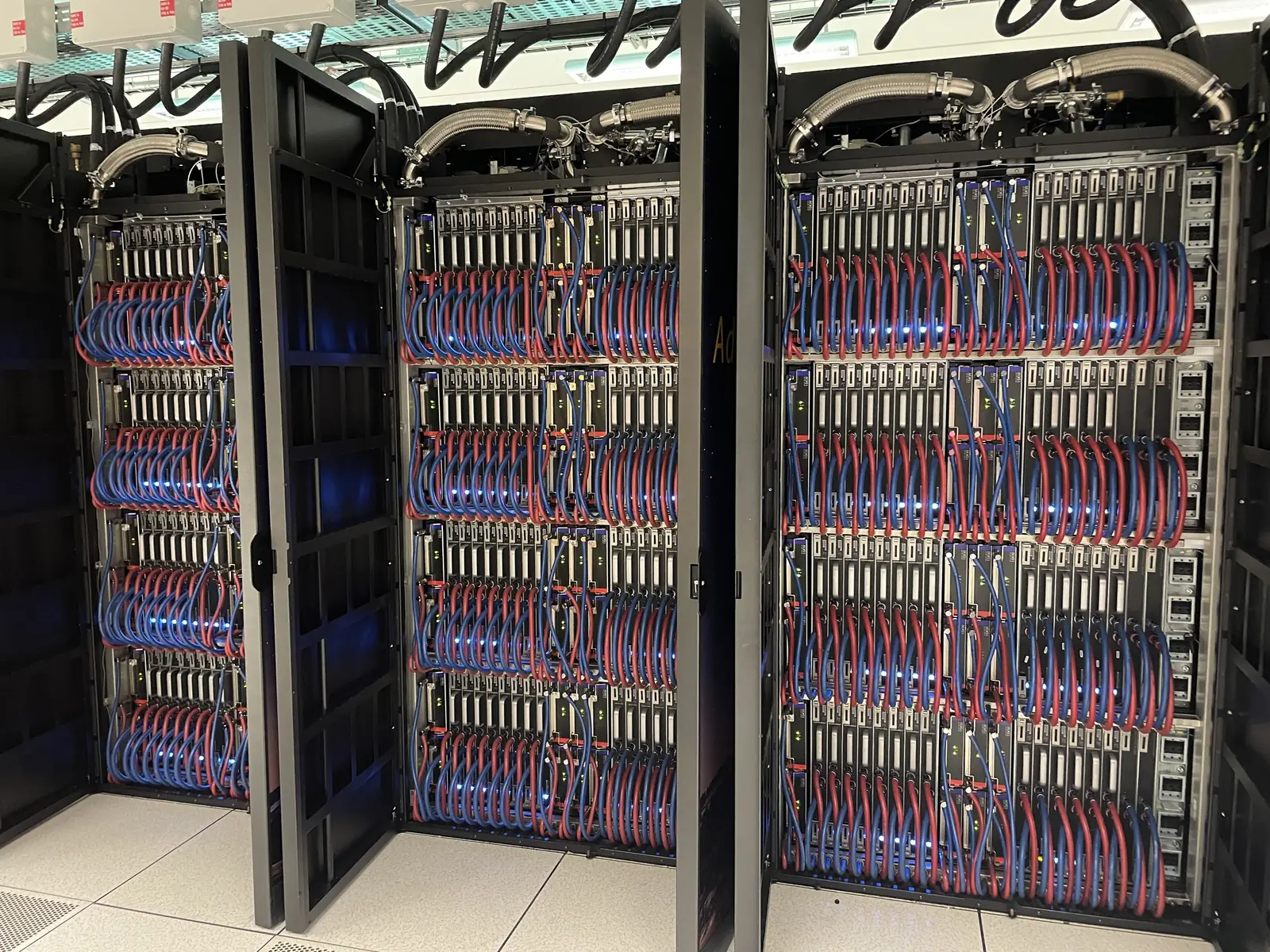
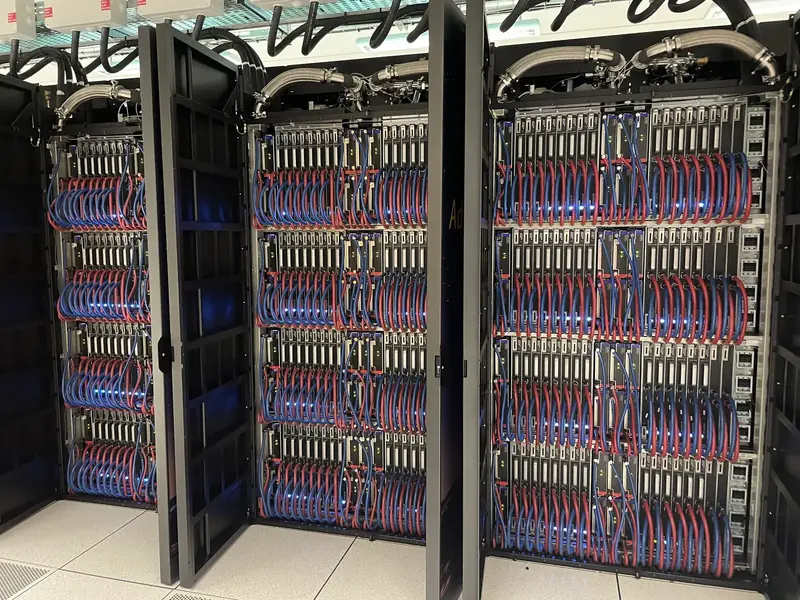
Racks of the Adastra supercomputer, installed by GENCI at CINES in Montpellier. Photo Rambiera, CC BY-SA 4.0, via Wikimedia Commons.
In Europe, France is 2nd for private investment in AI, behind the United Kingdom: $4.4 billion in 2025, ahead of Germany, according to the Stanford AI Index. It lags on use by its companies, 15th of 27 in the European Union with 18% of companies using AI, and on computing power: its best machine is 29th in the world ranking of supercomputers, against 5th for Germany. Worldwide, the United States invested 66 times more than France in 2025.
Contents
No single indicator measures a country's place in AI. We have selected 5, published by sources that compare countries using the same method: money invested, models produced, computing power, use by businesses and use by residents. For each, France is placed next to Germany and the United Kingdom and, for scale, the United States and China.
France through 5 indicators
| Indicator | France | France's rank | Germany | United Kingdom |
|---|---|---|---|---|
| Private investment in AI, 2025 | $4.4bn | 2nd in Europe, 1st in the EU | $3.9bn | $5.9bn |
| Notable AI models, cumulative since 2003, our count | 51 | 2nd in Europe, 1st in the EU | 29 | 84 |
| Supercomputers in the TOP500, June 2026 | 21, the best 29th | 2nd in Europe by number, 6th by cumulative power | 41, the best 5th | 11, the best 13th |
| Businesses with 10 or more employees using AI, 2025 | 18 % | 15th out of 27 in the EU | 26 % | not covered |
| People aged 16-74 who have used generative AI in the last 3 months, 2025 | 37 % | 16th out of 27 in the EU | 32 % | not covered |
Stanford AI Index 2026 (Quid data); Epoch AI database of 14 November 2026; TOP500 of June 2026, our count; Eurostat, surveys 2025. For scale: United States $285.9bn and China $12.4bn of private investment in 2025; 655 and 192 notable models; 161 and 31 supercomputers.
Investment and models
In 2025, private investment in AI reached $4.4 billion in France, according to Quid data reported in Stanford's AI Index: 4th in the world, 2nd in Europe behind the United Kingdom, 1st in the EU ahead of Germany. Per capita, that comes to about $63 per French resident, against $47 per German resident, by our calculation. 84 French AI companies received funding for the first time in 2025, against 92 in Germany and 172 in the United Kingdom. Over 2013-2025, France remains behind the United Kingdom and Germany. These figures do not include the €109 billion announced at the February 2025 summit, which are multi-year commitments, mostly for data centres.
For models, our count from the Epoch AI database gives 51 notable models to which at least one organisation based in France has contributed since 2003, against 84 in the United Kingdom and 29 in Germany. Meta's Paris laboratory, Facebook AI Research, took part in 34 of them and Mistral AI in 7, all published since 2023. In 2024, France published 4, all from Mistral AI, more than any other European country. The count is low across Europe: 1 French model in 2025, against 65 American and 36 Chinese. Our analysis on French AI shows that the nationality of the provider says nothing about the footprint of an answer.
Computing power
In the TOP500 supercomputer ranking of June 2026, France has 21 machines, 2nd in Europe by number behind Germany (41). By cumulative power, 317 PFlop/s, it is 6th in Europe, behind Italy, Germany, Switzerland, the United Kingdom and Finland, by our count. Its most powerful machine, at the CEA, is 29th in the world; Jean Zay, the public AI research machine, is 49th for its part equipped with H100 cards. Germany has the world's 5th machine, JUPITER, at Jülich, and the United Kingdom the 13th, Isambard-AI. Alice Recoque, the exascale machine ordered by EuroHPC for the CEA, is being installed and is due to open in 2027.
Supercomputers are only part of computing: large models are mostly trained in companies' data centres, for which no open source gives the power by country. France has an asset for hosting them, one of the least carbon-intensive electricity supplies in Europe and a net export balance of 92 TWh in 2025, but projects have already reserved nearly 18 GW of grid connection; our analysis on electricity gives the orders of magnitude, and our viewpoint the conditions.
Use by businesses and by residents
Businesses with 10 or more employees using at least one AI technology, 2025 (Eurostat)
French businesses use AI less than the EU average: 18% of those with 10 or more employees in 2025, against 20% in the EU and 26% in Germany, ranking 15th out of 27. Denmark, Finland, Sweden, Belgium, Luxembourg and the Netherlands exceed 33%. Residents, on the other hand, are above the average: 37% of those aged 16-74 have used generative AI in the last 3 months, against 33% in the EU and 32% in Germany, ranking 16th. Eurostat surveys people aged 16-74 on the last 3 months; Arcep's Baromètre du numérique, which surveys people aged 12 and over on their use in 2025, finds 48%. Our analysis on French users breaks this use down by age, qualification and occupation.
Our reading
For us at Projet Celsius, the answer depends on the indicator. Compared with its European neighbours, France is 2nd, behind the United Kingdom, for money raised and models, above the average for use by residents, and behind for use in businesses and public computing power. On a world scale, the question applies to Europe as a whole: the United States invests 66 times more than France, and the Epoch AI database counts 2 notable European models in 2025, 1 French and 1 British, against 36 Chinese. These indicators count amounts and uses; they do not say whether that use is worthwhile, or what it costs in electricity.
The investment measured by Quid is private only. The counts of models and supercomputers are our own, based on the Epoch AI and TOP500 databases. Eurostat no longer covers the United Kingdom. No open source gives the computing power of data centres by country.
Sources
7 documents
- Stanford HAI, The 2026 AI Index Report, chapter 4, Economy2026entry 503
- Epoch AI, Notable AI Models, database downloaded on 14 November 20262026entry 504
- TOP500, June 2026 list2026entry 505
- CEA, Alice Recoque, supercalculateur exaflopique du TGCC2026entry 506
- Eurostat, Intelligence artificielle dans les entreprises (isoc_eb_ai)2026entry 70
- Eurostat, Usage des outils d'IA générative par les particuliers (isoc_ai_iaiu)2026entry 255
- Élysée, clôture de la première journée du Sommet pour l'action sur l'IA, discours du 10 février 20252025entry 361
Every figure was read in its source; the hub's methodology is described in Methodology and sources.
AI Impact, Projet Celsius, "Is France behind in AI?", 14 November 2026. https://projetcelsius.com/en/ai/analyses/is-france-behind-in-ai/