
 Electricity13 November 2026
Should France host more data centres?
Low-carbon electricity, grid connection, peak demand and use of computing, as at 13 November 2026




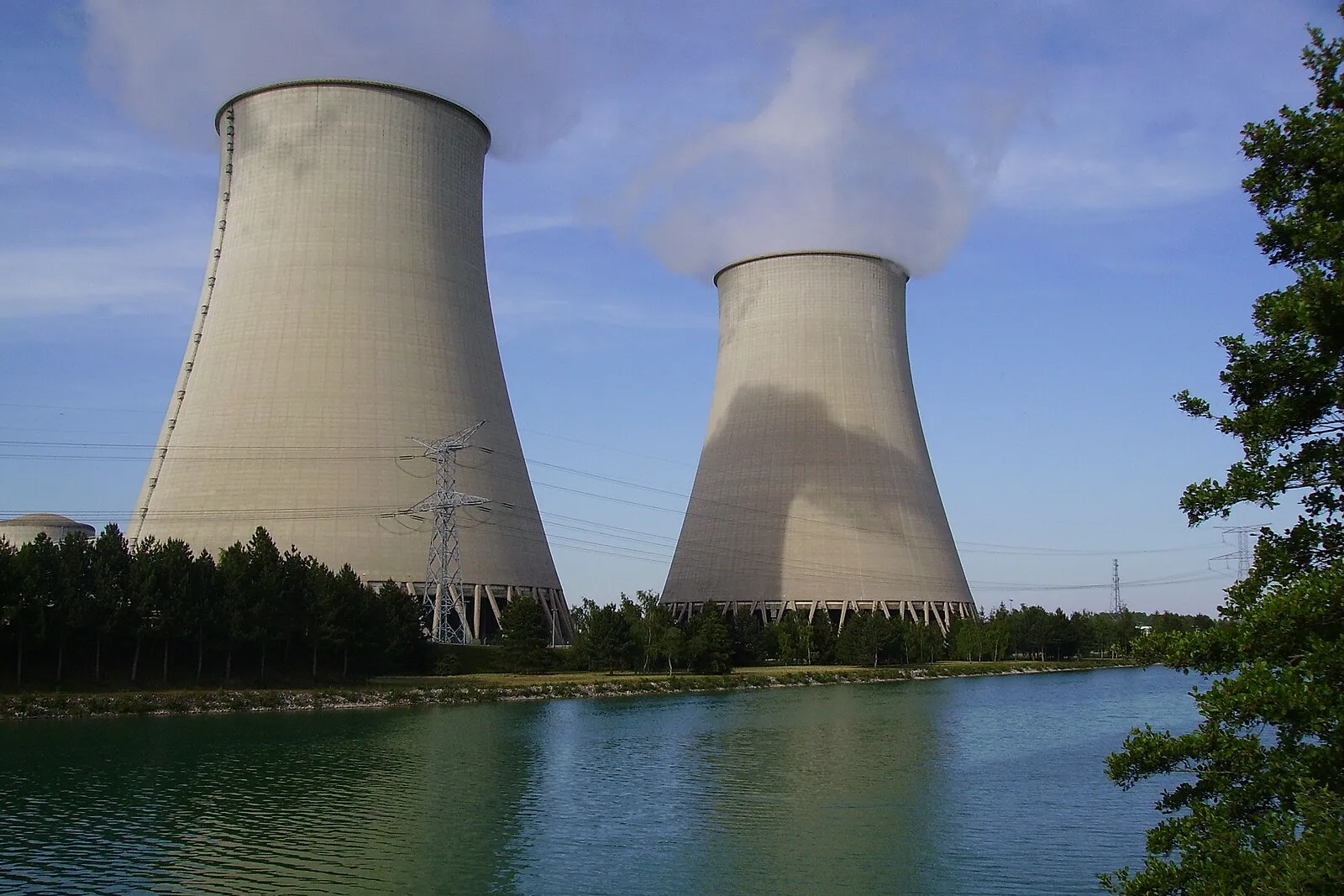
The Nogent-sur-Seine nuclear power plant, in the Aube. Photo Clicgauche, CC BY-SA 3.0, via Wikimedia Commons.
In February 2025, the State announced at least 35 sites suitable for data centres; in May 2026, about 80 projects had reserved nearly 18 GW of grid connection with RTE. On average, the same electricity emits 8 times less in France than in Germany; part of that gain disappears when the kWh consumed here would otherwise have been exported. At Projet Celsius, we think France is right to host more of them, provided sites are chosen for the grid and water, these centres reduce their demand at peak times, and they publish what they consume and the computing they host.
Contents
On 10 February 2025, at the close of the first day of the AI Action Summit, the President of the Republic confirms €109 billion of private investment in AI in France, including up to €50 billion for a 1 GW campus led by a French-Emirati consortium. The press kit lists at least 35 sites suitable for data centres, over 1,200 hectares in all, 15 of which could reach at least 750 MW. The argument put forward is electricity: France exports a great deal of it, and it is low in carbon.
In May 2026, about 80 projects had reserved nearly 18 GW of grid connection with RTE, 7 of it in Île-de-France. The first campus under the fast-track procedure, at Fouju, in Seine-et-Marne, obtained its environmental authorisations in July 2026. Our analysis of contested projects reads what these projects ask of the territories. Here we ask the question upstream: should France host more of them?
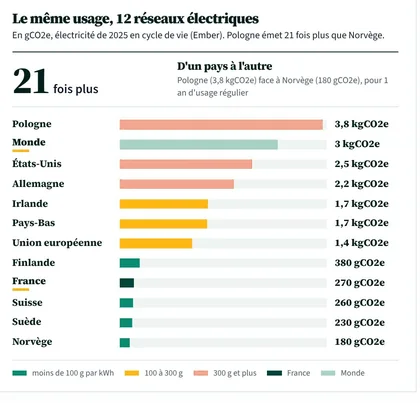
The same electricity emits 8 times less in France than in Germany
In 2025, according to Ember, consuming 1 GWh of electricity emitted 41 tCO2e in France, over the life cycle, against 330 in Germany, 384 in the United States and 589 in Poland. For a data centre, electricity accounts for the largest share of operating emissions, and it is the country that sets it; our explanation of the location of data centres shows this criterion by criterion.
À 41 gCO2e per kWh, the average French electricity of 2025.
À 330 gCO2e per kWh, the average German electricity of 2025.
According to our calculation, the gap comes to about 4.3 MtCO2e per year, the annual carbon footprint of about 520,000 French people. This calculation compares national averages and gives the highest possible gain. It assumes that the computing hosted in France would otherwise have been done elsewhere, on a more carbon-intensive grid. It also assumes that the electricity consumed in France is not missed by anyone, whereas France was a net exporter nearly 99% of the time in 2025: a kWh consumed by a new centre is often one kWh less exported to neighbours whose electricity is more carbon-intensive. The real gain is therefore smaller, to a degree we cannot quantify, except at the hours when low-carbon production exceeds what the country consumes and can export: 513 hours of negative prices in 2025, about 6% of the year, with about 3 TWh of wind and solar curtailed at those times.
The electrification objection concerns the grid
The strongest objection is that of a conflict of uses: the low-carbon electricity taken by data centres would be missing for the electrification of transport, heating and industry, on which the fall in the country's emissions depends; it is also the climate argument of the open letter that called in June 2026 for a boycott of AI. In energy over the year, the figures do not support it today. French consumption is about 450 TWh per year, below the 475 to 480 TWh of the 2010s, and RTE writes that the expected rise "has not materialised to date". In its rapid decarbonisation trajectory, consumption would grow by 60 TWh by 2030, of which 17 for transport, 15 for hydrogen, 13 for industry and 10 for data centres.
The objection does hold, however, for access to the grid. At the end of November 2025, the access rights already allocated on the transmission network reached about 30 GW, of which 14 for data centres, 9.5 for hydrogen production and 6.5 for the electrification of industrial sites, existing or new. The winter peak, 88 GW on 14 January 2025, is shared among everyone. Where reservations are concentrated, as in Île-de-France, a data centre can take a place that an industrial site that is electrifying also needs. Our analysis on the electricity shortage details these 3 quantities, energy, power and grid connection.
Our conditions
Sites chosen for the grid and for water. For the grid, the substation where a centre connects matters as much as the country. The sites identified by the State and the accelerated connection procedure go in this direction; they should also take into account the other connections waiting at the same substation. For water, cooling that evaporates water has no place in a basin under stress; a bill adopted by the Senate in March 2026 would allow a planning permit to be refused there.
Consumption that steps aside at peak. The International Energy Agency estimates that the current French electricity system could host about 6.5 GW of additional data centres if they reduced their consumption at critical hours, for the equivalent of 0.25% of their annual consumption. Writing this demand response into the grid connection conditions would make flexibility a counterpart of the connection, and the peak would remain available for electrification.
Data published site by site, with the use of the computing. Since 2024, every centre of 500 kW of IT load or more reports its energy and water each year to a European database, which publishes only totals by country. The European Energy Efficiency Directive already asks operators to make this information public, subject to commercial secrecy; a complete publication, site by site, would make it possible to check the climate argument. A project developer should also say for whom and for what it computes: the argument of "better here than elsewhere" only holds for computing that would have been done anyway; the computing that the new supply brings into being adds emissions, even in France.
Our position
At Projet Celsius, we think France is right to host more data centres. Its electricity emits little, and its production today exceeds its consumption over the year: it exported 92 TWh in 2025. This advantage is lost if the centres settle where the grid is already reserved, if they draw on the winter peak, or if they cool with evaporated water in a basin under stress. We therefore defend selective hosting: site by site, with published figures, and with flexibility as a condition of connection.
For a local councillor or resident facing a specific project, our guide to the questions to ask takes these conditions one by one, with reference values.
The calculation of the 15 TWh applies the average intensity of the electricity produced in each country; a new centre draws electricity that may differ from the average, in particular at peak times, and France exports part of its production to more carbon-intensive neighbours. The €109 billion figure groups together announcements of investment in AI in the broad sense; the share going to data centres is not published.
Sources
13 documents
- Élysée, clôture de la première journée du Sommet pour l'action sur l'IA, discours du 10 février 20252025entry 361
- Élysée, Faire de la France une puissance de l'IA, dossier de presse du Sommet pour l'action sur l'IA, 10 et 11 février 20252025entry 360
- RTE, Les data centers en chiffres clés, page mise à jour en mai 20262026entry 331
- Our World in Data, based on Ember, Lifecycle carbon intensity of electricity2026entry 34
- RTE, Bilan prévisionnel 2025, consommation2025entry 8
- RTE, Bilan électrique 20252026entry 9
- RTE, Bilan électrique 2025, rapport complet2026entry 332
- SDES and Insee, L'empreinte carbone de la France de 1990 à 20252026entry 53
- IEA, Powering Artificial Intelligence, 14 October 20262026entry 333
- Senate, bill to regulate the siting of data centres on French territory, adopted text No. 732026entry 295
- Delegated Regulation (EU) 2024/1364 on the first phase of a common rating scheme for data centres, March 2024, text reproduced by lagen.nu2024entry 292
- Directive (UE) 2023/1791 du 13 septembre 2023 relative à l'efficacité énergétique, articles 12 and 262023entry 362
- Next, La préfecture de Seine-et-Marne autorise l'installation de Campus IA à Fouju, 13 August 20262026entry 344
Every figure was read in its source; the hub's methodology is described in Methodology and sources.
AI Impact, Projet Celsius, "Should France host more data centres?", 13 November 2026. https://projetcelsius.com/en/ai/analyses/should-france-host-more-data-centres/



 Climate