
 Climate13 November 2026
Should we boycott AI for the climate?
The open letter of 18 June 2026, the boycott and the connection of data centres




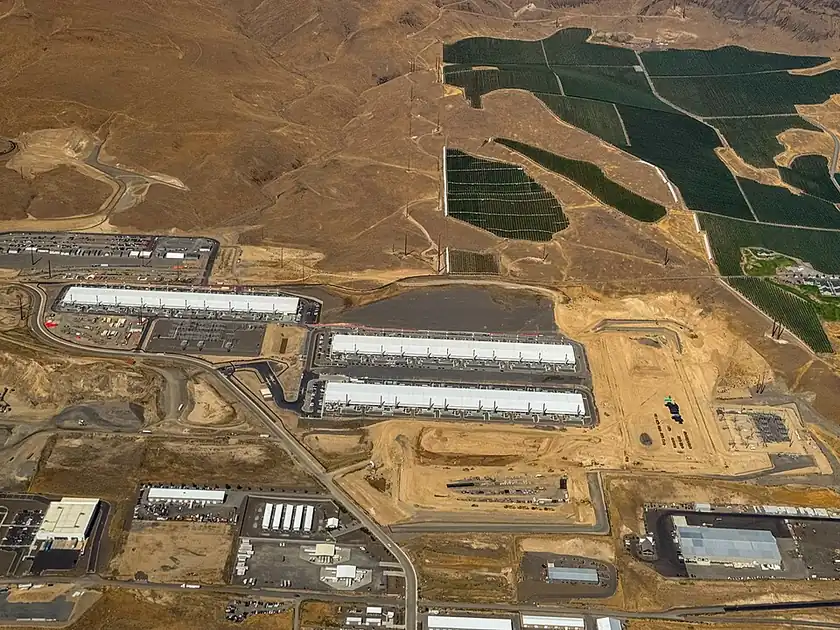
A Microsoft Azure data centre campus near Wenatchee, in Washington State. Photo Tedder, CC BY 4.0, via Wikimedia Commons.
On 18 June 2026, about 150 public figures call in Le Monde for a boycott of generative AI. Their climate argument concerns data centres, which draw on low-carbon electricity that other sectors need to decarbonise; their remedy concerns individual use, whose share of that electricity is small. In our view, the lever that matches their argument is the grid connection of data centres, which several countries already regulate.
Contents
On 18 June 2026, during a European AI summit in Lille, Le Monde published an open letter initiated by the Nord senator Alexandre Basquin and signed by around 150 people, including Annie Ernaux, Hervé Le Tellier, Enki Bilal and Françoise Nyssen. The text reads: "We refuse the inhuman project of an uninterrupted dialogue with machines." It calls for a boycott:
"Without waiting for lawmakers to build dikes, we call for a boycott of generative AI by all those who are not forced to use it."
The open letter puts forward human, social and ecological reasons. Here we read only the climate argument, the one on which a firm that counts carbon can say something; our article on the boycott reviews the others. This argument is worded as follows: data centres "capture green electricity at the expense of other sectors, delaying their necessary decarbonisation", including in countries whose electricity is already largely decarbonised. Before the call, the text mentions among the "proposals" that exist "a rationing of the energy resources allocated to generative AI", without making it its demand.
The open letter's climate argument concerns data centres
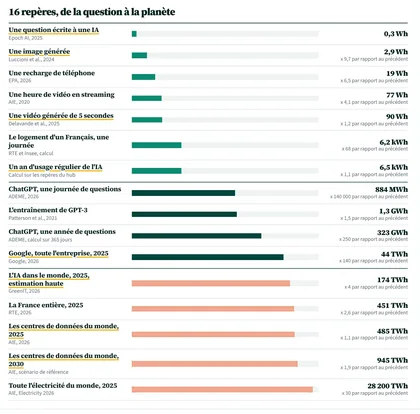
On this point, the figures give weight to the open letter. The world's data centres consumed 485 TWh in 2025, and the International Energy Agency (IEA) expects 945 in 2030 in its base case, a little more than Japan today. Worldwide, this increase remains smaller than that of air conditioning or electric cars. The pressure shows at country level: in Ireland, data centres consume 23% of the electricity recorded at meters in 2025.

 Electricity
Data centres' share of electricity
Share of national electricity consumption, latest published year · 2023 to 2025, depending on the country
Source: CSO; CBS; LBNL; IEA; RTE, Projet Celsius calculation · projetcelsius.com/en/ai · CC BY 4.0
The open letter's argument is one of conflict of use. A grid whose low-carbon electricity is limited shares it between uses: one more data centre means that much less low-carbon electricity to electrify heating, transport or industry, as long as production has not kept pace. The argument holds where the grid is tight; it therefore depends on the country and the region.
Weight of the use targeted by a boycott
The proposed boycott concerns people's use of generative AI. Yet consumer chat windows account, according to our estimate in "L'IA de surface et l'IA des profondeurs", for less than 5% of the electricity of data centres dedicated to AI. Set against the electricity of all data centres, which is what the open letter's argument concerns, this share is smaller still. The same analysis estimates that the heavy uses at the surface, images and video, do not change this order of magnitude. The rest goes through uses without an interface: recommendation, agents, business software, model training.
At the scale of one person, a year of ordinary personal use weighs about 340 gCO2e for server electricity, according to the AI Impact Database estimate, or 0.004% of the carbon footprint of a French person. A widely followed boycott would therefore mainly reduce a small share of the electricity concerned. It would have no direct effect on the connection of a data centre already decided, or on the electricity that supplies it.
The levers on grid connection already exist
The open letter mentions "rationing" in passing. Several countries already regulate the siting of data centres: their connection to the grid, their location, or the publication of their consumption.
| Country or area | Measure | Date |
|---|---|---|
| Ireland | A data centre requesting a connection of more than 10 MVA must generate or store electricity on site or nearby, and eventually cover 80% of its annual consumption with new renewable electricity produced in the country | Regulator decision, December 2025 |
| Singapore | End of a 4-year moratorium on new data centres; 80 MW provisionally allocated, on criteria of energy efficiency, computing capacity for AI and international connectivity | July 2023 |
| European Union | Annual reporting of the energy and water of each data centre of 500 kW of IT load or more | Delegated Regulation of March 2024, first reports in September 2024 |
| France | Senate bill: possible refusal of the building permit for a data centre in an area under structural water stress | Adopted at 1st reading on 25 March 2026 |
Measures read in the texts or in their presentation by reference sources, as of 13 November 2026.
These measures act on what the open letter describes: the electricity that a data centre takes from the grid, the place where it is built and what it must publish. They are decided by a regulator or a legislator, and their effect is measured site by site.
The objection about the signal sent to companies
The strongest objection is about the signal. A boycott does not target only the kilowatt-hours of its participants: it tells companies and investors that demand is not guaranteed, and it is this expected demand that gets data centres built. The US campaign QuitGPT, launched in early 2026, asked people to cancel their ChatGPT subscription; its organisers claimed more than 17,000 sign-ups as of 10 February, then more than 1.5 million people on 2 March, counting cancellations, shares and sign-ups, according to Euronews. Its main motive was political: a donation by Greg Brockman, president of OpenAI, in support of Donald Trump.
This signal exists, and it stems from a political choice that it is not for us to settle on behalf of everyone. For the climate, it remains indirect: it works through company forecasts, with no guarantee of reaching the electricity of a given grid. Connection decisions can be measured and discussed site by site.
Our position
We do not recommend boycotting generative AI for the climate: it concerns a small share of the electricity at issue, and it leaves aside the decisions that determine it. We recommend that the debate the open letter opens be about those decisions: where a data centre connects, with what electricity, with what water, and with what published data to verify it. In France, a bill on the siting of data centres was adopted by the Senate on 25 March 2026 and sent to the National Assembly.
For anyone who wants to act on their own use, the "My AI footprint" tool gives the order of magnitude of a year, and our analysis of everyday actions ranks what reduces it the most. Our viewpoint on guilt says why we prefer this approach to guilt, and our viewpoint on hosting data centres specifies the grid connection conditions we defend.
The open letter is quoted from the text that its initiator reproduced on 19 June 2026: we could not read the Le Monde page. The share of chat windows in the electricity of AI is a Projet Celsius estimate, and the year of personal use an estimate from the AI Impact Database, server electricity only. The Irish decision is read from its presentation by the press and a law firm, as the regulator's text could not be opened.
Sources
12 documents
- We refuse the inhuman project of an uninterrupted dialogue with machines, open letter published in Le Monde on 18 June 2026, text reproduced by Alexandre Basquin2026entry 287
- AFP, Boycott de l'IA générative : 150 personnalités signent un appel dans Le Monde, repris par L'essentiel2026entry 288
- IEA, Key Questions on Energy and AI2026entry 2
- Central Statistics Office (Ireland), Data Centres Metered Electricity Consumption 20252026entry 10
- Irish Times, New data centres must generate and supply electricity to wider market, regulator rules2025entry 289
- William Fry, CRU publishes long-awaited final policy on data centre connections2025entry 290
- Data Center Knowledge, Singapore ends data center pause as it seeks sustainable growth2023entry 291
- Delegated Regulation (EU) 2024/1364 on the first phase of a common rating scheme for data centres, March 2024, text reproduced by lagen.nu2024entry 292
- Senate, bill to regulate the siting of data centres on French territory, adopted text No. 732026entry 295
- Banque des Territoires (Localtis), Datacenters : le Sénat adopte une proposition de loi allégée2026entry 293
- MIT Technology Review, A QuitGPT campaign is urging people to cancel ChatGPT subscriptions2026entry 294
- Euronews, Cancel ChatGPT: AI boycott surges after OpenAI Pentagon military deal2026entry 296
Every figure was read in its source; the hub's methodology is described in Methodology and sources.
AI Impact, Projet Celsius, "Should we boycott AI for the climate?", 13 November 2026. https://projetcelsius.com/en/ai/analyses/should-we-boycott-ai-for-the-climate/
 Society