
 Electricity13 November 2026
What questions should you ask about a data centre project?
10 questions for an elected official or a resident, with the expected answers and reference values




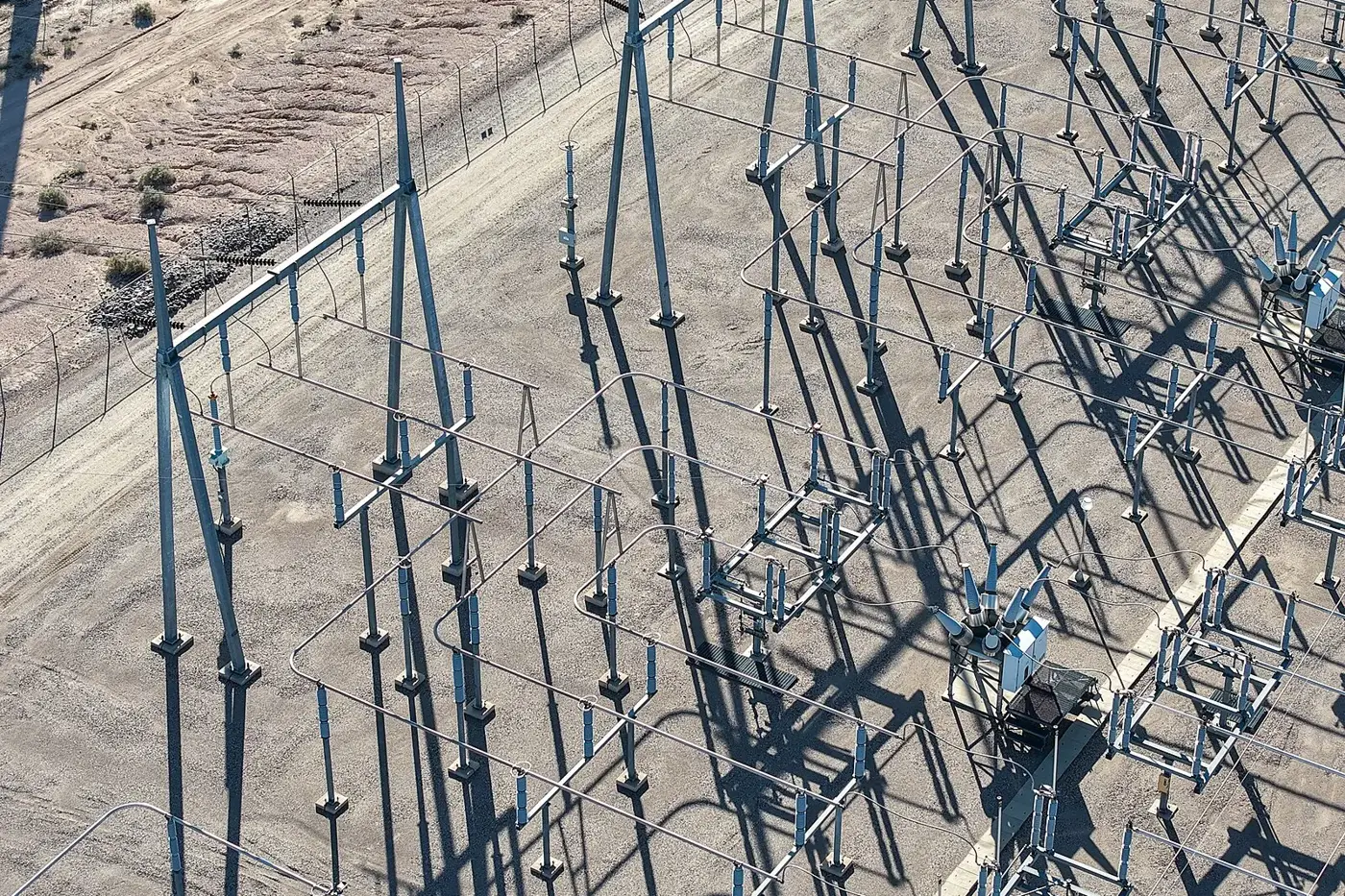
230 kV substation, aerial view. Photo Rsparks3, CC0, via Wikimedia Commons.
A data centre project commits a territory on electricity, water, heat, air and land, and also raises the question of jobs and published data. This guide gives 10 questions to put to the project developer, the answer they should be able to give and a reference value to judge it by. Most of these answers are already, or should be, in the file submitted to the public.
Contents
In May 2026, about 80 data centre projects had reserved nearly 18 GW of grid connection with RTE. For an elected official, an association or a resident, each project arrives with a thick technical file, and a public meeting where questions are often asked in no particular order. Our analysis of contested projects has read 3 of these files; this guide draws from them a list of questions, topic by topic.
For each question, we give the answer a project developer should be able to give, and a published reference value to judge it by. These values are averages or regulatory thresholds: they serve to place an answer in context.
List of the 10 questions
| Topic | Question for the project developer | Expected answer | Reference value |
|---|---|---|---|
| Electricity | 1. What power are you reserving, and what consumption do you expect per year, at opening and at full load? | The connection power in MW, the stages and their dates, the annual consumption in GWh for each stage | Centres connected to the transmission network draw on average 22% of their connection power (2025) |
| Electricity | 2. Which substation are you connecting to, and what other projects are waiting at that substation? | The substation, its capacity, the connection date given by RTE, and the other known requests | At the end of November 2025, 14 of the 30 GW of transmission network access rights went to data centres |
| Electricity | 3. What does the centre do at winter peak hours? | A quantified demand response commitment, in MW and hours per year | According to the IEA, the current French system could host about 6.5 GW of additional centres if they reduced demand at critical hours by 0.25% of their annual consumption |
| Electricity | 4. What energy efficiency indicator (PUE) are you aiming for, and how will it be measured? | An annual value, measured at the site's meters and published every year | 1.52 global average declared in 2026, 1.45 for the largest centre of each respondent; 1.07 to 1.10 for Google's European campuses |
| Water | 5. What cooling method, how much water withdrawn and consumed per year, in which basin? | The cooling system, the volumes withdrawn and evaporated in m³ per year, the resource and its condition | Meta declares 0.19 L of water withdrawn per kWh of IT load in 2024, Microsoft 0.27 L per kWh in its 2025 financial year, with definitions that are not identical |
| Climate | 6. Which refrigerants, in what quantity, and how are leaks tracked? | The fluid, its quantity in tonnes, its warming potential, the leak control plan | Declaration with inspection under ICPE (heading 1185) from 300 kg of HFC, PFC or SF6 in equipment of more than 2 kg; HFOs, such as R-1234ze, do not fall under this heading |
| Heat | 7. What happens to the waste heat? | The outlet (heat network, greenhouses, buildings), its distance, the targeted share of heat reused and its date | Above 1 MW, recovery is mandatory unless infeasibility is demonstrated; France considers it achieved at an energy reuse factor of 0.20; 1.8% of the heat of the EU's reporting centres was reused, according to the 2024 declarations |
| Air | 8. How many generators, what total power, how many test hours per year? | The number, the total thermal power in MW, the fuel, the test hours and the emissions | Combustion heading: declaration with inspection from 1 to 20 MW thermal, registration from 20 to 50 MW, authorisation from 50 MW |
| Land | 9. What surface area, what share sealed, on what soils? | The surface area in hectares, the built and sealed share, the current use of the land (farmland, brownfield) | Systematic environmental assessment for a development operation of 10 ha or more, or a construction of 40,000 m² or more of floor area or footprint; case by case below that, from 5 ha or 10,000 m²; the 35 sites identified by the State in 2025 range from 18 to more than 150 ha |
| Jobs and data | 10. How many operating jobs, what tax revenues, and what data will you publish each year? | Direct operating jobs, distinct from construction; quantified local tax revenues; a commitment to publish the indicators declared to the European register | The European register publishes aggregates by country, and the Commission announces a public label per centre; the 2023 directive asks operators of 500 kW of installed IT power or more to make their information public, except where commercial secrecy applies |
Reference values published by RTE, the IEA, the Uptime Institute, operators, the European Commission and the texts cited, as at 13 November 2026. A list to take up as it stands in a public meeting, citing the source.
Electricity: reserved power and actual consumption
The connection power is the figure put forward, and it says little about consumption. A centre almost never draws all of it: in 2025, data centres connected to the transmission network used only 22% of it on average, and operators expect to rise towards 80% in 10 to 15 years, according to RTE. Annual consumption says what the centre will consume; for the Microsoft project at Petit-Landau, the environmental authority of Grand Est estimates it at the consumption of more than 280,000 households, about 80% of that of the households of Haut-Rhin.
The connection substation counts as much as the power. A grid becomes saturated locally, as in the Dublin region, well before energy runs short at national scale; our analysis of the electricity shortfall details these quantities. A commitment to demand response at winter peak hours can feature among the questions: a centre that steps aside for a few hours a year frees up power for heating and industry.
Water, heat and air
Water depends first on the cooling method. Dry cooling, chosen for phase 1 at Fouju, withdraws almost nothing locally; it relies on chillers charged with fluids: 601 tonnes of refrigerant gas at Fouju, according to Next. Evaporative cooling consumes water; the question then becomes that of the basin and its summer stress. Our analysis of the water use of data centres gives benchmarks basin by basin.
Heat is almost all of the electricity consumed, rejected at low temperature. The 2023 European Energy Efficiency Directive requires centres of more than 1 MW to recover it, unless they demonstrate that this is not technically or economically feasible; according to the 2024 declarations, the EU's reporting centres reused 1.8% of it. Our explanation of heat says why: it takes a nearby heat network, and demand in summer.
Backup generators are tested regularly and emit nitrogen oxides. At Meudon, the environmental authority counted 33; at Petit-Landau, it notes a rise of about 20% in the nitrogen oxide emissions of Alsace. In the files submitted, their total thermal power is classified under combustion: declaration with inspection from 1 to 20 MW, registration from 20 to 50 MW, authorisation from 50 MW, a threshold that also makes environmental assessment systematic.
Land, jobs and published data
Surface area partly decides the procedure. Combustion of 50 MW or more, a development operation of 10 hectares or more, or a construction of 40,000 m² or more subject the project to environmental assessment, and therefore to a public inquiry; a substation of 63 kV or more, a plot of 5 to 10 hectares or an installation subject to registration go through a case-by-case review. At Aulnay-sous-Bois, the environmental authority took into account the combustion, the 225 kV substation and a plot of 12.1 hectares. The question of soils follows: farmland at Fouju and Petit-Landau, an industrial brownfield for the MRS5 centre in Marseille.
On jobs, no public source gives a ratio of jobs per megawatt: the developer must be asked for its direct operating jobs, distinct from those of the construction phase. A data centre pays the property tax on built properties; the amounts expected for the municipality and the intercommunal body appear in none of the 3 files we read.
On data, every centre of 500 kW of IT load or more reports each year to the European register its energy, its water, its reused heat and the types of refrigerant it uses. The 2024 regulation publishes these declarations only aggregated by country, and keeps those of each site confidential. In its September 2026 report, the Commission announces a delegated regulation creating a label per centre, built on some of these indicators and accessible to the public. The 2023 directive, on the other hand, asks operators to make their information public, subject to commercial secrecy. A developer can therefore commit to publishing each year, for its site, what it declares.
Who decides
The environmental authority issues a simple opinion; the developer responds in writing, and the prefect decides on the environmental authorisation. The municipality sets the planning rules, RTE connects. A law of 26 May 2026 allows a data centre to be designated by decree as a project of major national interest, which entrusts the planning permit to the prefect. The questions in this list are useful at each of these moments: the prior consultation, the public inquiry, the local deliberation.
The reference values are declared averages or regulatory thresholds read on 13 November 2026; a project may depart from them for good reasons. The texts of the environmental code were read only in copies: the thresholds for classified installations come from the nomenclature published by Ineris, those for environmental assessment from a copy of the annex to article R. 122-2 and from opinions of the environmental authority.
Sources
25 documents
- RTE, Les data centers en chiffres clés, page mise à jour en mai 20262026entry 331
- RTE, Bilan électrique 2025, rapport complet2026entry 332
- RTE, Bilan électrique 20252026entry 9
- IEA, Powering Artificial Intelligence, 14 October 20262026entry 333
- Uptime Institute, Global Data Center Survey 20262026entry 324
- Google, Data centers, Efficiency, PUE par campus2026entry 321
- Meta, 2025 Environmental Data Index, section 2.4, efficacité de l'eau des centres de données2025entry 380
- Microsoft, Datacenter efficiency, PUE et WUE par région, exercices 2024 et 20252025entry 381
- Ineris, AIDA, nomenclature des installations classées, rubrique 1185, Gaz à effet de serre fluorés2026entry 376
- Ineris, AIDA, nomenclature des installations classées, rubrique 2910, Combustion2026entry 375
- Ineris, AIDA, nomenclature des installations classées, rubrique 3110, Combustion2026entry 377
- Directive (UE) 2023/1791 du 13 septembre 2023 relative à l'efficacité énergétique, articles 12 and 262023entry 362
- Décret n° 2025-1382 du 29 décembre 2025 relatif à la transposition de la directive (UE) 2023/1791, articles R. 237-4 à R. 237-7 du code de l'énergie (texte reproduit par l'Ineris)2025entry 277
- European Commission, rapport COM(2026) 500 sur l'efficacité énergétique des centres de données dans l'Union, 21 September 2026 (document du Conseil ST 13443/26)2026entry 275
- Delegated Regulation (EU) 2024/1364 on the first phase of a common rating scheme for data centres, March 2024, text reproduced by lagen.nu2024entry 292
- Mission régionale d'autorité environnementale Île-de-France, avis APJIF-2025-004 sur le centre de données Data Hills à Aulnay-sous-Bois, 12 février 20252025entry 378
- Mission régionale d'autorité environnementale Île-de-France, avis délibéré sur le centre de données de Meudon, 19 novembre 20252025entry 379
- Mission régionale d'autorité environnementale Grand Est, communiqué de la séance du 19 March 20262026entry 341
- Senate, rapport n° 435 sur la proposition de loi visant à encadrer l'implantation des centres de données, 25 février 20262026entry 382
- Élysée, Faire de la France une puissance de l'IA, dossier de presse du Sommet pour l'action sur l'IA, 10 et 11 février 20252025entry 360
- Next, La préfecture de Seine-et-Marne autorise l'installation de Campus IA à Fouju, 13 August 20262026entry 344
- Campus IA, dossier de concertation préalable, Commission nationale du débat public2025entry 337
- Loi n° 2026-403 du 26 mai 2026 de simplification de la vie économique, Article 352026entry 383
- Cabinet Gossement Avocats, Centres de données : ce que change la loi de simplification de la vie économique2026entry 347
- Mission régionale d'autorité environnementale Provence-Alpes-Côte d'Azur, avis n° 2024APPACA16 sur le projet MRS5 de Digital Realty, 4 April 20242024entry 342
Every figure was read in its source; the hub's methodology is described in Methodology and sources.
AI Impact, Projet Celsius, "What questions should you ask about a data centre project?", 13 November 2026. https://projetcelsius.com/en/ai/analyses/questions-to-ask-about-a-data-centre-project/
 Climate