
- 1Four industrial routes structure bioplastics: fossil, attributed, drop-in, dedicated.
- 2Biogenic content × biodegradability matrix: being bio-based never implies being biodegradable.
- 3PEF LCA with 16 indicators: climate benefit but trade-offs in eutrophication, land and water.
- 4Actual end of life available locally determines whether the bioplastic delivers its promises.
The technical decisions in a bioplastics project rest on three questions to which the specialist press and supplier marketing rarely provide a rigorous answer: how is this polymer produced?, where does it sit relative to the others? and, above all, what do independent LCA studies say about its impacts?
The challenge: move beyond binary comparisons such as "PLA is bio-based, so it is better", still circulating in eco-design committees in 2026, and reach the level of detail needed to decide material by material, application by application.
1Step 1 · Understand the four production routes
Bioplastics are classified according to the stage of the production process at which biomass replaces fossil feedstocks. Four routes are possible, including one (route 0) that is conventional fossil plastic - useful to retain as a reference.
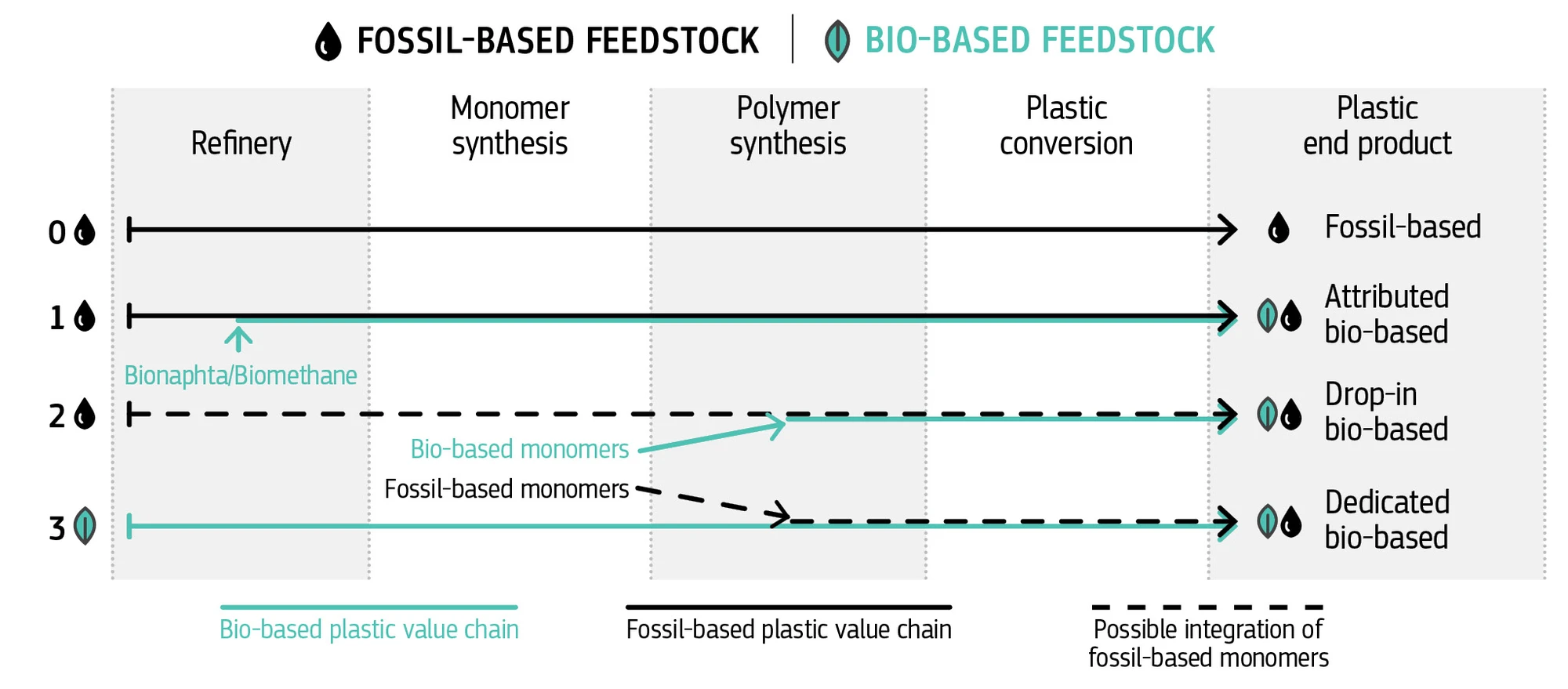
Route 0 - Conventional fossil plastic (reference)
Four stages: (1) refinery + naphtha extracted from crude oil, (2) monomer synthesis (ethylene, propylene, styrene), (3) polymer synthesis (PE, PP, PET, PS, PVC), (4) conversion into the final product. No biomass is involved. This is the dominant route: 99.5% of the global plastics market in 2025.
Route 1 - Attributed bioplastic (mass balance)
Biomass is injected at the refinery in the form of intermediates (biomethane, biomethanol, bionaphtha - typically derived from tall oil or used vegetable oils). Co-processing with fossil naphtha is physical, but the bio-based share of the final polymer is attributed through mass balance, rather than physically measurable. In principle, all fossil plastics can be converted into attributed plastics. Advantages: full compatibility with existing industrial chains + recycling. Limitations: conventional traceability, under growing scrutiny from the DGCCRF and the EU Commission regarding mass balance certifications.
Route 2 - Drop-in bioplastic
Monomers identical to fossil-based ones are produced from biomass, downstream of the refinery. The final polymer is chemically identical to its fossil equivalent, but with biogenic content measurable analytically (ASTM D6866, for example). Flagship examples: 100% bioPE (bioethanol → ethylene → PE, Braskem's route in Brazil using sugar cane), 20% bioPET (bio-based MEG + fossil terephthalic acid), emerging bioPP. Advantages: 100% compatible recycling, straightforward integration. Limitations: no functional advantage + 15-30% price premium (bioPE).
Route 3 - Dedicated bioplastic
Polymers developed specifically for biomass, with no direct fossil equivalent. Three sub-routes: (a) modification of natural polymers - cellulose acetate (CA, since 1900), thermoplastic starch (TPS); (b) dedicated bio-based building blocks - PLA through lactic acid fermentation → lactide → polymerisation, PBS, PEF; (c) direct biosynthesis by microorganisms - PHA (PHB, PHBV) produced intracellularly by bacteria (particularly Cupriavidus necator). Advantages: unique properties (industrial biodegradability, oxygen barrier for PEF, biocompatibility for PHA). Limitations: low volumes, varying TRLs (PHA: TRL 7-8, PEF: TRL 6-7), incompatible with current recycling.
2Step 2 · Position the polymer on the matrix (bio-based × biodegradability)
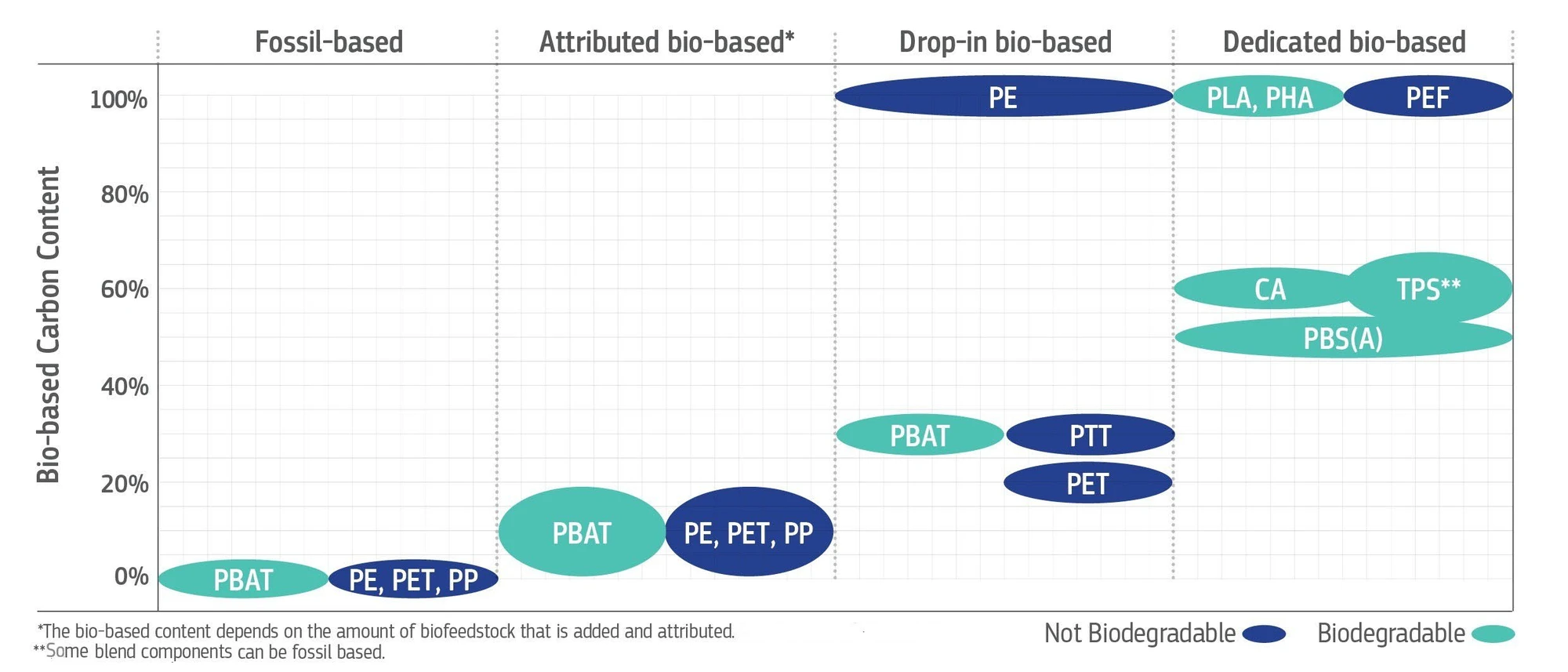
Once the production route has been chosen, the polymer is positioned on two independent axes: share of bio-based carbon (0% to 100%) and biodegradability (yes/no, and, if yes, under what conditions). The JRC 2026 report proposes a 2D matrix that we have reinterpreted. Key point to remember: being bio-based does not imply being biodegradable, and vice versa. BioPE is 100% bio-based but as persistent as its fossil equivalent; PBAT is entirely fossil-based but biodegradable.
Four dominant clusters on the matrix
- Cluster 1 - 100% bio-based, non-biodegradable drop-ins: 100% bioPE (sugar cane, Braskem). Can reach 100% biogenic content but are identical to fossil PE at end of life - persistent, compatible with existing PE recycling.
- Cluster 2 - 100% bio-based and biodegradable dedicated polymers: PLA, PHA, PEF, TPS, CA. The most publicised family. Conditional biodegradability (industrial, marine, soil) must be checked polymer by polymer under EN 13432 (industrial composting) or ISO 17556 (soil).
- Cluster 3 - Partially bio-based dedicated polymers: PBS/PBSA (40-50% bio-based), PTT (35% bio-based). Interesting hybrids: usable mechanical properties, measurable biogenic content.
- Cluster 4 - Biodegradable fossil polymers: PBAT, PCL. Not bio-based, but biodegradable - used in blends with PLA or TPS to adjust mechanical properties. Example: PLA + PBAT for a more flexible compostable bag.
Direct implication for eco-design: a specification mentioning "bioplastic" without identifying the cluster is unusable. Good supplier specifications state both the % biogenic content (and measurement method: ASTM D6866 or EN 16785), biodegradability (and standard: EN 13432 or another), and the intended end-of-life scenario (industrial composting, material recycling, incineration with recovery).
3Step 3 · Assess multi-criteria LCA impacts
We now enter the methodological core. The Sinkko et al., 2025 report (JRC142832) models four representative substitution cases using the Environmental Footprint EF 3.1 method (16 impact categories, the European Commission's official methodology). Here are the consolidated results.
Three methodological choices that can change an LCA result
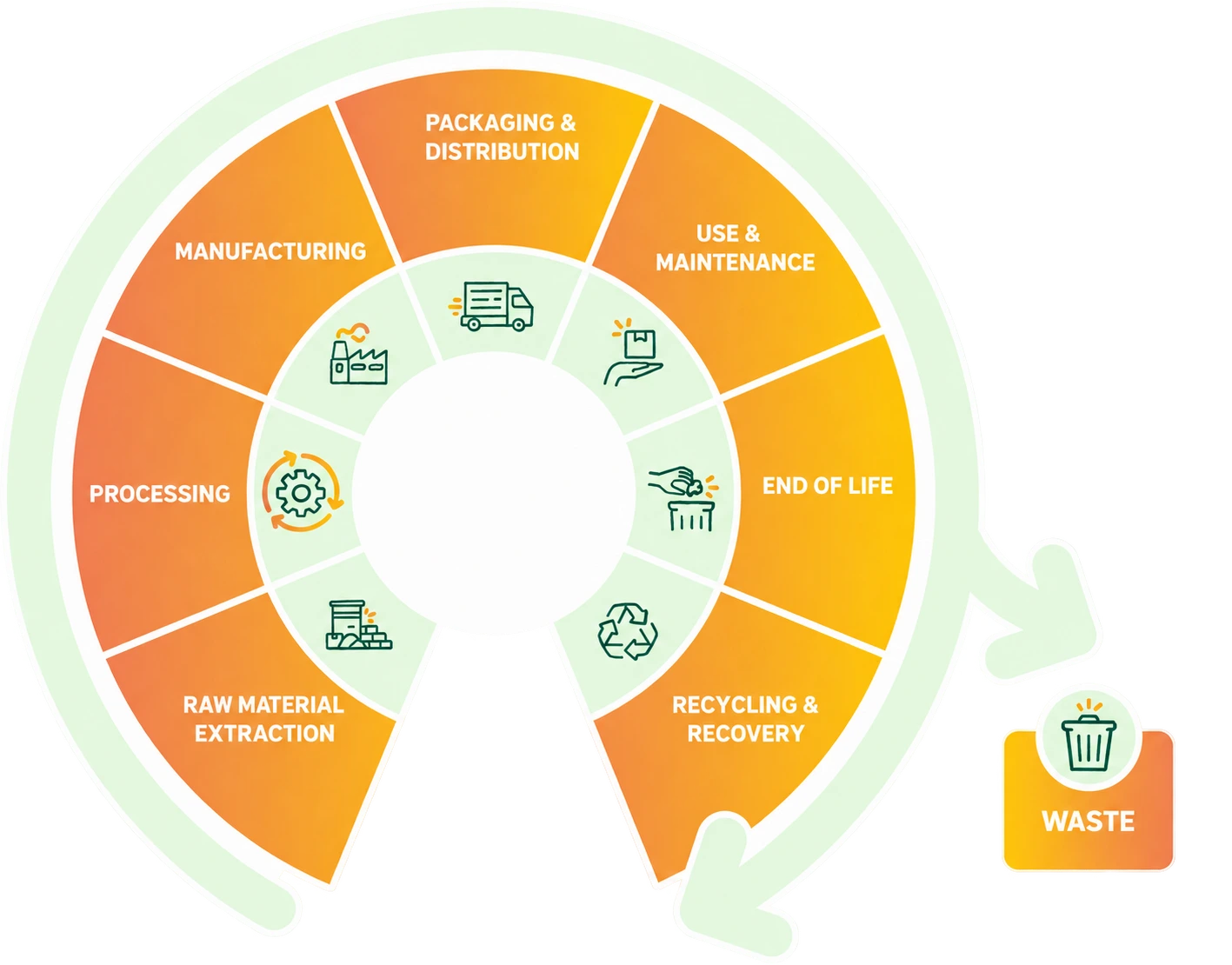
Before presenting an LCA result to a decision-making committee, the team must explicitly resolve three methodological choices: biogenic carbon (how to account for CO₂ captured during biomass growth and subsequently re-emitted at end of life), co-product allocation (how to distribute impacts between the bioplastic and other products derived from the same biomass), and ILUC (the indirect land-use effect). These three choices can vary an LCA result by 30 to 50%. The interactive infographic below details the available options and the European Commission's official position for each (Environmental Footprint EF 3.1 method).
The three decisions that change a bioplastic LCA result
Biogenic carbon, co-product allocation, ILUC: each of these three methodological choices can vary the LCA result by 20 to 50%. The European Commission has published explicit recommendations through the Environmental Footprint EF 3.1 method. Select a choice to see details and the official EU position.
How should CO₂ captured by biomass during growth and then re-emitted at end of life be accounted for?
- 0/0 method: neither capture nor emissions accounted for (conservative).
- -1/+1 method: upstream capture (-1) and downstream emissions (+1), net zero balance.
- ISO 14067: credit for temporary carbon storage during useful life.
The Environmental Footprint EF 3.1 method recommends the -1/+1 approach, aligned with JRC ILCD guidelines. Temporary sequestration (ISO 14067) remains optional and must be documented separately.
The golden rule: explicitly document the three choices before publishing an LCA result. A study that does not specify the chosen method on these three points is not auditable under PEF EF 3.1, and legally fragile under EmpCo (EU 2024/825).
Three representative cases: what PEF LCA reveals
Once the method has been defined, here are three concrete substitutions modelled by the European Commission's scientific analyses (report JRC142832): rigid bottle PET → PLA, flexible film LDPE → starch-based, premium film PET → algae-based. The same pattern repeats: a real climate benefit on one side, systematic trade-offs in eutrophication, land use and water on the other.
Climate benefit on one side, trade-offs on the other
Three bio-based/fossil substitutions modelled by the European Commission's scientific report (JRC142832). For each case: on the left, the climate impact saving; on the right, the other environmental impacts that increase. The common pattern: a bioplastic reduces carbon, but shifts the problem towards eutrophication, land use or water.
- Eutrophication×3
- Land use×3.5
- Water×6
- Eutrophication×3
- Land use×2.5
- Acidification×1.75
- Eutrophication×1.5
- Land use≈ 0
- Water×1.3
Case 1 · Rigid bottle PET → PLA. PLA's density (1.24) requires a slightly thicker bottle than its PET equivalent (1.38) to retain barrier properties. The -20% climate benefit at material level falls to -4% once the packaged product is taken into account. The central trade-off: eutrophication and land use have a substantial impact because of maize or sugar cane production. Substitution is valid only if an industrial composting stream is available locally.
Case 2 · Flexible film LDPE → starch-based. Almost identical densities (LDPE 0.92 vs starch 0.925), kilogram-for-kilogram substitution without extra thickness. This case has the best climate benefit / cost ratio: -50% at material level, -10.6% at product level for 20% substitution. Industrial composting at end of life still needs to be guaranteed - without it, the trade-offs of eutrophication × 3 and acidification × 1.75 are not offset by a realised climate benefit.
Case 3 · Premium film PET → algae-based. Algal biomass (mainly spirulina) does not compete with food agriculture and could be considered on marginal land or in ponds. This gives the trade-offs a more moderate profile (eutrophication × 1.5, land ≈ 0). But TRL 6-7, low volumes and a high price premium mean it cannot yet be industrialised at large scale. A promising direction for the 2030s, rather than an operational solution in 2026.
4Step 4 · Choose the right feedstock and suitable manufacturer
One figure changes the entire analysis: 50% of current bioplastics are produced from food crops (sugar cane, wheat, maize). This dependence on intensive agriculture creates the main LCA trade-offs. Four feedstock families structure the market, each supported by specialist manufacturers - the choice of polymer and supplier are linked.
The leading producers and brands in 2026
In material production, the market remains dominated by a handful of players: NatureWorks (Cargill subsidiary, United States), the world's largest PLA producer under the Ingeo brand; Total Corbion PLA (Total + Corbion joint venture, Luminy range); Braskem (Brazil, I'm Green bioPE from sugar cane); Novamont (Italy, Mater-Bi TPS for compostable bags); Sulapac (Finland, wood-biopolymer cosmetics packaging).
Among user brands: Coca-Cola PlantBottle has deployed partially bio-based PET since 2009 (30% bio-based MEG), with the ambition of 100% bio-based content postponed several times; Stora Enso partners with Sulapac on cosmetics packaging; Vegware in the United Kingdom uses PLA + paper catering packaging (acquired by Bunzl in 2022). An instructive counterexample: Lego announced a bioplastic for 2030 in 2018, withdrew its recycled PET project in 2023 after an unfavourable internal LCA, then pivoted towards recycled content + renewable energy. The recurring lesson: brands that base their material choice on a multi-criteria LCA from the scoping stage avoid costly withdrawals.
Family 1 - Dedicated food crops
Sugar cane, maize, wheat, beet, potatoes. Advantages: availability, energy density, existing infrastructure. Disadvantages: food competition, intensive fertilisation (eutrophication), water consumption (PLA: 500-1900 L/kg vs PE 180 L/kg), ILUC risk. This is the dominant family in 2026 (PLA, Brazilian bioPE, 20% bioPET).
Family 2 - Co-products and agricultural residues
Bagasse (sugar cane residue), tall oil (pulp residue), straw, wheat bran, fruit pulps. Major LCA advantages: no food competition, favourable allocation (waste recovered), low additional eutrophication. Disadvantages: limited volumes, complex logistics (decentralised collection), variable composition. This is the route the JRC considers most promising for favourable LCAs.
Family 3 - Lignocellulose (wood, forestry waste)
Wood, sawdust, forestry waste, recycled paper. Enables production of cellulose acetate (CA), future second-generation bionaphtha, and some TPS. Advantages: no food competition, use of sustainably managed forests (PEFC or FSC label). Disadvantages: fractionation technologies remain expensive (TRL 6-8 depending on the route), possible pressure on forests at massive volumes.
Family 4 - Algae and waste
Algae (spirulina, laminaria), municipal organic waste, used cooking oils, biogenic methane. Advantages: no land competition (marine algae), circular recovery. Disadvantages: very low volumes at this stage (TRL 5-7), high production costs. A future route, but not yet at scale. JRC142832 cites algae as one of the most promising prospects for the 2030-2040 decade.
Practical implication for the eco-design team: before choosing a polymer, check feedstock traceability with the supplier. ISCC PLUS, REDcert or Bonsucro certifications guarantee biomass sustainability. Without certification, ILUC risk and food competition remain undocumented.
5Step 5 · Anticipate actual end of life
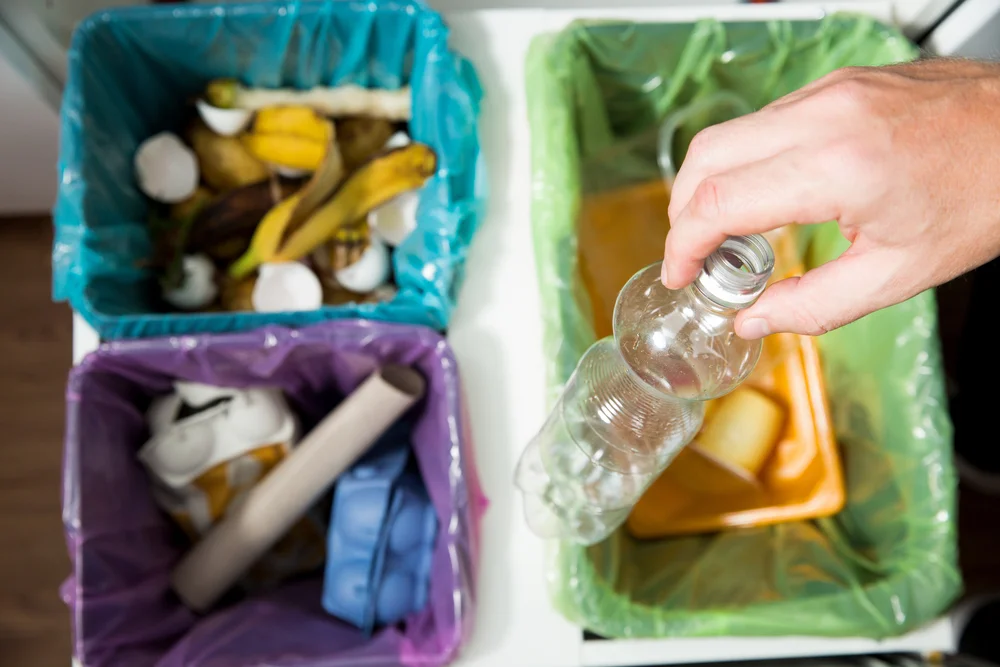
The "compostable" argument is central to communication about dedicated bioplastics. The European Commission's Joint Research Centre (JRC, its scientific body) severely qualifies it: "so-called dedicated bioplastics do not fit into current plastic recycling streams, and building parallel streams is not viable because volumes are insufficient". In other words: material recyclability is not an option for PLA, PHA and other dedicated polymers. Here are the realistic end-of-life scenarios for 2026.
Scenario 1 - Material recycling (mechanical)
Compatible: drop-in bioplastics (bioPE, bioPET, bioPP). They fit 100% into existing recycling streams. Incompatible: dedicated bioplastics (PLA, PHA, PEF). Beyond 2-3% contamination, they degrade PET or PE recyclate quality. The PPWR (EU 2025/40) requires 100% recyclability - dedicated polymers may be classified as non-recyclable, resulting in higher EPR fees.
Scenario 2 - Industrial composting
Compatible: PLA, PHA (subject to conditions, verifiable EN 13432). Critical limitation: actual availability of industrial composting streams in France is uneven. The AGEC law made source separation of biowaste universal from 1 January 2024, through local composting or separate collection, but sorting biowaste does not guarantee access to industrial composting. Almost all PLA in France currently ends up being incinerated.
Scenario 3 - Chemical recycling (emerging)
A future route, still being industrialised. Enzymatic depolymerisation (Carbios for PET, applicable to PLA), chemical depolymerisation (Eastman, Loop Industries for PET). If scale is reached between 2027 and 2030, this would change the picture for dedicated polymers by making them compatible with genuine material recycling. A future variable to watch, but not to bet on for a short-term packaging decision.
Scenario 4 - Incineration with energy recovery
The quantitative reality for most bioplastics in 2026, especially dedicated polymers. LCA: partial energy recovery partly offsets emissions, but not upstream impacts (agriculture, processing). Implication: if the actual end-of-life scenario is incineration, a bioplastic's climate advantage diminishes. JRC142832 demonstrates this quantitatively: in 4 cases tested, switching from industrial composting to incineration reduces the climate advantage by 30 to 60%.
6Key takeaways
- Four distinct industrial routes, classified by the biomass/fossil substitution stage: route 0 (conventional fossil), route 1 (attributed/mass balance), route 2 (drop-in), route 3 (dedicated). Each route has its own industrial compatibility, recycling and cost profile.
- Four clusters on the matrix of biogenic content × biodegradability: non-biodegradable drop-ins (100% bioPE), biodegradable dedicated polymers (PLA, PHA, PEF), partially bio-based dedicated polymers (PBS, PTT), biodegradable fossil polymers (PBAT). Specifying the cluster is mandatory in any specification.
- JRC142832 PEF LCA results: climate advantage of -4% to -50% depending on polymer and scope. Systematic trade-offs in eutrophication (×2 to ×4) and land use (×1.5 to ×3) for agricultural biomass. Starch-based substitution for flexible LDPE appears among the most robust.
- Three methodological choices can vary an LCA result by 30 to 50%: biogenic carbon accounting (0/0 vs -1/+1 vs ISO 14067), co-product allocation (mass/economic/energy), inclusion or exclusion of ILUC. All three must be explicitly resolved.
- Feedstock determines everything: 50% of current bioplastics come from food crops - this dependence creates the LCA trade-offs. Co-products, lignocellulose and algae are future routes with the best environmental profiles.
- Actual end of life determines whether a bioplastic delivers its promises. Switching from industrial composting → incineration reduces the climate advantage by 30 to 60%. Before specifying a dedicated polymer, map the end-of-life stream available in the final market.
- The decision rule: drop-ins for high-volume applications where PPWR recycling compatibility is critical, dedicated polymers for niches where their properties (biodegradability, barrier) justify the LCA trade-offs.