
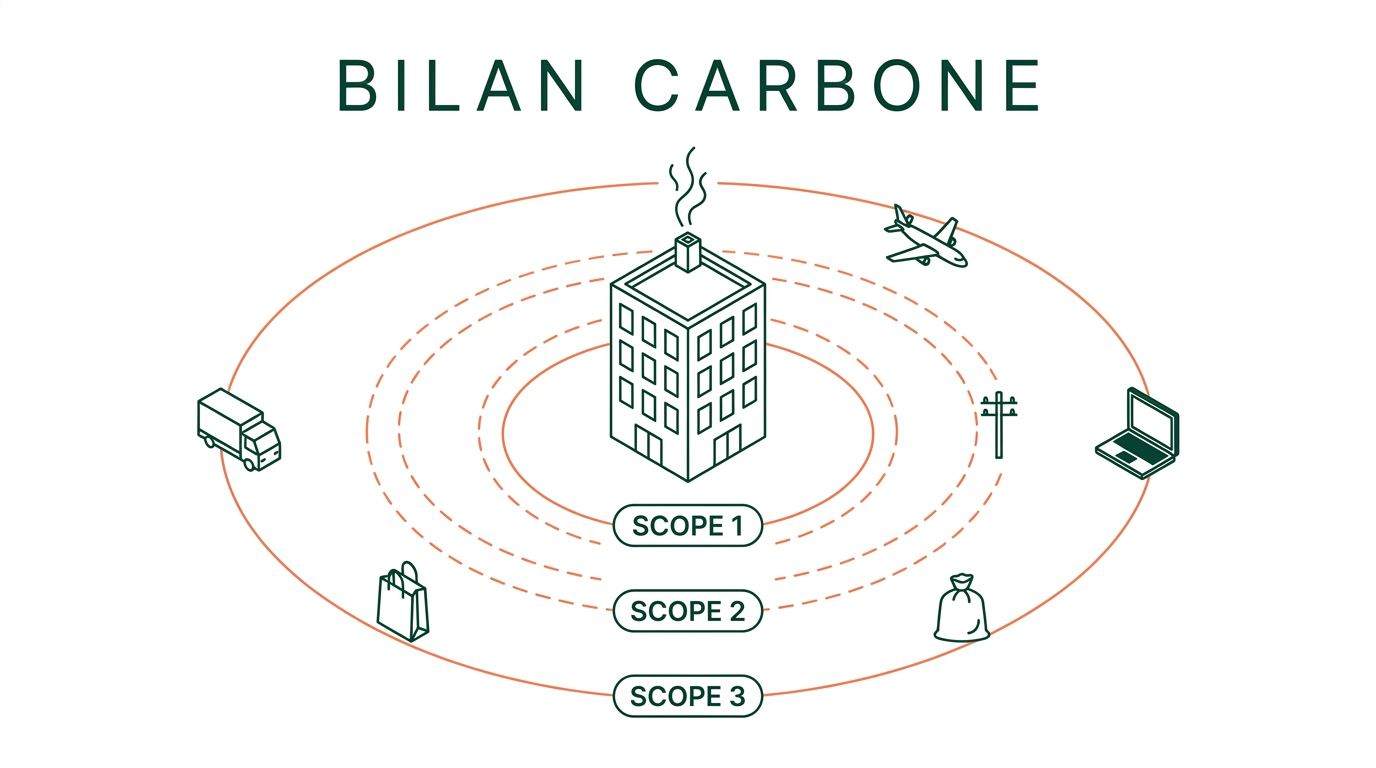
- 1Bilan Carbone®, France's reference method, measures an organisation's greenhouse gas emissions across Scopes 1, 2 and 3.
- 2The greenhouse gas emissions report (BEGES) is mandatory above 500 employees (French Environmental Code); Bilan Carbone® is one method for producing it.
- 33 ways to carry it out: self-managed, with support from a consultancy, or hybrid with an internal lead.
- 4With Bpifrance's Diag Décarbon'Action, the out-of-pocket cost is €6,000 excl. VAT for companies established in France with fewer than 500 employees.
Bilan Carbone® for companies: the essentials
V9 methodology (ABC) - the key points in 15 seconds
The carbon footprint does not reduce anything on its own: its purpose is to build a quantified action plan, which management must sponsor.
Source: Bilan Carbone® V9 methodology, ABC / ADEME, 2026
When a company says "we have done our Bilan Carbone®" (the French carbon accounting method), it often means that a service provider spent six weeks collecting data, produced an 80-page report and presented it to the executive committee, after which the report ended up gathering dust in a drawer. This is a common outcome, yet the exercise has considerable potential: it makes visible what is otherwise hidden, identifies the levers that matter most and creates a shared language between the finance director, purchasing, logistics and management, provided you are clear about what you expect from it.
This guide covers what you need to know before starting: what a Bilan Carbone® measures, how the 3 Scopes work, how emission factors feed into the calculation, the 3 ways to carry it out (on your own, with support or hybrid), the 5 steps of an engagement, and the regulatory and funding framework in France in 2026. It is the document we send our clients before scoping: over 6 years and more than 120 engagements, we have seen what works and what does not.
1What a Bilan Carbone® is, and what it is not
A Bilan Carbone®, also known as a carbon footprint assessment, quantifies an organisation's greenhouse gas (GHG) emissions over a given period, usually one year, and within a defined boundary. The result is expressed in tonnes of CO2 equivalent (tCO2e), a unit that combines the different gases (CO2, methane, nitrous oxide, HFCs, SF6) according to their global warming potential.
In France, the reference method is the Bilan Carbone®, developed by Jean-Marc Jancovici for ADEME (the French Agency for Ecological Transition) in 2004 and transferred in 2011 to the Association pour la transition Bas Carbone (ABC), the French low-carbon transition association. The current version, V9, has been in force since January 2025 and introduces three maturity levels (Initial, Standard, Advanced) that let you adjust the depth of the assessment to your context. ABC merged with the APCC (an association of climate consulting professionals) at the end of June 2025 to form the main federation of climate professionals in France.
Three distinctions need to be made at the outset:
- Bilan Carbone® ≠ BEGES. The Bilan Carbone® is a method run by ABC. The greenhouse gas emissions report (BEGES) is a regulatory obligation (Article L229-25 of the French Environmental Code). The BEGES can be produced with either the Bilan Carbone® method or the GHG Protocol. In practice, when a company subject to the obligation has a Bilan Carbone® carried out, the deliverable also serves as its BEGES
- Bilan Carbone® ≠ LCA. The Bilan Carbone® is single-criterion: it measures greenhouse gases only. Life cycle assessment (in French) (LCA) covers 16 impact categories (water, biodiversity, soil pollution, resource depletion and so on) for a product or a service. The Bilan Carbone® is the map of your organisation, whereas the LCA is the magnifying glass on a product
- Bilan Carbone® ≈ GHG Protocol. The two methods measure the same emissions from the same data. They classify them differently (the Bilan Carbone® splits emissions into 10 emission categories and 48 subcategories in its current version, whereas the GHG Protocol has 3 Scopes and 15 categories), but the results can be converted from one to the other. A good service provider produces both formats at no extra cost. The detailed comparison is in our dedicated article
A Bilan Carbone® is to a company what a blood test is to a patient: it treats nothing, but it stops you prescribing in the dark. Misread, it can lead to absurd decisions, such as banning plastic cups (0.01% of the total footprint) while ignoring the executive committee's transatlantic flights, which account for far more.
2Scopes 1, 2 and 3: where a company's emissions come from
Emissions are sorted into three groups called Scopes. The distinction affects how the results are interpreted and how the action plan is built.
Typical emissions breakdown of a services SME
3 to 5 emission sources account for 80% of emissions, and they are rarely the ones you would expect
On average, scope 3 accounts for 88% of the total and is the hardest to measure: the credibility of the carbon footprint rests on it.
Sources: Celsius engagements, Bilan Carbone® V9 methodology
Scope 1: what you burn directly
Scope 1 covers direct emissions: natural gas in boilers, heating oil, fuel for your fleet, refrigerant leaks and industrial processes. These are sources that you physically control. Scope 1 is generally the easiest to measure, because the data sits in your energy bills and fleet records. For a service-sector company, it often accounts for 5 to 15% of the total footprint. For an industrial company with combustion processes, it can rise to 30-50%.
Scope 2: purchased electricity and heat
Scope 2 covers the energy you consume but do not produce: mainly electricity, but also district heat and steam. In France, where the electricity mix is 92% low-carbon thanks to nuclear power, the emission factor for electricity is low: around 57 gCO2e per kWh, against 385 gCO2e/kWh in Germany and 773 in Poland. Scope 2 rarely exceeds 5-10% of a French company's footprint.
Scope 3: the 70 to 90% that most companies avoid
Scope 3 (in French) covers everything else, which is most of the emissions: purchases of raw materials and services, upstream and downstream freight, business travel, commuting, capital goods, and the use and end of life of sold products. The GHG Protocol splits it into 15 categories. On average, Scope 3 accounts for 88% of a company's emissions. In financial services the share is 99.98% (financed emissions), and in industry 80-95%. It is the Scope that most companies avoid: the data is harder to obtain, and the levers depend on your suppliers and your clients. But it is also where the largest reduction (in French) levers lie.
On average, Scope 3 accounts for 88% of emissions: a footprint that stops at Scopes 1 and 2 leaves out the bulk of them.
3Emission factors and data collection: how the calculation works
The principle is simple: for each emission category, you multiply the activity data by an emission factor. Activity data is what you consume (kWh of electricity, litres of fuel, euros spent on purchases, kilometres travelled). The emission factor is the coefficient that converts this consumption into kgCO2e: 57 gCO2e/kWh for French electricity, 3.16 kgCO2e for a litre of diesel, and around 1.75 tCO2e for an economy-class return trip between Paris and New York.
What data collection reveals over time
Total: 16-20 weeks - scope 3 accounts for most of the effort
Scope 3 data collection is the longest phase, but it is what reveals the real emission sources.
Sources: Celsius engagements, Bilan Carbone® V9 methodology
Physical versus spend-based emission factors
Emission factors in physical units (kgCO2e per kWh, per litre, per tonne) are precise: you know exactly what you are measuring. Spend-based emission factors (kgCO2e per thousand euros spent) are sector averages, useful when an emission category cannot be traced in physical units. ADEME provides these coefficients in its public emission factor database, the Base Empreinte (formerly Base Carbone), which contains more than 60,000 emission factors. They were updated in March 2025 using the multi-regional input-output (MRIO) model FIGARO, which traces actual production chains across 45 countries.
In practice, physical factors are used wherever possible (energy, transport, waste), and spend-based factors for what is harder to trace (purchases of services, subcontracting). The classic mistake is to apply an average spend-based factor to a whole category of purchases without distinguishing between subcategories: this produces a figure, but one that gives you nothing to steer by.
The data to prepare (and how long it takes)
Data collection is the longest phase of a carbon footprint assessment, at 2 to 4 months depending on the size of the company and the quality of your information system. A service provider will ask you for the following:
- Energy: gas, electricity and heating oil bills covering 12 months. This is the simplest item: allow half a day
- Fleet: mileage and fuel consumption per vehicle or, failing that, fuel card records. If your fleet is leased, the leasing company has this data
- Purchases: an accounting export broken down by supplier category. This is the crux of the exercise: if everything sits in a single "purchases" account with no breakdown, the data has to be rebuilt item by item
- Travel: the travel policy, train and plane tickets, and a commuting survey. If you have no centralised booking tool, this means sending employees a questionnaire
- Freight: tonne-km by transport mode or, failing that, carrier invoices
- Waste: tonnages by waste stream (non-hazardous industrial and commercial waste, infectious healthcare waste if you work in healthcare, recycling, landfill)
- Capital goods: building floor areas, construction dates, IT equipment. The data often sits with the finance director or the facilities team
The hidden cost of the assessment is internal time: allow 3 to 5 working days spread over the engagement, mainly for the finance director and the purchasing department. A good service provider warns you at the scoping stage and structures the collection to keep the effort to a minimum, and every hour spent preparing your data saves two or three during the engagement.

4Three ways to carry out a Bilan Carbone®: on your own, with support or hybrid
This is the first question most corporate social responsibility (CSR) managers ask. The answer depends on your context, and the three routes differ widely in quality, cost and time.
Self-managed: good tools exist
Yes, you can do a Bilan Carbone® yourself. ABC has launched Bilan Carbone®+ (BC+), a web platform that replaces the old Excel spreadsheet and supports data collection from several contributors, automated calculation and exports in the formats of the Corporate Sustainability Reporting Directive (CSRD), the GHG Protocol and the BEGES. Alongside it, ADEME's Base Empreinte is freely accessible, with more than 60,000 emission factors. And the bilancarbone-methode.com website sets out the V9 method from A to Z.
The Bilan Carbone® training path offered by IFC.D (Institut de Formation Carbone) has three progressive modules: Initiation, Mastery and Professional. Each module combines online preparation with sessions led by a trainer, and you must have passed the previous module to join the next. Celsius helps deliver training with IFC.D. The official programme specifies the prerequisites, the assessment arrangements and the rights attached to the path.
The self-managed route is realistic for a service-sector micro-business with a simple activity and a motivated lead. The quality of the result, however, depends entirely on the skill of the person carrying out the assessment. The most frequent errors, such as an underestimated Scope 3, wrong emission factors or inconsistent data that goes undetected, almost always come from a lack of experience, and a poorly done assessment leads to misdirected decisions.
With a consultancy of ABC-certified practitioners: the safest route for a first assessment
An ABC-certified practitioner brings three things you will not have on your own: experience from dozens of similar engagements (knowing where to find the data, which pitfalls to avoid and which orders of magnitude to expect), methodological rigour (command of the subtleties of V9, the edge cases of emission factors and the allocation rules) and, above all, the ability to turn the diagnosis into an action plan that the executive committee finds credible.
Budget: €10,000 to €15,000 excl. VAT for a single-site SME, including Scopes 1, 2 and 3, the action plan and the presentation to the executive committee. Diag Décarbon'Action (in French) (in French) brings the out-of-pocket cost down to €6,000 excl. VAT: it is a carbon footprint programme for companies established in France, subsidised by Bpifrance (the French public investment bank) and open to SMEs and mid-cap companies (ETI in French) with fewer than 500 employees. It is the best entry point for a first assessment. The price ranges are set out in detail in our dedicated guide to the cost of a Bilan Carbone® (in French).
Hybrid software-as-a-service (SaaS) and expert support: the compromise
The third route combines a SaaS platform (Greenly, Sweep, Sami, Carbo and others) for data collection and calculation with occasional support from an expert for scoping, quality control and the action plan. Budget: €2,000 to €9,000 per year, depending on the platform. It is a good compromise for service-sector companies with a competent in-house lead and a standard activity. Our dedicated article on SaaS or consultancy (in French) (in French) compares the two in detail.

5The five steps of a Bilan Carbone® engagement, from scoping to action plan
Once the quote is signed, an engagement generally lasts 3 to 4 months from scoping to presentation for a single-site SME, and 4 to 8 months for a multi-site mid-cap company.
The 5 steps of a Bilan Carbone®
Total duration: 16-20 weeks, depending on complexity
60 to 70% of total time, and the quality of the carbon footprint depends on it
Management sponsorship is decisive: without a mandate from the executive committee, the action plan remains a dead letter.
Sources: Celsius engagements, Bilan Carbone® V9 methodology
Step 1: scoping (weeks 1-2)
This step defines the organisational boundary (which sites, which subsidiaries) and the operational boundary (which Scopes, what level of detail), and identifies the internal contributors who will supply the data. It is also when the collection schedule is set and eligibility for Diag Décarbon'Action is checked. Thorough scoping keeps the engagement from dragging on.
Step 2: data collection (weeks 3-8)
This is the longest phase, and it determines the quality of the final result. The service provider sends a collection spreadsheet structured by emission category, and your teams fill it in as they go. It is also the phase where you have the most levers to speed up the engagement and cut costs (in French) (in French). Collecting Scope 1+2 data takes one to two weeks, while Scope 3 collection takes up the rest of the time: purchasing data is the key.
Step 3: calculation and analysis (weeks 9-12)
The service provider models the emissions using the emission factors in ADEME's Base Empreinte. This is where expertise makes the difference: knowing which factor to apply, spotting inconsistencies in the data collected and identifying the categories whose orders of magnitude do not add up. As a rule, 3 to 5 emission categories account for 80% of emissions, and they are almost never the ones you would expect.
Step 4: executive committee presentation (week 13)
This is the key moment. The service provider presents the results by emission category, identifies the reduction (in French) levers and points out the surprises, of which there are always some. Executives are almost always more interested than they expected to be, because the assessment speaks their language (euros, risks, opportunities), and the results are often counter-intuitive: in a hospital the largest category is medicines, in a consultancy it is travel, and in an industrial SME it is purchases of raw materials.
Step 5: action plan and pathway
The action plan prioritises the levers by impact (tCO2e avoided) and by feasibility (cost, lead time, complexity). It sets quantified, dated targets, for example "-30% on Scope 1+2 by 2030" or a 1.5°C pathway aligned with the Science Based Targets. Quick wins include switching to LED lighting, optimising heating, adopting a travel policy (train versus plane) and using local suppliers. Some actions deliver a positive return on investment from the first year.
One point is essential and often underestimated: sponsorship by management is the main success factor. The proverbial "CSR manager who does everything on her own" is a familiar figure in many SMEs. As long as one isolated person carries the subject without a mandate from management, the action plan remains a dead letter. The companies that make the most progress have a member of the executive committee as sponsor, champions in each department and a visible indicator. In our Bilan Carbone® support, scoping specifically covers the contributors, the presentation and the work on actions with your teams.
The assessments that make a difference in a company are those sponsored by a member of senior management.
6Regulation and funding in France in 2026
BEGES (French greenhouse gas emissions report): compliance figures
Article L229-25 of the French Environmental Code
Since June 2024, a company subject to the BEGES that has not filed it has been ineligible for public aid for the ecological transition, and since January 2026 a public buyer may exclude it from a contract.
69% of the companies subject to the obligation are not compliant. The fine is still rarely imposed, but a report missing from the platform of ADEME, the French Agency for Ecological Transition, stands out.
Sources: Article L229-25, ADEME platform 2024
BEGES and CSRD: who is subject to them
The greenhouse gas emissions report (BEGES) is mandatory for companies with more than 500 employees in metropolitan France (250 in overseas France), local authorities with more than 50,000 inhabitants, and public establishments with more than 250 staff. Since 2023, the decree of July 2022 has required significant Scope 3 emissions to be included for public entities and for companies that must publish a sustainability statement under the CSRD. Companies must publish their reports on the ADEME platform every 4 years. The penalty is a fine of up to €50,000 (€100,000 for a repeat offence). In practice, only 31% of the companies subject to it comply with the obligation. However, since June 2024 a company subject to the BEGES that has not filed it can no longer obtain public funding for the ecological transition, and since January 2026 a public buyer may exclude it from a contract.
Since the Omnibus I Directive (EU) 2026/470 was published in February 2026, the CSRD has applied only to companies with more than 1,000 employees and more than €450 million in turnover (transposition into French law before March 2027). SMEs that supply these large groups are still affected indirectly, because their clients ask them for carbon data for their own Scope 3 reporting.
What it costs
Price ranges in 2026, across all service providers:
- Micro-businesses and start-ups (fewer than 50 employees): €3,000 to €8,000 excl. VAT, 1 to 3 months
- Single-site SMEs (50-250 employees): €10,000 to €15,000 excl. VAT, 3 to 4 months, the typical case
- Multi-site mid-cap companies (250-5,000 employees): €20,000 to €40,000 excl. VAT, 4 to 8 months
- Large groups (5,000+ employees): €30,000 to €50,000 excl. VAT, 6 to 12 months
For a given size, the price depends mainly on the number of consultant days required, which in turn depends on the quality of your data, the level of detail you want and how responsive you are during the engagement. The complete guide to the cost of a Bilan Carbone® (in French) sets out how the price is built up.
Funding schemes that cut the bill
Bpifrance's Diag Décarbon'Action (in French) (in French) is the flagship scheme: the price is fixed at €10,000 excl. VAT, of which Bpifrance subsidises 40%, leaving €6,000 excl. VAT to pay. Eligibility: companies with fewer than 500 employees (micro-enterprises included), in any sector, with at least 1 year of activity and no GHG assessment in the last 5 years. The acceptance rate is high and the process is simple (an application takes 30 minutes).
Other support schemes (in French) (in French) can be combined: ACT Pas à Pas (ADEME) funds the climate strategy, and the Diag Éco-conception (Bpifrance), an eco-design diagnostic, funds product LCAs (in French). The ADEME Tremplin programme, often cited, closed in October 2025. Over 12 to 18 months, combined funding can reach €15,000 to €25,000 of public support.
In addition, half of our clients are not subject to any regulatory obligation. They carry out a carbon footprint assessment because a client has asked for one, because a tender requires it or because they want to build a credible climate strategy before it is too late. We are seeing more and more private tenders with a "carbon footprint provided" criterion weighted between 5 and 10%.

7Key takeaways
- A Bilan Carbone® measures your GHG emissions over a year, broken down into 3 Scopes. Scope 3 (purchases, freight, travel, value chain) accounts for 88% of them on average
- The mechanics are simple: activity data × emission factor = tCO2e. The complexity lies in data collection, not in the calculation
- 3 possible routes: self-managed with ABC tools (BC+, IFC training), supported by a consultancy of ABC-certified practitioners (€10k to €30k excl. VAT, or €6k via Diag Décarbon'Action), or hybrid SaaS plus expert. For a first assessment, support remains the safest route
- The first assessment is always the longest (3 to 4 months for an SME). The second is 3 times faster because the collection channels are already in place
- Management sponsorship is decisive: without a mandate from the executive committee, the action plan remains a dead letter
- The BEGES is mandatory above 500 employees, but even below this threshold, pressure from clients, tenders and funders is pushing more and more SMEs to get started