
- 1The BEGES is mandatory at 500 employees in metropolitan France (250 in overseas France), every 4 years for private companies.
- 2Scope 3 is mandatory only for companies subject to the CSRD, while the quantified transition plan applies to all.
- 3Non-compliance carries real penalties: a €50,000 fine (€100,000 for a repeat offence) and possible exclusion from public contracts.
- 4CSRD exemption: companies subject to the CSRD have been exempt from a separate BEGES since April 2025.
Thresholds, content and publication frequency
The Bilan d'Émissions de Gaz à Effet de Serre (greenhouse gas emissions report) is France's regulatory format, to be published on the platform of ADEME, the French Agency for Ecological Transition. The essentials to know before reading on.
Companies with more than 500 employees in metropolitan France, local authorities with more than 50,000 inhabitants, the State and public bodies with more than 250 staff.
GHG emissions report for scopes 1 and 2, plus scope 3 (at least 80% of indirect emissions) for companies subject to the CSRD and the public sector, with a quantified transition plan.
Every 4 years for companies, every 3 years for the public sector. Publication on bilans-ges.ademe.fr.
1Who must publish a BEGES: thresholds and frequency by type of organisation
In France, the greenhouse gas emissions report (BEGES) is mandatory for three categories of organisation, under Article L. 229-25 of the French Environmental Code (in French). Before looking at what the report must contain and what it costs, the first thing to establish is whether you are within scope and, if so, which requirements apply to you.
BEGES or Bilan Carbone®: what is the difference?
Switch between the two to see what separates them, and why a single exercise can serve both.
The three cases, and the frequency that applies to each:
- Private companies with more than 500 employees in metropolitan France (250 in overseas France), every 4 years. The threshold is assessed per legal entity, not per group, although a consolidated group BEGES has been possible since the decree of July 2022.
- Local authorities with more than 50,000 inhabitants (regions, départements, agglomeration communities and metropolitan authorities) and public establishments with more than 250 staff, every 3 years. Here, public establishments include hospitals, university hospitals (CHU), universities, public grandes écoles, and public industrial and commercial establishments (EPIC) and administrative establishments (EPA).
- The State and its public establishments: also every 3 years.
SMEs with fewer than 500 employees are not subject to the obligation. A growing number of them nonetheless carry out a voluntary carbon footprint assessment, either because they are under pressure from their clients and from corporate social responsibility (CSR) rating platforms such as EcoVadis, or in order to qualify for Diag Décarbon'Action (in French) (in French). This carbon footprint programme, available to companies established in France and subsidised by Bpifrance (the French public investment bank), covers 40% of the cost, leaving €6,000 excl. VAT to pay. The voluntary VSME standard published by EFRAG (the European Financial Reporting Advisory Group) offers a simplified framework for these SME initiatives, lighter than the European Sustainability Reporting Standards (ESRS) of the Corporate Sustainability Reporting Directive (CSRD). This national framework now sits within the pathway set by France's National Low-Carbon Strategy (SNBC 3), which does not, however, create any direct obligation for companies (in French) (in French).
What if you are also subject to the CSRD?
If you are a large company, you are probably subject to both. Since April 2025, companies that report their greenhouse gas (GHG) emissions in the sustainability statement required under the CSRD have been exempt from a separate BEGES. However, the Omnibus Directive (EU) 2026/470, in force since 18 March 2026, raised the CSRD thresholds to 1,000 employees and €450 million in turnover, whereas the French BEGES threshold remains at 500 employees. A company with 600 employees and €80 million in turnover therefore remains required to produce a BEGES even though it falls outside the CSRD: for mid-sized companies like this, the BEGES is once again the main obligation.
2What the BEGES must contain and how it is published
The expected content has changed significantly since Decree No. 2022-982 came into force on 1 January 2023: the BEGES is no longer a simple spreadsheet of emissions by scope, and now includes a quantified action plan.
Scopes 1, 2 and 3: what the BEGES must contain
Scopes 1 and 2 for all companies covered, with scope 3 added for those subject to the CSRD and for the public sector. Click on a scope to see its definition, its average weight and the classic pitfall.
Everything else: the emissions of your value chain, upstream and downstream.
The three scopes, and why Scope 3 changes the picture
The report must cover three distinct scopes:
- Scope 1: direct emissions, from gas and fuel oil combustion, vehicle fleets, refrigerants and industrial processes.
- Scope 2: indirect emissions from purchased energy, namely electricity, heat and steam.
- Scope 3 (in French): other significant indirect emissions, from purchases, freight, travel, waste and capital goods. Mandatory for public entities and for companies that must publish a CSRD sustainability statement, with coverage of at least 80% of estimated indirect emissions.
One derogation is worth noting: private companies that do not publish a CSRD sustainability statement, which means most companies subject to the BEGES, may limit themselves to Scopes 1 and 2 (Article R229-47 of the Environmental Code). Even so, including Scope 3 is recommended: that is where most of the emissions of most companies sit, service businesses included.
The transition plan (now mandatory)
Since the French Energy and Climate Law of 8 November 2019, as detailed in Decree No. 2022-982, the BEGES must include a transition plan (in French): quantified short- and medium-term reduction targets, planned actions and the resources allocated. The plan must be credible and consistent with sector pathways. A BEGES published without a transition plan is not compliant, even if the emissions figures are flawless.
Format and publication
The BEGES is published on bilans-ges.ademe.fr, where it is public: anyone can view it, including competitors, clients, journalists and NGOs. The format is free, provided that the mandatory sections are completed. Companies subject to the CSRD may include the BEGES in their sustainability statement (an exemption in place since April 2025).
3The BEGES process in 5 steps: from checking your status to ADEME publication
The process takes 3 to 6 months on average. Most of the effort, 60 to 70% of the time, goes into data collection rather than calculation. The better structured your data is beforehand (energy invoices, fleet data, purchasing, freight, travel), the faster and cheaper the BEGES will be.
The BEGES process, step by step
On average 3 to 6 months, of which 60 to 70% of the time goes on data collection. The calculation is the shortest step.
Collect the data
The service provider supplies a collection matrix. The aim is to obtain reliable orders of magnitude for each emission source. You do not need invoice figures to the nearest euro: emission factors are themselves averages.
- Step 1: check your status. Go to bilans-ges.ademe.fr and search for your organisation. If your latest BEGES is more than 4 years old (3 years for the public sector) or does not exist, you are in breach.
- Step 2: define the reporting boundary. Which legal entities, which sites, Scopes 1 and 2 only or Scopes 1, 2 and 3? If you publish a CSRD sustainability statement, Scope 3 is mandatory. The method is also chosen at this stage (Bilan Carbone®, GHG Protocol, ISO 14064-1).
- Step 3: collect the data. The service provider supplies a data collection template. The aim is to obtain reliable orders of magnitude for each emission category. There is no need to match invoices to the nearest euro, since emission factors are themselves averages.
- Step 4: calculate the emissions and draft the transition plan. This step covers the results by scope, the main emission categories, the quantified reduction targets and the planned actions. It is this plan that gives the BEGES strategic value beyond compliance.
- Step 5: publish on the ADEME platform. Publication is what legally validates compliance. The result is public, and clients now check it.
In-house or outsourced?
For a first BEGES, outsourcing to a consultancy is almost always the right option: the method is complex, emission factors change, and a poorly scoped BEGES costs more to redo than to get right the first time. For the four-yearly updates, some companies bring the work in-house once the first engagement has set the scope, but this requires a strong internal CSR lead and a dedicated tool. Our guide comparing SaaS (software-as-a-service) platforms with consultancies (in French) (in French) sets out both approaches.
4What a BEGES costs and how to fund it
In France, the cost ranges from €8,000 to €50,000 depending on size, complexity and the scopes covered. It is an investment that also creates value beyond compliance: it identifies your major emission categories, prioritises reduction levers and provides the data you need to answer your clients' CSR questionnaires.
How much a BEGES costs
4 scenarios. The most common among affected companies: a full BEGES covering scopes 1, 2 and 3, with scope 3 accounting for most of the data collection time.
Scopes 1-2 onlyoutside CSRD, 2-3 months
€8-15k2-3 monthsFull scopes 1-2-3standard case, 3-6 months
€15-40k3-6 monthsMulti-site consolidatedgroups, 4-8 months
€30-50k4-8 monthsFour-yearly updaterenewal, 1-3 months
€5-15k1-3 months2026 cost ranges
- Scopes 1 and 2 only: €8,000 to €15,000, 2 to 3 months.
- Scopes 1, 2 and 3: €15,000 to €40,000, 3 to 6 months, the most common case among the companies subject to the obligation.
- Consolidated multi-site BEGES: €30,000 to €50,000, 4 to 8 months.
- Four-yearly update: €5,000 to €15,000, 1 to 3 months (if the data is already structured in-house).
Our guide to the cost of a Bilan Carbone® (in French) details the ranges by company profile and the levers for reducing the bill without compromising quality.
Funding and support schemes
SMEs with fewer than 500 employees that want a voluntary carbon footprint assessment can use Bpifrance's Diag Décarbon'Action (in French) (in French), which covers 40% of the cost of a fixed-price assessment at €10,000 excl. VAT, leaving €6,000 excl. VAT to pay. Companies subject to the BEGES (that is, with more than 500 employees) are not eligible for this scheme, but may qualify for regional ADEME funding for more in-depth voluntary initiatives (life cycle assessment, eco-design).
5Pitfalls to avoid: a BEGES with no strategic value
When we review a BEGES, or take one over after a failed first engagement, the same 4 mistakes come up every time. None triggers an immediate fine, but they reduce the BEGES to a pure compliance exercise with no strategic value, and it often has to be redone 2 years later, when a demanding client asks for it.
4 mistakes that reduce a BEGES to a compliance exercise
None triggers an immediate fine, but they often force the work to be redone 2 years later, at the first serious request from a client.
Compliant on paper if you are not subject to the CSRD. In practice, you leave out purchases, freight and travel, where most of the emissions lie.
A euro spent on IT services does not have the same footprint as a euro spent on raw materials. Ratios are enough for an administrative check, rarely for a client audit.
"Reduce by 20% by 2030" without a quantified action plan has not been compliant since France's 2023 Green Industry Act.
The footprint has been calculated and the report written, but nobody has filed it on bilans-ges.ademe.fr. Until it is published, you are in breach.
- The "bare minimum" BEGES without Scope 3. Compliant on paper if you are not subject to the CSRD. In practice, it leaves out most of your real emissions in most sectors. Redoing it in 2 years with Scope 3, when a client demands it, costs more than doing it properly now.
- Scope 3 outsourced, with spend-based emission factors only. Quick to produce (3-4 days), but imprecise: a euro spent on IT services does not carry the same footprint as a euro spent on raw materials. Spend-based factors pass the administrative check but do not stand up to a client audit. Prefer a mix of spend-based factors for small categories and sector-specific physical data for large ones.
- The empty transition plan. A plan with three generic targets ("reduce by 20% by 2030"), no quantification by emission category and no timeline. This does not comply with Article R. 229-47 of the Environmental Code. A credible transition plan quantifies the identified levers category by category and schedules actions over 3-5 years.
- Forgetting to publish on the ADEME platform. The footprint was calculated and the report written, but nobody filed it on bilans-ges.ademe.fr. Until it is published, you are in breach, however good the internal document. Always check the publication confirmation before closing the engagement.
6Penalties, and the consequences that matter most
Until 2019, failing to produce a BEGES carried a fine of €1,500, too low to get some of the companies subject to the obligation to act. The Energy and Climate Law of 2019 raised it to €10,000, and the French Green Industry Law of 23 October 2023 then raised it to €50,000.
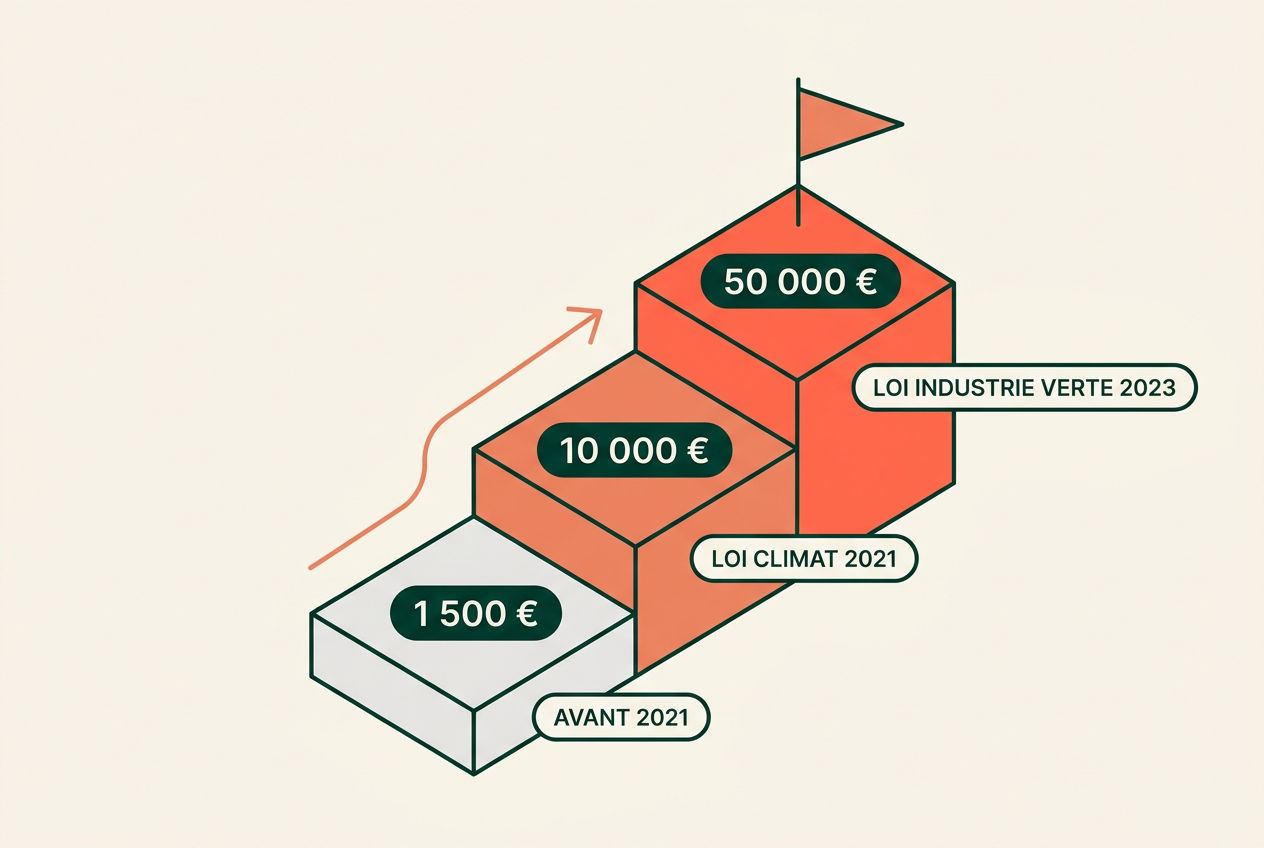
From a symbolic €1,500 until 2019 to €50,000 today (€100,000 for a repeat offence), in two successive increases. On top of this, since October 2023, companies that fail to publish can be excluded from public contracts.
Fines (€1,500 to €100,000)
- A fine of €50,000 for failing to produce or submit the report (previously €10,000 under the 2019 Energy and Climate Law, and €1,500 before that).
- €100,000 for a repeat offence.
The amount is no longer symbolic, even for a mid-cap company (ETI in French), although it is not the heaviest consequence.
Public contracts, ADEME funding and reputation
In practice, the indirect consequences weigh far more heavily than the fine:
- Exclusion from public contracts: since October 2023, a non-compliant company may be excluded from public procurement procedures, a direct commercial risk for a mid-cap company that bids for public tenders.
- Loss of public funding: since 1 June 2024, a company subject to the BEGES may receive funding under France 2030, the French government's investment plan, for an ecological transition project only if it complies with that obligation (Article 235 of the Finance Act for 2024).
- Pressure from clients: CSR platforms such as EcoVadis, rating agencies and the procurement departments of large groups increasingly check regulatory compliance, and the absence of a BEGES can cost a place on a supplier panel.
The Green Industry Law raised the BEGES fine from €10,000 to €50,000 in 2023. Yet for a mid-cap company, exclusion from public contracts and the loss of funding weigh even more heavily.
7Key takeaways
Beyond compliance, the BEGES provides the quantified basis for a climate strategy. Since the Green Industry Law, the penalties have been real, while Scope 3 is required only of companies subject to the CSRD and of public entities. The main points to remember:
- Threshold: 500 employees in metropolitan France (250 in overseas France), every 4 years in the private sector and every 3 years in the public sector. Scope 3 is mandatory for companies subject to the CSRD and for public entities.
- Expected content: at least Scopes 1 and 2 (3 scopes under the CSRD or in the public sector) plus a quantified transition plan (since the 2019 Energy and Climate Law), failing which the report is not compliant.
- Realistic cost: €15,000 to €40,000 for a full BEGES covering Scopes 1, 2 and 3. An update costs €5,000 to €15,000.
- Real penalties: €50,000 (€100,000 for a repeat offence), possible exclusion from public contracts, and loss of France 2030 funding for ecological transition projects.
- CSRD cases: since April 2025, companies subject to the CSRD have been exempt from a separate BEGES, but the Omnibus Directive has narrowed the scope of the CSRD, and some companies fall outside it while remaining subject to the BEGES.
- The transition plan gives the BEGES its value: identifying reduction levers and scheduling actions is what makes it a management tool.