
- 1Calls to boycott or refuse AI cite 5 risks, only one of which can be measured in CO2e.
- 2A year of regular AI use adds up to about 2.8 kgCO2e, or 57% of a beef meal (our calculation).
- 3With 1 generated video per day, the year rises to 15 kgCO2e, or 3 beef meals.
- 4In 2025, 48% of people in France used generative AI, and search engines have since been showing it by default.
Since late 2025, several calls have urged people to boycott or refuse AI: an op-ed with 150 signatories in the French daily Le Monde; a manifesto by teachers and researchers, which has gathered more than 3,400 signatures; and a campaign to cancel ChatGPT subscriptions. These calls to boycott generative AI cite 5 risk categories: cultural, informational, societal, environmental and civilisational, of which only one can be measured in CO2e.
The 5 risks cited in calls to boycott AI
Choose an image: what the op-ed says, a dated fact and what can or cannot be measured. The order does not indicate their severity.
Creation and copyright
What the op-ed of 18 June 2026 says
It thrives on the massive theft of data, articles and works. (our translation)
A dated fact: 20 July 2026
A federal court in California approves the settlement ending the authors' lawsuit against Anthropic: $1.5 billion for 482,460 works, or about $3,000 per work.
Federal court for the Northern District of California, Bartz v. Anthropic
What can be measured
Amounts and numbers of works, when a settlement or a court sets them.
What cannot be measured
What an imitated style is worth; the works that will not be written.
On the climate, a year of regular AI use comes to about 2.8 kgCO2e (kilograms of CO2 equivalent): a little more than half of a beef meal, according to our calculation. Giving up AI therefore does very little to reduce a person's carbon footprint; on a global scale, what matters is the growth in data centres. The other 4 risks cannot be counted in CO2e, but the calls cite them just as much.
1Calls to boycott AI: an op-ed, a manifesto and a cancellation campaign
An op-ed with 150 signatories, in June 2026
On 18 June 2026, Le Monde published an op-ed signed by 150 people, according to AFP (Agence France-Presse), including the writers Annie Ernaux and Hervé Le Tellier, the comic-book author Enki Bilal, the former French culture minister Françoise Nyssen and the biologist Marc-André Selosse.
The op-ed was initiated by Alexandre Basquin, senator for the Nord département, according to his own website, where he publishes the text. In our translation, it asks everyone who is not obliged to use generative AI to boycott it. The text also asks legislators to ration the energy resources allocated to generative AI.
A manifesto by teachers and researchers, late 2025
In late 2025, the Toulouse political ecology workshop (Atelier d'écologie politique de Toulouse, Atécopol) published a manifesto titled Face à l'IA générative, l'objection de conscience (Faced with generative AI, conscientious objection, in our translation). Its signatories, mostly from higher education, research and the French national education system, commit not to use these tools in their teaching, research or administrative work, unless expressly obliged to do so. According to La Relève et la Peste, a French news site, the manifesto had more than 1,300 signatories in early December 2025; according to the French news site Mediapart, it had more than 3,400 signatures in early July 2026. The text speaks of conscientious objection; the word "boycott" comes from press coverage.
From the 2023 call for a pause to the 2026 call for a boycott
8 milestones on a time scale: warnings, collective actions, then calls to boycott or to refuse generative AI.
18 June 2026 · Boycott or refusal
150 signatories call for a boycott in Le Monde
Writers, artists, scientists, former ministers
- Boycott or refusal
- Warning
- Collective or legal action
A cancellation campaign and a video game awards decision
In the United States, the QuitGPT campaign, organised in late January 2026, calls on people to cancel their ChatGPT subscriptions. Its organisers first criticise OpenAI for a donation by its president, Greg Brockman, to the political committee MAGA Inc., according to MIT Technology Review. They then criticise it for the agreement announced on 28 February 2026 with the US defence department, which they say could lead to mass surveillance and autonomous weapons; OpenAI states that the agreement rules out these 2 uses.
According to Euronews, the campaign claimed more than 1.5 million participants on 2 March 2026. The figure adds together cancellations, social media shares and sign-ups on its website.
Refusal also takes the form of rules. On 20 December 2025, the Indie Game Awards withdrew 2 awards from the French game Clair Obscur: Expedition 33, because the awards' rules exclude games developed with generative AI. According to Next, a French technology news site, the studio explained that the issue concerned placeholder textures, which were removed and replaced by the final textures.
2The 5 risks the calls cite, from copyright to loss of control
The calls do not all say the same thing. We sort their reasons into 5 risk categories, which the op-ed brings together in a single text. For each category, we give what the op-ed says (quoted from the text published by its initiator, in our translation), a fact, and what can and cannot be measured. The order is that of our framework and says nothing about how serious each risk is.
Cultural: creation and copyright
The op-ed says that generative AI thrives on the mass theft of data, articles and works. On 20 July 2026, a federal court in California approved the settlement ending the lawsuit brought by authors against Anthropic over the unauthorised use of their works to train its models, according to the Authors Guild, an organisation of authors. The settlement amounts to $1.5 billion for 482,460 works, or about $3,000 per work, according to the order.

Informational: errors, fakes and trust
The op-ed denounces a mush of synthetic images and deepfakes. In June 2023, a New York court sanctioned lawyers who had cited 6 court decisions that ChatGPT had invented, and Damien Charlotin's database listed, as of 3 October 2026, 2,125 decisions in which a court noted content invented by an AI. As for fakes, CNN reports that in January 2024 an employee of the engineering group Arup in Hong Kong transferred the equivalent of $25.6 million after a faked video conference.
Societal: employment and learning
The op-ed predicts millions of jobs destroyed and, among young people, weakened cognitive abilities. In US payroll records, employment among workers aged 22 to 25 in the occupations most exposed to AI is 19% lower than it would have been had it tracked employment in other occupations, according to a Stanford study (August 2026); its authors do not establish the cause.
On learning, an MIT study of 54 participants, which has not yet been peer-reviewed, observes lower brain connectivity among those who write with an assistant; the study team asks people not to read this as meaning that AI damages the brain. See AI and jobs and AI and the brain.
Environmental: energy, water, metals
The op-ed writes that the frenzy around generative AI marks a clear renunciation of the great battle of our century, ecology. It is the only one of the 5 risks that is counted in kilowatt-hours and CO2e. See all the environmental impacts of AI and the water AI consumes.
Civilisational: loss of control
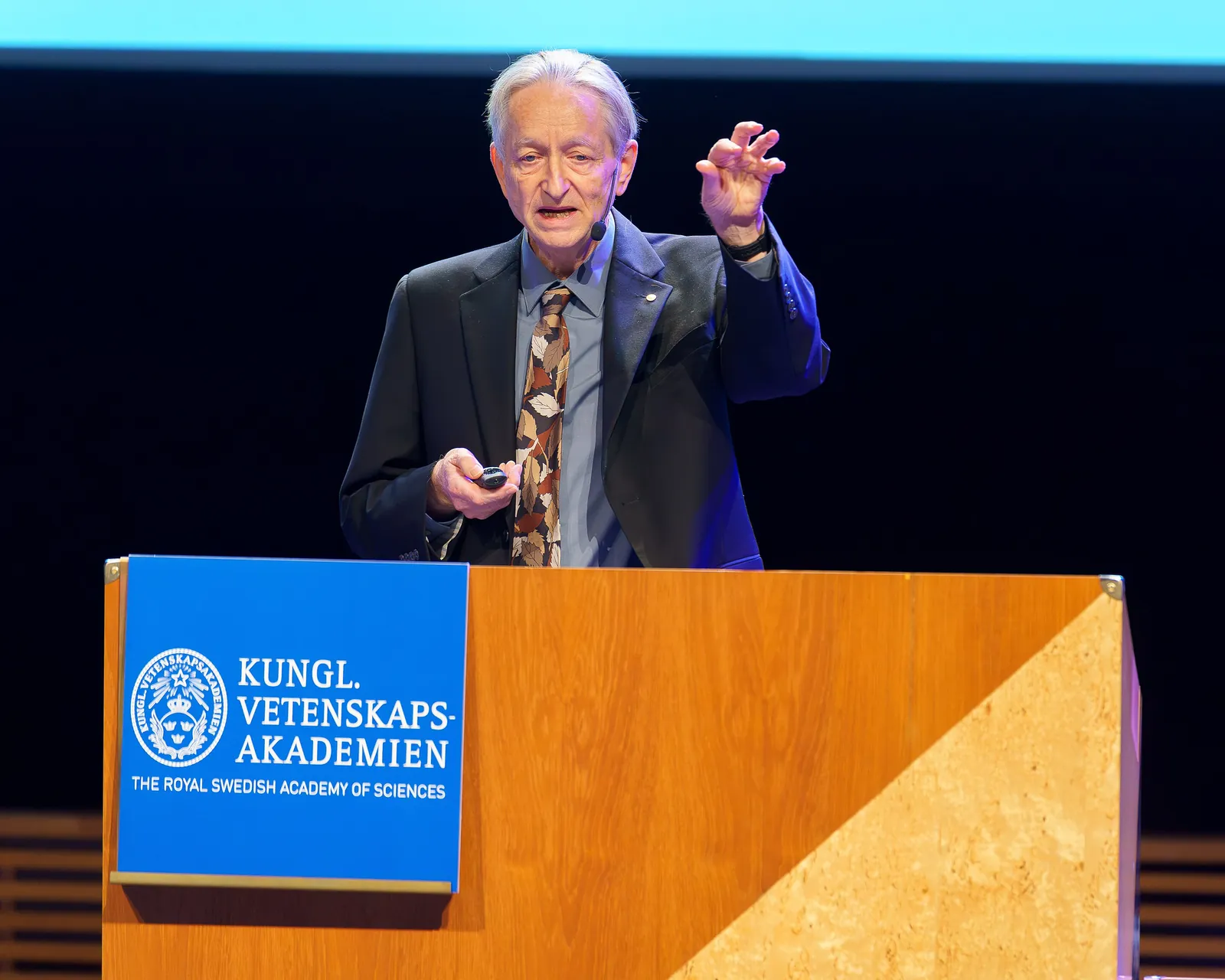
On 30 May 2023, a 22-word statement from the Center for AI Safety put the risk of extinction from AI alongside pandemics and nuclear war. The statement had more than 350 signatories, according to the New York Times, including the heads of OpenAI, Google DeepMind and Anthropic. In April 2025, Geoffrey Hinton, winner of the 2024 Nobel Prize in Physics, put the risk that AI would end up taking control from humans at between 10 and 20%, according to CBS News.
The risk of loss of control is disputed. In October 2024, Yann LeCun, Turing Award winner, then a researcher at Meta and a professor at New York University, called these fears absurd ("complete B.S.", in his words), according to TechCrunch. As early as March 2023, in response to a letter calling for a pause, the DAIR research institute, founded by Timnit Gebru, wrote that these hypothetical risks distract from the real harms of systems already deployed.
We found no mention of a risk of extinction in the text of the op-ed. It condemns a vision of society founded on the marginalisation of human beings and the destruction of our living environment.
3The environmental risk in orders of magnitude: one user, then the system
A year of regular use: a little more than half of a beef meal
For 10 questions per day, plus 5 images and 1 video of 5 seconds per week, the year comes to 2.8 kgCO2e with the global average electricity mix: 57% of the emissions of a beef meal, or those of 20 km by car, according to our calculation based on reference values from ADEME (the French Agency for Ecological Transition). It would take 725 years of this use to equal a Paris-New York return flight; see what a flight represents in a carbon budget (in French). For one person, giving up AI makes very little difference to their carbon footprint.
A year of your AI, on a scale that runs up to a Paris-New York round trip
Set your usage and see where the total falls, next to a meal, a smartphone, a car and a flight.
One year of your AI
2.8kgCO2e
That is 57% of the emissions of a beef meal, or 20 km by car.
0.03% of the annual carbon footprint of a person in France.
- Questions480 g
- Images330 g
- Videos2 kg
The full scale, from 0 to 2,060 kgCO2e
Close-up: the first 10 kg, magnified 206 times
This calculation counts only the electricity used by servers. Using the life cycle assessment figure that Mistral AI has published for one response (1.14 gCO2e, including server manufacturing), the emissions from the questions are nearly 9 times higher and the year rises to 6.5 kgCO2e, or 1.3 beef meals: the same order of magnitude. See why AI is bad for the environment, from the chip to the response, and how much energy a question put to ChatGPT uses.
Video changes the calculation
Of this total, the 52 videos account for 2.0 kgCO2e, the 3,650 questions for 0.5 and the 260 images for 0.3. With 1 video per day, the year rises to 15 kgCO2e, or 3 beef meals, of which the videos account for 14. The generator used as the reference in this series of articles is one of the most energy-hungry of those measured; with a median generator, the year of regular use falls to 1.4 kgCO2e. See the footprint of an AI-generated video and that of an image.
Depending on the assumptions, a year of AI emits between 0.34 and 15 kgCO2e
Our regular-use profile, changing one assumption at a time. In kgCO2e per year.
- With French electricity0.34kg
- With no video at all0.81kg
- With a median video generator1.4kg
- Regular use, our reference case2.8kg
- With questions counted on a life cycle basis6.5kg
- With 1 video per day15kg
At system level, consumption that could almost double by 2030
The environmental argument made in the calls is aimed at the system. The world's data centres consumed 485 TWh of electricity in 2025 (terawatt-hours, that is billions of kWh), and the International Energy Agency (IEA) expects 945 TWh in 2030. At this scale, what matters is the number of centres built, the electricity that powers them and the uses built in by default, far more than any individual user's choice. See how much electricity AI uses.
4Can a boycott of AI make a difference when AI is widely used and built in by default?
Nearly half of people in France already use generative AI
According to the Baromètre du numérique (the French digital barometer), 48% of French people aged 12 and over used generative AI in 2025, compared with 20% in 2023, and the share reached 85% among 18 to 24 year-olds. In the same survey, 46% consider that it has a greater environmental impact than a conventional search.
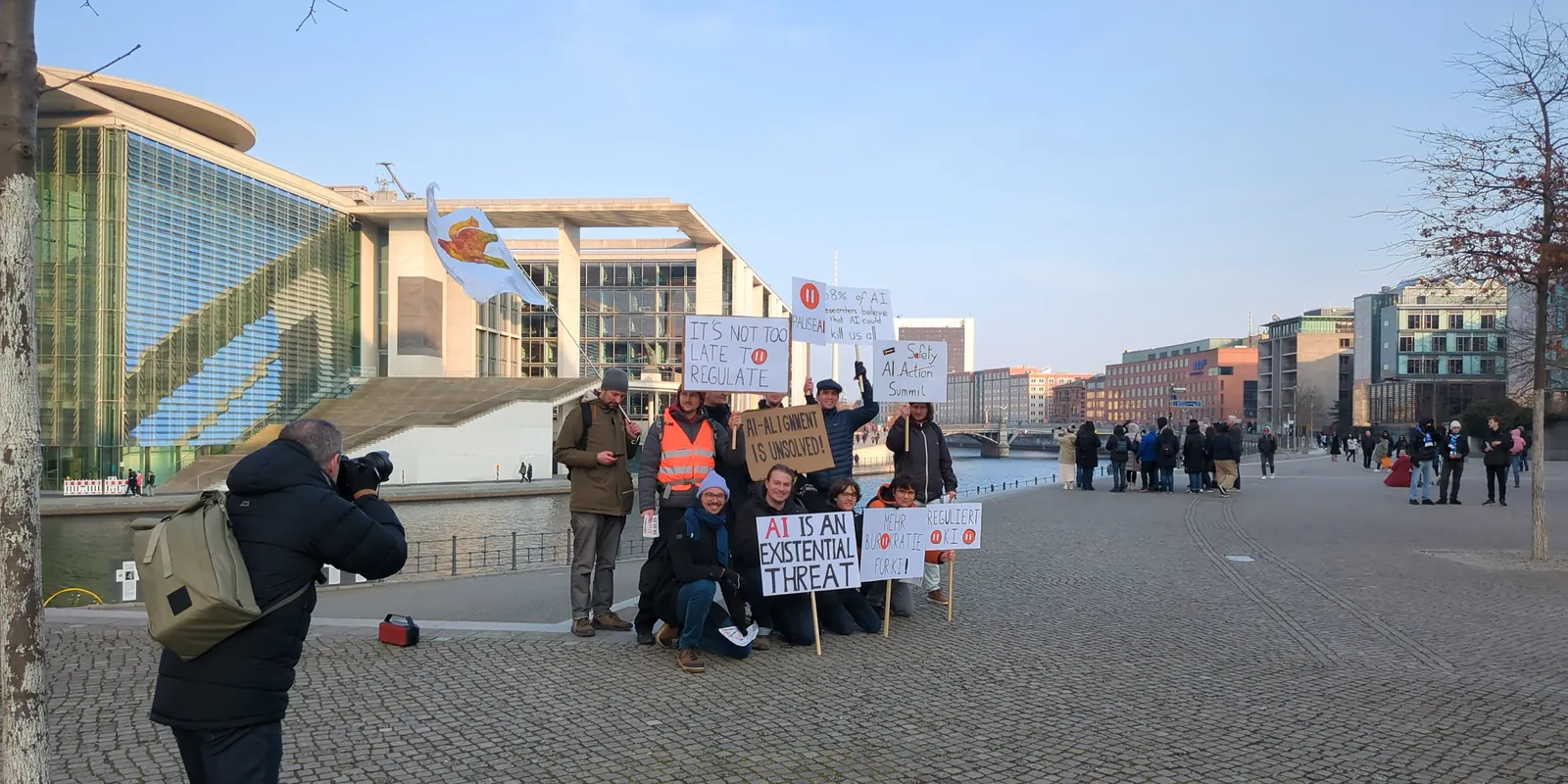
An OpinionWay poll commissioned and presented in May 2026 by CeSIA (Centre pour la sécurité de l'IA, a French organisation), and cited by the op-ed, found that 8% of French people want to speed up the development of AI in France and Europe, while 42% want to slow it down sharply or pause it temporarily.
AI built into search engines, messaging apps and software
You can do without an assistant; AI built in by default is harder to avoid. Google launched its AI Overviews in France on 22 July 2026: AI-generated answers appear in the results, and we found no setting to turn them off in its blog post.
Meta has been rolling out its assistant on WhatsApp in 41 European countries since March 2025; the Italian competition authority opened an investigation in July 2025 for suspected abuse of a dominant position, noting that the assistant had been pre-installed without users having asked for it. It closed its proceedings in May 2026 without ruling: the European Commission had extended to Italy its own investigation into a Meta rule closing WhatsApp to competing assistants. On 9 June 2026, the Commission ordered Meta to reopen that access provisionally, pending its final decision.
Microsoft included its Copilot assistant in its consumer subscriptions in January 2025, with a price increase of €30 a year in France, according to Next. According to Microsoft, a setting lets you turn it off, and existing subscribers could switch to a plan without Copilot.
What a boycott can achieve, and what it does not reach
An individual boycott sends a signal, especially when it targets a paid subscription: that is QuitGPT's bet. It does not reach AI installed by default or corporate uses. Clubic, a French technology site, notes that the general public is only one part of the market (our translation). On the climate, its direct effect is small; on the other 4 risks, it expresses a refusal that emissions figures do not measure. None of this makes a boycott useless: its effect is felt elsewhere than in a person's carbon footprint.
5Between a boycott and unlimited use: individual, professional and collective action
Between using nothing and using everything, there are 3 levels of action: individual choice, refusal within a profession and collective rules.
From individual choice to collective rule: 3 levels of action
What to expect from each level, and its limit.
Level 1Individual choice
A signal sent to vendors, especially when it targets a paid subscription.
Examples: Cancelling a subscription (QuitGPT); following the op-ed's call to users; being selective about one's usesLevel 2Refusal within one's profession
A professional standard, visible to the public: a label, a statement, award rules.
Examples: The manifesto of teachers and researchers; the rules of a video game awardsLevel 3Collective rules
Enforceable rights: not having the tool imposed, being informed, being able to object or to switch it off.
Examples: The 2023 agreement of American screenwriters; the opt-out form obtained from Meta in Europe; what the op-ed asks of legislatorsIndividual choice: boycott AI, or use it selectively
At this level, you can either boycott AI or use it selectively. In our ranking of 10 ways to reduce the impact of AI, the top 3 actions are doing without generated video, asking yourself whether AI is needed and keeping reasoning mode (where the model works through steps before answering) for difficult questions. The choice of service also matters: see which eco-friendly AI chatbot to choose.
Refusal within one's profession
The Atécopol manifesto is a professional refusal: its signatories commit to it in their teaching and research, and say so publicly. The Indie Game Awards wrote it into the rules of their awards. In France, the publisher Éditions Double Ponctuation announced in November 2024 that it was putting on its books a logo reading, in our translation, guaranteed free of artificial intelligence, according to ActuaLitté, a French publishing news site. These refusals create a norm visible to the public in settings where no employer or client imposes the tool.
Collective rules
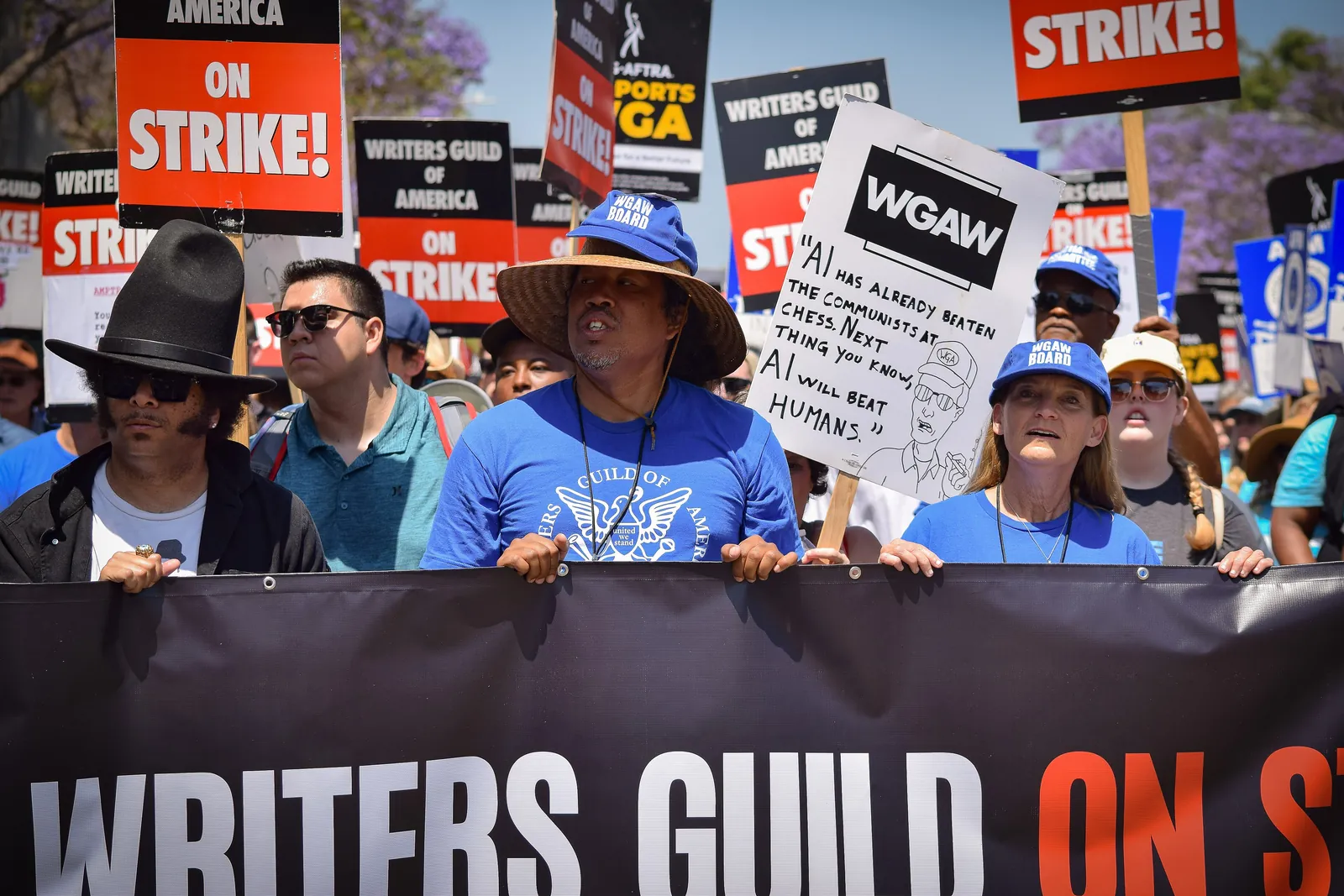
In 2023, after 148 days on strike, American screenwriters secured an agreement under which a studio cannot impose AI software on them and must tell them about any AI-generated material, according to the summary of the agreement; the next contract, in force until 1 May 2030, keeps these protections according to the Writers Guild of America. In Europe, the Irish data protection authority obtained from Meta in May 2025 a simplified objection form, ahead of the training of Meta's models on users' public posts.
In France, ADEME has asked since July 2026 for users to be able to switch off, if they wish (our translation), the generative AI functions added to existing services. For a company, the rule starts with a usage policy and a measurement: our AI footprint calculator gives an order of magnitude, and our guides explain how to count AI in your Bilan Carbone® (the French carbon accounting method) and measure the AI footprint of a company.
6Key takeaways
- Calls to boycott or refuse AI cite 5 risks: cultural, informational, societal, environmental and civilisational.
- A year of regular use comes to about 2.8 kgCO2e, a little more than half of a beef meal; video accounts for most of it.
- The other 4 risks cannot be measured in CO2e: they concern copyright, information, jobs and loss of control.
- Nearly half of French people already use generative AI, and it is arriving by default in search engines and messaging apps.
Further reading: digital pollution statistics.
- The calls: Op-ed of 18 June 2026, text published by its initiator, Alexandre Basquin, page of 19 June 2026; AFP, dispatch of 18 June 2026, read in L'essentiel; Atécopol, Face à l'IA générative, l'objection de conscience, late 2025, read in a reproduction; La Relève et la Peste, 10 December 2025; Mediapart, 5 July 2026, read in a reprint; MIT Technology Review, 10 February 2026; OpenAI, Our agreement with the Department of War, 28 February 2026; Euronews, 2 March 2026; QuitGPT website, read on 3 October 2026; Next, 22 December 2025; Future of Life Institute, Pause Giant AI Experiments, 22 March 2023, and Fortune, 29 March 2023; Variety, 10 October 2023. Many of the pages cited in this section (French media, French public bodies, the op-ed, the manifesto) are in French.
- The 5 risks: Federal court for the Northern District of California, Bartz v. Anthropic, order of 20 July 2026, and Authors Guild; SNE, SGDL and SNAC (French publishers' and authors' bodies), press release of 12 March 2025; federal court for the Southern District of New York, Mata v. Avianca, 22 June 2023; Damien Charlotin, AI Hallucination Cases Database, read on 3 October 2026; CNN, 16 May 2024, read in a reprint; Brynjolfsson, Chandar and Chen, Canaries in the Coal Mine?, revision of 12 August 2026; Kosmyna et al., Your Brain on ChatGPT, preprint, version of 31 December 2025, and the study's FAQ; Center for AI Safety, Statement on AI Risk, 30 May 2023; New York Times, read in Boston.com, 31 May 2023; MIT Technology Review, 2 May 2023; Royal Swedish Academy of Sciences, 8 October 2024; CBS News, 26 April 2025; TechCrunch, 12 October 2024; DAIR institute, 31 March 2023.
- Climate and electricity: Epoch AI, How much energy does ChatGPT use?, 2025; Luccioni, Jernite and Strubell, Power Hungry Processing, 2024; Delavande, Pierrard and Luccioni, Video Killed the Energy Budget, 2025; IEA, Electricity 2026; ADEME, Base Carbone and Impact CO2, accessed on 2 October 2026; SDES (the statistics service of the French Ministry of Ecological Transition), carbon footprint of France; Mistral AI, Our contribution to a global environmental standard for AI, 22 July 2025; IEA, Key Questions on Energy and AI, April 2026.
- Uses and rules: CRÉDOC for Arcep, Arcom, the CGE and ANCT, Baromètre du numérique, 2026 edition, p. 8, 9 and 18 (CRÉDOC is a French research centre on living conditions; Arcep is the French electronic communications regulator, Arcom the French audiovisual and digital regulator, the CGE the General Council for the Economy and ANCT the National Agency for Territorial Cohesion); CeSIA, OpinionWay poll, 6 May 2026; Google France, launch of AI Overviews, 22 July 2026; Meta, Europe, Meet Your Newest Assistant, 19 March 2025; Autorità Garante della Concorrenza e del Mercato, press release of 30 July 2025, and bulletin of 8 June 2026, decision of 19 May 2026; European Commission, press release of 9 June 2026; Microsoft, Copilot is now included in Microsoft 365 Personal and Family, 16 January 2025, and Next, 17 January 2025; Clubic, 10 July 2026; ActuaLitté, 19 November 2024; Writers Guild of America, Summary of the 2023 WGA MBA and Summary of the 2026 WGA MBA, contract in force from 2 May 2026 to 1 May 2030; Data Protection Commission, statement on Meta AI, 21 May 2025; ADEME, press release of 22 July 2026.
- Images: Opening photo: Anderseidesvik, Wikimedia Commons, CC BY-SA 4.0, cropped. Geoffrey Hinton: Jay Dixit, Wikimedia Commons, CC BY-SA 4.0, cropped. Berlin rally: C.Suthorn / cc-by-sa-4.0 / commons.wikimedia.org, cropped. Screenwriters' strike: UFCW 770, Wikimedia Commons, CC BY 2.0.