
- 13 uses to count: AI your teams use, AI inside your software, AI built into your product.
- 2Cloud AI is Scope 3 Category 1: a purchased service, not your electricity. Only self-hosted AI is Scope 2.
- 34 steps to a defensible figure: inventory the uses, choose factors, calculate a range and document it.
- 4Reduction starts with the right model: matching it to the task cuts energy use by a factor of 10 to 50.
You are building your organisation's Bilan Carbone® (the French carbon accounting method) and have reached digital uses, where one line gives you pause: AI. It covers ChatGPT, Copilot and the "smart" features appearing in every tool. The CSR (corporate social responsibility) manager's question is a fair one: is it significant, does it have to be counted, and how can it be counted without perfect data?
How much AI weighs in a Bilan Carbone®, depending on your profile
AI's share of the total footprint: almost invisible when your teams use it, dominant when it IS your product. Hover over a card to see the measurement priority.
The answer fits in one sentence: yes, it has to be included, under Scope 3 in almost every case, with the stakes depending on where AI is used in your organisation: by your teams, inside your software or at the core of your product. The overview above gives the orders of magnitude. The rest of the article covers the method: whether AI needs to be addressed, where to classify it, how to quantify it, how to reduce it and which pitfalls can sink a carbon footprint at audit. For absolute consumption figures, the energy used by a ChatGPT query gives the 2026 values.
1AI belongs in your Bilan Carbone®, and in more than one place
AI does not appear in a single place in your activity, and these 3 uses differ in both weight and accounting treatment. Telling them apart from the start avoids looking in the wrong place.
- Internal use: your teams using ChatGPT, Copilot or Gemini every day. Generally marginal (less than 1% of the footprint), but it should be documented.
- AI included in your software: the AI features already built into the tools you use every day (Copilot in Microsoft 365, your CRM, your "AI-enhanced" SaaS products), invisible on invoices and the classic blind spot when mapping your uses.
- AI in your products: if you build AI into a service you sell, inference (running a trained model to answer a query) runs each time a customer uses it. This can become a heavy emission source, falling under downstream Scope 3.
This last case is the most underestimated. For a software publisher that builds AI into its offer (an app, a platform, a data product), AI stops being an anecdotal item and should be managed as an emission source in its own right. Even where internal use is marginal, it should be documented, because it doubles every year in many organisations, the macro trajectory is rising (data centres are projected to go from ~1.5% to ~3% of global electricity between 2024 and 2030, according to the International Energy Agency (IEA)), and, if the Corporate Sustainability Reporting Directive (CSRD) applies to you, ESRS E1 (one of the European Sustainability Reporting Standards) expects a complete Scope 3 inventory; an emission source that has not been mapped cannot be brought under control.
2Cloud AI belongs in Scope 3, not Scope 2, and internal use weighs little
There are 2 separate questions, to be taken in order: how much AI weighs, then where it is classified. The second is the one that trips up the most carbon footprint assessments.
Weight: a small item for internal use
For internal use, AI generally weighs less than 1% of the Bilan Carbone® of a services company: roughly a few hundred kilograms to a few tonnes of CO2e per year for 200 employees, depending on how intensively it is used and which models are switched on (move the sliders of the calculator at the start of the article). That is a real share but a minor one: the manufacturing of workstations alone accounts for around 80 kgCO2e per employee per year, often 25 to 100 times that employee's AI use. Digital emissions are ranked by orders of magnitude (in French), and in that ranking equipment weighs far more than cloud services. The exception remains AI built into your products, which can weigh much more.
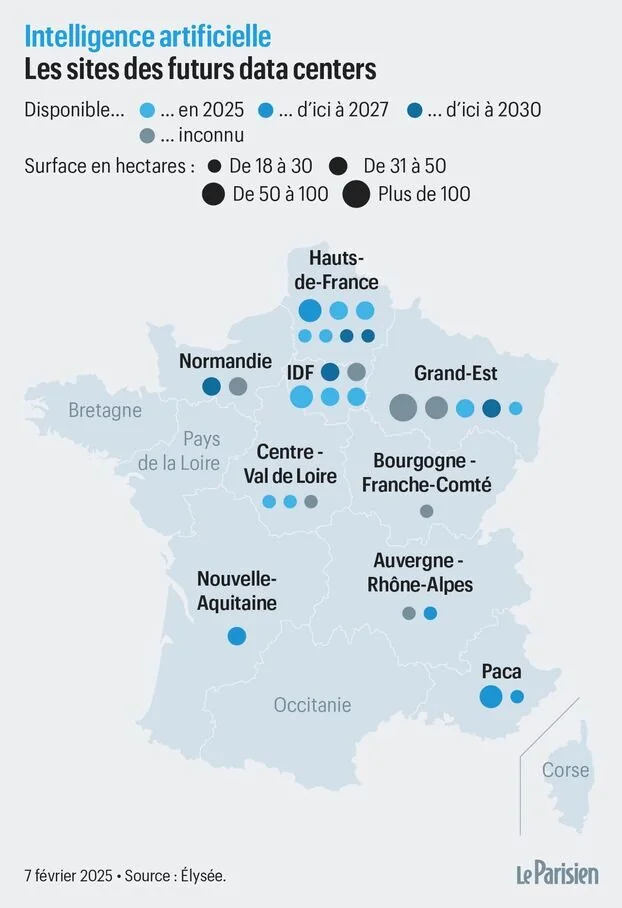
The sites identified by the Élysée (the French presidency) at the time of the AI Action Summit. For your Bilan Carbone®, this geography matters: a query served from a French data centre emits several times less CO2e than the same query served from a coal-heavy electricity mix, and the only point at which you can act on that factor is the choice of supplier and hosting region.
Classification: a purchased service, so Scope 3 Category 1
This is where many carbon footprints go wrong. AI used through a cloud service (ChatGPT, Copilot, Azure AI, Gemini) falls under Scope 3 Category 1 as defined by the GHG Protocol, not under Scope 2, because you are buying a service, not the electricity consumed in your supplier's data centres. The reasoning is exactly the same as for your cloud hosting or your SaaS products. There are 2 exceptions worth keeping in mind.
- Self-hosted AI on your own servers (an in-house Llama or Mistral): the electricity goes through your meter, so it is Scope 2, though this is still a minority case in 2026.
- AI built into a product you sell: its use by your customers falls under downstream Scope 3 (Category 11, use of sold products).
- Everything else - ChatGPT Team, Microsoft 365 Copilot, the AI in your CRM, an OpenAI API: Scope 3 Category 1, like your other purchases of digital services.
Scope 3 is not mandatory for every organisation (in French), and a footprint limited to Scopes 1 and 2 will never show AI. That is precisely what makes a complete Scope 3 valuable (in French): it picks up growing emission sources before they come as a surprise.
Where does AI belong: Scope 2 or Scope 3?
Two questions, one verdict. AI is always somewhere in your carbon footprint: the question is whether it runs at your supplier (Scope 3) or on your own machines (Scope 2) or, exceptionally, on your own fuel (Scope 1).
Where do the models you use run?
3How to calculate AI emissions: method, worked example and figures to use
AI providers disclose little about their consumption and do so poorly: only Google has published an official measurement per query (0.24 Wh median for Gemini) and only Mistral a full life cycle assessment of a model. But a Bilan Carbone® works from documented orders of magnitude, not measurements to the nearest tenth, and the V9 version of the method, in force since January 2025, specifically asks for uncertainties to be assessed item by item. 4 steps are enough to produce a defensible figure, and our AI carbon footprint calculator gives a first order of magnitude by model and by volume.
The recommended protocol: what you need to do in practice to calculate the carbon footprint of your AI
The typical process for an AI emission category covering internal use, in four steps. Click on a step to see the detail, the pitfall and the deliverable. If you would like us to carry this out for you, the Celsius consultancy is available.
AI tools used directly (ChatGPT, Claude, Gemini), bundled licences (M365 Copilot, "augmented" SaaS), API calls in your own products. Sources: invoices, IT department, a quick survey of the teams.
The pitfall: Bundled AI has no dedicated invoice line: it has to be tracked down licence by licence.
An energy value per query, tied to a specific model (0.2 to 0.4 Wh for a common model, up to 100 times more for reasoning), converted into CO₂e with the electricity mix of the data centres' region. Documented sources: ADEME, IEA, supplier publications.
The pitfall: A single "AI" factor averages out differences of 1 to 100: it cannot be defended in an audit.
Volumes × factor, on low and high assumptions. Precision to one decimal place makes no sense on a category that accounts for less than 1% of the footprint: an openly stated range is the right level of granularity.
The pitfall: False precision: an invented decimal undermines credibility more than a stated range.
Origin of each factor, date of consultation, acknowledged uncertainty, written reasoning. The Bilan Carbone® V9 method assesses uncertainties category by category, which is what makes the estimate defensible.
The pitfall: A figure with no source will not survive a verifier's first look.
A worked example
Take a services company with 200 employees, average use (25 queries per day per person) and common models: 200 × 25 × 220 working days ≈ 1.1 million queries per year. At ~0.3 Wh per query, that comes to ≈ 330 kWh, or ≈ 0.16 tCO2e with the global electricity mix, and 10 times lower if the data centres run in France. Compared with a services-sector footprint that runs to hundreds of tonnes for 100 employees (in French) (in French), this stays below 0.1% of the total. The same calculation for heavy generative use (reasoning models, long prompts, ~3 Wh per query on average) raises the item tenfold without changing its place in the ranking.
Your estimate, as an order of magnitude
Set the three parameters: your headcount, how often your teams use AI, and the electricity mix the data centres run on. The estimate then appears, to be redone with your actual volumes.
Workstation hardware and electricity weigh more than AI use: the priority for digital remains the lifespan of equipment.
Where to find the right figures
- Energy per query: this varies by a factor of more than 100 depending on the model. Use a range tied to a specific model, never a generic "AI" average. The ChatGPT, Claude and Gemini comparison gives the 2026 values.
- The electricity mix of the region where the data centres are located: ~50-60 gCO2/kWh in France against ~473 g on the global average (Ember, 2024), a gap of up to a factor of 10 for the same watt-hour.
- Volumes: logs and API invoices where they exist, otherwise a transparent proxy (active users × estimated average use).
- Official factors: the Base Empreinte® database of ADEME (the French Agency for Ecological Transition), with more than 60,000 emission factors, for everything that surrounds AI: equipment, cloud and network.
The difficulty therefore lies not in the calculation, which can perfectly well be done in-house (in French) (in French) for this emission source, but in data collection (tracking down the AI included in your software, questioning suppliers) and traceability. An auditor does not penalise a stated margin of uncertainty, but does penalise a figure plucked out of thin air or an overlooked emission source. The water footprint follows the same logic of ranges: a query consumes about 0.26 mL of water, and the real issue is where the data centres are located.
4Reducing AI emissions with usage habits rather than investment
This is often the real question behind the concern: how to bring AI down once it is in the footprint. The levers are simple and inexpensive and fall under a usage policy, not an investment.

Reducing the impact: 5 levers, from the simplest to the most structural
| Lever | Action | Reference |
|---|---|---|
| 1Question the need | Before switching on AI, check that it is needed for this use case. | Principle No. 1 of the general framework for frugal AI (AFNOR SPEC 2314, 2024). |
| 2Choose the right model | Reserve reasoning models for hard problems. A small model is enough to summarise, extract or rephrase. | ÷ 10 to 50A reasoning model can consume more than 100× as much as a small model. |
| 3Concise prompts | Fewer tokens, both in input and in output. No unnecessary context, no cosmetic follow-ups. | Energy consumed ≈ proportional to the number of tokens processed. |
| 4Monitor and set a budget | Think in terms of a carbon/energy budget for each use case. Track volumes through logs and API invoices. | ARCEP recommendation · ADEME's Base Empreinte® (60,000+ emission factors). |
| 5Engage suppliers and teams | Ask suppliers for their energy and electricity mix data. Train teams in frugal usage. | A defensible position for a Bilan Carbone® V9 or CSRD audit. |
The reference framework: frugal AI
In July 2024, France published the world's first framework on the subject, the general framework for frugal AI (AFNOR SPEC 2314 (in French), from AFNOR, France's national standards body), with 31 best-practice sheets. It defines frugal AI by three conditions: the need to use AI rather than a simpler solution has been demonstrated, practices of restraint are applied, and uses have been questioned against planetary boundaries. Frugality therefore starts before any technical measure, with common sense. For digital services, the RGESN (in French), the French general framework for the eco-design of digital services published in 2024 by Arcep (the French electronic communications regulator), Arcom (the French audiovisual and digital regulator) and ADEME, complements it with its 78 eco-design criteria, which cover AI tools.
The action that counts most: match the model to the task
A smaller model is enough to summarise, classify or draft, and uses 10 to 50 times less energy than a large one; reasoning models should be kept for problems that warrant them. The other habits are concise prompts (energy follows the volume of tokens, the units of text a model reads and writes, especially in the output), volume monitoring with an energy or carbon budget for each use case, and requesting data from suppliers: low-carbon data centre regions and emission factors by service. None of them costs a penny, and all fit into a broader reduction approach (in French) in which AI remains a small lever among large ones.
The opposite reflex would be to ban the tool, but taken individually an AI query uses as much energy as a Google search, around 0.3 Wh, and giving up a worthwhile use to save a few tens of kilograms of CO2e per year would be a poor trade-off. Restraint means choosing the model and the volume, not prohibition.
Matching the model to the task cuts the energy of a query by a factor of 10 to 50 without investment: it is the first lever for reducing the footprint of AI, ahead of any technical measure.
5Pitfalls to avoid: misclassification, hidden AI, a single factor and false precision
4 blind spots come up on almost every engagement, and a verifier will spot them at first glance.

- Putting everything in Scope 2. This is classification error No. 1: it distorts the structure of the footprint and its comparability between methods. Start from the distinction between a purchased service and electricity consumed, not from intuition.
- Forgetting the AI included in your software. M365 Copilot and the AI features of SaaS products appear on no dedicated invoice. Track them down as soon as you map your purchases by asking: "does this licence include active AI, and for how many people?"
- Applying a single "AI" factor. Between a light model and a reasoning model, the gap exceeds a factor of 100, so an average factor for "AI" in general does not stand up to scrutiny.
- Aiming for false precision. A figure to the nearest tenth on an emission source below 1% of the footprint is a waste of time, and a documented range is worth more than an invented decimal.
In our experience at Projet Celsius, the fourth pitfall is the most widespread: teams spend days chasing the decimal of an AI emission source worth 0.05% of the footprint, while purchases, which often weigh 60% of it, are left waiting. AI should be documented properly, and attention then moves to the sources that count.
6Key takeaways
- 3 uses to tell apart: internal use by teams (marginal), AI included in your software (the blind spot), AI built into your products (potentially heavy, under downstream Scope 3).
- Cloud AI use falls under Scope 3 Category 1, not Scope 2: you are buying a service. Only self-hosted AI moves to Scope 2.
- The method comes down to 4 steps: inventory the uses, choose factors by model, calculate a range and document the assumptions.
- The orders of magnitude are set out: ~0.3 Wh per typical query, less than 1% of a services company's footprint, and a workstation that often weighs 25 to 100 times more than the same employee's AI use.
- Reduction starts before any technical measure: match the model to the task (10 to 50 times less energy), use concise prompts, monitor volumes and engage suppliers. This is the logic of frugal AI.
Classifying AI correctly, quantifying it and reducing it costs little when it is done in time, and the approach fits within the general framework of a first Bilan Carbone®: boundary, emission sources, method. To budget for a complete carbon footprint, the 2026 price ranges in France (in French) give a benchmark, and for the rest of digital, mapping a company's digital carbon footprint is the right starting point.