
- 1More than 1,000 employees and €450 million turnover: post-Omnibus CSRD thresholds exclude all SMEs from direct scope.
- 2VSME, with around a hundred indicators, structures responses and caps covered clients' requests for financial years from 2027.
- 3Bilan Carbone® covering Scopes 1-2-3 is the first data requested in supplier ESG questionnaires.
- 4Diag Décarbon'Action finances 40% of a €10,000 excl. VAT project: company contribution €6,000 excl. VAT.
The Corporate Sustainability Reporting Directive (CSRD) has been substantially reworked in 18 months. The Omnibus Directive raised the thresholds and exempted listed small and medium-sized enterprises (SMEs), while the standards revision removed around 60% of mandatory data points. Meanwhile, environmental, social and governance (ESG) questionnaires continue to circulate among suppliers.
Outside the scope of the CSRD, still approached by your clients
3 steps to see where your SME stands since the Omnibus Directive, which entered into force on 18 March 2026.
This guide is for SME and mid-cap company (ETI in French) leaders: what applies to their business in autumn 2026, the order in which to act and the budget required.
1How the CSRD framework changed
The CSRD (Corporate Sustainability Reporting Directive) was adopted in 2022 to replace the previous Non-Financial Reporting Directive (NFRD). It was intended to require European companies to publish a sustainability statement structured around the European Sustainability Reporting Standards (ESRS) developed by EFRAG (the European Financial Reporting Advisory Group), audited by an independent third party and covering climate, social matters, governance and the business model.
NFRD vs CSRD: what changes
| Criterion | NFRD (Non-Financial Reporting Directive) | CSRD (Corporate Sustainability Reporting Directive) |
|---|---|---|
| Coverage | 11,000 EU companies | About 10,000 since the Omnibus (50,000 planned) |
| Standards | No binding standard | European Sustainability Reporting Standards (ESRS), revised in 2026 |
| Audit | No requirement | Third-party verification |
| Climate scope | Non-standardised GHG | Scopes 1, 2 and 3 (ESRS E1) |
| Double materiality | Not required | Mandatory |
| Format | Free-form | Tagged XHTML (European Single Electronic Format, ESEF) |
The framework was intended to apply in waves: large listed companies from 2025, large unlisted companies in 2026 and listed SMEs in 2027. Consultancies organised their services, companies launched double materiality assessments and ESG software publishers raised funds.
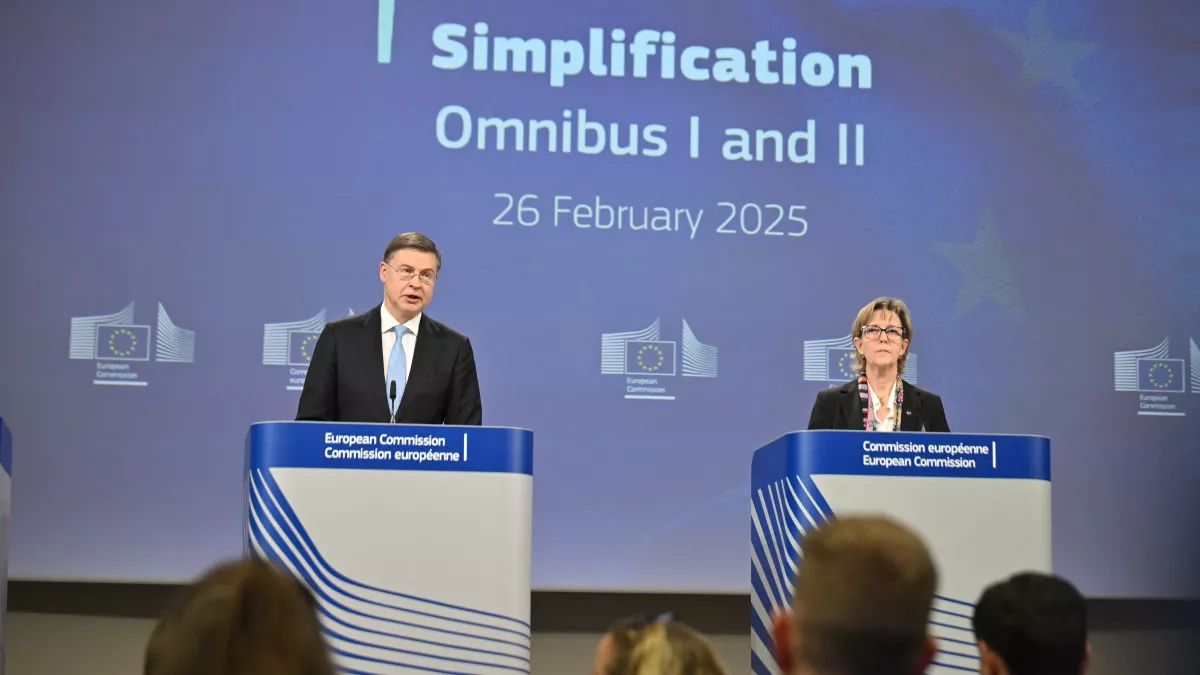
The political context then changed. In April 2025, the stop-the-clock Directive (EU 2025/794) postponed application by 2 years for waves 2 and 3. Then came the Omnibus Directive: political agreement in December 2025, formal adoption by the Council on 24 February 2026 and entry into force on 18 March 2026. It changes the substance as well as the timeline: significantly higher thresholds, around 60% fewer mandatory data points, abandoned sector-specific standards and complete exemption for listed SMEs, which were to form wave 3.
The technical implementation of this simplification, the delegated act revising the ESRS, was adopted by the Commission on 3 July 2026 (more than 60% fewer mandatory data points). It was published in the Official Journal of the European Union on 21 September 2026 (Delegated Regulation (EU) 2026/1563) and applies to financial years beginning on or after 1 January 2027. Meanwhile, on 23 July 2026, EFRAG opened a 100-day public consultation on N-ESRS standards for non-EU companies (Article 40a), which closed on 31 October 2026.
The number of companies directly in scope therefore falls from around 50,000 to around 10,000 in the EU, making CSRD articles published in 2024 largely out of date.
What the CSRD requires of companies in scope
- A prescribed framework, the ESRS, whereas the NFRD let every company choose its format
- Independent third-party verification of the statement, replacing self-reporting
- A climate component covering Scopes 1, 2 and 3, with a full Bilan Carbone® (the French carbon accounting method) and a reduction pathway under the Greenhouse Gas Protocol (GHG Protocol) or an equivalent method
- A double materiality assessment identifying the issues on which the company has a significant impact and those affecting its economic activity
- A statement tagged in eXtensible Business Reporting Language (XBRL) for the EU's European Single Access Point (ESAP), rather than a PDF with no prescribed format
2Who remains in scope and who no longer is
With Omnibus, the scope question has become simpler to resolve.
Omnibus: what changes for SMEs
| Change | Before | After Omnibus |
|---|---|---|
| Thresholds | 2 of 3 criteria: 250 employees, €50 million turnover, €25 million balance sheet total | More than 1,000 employees and €450 million turnover |
| Listed SMEs | Included in 2027 | Exempt |
| ESRS datapoints | About 1,200 | About 60% fewer |
| Sector-specific standards | Planned for 2026 | Abandoned |
- Before Omnibus: 250 employees, €50 million turnover and a €25 million balance sheet total (exceeding 2 of these 3 thresholds was enough)
- After Omnibus: more than 1,000 employees and €450 million turnover (cumulative criteria: you must exceed both)
- Listed SMEs: initially in scope in 2027, now exempt from mandatory reporting
- Mandatory ESRS data points: around 60% fewer than in the initial framework (around 1,200 indicators)
- Sector-specific standards: abandoned
A company with 250 employees and €40 million in turnover is therefore outside the mandatory scope. It remains indirectly affected, and this exposure often has the greatest impact, as the rest of the article shows.
3The cascade effect: why SMEs are still affected
Omnibus removed more than 80% of companies from mandatory scope. Those still covered, however, are Europe's largest and have thousands of SME suppliers in their value chains.
Why your SME is still affected, even outside the mandatory scope
After Omnibus, ~10,000 companies remain within the mandatory scope. The cascade to suppliers has stayed the same.
The mandatory scope has lost about 80% of companies, but the pressure on suppliers remains the same.
The mechanism in 3 stages
- First, large companies subject to the CSRD must document their Scope 3 (in French), meaning indirect value chain emissions
- Next, as a large group's Scope 3 includes its suppliers' Scopes 1 and 2, its procurement teams turn to SME suppliers for carbon and ESG data
- Finally, ESG criteria enter supplier selection frameworks, sometimes as an exclusion criterion
In practice, we have seen supplier ESG questionnaires multiply since 2024. If you are an SME with 150, 200 or 300 employees and your main customers are large groups, you already receive, or will soon receive, requests for carbon and ESG data. Having no structured data becomes a commercial risk: we see companies lose points in tenders and sometimes simply be excluded from the supplier panel. Our dedicated guide explains the orders of magnitude (in French) involved.
Supplier ESG reporting: what your customers expect
In practice, the ESG report your clients request usually comes down to 3 elements: a Bilan Carbone® covering Scopes 1-2-3 (the data requested first), a social overview (headcount, workplace accidents and training (in French)) and a formal environmental policy. There is no need to aim for the hundreds of ESRS data points: the Voluntary Sustainability Reporting Standard for SMEs (VSME) organises this information into around a hundred indicators, and the voluntary standard derived from it will cap requests from your clients subject to the CSRD for financial years from 2027.
For an SME, pressure now comes more from customers' procurement teams than the regulator, and they are not waiting for Omnibus transposition to send their questionnaires.
An SME outside the CSRD's scope remains exposed through questionnaires from customers subject to it.
4VSME: the framework for responding to clients
The VSME (Voluntary Sustainability Reporting Standard for SMEs) was developed by EFRAG, the organisation that designed the ESRS. It is a simplified reporting framework for companies outside direct scope that must respond to value chain requests. The Commission incorporated it into a voluntary standard adopted on 3 July 2026 and published in the Official Journal of the European Union on 21 September 2026 (Delegated Regulation (EU) 2026/1560).
VSME or ESRS: the difference for an SME
About 4 times fewer datapoints, no audit, a few weeks instead of several months
From financial year 2027, the Omnibus value chain cap will allow companies with at most 1,000 employees to refuse requests that go beyond the voluntary standard derived from the VSME.
What the VSME contains
- A basic module of 11 disclosure requirements covering the essentials of supplier questionnaires
- A comprehensive module with 9 additional requirements for SMEs wanting to go further
- No mandatory third-party verification, unlike the ESRS
- Around a hundred data points, compared with around 400 for the full ESRS
- A quality or corporate social responsibility (CSR) manager can complete the basic module in a few weeks
The value chain cap
This is a little-known aspect of Omnibus. The text introduces a value chain cap: for their sustainability reporting, companies subject to the CSRD will not be able to require suppliers with at most 1,000 employees to provide information beyond the voluntary standard derived from the VSME, and these suppliers may refuse to provide it. The cap will apply to financial years beginning on or after 1 January 2027 once Omnibus is transposed (by 19 March 2027 at the latest).
Until now, every client could send its own questionnaire, sometimes asking far more than an SME can produce. From financial years 2027, a company with 200 employees whose customer is subject to the CSRD and requests a full ESRS statement may limit its response to the voluntary standard and refuse the rest. Until then, the VSME remains the best basis for negotiating questionnaire contents.
How far adoption has progressed
In an EFRAG survey published in December 2025 (282 respondents), 43% of responding companies producing a report said they had applied the VSME in full, and 67% of users (banks and large groups) said they had begun using it as a framework for collecting counterparty data. The VSME is becoming the reference framework for sustainability reporting in the value chain.
For financial years from 2027, a company with at most 1,000 employees may refuse requests from customers subject to the CSRD if those requests exceed the voluntary standard.
5Timeline, costs and funding
The timeline published in 2024 has been completely revised. The timeline applicable in September 2026 is set out below, followed by budgets for each profile.
CSRD milestones, status as of September 2026
Filter by status. The new thresholds must still be transposed by each Member State, no later than 19 March 2027.
The current timeline
- 2025: wave 1, large listed companies (formerly under the NFRD) publish their first CSRD statement on 2024 data
- April 2025: stop-the-clock Directive (EU 2025/794), a 2-year delay for waves 2 and 3
- 18 March 2026: Omnibus Directive enters into force, new thresholds (1,000 employees + €450 million turnover)
- 21 September 2026: publication in the Official Journal of the European Union of the voluntary standard derived from the VSME (Delegated Regulation (EU) 2026/1560)
- 21 September 2026: publication in the Official Journal of the European Union of the revised, simplified ESRS
- 19 March 2027: national Omnibus transposition deadline
- 2028: wave 2, large companies (more than 1,000 employees and €450 million turnover) publish their statement on 2027 data
For SMEs outside scope but affected by the cascade effect, the relevant deadline is that of their clients' questionnaires, and many already receive them.
What it costs for an SME: a VSME response
- Bilan Carbone® (in French) covering Scopes 1-2-3: €10,000 to €30,000 excl. VAT depending on complexity, for the data your customers prioritise
- ESG data collection (social matters, governance and environmental policy): €3,000 to €8,000
- Structuring VSME reporting: €0 to €7,000 (some SMEs do this in-house with a good CSR manager)
- Total in the first year: €13,000 to €45,000, then €5,000 to €12,000 per year for updates
For a large company directly in scope
The all-inclusive budget in year 1 is €45,000 to €105,000 (a full Bilan Carbone® (in French) €15k-€30k, double materiality €10k-€25k, ESRS structuring €15k-€35k and third-party audit €5k-€15k). The budget is 40 to 60% lower in subsequent years. For mid-cap companies subject to the French mandatory greenhouse gas emissions report (BEGES), some of the work can be shared with the French regulatory declaration.
Funding programmes to check
Bpifrance's Diag Décarbon'Action (carbon footprint programme, in French) finances 40% of the Bilan Carbone® for SMEs and mid-cap companies with fewer than 500 employees (company contribution: €6,000 excl. VAT on a €10,000 excl. VAT flat fee). Bpifrance is the French public investment bank. This is the first programme to check before budgeting. ADEME (the French Agency for Ecological Transition) then subsidises climate strategy through ACT Pas à Pas (in French), at a rate depending on company size. Every region also has complementary programmes that may be combined with this national funding.
The post-Omnibus CSRD in 4 figures
The changes introduced by the Omnibus Directive for companies, without detailing what it left unchanged (supplier pressure, scope 3, funders' expectations).
6Where to start: the checklist by company profile
We recommend the following sequence for your situation, with a realistic schedule.
Prepare a first CSRD report in 5 steps
For companies with more than 1,000 employees and €450 million turnover: an SME responding to its customers uses the VSME alone. Click a step to see deliverables, advice and a typical obstacle.
SME outside scope: fewer than 1,000 employees
- Month 0: identify clients subject to the CSRD, meaning your customers with more than 1,000 employees, who will request data
- Months 1 to 3: start a Bilan Carbone® covering Scopes 1-2-3, the first data requested. Through Diag Décarbon'Action (in French), the company contribution falls to €6,000 excl. VAT
- Months 2 to 4: collect basic ESG data (social matters, governance and environmental policy), the VSME basic module
- Months 4 and 5: structure your VSME reporting, identify missing data and plan collection
- Continuously: respond to supplier questionnaires using the VSME framework and invoke the value chain cap once it applies (financial years from 2027)
Do not aim for perfection in the first reporting year. An honest VSME report showing the available data, missing data and the plan to obtain them will be more useful to your customers than a complete report delivered in 2 years.
Large company directly in scope: 1,000+ employees and €450 million+ turnover
- Months 1 to 3: Bilan Carbone® covering Scopes 1-2-3 with structured data collection
- Months 3 to 5: double materiality assessment to identify relevant issues
- Months 5 to 8: structure the ESRS statement and reduction (in French) pathway. If you are also subject to the BEGES, this is the point to combine work for the two declarations
- From month 9: independent third-party verification
- We recommend starting in 2026 with a dry run using 2026 data, before the mandatory statement on 2027 data: starting the project in 2027 leaves 12 months for work requiring 18
7Key takeaways
Since Omnibus, SMEs are no longer directly subject to the CSRD, but the cascade effect reaches them through supplier questionnaires. Europe has provided a proportionate framework, the VSME, and a cap on customer requests applying for financial years from 2027. Other mandatory or voluntary product frameworks are emerging alongside it (environmental labelling (in French), the Digital Product Passport (DPP) (in French) and the Ecodesign for Sustainable Products Regulation (ESPR) (in French)), and the CSRD is only part of the climate regulatory framework.
- Since Omnibus, the CSRD covers companies with more than 1,000 employees and €450 million turnover (cumulative criteria). Below this, there is no direct obligation (in French), but your covered customers will request data
- The VSME contains around a hundred data points, and for financial years from 2027 your clients subject to the CSRD will not be able to require more for their reporting
- Bilan Carbone® covering Scopes 1-2-3 is the first data requested in ESG questionnaires: start here
- Diag Décarbon'Action finances 40% of the assessment for companies with fewer than 500 employees (company contribution €6,000 excl. VAT): this is the funding to activate first
SMEs that structured their data from 2025 already use them in tender responses, whereas those waiting until 2027 will have to catch up under pressure from their customers.
Sources: Omnibus Directive (EU) 2026/470, stop-the-clock Directive (EU 2025/794), EFRAG, VSME standard (December 2024), Delegated Regulations (EU) 2026/1560 (voluntary standard) and 2026/1563 (revised ESRS), CSRD text (EU 2022/2464).