

- 1Five categories, five regimes (portable, LMT, industrial, SLI, EV): the 2 kWh threshold is decisive.
- 2The European assembler bears declaration responsibility, rather than the cell manufacturer: importing a pack makes you responsible.
- 3Supplier data are the bottleneck: allow 8 to 12 weeks for a usable dataset.
- 4EV footprint: late 2027 earliest, delegated act still pending; battery DPP February 2027, recycling 2028.
Regulation (EU) 2023/1542 replaces Directive 2006/66/EC and follows the battery from raw material extraction to end of life. Its obligations depend on the battery category (5 in total) and the company's role: manufacturer, importer, distributor or assembler.
The principle is simple: no battery can enter the European market without a verified environmental identity record. Seven obligations surround the pack, and each category (portable, SLI, LMT, EV traction and industrial > 2 kWh) follows its own timeline, based on end use rather than chemistry. To go further: the battery carbon footprint declaration (in French), the Digital Product Passport (DPP) (in French) or the ESPR-DPP-batteries 2025-2030 map (in French).
- Carbon footprint - verified declaration, Feb. 2025-2028
- Digital passport (DPP) - mandatory QR code, Feb. 2027
- Recycled content - thresholds in 2031, then 2036
- Due diligence - supply chain, August 2025
- Performance & durability - minimum thresholds by use
- Collection & recycling - extended producer responsibility
- Labelling - QR + harmonised symbols
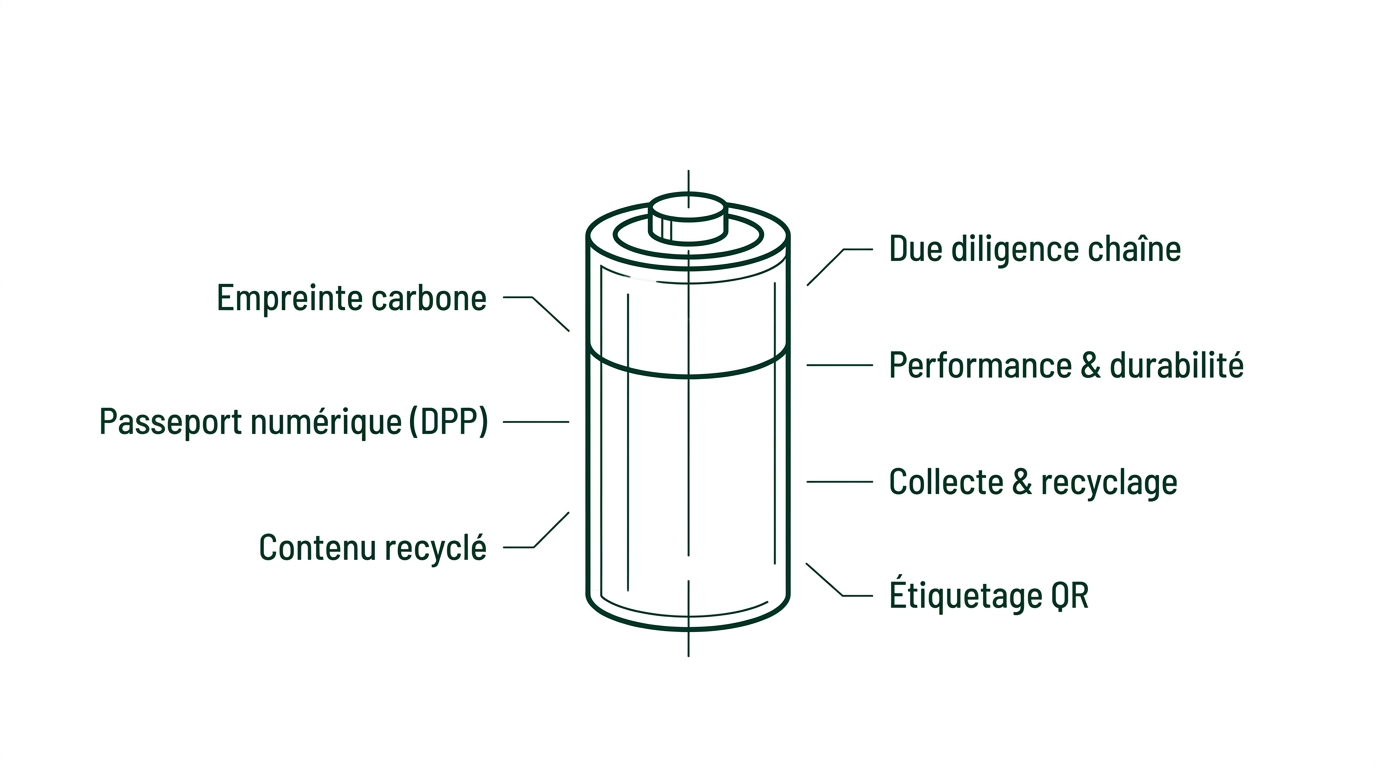
The six key obligations are then explained individually: carbon footprint, digital passport, recycled content, due diligence, performance and collection, with their actual deadlines and operational pitfalls. The full 2024-2036 timeline is summarised at the end of the article, followed by a five-step roadmap to get started. In 12 minutes of reading, you will have a full view of the framework and the practical understanding needed to start achieving compliance.
1What exactly is the EU Battery Regulation?
Regulation (EU) 2023/1542 entered into force on 17 August 2023. It is a regulation rather than a directive, meaning it applies directly in the 27 Member States without national transposition. There is no scope for local interpretation or need to wait for a French decree. The text applies as it stands.
From a waste directive to a life cycle regulation
Switch between the old and new frameworks to see the change in scope.
- 5 categories, from portable to electric vehicle
- Carbon footprint, recycled content, due diligence
- Digital passport + collection + performance
It replaces Directive 2006/66/EC on batteries and accumulators, which was almost 20 years old and covered neither electric vehicle (EV) batteries, industrial storage systems nor carbon footprint or raw material traceability issues. The change is substantial: a framework focused on collection and recycling becomes a regulation covering the entire life cycle (in French).
In summary, the regulation requires a carbon footprint declaration (in French), a Digital Product Passport (DPP) (in French), performance and durability requirements, a minimum recycled content level, due diligence on sensitive materials and collection and recycling targets. All follow a phased application timeline: some obligations are already in force, while others will start applying at different points up to 2036.
The text contains 117 articles. Delegated implementing acts are being introduced progressively, and some deadlines have already been revised (Regulation 2025/1561 postponed due diligence by two years). The text continues to evolve, which is precisely why it is difficult to follow without an up-to-date guide.
2The 5 battery categories
The first step when approaching this regulation is to identify your category. Obligations differ between categories, and a single manufacturer may fall under several.
Five battery categories, five sets of requirements
Click your category. The key rule: end use determines battery classification, rather than chemistry.
The broadest category. The 2 kWh threshold activates the full regime: carbon, passport, recycled content.
For industrial and light mobility batteries, everything changes at 2 kWh. Below this, a lighter regime. Above it, the full regime applies: carbon footprint, digital passport, recycled content.
- Portable (primary cells, rechargeable cells and portable tools): sealed, below 5 kg. No carbon footprint or DPP obligation, but 63% collection by the end of 2027 and user removability from February 2027.
- LMT, light means of transport (e-scooters, e-bikes and scooters): electrically powered vehicles below 25 km/h or not approved for road use. Carbon footprint from August 2028, DPP if capacity exceeds 2 kWh.
- Industrial (stationary storage, machinery, maritime applications, telecoms and uninterruptible power supplies, UPS): above 5 kg or designed for industrial use. Carbon footprint declaration for rechargeable batteries above 2 kWh 18 months after the delegated act defining its methodology, still awaited; DPP in February 2027. This is the broadest and most heterogeneous category.
- SLI, starting, lighting and ignition (car and truck starter batteries): recycled content and labelling, but no DPP or carbon footprint.
- EV, electric vehicles (cars and vans): the most demanding regime. Carbon footprint: the Joint Research Centre's (JRC) CFB-EV methodology awaits formal adoption of the delegated act (the obligation takes effect 12 months after its entry into force, late 2027 at the earliest), DPP in February 2027 and a maximum threshold from February 2028 at the earliest.
The 2 kWh threshold is critical for industrial batteries: below it, most of the demanding obligations (carbon footprint and DPP) do not apply. Above it, the full regime takes effect.
One point that often surprises manufacturers: categorisation depends on end use, rather than technology. The same cell chemistry (nickel manganese cobalt, NMC, or lithium iron phosphate, LFP) can produce an industrial or EV battery depending on the product into which it is incorporated.
3Who is responsible for the declaration
This point causes the most confusion and the greatest delays in compliance projects.
Who is the declarant in the battery supply chain?
Four links, two declarants. Filter by role or click a link to see the details.
Receives the cells and assembles a finished battery pack in Europe.
Carbon footprint, recycled content, due diligence, digital product passport (DPP).
The entity that places the product on the European market bears the obligations, regardless of its address or the chemistry.
The regulation assigns declaration responsibility to the economic operator placing the battery on the European market. In practice, this is the entity marketing the final product containing the battery, rather than the cell manufacturer.
A practical example: your company assembles energy storage systems using cells bought from a Chinese manufacturer (CATL, EVE Energy or BYD). You incorporate these cells into modules, add a battery management system (BMS), enclosure and cooling system, then sell the complete system to European customers. In this case:
- You must produce the carbon footprint declaration.
- You must create the digital passport.
- You must obtain, verify and format your cell supplier's data.
If you assemble batteries using purchased cells, you are responsible for the declaration, rather than your cell supplier. This is the regulation's most common and costly source of confusion.
Your cell supplier has no direct obligation under the European regulation if it does not sell directly on the EU market. However, you need its data to fulfil your obligations. Obtaining those data, such as the exact cathode chemistry, factory electricity mix and geographical origin of materials, takes weeks, sometimes months. It is the number one bottleneck in achieving compliance.
If you import finished batteries without assembling them yourself, the importer bears responsibility. If you distribute batteries without importing or manufacturing them, obligations are lighter, but you must check that the manufacturer or importer has fulfilled its own obligations.

4The key obligations, one by one
We now reach the substance of the framework. You do not need to remember everything at once: what matters is identifying which obligations apply to your category and when they take effect. The six pillars are connected: the carbon footprint feeds the digital passport, and due diligence overlaps with recycled content, but each has its own logic.
What recycled material content, by which date?
Click a material. Shared 0-100% scale. The vertical 85% marker shows the level of a mature recycling sector (lead).
Before 2028: mandatory declaration of recycled content, with no minimum threshold.
Almost non-existent in Europe today. Reaching 6% in 2031 requires several hydrometallurgical recycling plants to enter service.
Lead is already at 85%. Cobalt is on track. The main challenges are nickel and lithium : to reach 6% in 2031, European recycling plants must be operating by then.
Carbon footprint (Article 7)
This is the foundational obligation underpinning everything else. It concerns manufacturers and those placing EV batteries, rechargeable industrial batteries above 2 kWh and LMT batteries on the market.
It is a carbon footprint declaration covering the entire life cycle, calculated using the methodology developed by the JRC (the European Commission's Joint Research Centre). The footprint is expressed in kgCO2e per kWh of total energy delivered by the battery over its lifetime (Annex II to the regulation). To understand this method's place in the wider DPP framework, see our explanation of which method to use to calculate a DPP (in French).
Timeline: for EV batteries, the declaration was initially due to apply from February 2025, but the methodological delegated act (the JRC's CFB-EV rules) had not been formally adopted as of 20 July 2026. The obligation will apply 12 months after its entry into force, meaning late 2027 at the earliest. Industrial batteries above 2 kWh follow, initially from February 2026 but aligned with the delegated act's delay. LMT batteries: from August 2028.
The declaration must be verified by a third-party notified body. This requires external verification rather than self-declaration.
To give an indication of the scale: according to Nature Communications (2024), the median footprint of an NMC811 battery ranges from 64 kgCO2e/kWh in Sweden to 105 in China, for identical chemistry. The electricity mix in the cell manufacturing country remains by far the largest impact factor, ahead of the chemistry itself.
Carbon footprint performance classes and maximum threshold
Labelling follows the declaration. The regulation provides for carbon footprint performance classes, following the A-G model used for household appliances. A maximum carbon footprint threshold then applies to EV batteries from 2028. The highest-carbon batteries will be prohibited from the European market. This threshold has not yet been set by delegated act, but the industrial signal is clear: it will reshape the supplier landscape.
Digital passport / DPP (Article 77)
This concerns industrial batteries above 2 kWh, EV batteries and all LMT batteries. It is mandatory from 18 February 2027. It is the first mandatory DPP (in French) across all products in the EU.
There is a unique identifier accessible through a quick response (QR) code on the physical battery. The passport must contain around 80 data fields organised into 7 categories:
- Identification: model, manufacturer, date and category
- Compliance: CE marking and certifications
- Carbon footprint: kg CO2e/kWh and performance class
- Due diligence: sensitive material traceability (from August 2027)
- Composition: chemistry, recycled content levels and hazardous substances
- Circularity: expected lifetime, dismantlability and recyclability
- Performance: rated capacity, voltage, cycle endurance and state of health
Access to data varies: some information is public, while other information is reserved for repairers, recyclers or regulators.
The Battery Pass consortium has published technical reference guides for implementation. DIN DKE SPEC 99100 (January 2025) defines the structured attributes. Follow it closely if you work in the sector.
Recycled content (Article 8)
The regulation requires a minimum level of recycled materials in new batteries, with a phased timeline:
- August 2028: mandatory declaration of recycled cobalt, lead, lithium and nickel levels
- August 2031, phase 1 thresholds: 16% cobalt, 85% lead, 6% lithium and 6% nickel
- August 2036, reinforced thresholds: 26% cobalt, 85% lead, 12% lithium and 15% nickel
These thresholds require an operational European recycling sector, which is under development but remains fragile. Lead is already widely recycled, making 85% achievable. For lithium and nickel, the recycling industry still needs to scale up.
Supply chain due diligence
The regulation requires due diligence on sensitive materials: cobalt, lithium, nickel and natural graphite. It concerns operators placing batteries on the market, except those with net turnover below €40 million that do not belong to a group exceeding this threshold.
The initial August 2025 deadline was postponed by two years through Regulation 2025/1561 (stop the clock). The new date is 18 August 2027. The same regulation gave the Commission until 26 July 2026 to publish its guidelines.
In practice:
- Mapping the supply chain
- Risk assessment: environmental, social and human rights risks
- Mitigation plan and third-party audit
- Annual public report
Performance and durability (Article 9)
The regulation imposes performance requirements: rated capacity, internal resistance, cycle endurance and self-discharge. Delegated acts setting minimum thresholds are still being prepared, prioritising EV batteries, then industrial and LMT batteries.
Dismantlability obligation: industrial batteries must be dismantlable and replaceable by an independent professional. Portable batteries must be removable by the end-user from February 2027.
Collection and recycling
- Portable: 63% by the end of 2027
- LMT: 51% by the end of 2028, then 61% by the end of 2031
- Industrial, SLI and EV: no numerical target, but adequate collection systems are mandatory
Material recovery targets: phase 1 (end of 2027), 90% for cobalt, copper, lead and nickel, and 50% for lithium. Phase 2 (end of 2031), 95% for cobalt, copper, lead and nickel, and 80% for lithium.
5The full 2024-2036 timeline
The regulation's timeline spans more than twelve years, but three milestones define its phases: 2026 remains a waiting year, as the carbon footprint delegated acts have not been adopted; 2027 is the pivotal year, with the simultaneous arrival of the DPP, due diligence and collection targets; and 2028-2036 brings progressive tightening through maximum carbon thresholds and recycled content levels.
Battery timeline, 2024 to 2036
12 milestones over twelve years. Click a year to expand the details.
- FebRegulation enters into force
- FebMandatory carbon footprint (EVs)
- JanRe-registration in the national register
- FebIndustrial CO2 footprint > 2 kWh
- AugFull labelling mandatory
- FebDPP mandatory (EV, industrial, LMT)
- AugSupply chain due diligence (> 500 t/year)
- AugLMT footprint + maximum EV threshold
- Year end51% portable LMT collection
- AugRecycled content - phase 1
- Year end61% portable LMT collection
- AugRecycled content - phase 2 (higher thresholds)
The timeline below covers all currently known deadlines, incorporating the postponements introduced by amending Regulation 2025/1561. Each entry corresponds to a verifiable obligation, with the battery category concerned.
This timeline is easier to read if you keep these three phases in mind. 2026 is the preparation year for industrial batteries: the carbon footprint declaration awaits its delegated act, then applies 18 months later. Companies that have not yet started collecting data from cell suppliers are already behind. 2027 brings together the most consequential obligations, DPP, due diligence and collection, and is the year when the regulation takes full operational effect.
After 2027, the pace changes. Implementation gives way to optimisation: maximum carbon footprint thresholds and recycled content levels will progressively tighten access to the European market. Manufacturers that structured their data systems during the 2024-2027 phase will be in a strong position. Those that waited will need to make up for several years of delay under stricter requirements.

6Where to start
Faced with a text of 117 articles and a timeline running to 2036, there is a risk of spreading efforts too thinly. Here are the five practical steps we recommend to manufacturers to structure compliance, from category identification to starting the life cycle assessment (LCA) (in French).
Where to start: five steps
Five steps to structure compliance work. Click a step for the details: duration, internal lead and expected deliverables.
Read Article 1 of the regulation and classify each of your products into one of five categories: portable, light mobility, industrial, vehicle starting or electric vehicle. A manufacturer may have several categories.
- Product / regulatory category mapping
- List of products exceeding the 2 kWh threshold
- Identification of borderline cases requiring a decision
Step 1: identify your category and deadlines
It sounds basic, but we see manufacturers unsure whether their battery is classified as industrial or LMT. A single manufacturer may have several categories if its range covers different uses. Ask the question clearly and document the answer.
Step 2: clarify declaration responsibility in your value chain
If you assemble systems from purchased cells, it is you. If you import finished batteries, it is also you. If you are unsure, it is probably you.
Step 3: start collecting supplier data
This is the bottleneck. Do not wait until every methodological detail is settled before sending the first questionnaires to your cell manufacturers. The three priority data points are:
- The exact cathode chemistry (NMC811, LFP, nickel cobalt aluminium, NCA, etc.)
- The electricity mix at the cell manufacturing factory
- The geographical origin of active materials (lithium, cobalt and nickel)
These data have the greatest influence on the results and take the longest to obtain.
Step 4: calculate the carbon footprint
Use the JRC methodology, with a cradle-to-gate boundary plus module D (end of life). Allow 3 to 6 months overall, mostly for data collection. Plan for verification by a third-party notified body (an additional 4 to 8 weeks).
Step 5: structure the data for the DPP
Once the environmental data exist, the digital part is a technical exercise. However, it requires a structured data format compatible with standards being finalised (Battery Pass and DIN DKE SPEC 99100).
7Key takeaways
The Battery Regulation is dense, but its operational logic fits into a handful of points. Here is what to keep in mind before taking action.
- Five categories, five different regimes. Identifying the category (portable, LMT, industrial, SLI or EV) and whether the 2 kWh threshold is exceeded is the first step: everything else follows.
- The assembler, rather than the cell manufacturer, bears declaration responsibility. If you buy cells from an Asian supplier and incorporate them into a product sold in Europe, you must produce the carbon footprint and DPP.
- Supplier data are the real bottleneck. Obtaining the exact chemistry, factory electricity mix and geographical origin of materials takes weeks or even months, determining the realistic date for achieving compliance.
- Deadlines are close together. EV carbon footprint: delegated act awaiting adoption, obligation effective in late 2027 at the earliest; industrial batteries above 2 kWh 6 months later; battery DPP in February 2027 (fixed date, Article 77); due diligence in August 2027; recycled content thresholds in August 2028. The industrial signal has been given.
- Third-party verification is mandatory for the carbon footprint. Allow an additional 4 to 8 weeks after calculation and a dedicated budget for the notified body: external verification is required.
Manufacturers that start early gain two benefits: they control their data collection timetable and turn a regulatory constraint into a competitive advantage (in French) with European customers that will themselves need to account for their supply chains. Positions are being established now.