
- 1French environmental cost labelling remains voluntary: it does not become mandatory for anyone on 1 October 2026.
- 2A third party can publish your environmental cost without consent (Article D. 541-244 of the French Environmental Code).
- 3If you publish a score, you must also publish the environmental cost (Article D. 541-245).
- 4A third party that publishes a brand's cost is still required to follow the same calculation and publication rules as the brand.
Since 1 October 2025, a brand has been able to display the environmental cost (coût environnemental in French) of its clothing: a figure expressed in impact points, calculated under a public methodology, for the clothing textile products defined by ministerial order. Decree No. 2025-957 of 6 September 2025 sets out who may calculate it, how, and what must be published before the figure can be communicated.
Two of its articles protected brands until 1 October 2026. Those 2 protections ended on that date, but labelling has not become mandatory.
1From 1 October 2026, labelling stays voluntary but brands have less control over publication
Labelling does not become mandatory for anyone on 1 October 2026. The French scheme is based on voluntary participation: Article D. 541-243 of the French Environmental Code applies to anyone who voluntarily informs consumers of the environmental cost of their products.
What changes is how much control a brand keeps over this information. Until 1 October 2026, a company that did not want to label its products could publish nothing, and under the decree nobody could publish an environmental cost in its place: that protection has ended.
2A third party can publish your environmental cost without your consent
Article D. 541-244 opens the calculation to everyone, subject to conditions: any legal entity or individual may calculate and communicate the environmental cost of a textile product reference, based on available data or on data estimated from available data, provided that they meet all the conditions set out in Article D. 541-243.
The article's next sentence set a time limit. Until 1 October 2026, this possibility applied only if the persons referred to in Article D. 541-243 had given their consent or had published the environmental cost concerned on the portal referred to in Article D. 541-243. Since that date, neither the brand's consent nor a prior publication is required.
A non-profit organisation, a media outlet, a comparison platform or a competitor can therefore calculate the environmental cost of your product references from estimated data and publish it, even if you have published nothing yourself.
The 2 rules that change on 1 October 2026
Two sentences of the decree begin with "Until 1 October 2026": they protected brands until that date.
Labelling of the environmental cost remains voluntary: only the transitional protections for brands have ended.
What a third party must do to publish
The same article requires the third party to meet all the conditions set out in Article D. 541-243. It must therefore file on the official portal the calculated cost, its breakdown by impact category, the durability coefficient, the identification of the product reference, the date of the calculation, its own legal status and the version of the methodology used. It must also make the cost available at the time of purchase and comply with the official signage.
The portal holds more than the result: the data used in the calculation must be filed there for each parameter of the methodology. Fraud enforcement officers, ministry officials and staff of ADEME (the French Agency for Ecological Transition) can consult them, and Article R. 541-246 requires the evidence that justifies the calculation to be kept available to them. A third party that publishes is therefore subject to the same checks as a brand.
The decree also sets a hierarchy between figures, which matters to brands. Where the manufacturer, the importer or any other company placing the product on the market determines the environmental cost of one of its own product references, that environmental cost is then the information used by anyone who voluntarily communicates it. The third party must then align with it within one month at most.
Publishing your own calculation is therefore the most direct way to make your figure prevail over anyone else's. The decree does not, however, provide a procedure for contesting a published figure, and it does not state what starts the one-month period. This adds to the arguments in our article on the risk of publishing nothing (in French) (in French), which focused mainly on commercial pressure.
3Anyone who publishes a score must now publish the environmental cost too
Article D. 541-245 covers a different situation: any legal entity or individual that voluntarily communicates a score relating to one or more environmental impacts of a textile product must also communicate the environmental cost. That score must not contradict the environmental cost or cause confusion with it.
Here too, a transitional sentence limited the obligation. Until 1 October 2026, it applied only if the manufacturer, the importer or any other company placing the product on the market had calculated and communicated the environmental cost of the textile product references concerned. Since that date, it applies in all cases.
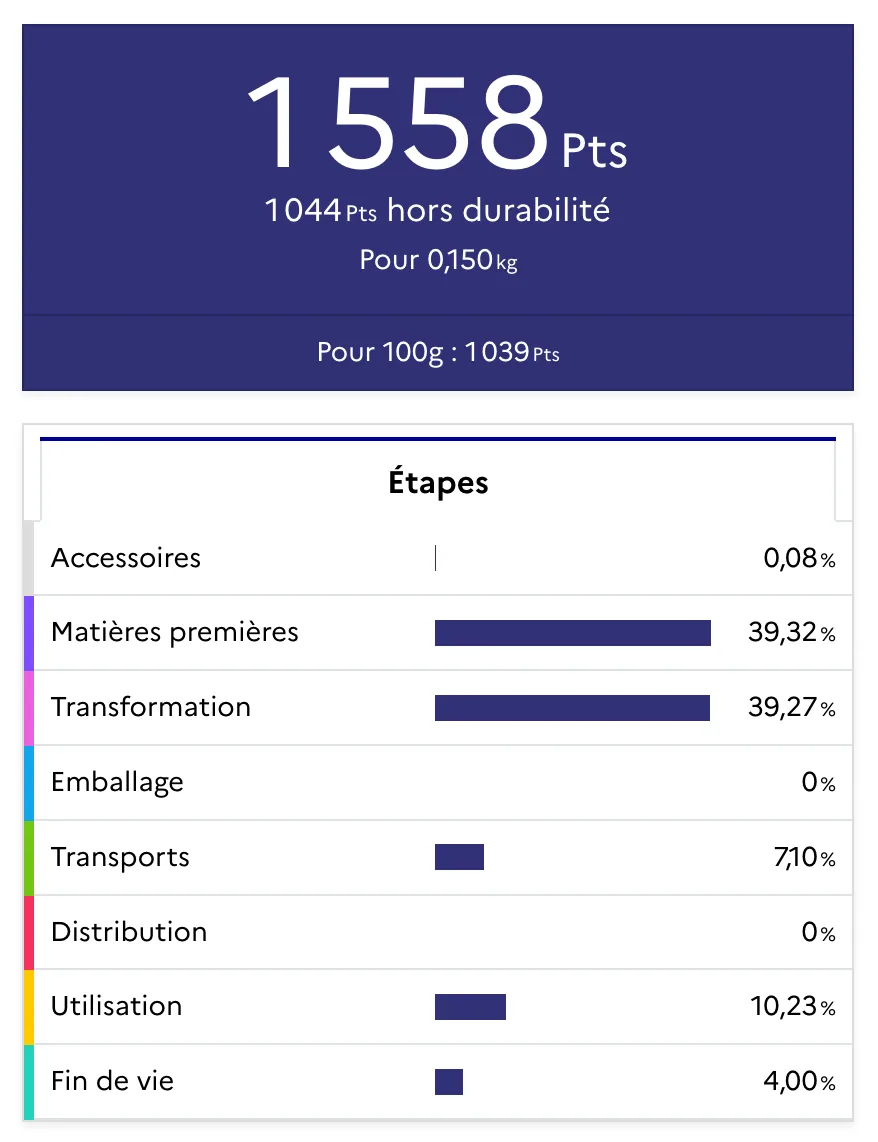
Brands that developed their own indicator before the public scheme existed are the first to be affected: since 1 October 2026, that figure must sit alongside the environmental cost without contradicting it. If it is communicated on a physical medium, the environmental cost must be communicated there as well.
4Key takeaways
The method and the calculator are already available. The Ecobalyse calculator, developed by the French government and ADEME, calculates the environmental cost of a product reference free of charge, and our overview of the tool explains how it works. The timetable by sector (in French) (in French) and the general guide to environmental labelling (in French) place textiles within the scheme as a whole.
- Labelling remains voluntary: no brand is required to publish its environmental cost, unless it communicates a score.
- The 2 transitional protections ended on 1 October 2026: the brand's prior consent and the prior publication condition.
- A third party can publish your cost, from estimated data, provided it follows the same rules as you.
- Your own calculation prevails: once published, it becomes the information that third parties must adopt, within one month at most.
For a textile brand, the question therefore becomes what figure its own product references would give, and whether it is better to find out before a third party publishes it. The textile eco-design levers (in French) matter too, since the durability coefficient takes account of the breadth of the range and repair incentives.
- Légifrance · Decree No. 2025-957 of 6 September 2025 on the methods for calculating and communicating the environmental cost of textile products · . The Légifrance, AIDA and Ministry pages are in French. ↗
- AIDA, INERIS · Full text of Decree No. 2025-957, Articles D. 541-240 to R. 541-246 of the French Environmental Code ↗
- Légifrance · Ministerial order of 6 September 2025 on the signage and the methodology for calculating the environmental cost of clothing textile products ↗
- Ministry of Ecological Transition · Press factsheet, environmental cost labelling of clothing ↗
- French State and ADEME · Ecobalyse, public environmental cost calculator ↗